UN - SDG Goals
Goal 15: Life on land
Proteggere, ripristinare e favorire un uso sostenibile dell’ecosistema terrestre, contrastare la desertificazione, arrestare il degrado del terreno, fermare la perdita della diversità biologica.

Anthropogenic pressure on forest ecosystems in recent decades, due in part to the increased use of woody biomass for bioenergy and as a technical and construction material, has led to the degradation of many natural and semi-natural systems, particularly in tropical areas. These phenomena are often associated with the unsustainable and/or illegal exploitation of forest resources. The harvesting, processing, and transportation of wood and its derivatives can generate significant negative impacts on the environment, local/global economics, and even society. Over the last twenty years, attention has been focused on the sustainable use of forest biomass, encouraging concrete actions and effective tools aimed at preventing such impacts and mitigating their effects. These positive initiatives have involved policymakers, private companies, associations, and private citizens. Forest certification was created as a tool to prevent negative impacts and threats to national and international forestry heritage through the adoption of appropriate practices, based on careful planning and monitoring of the use and management of woody biomass.
In Italy, as of December 31, 2025, the forest area certified according to the Programme for Endorsement of Forest Certification schemes (PEFC™) scheme is equal to 1,124,507 hectares (with a 6% increase compared to 2024); while the area certified according to the Forest Stewardship Council® (FSC®) scheme amounts to 155,751 hectares (35% more than the previous year).
The indicator illustrates the trends and conservation status of the over 340 Italian species protected by the Habitats Directive 92/43/EEC and is based on the results of the last three Italian reports pursuant to art. 17, coordinated by ISPRA on behalf of MASE and transmitted to the European Commission in 2013, 2019 and 2025. The data from the latest report (referring to the period 2019-2024 and delivered in 2025) are presented in detail, in which the 346 species of community interest present in our territory and in our seas were evaluated (226 animal species and 120 plant species), creating 344 distribution maps and 580 reporting sheets (one for each species in each biogeographical region of presence).
The results show that in 2025, 29% of species are in poor conservation status (SC) and 20% are in bad conservation status, meaning they are in worrying conditions and at risk of extinction. Terrestrial and freshwater fauna is the group with the highest percentage of species in bad SC (22%), followed by terrestrial flora (16%) and marine species (11%).
Comparing the results of the V Report with the previous ones (III Report-2013, IV Report-2019) no improvements in the SC emerge for most species, even if there was an increase in knowledge for marine species. The percentages of change in the SC of the species between IV and V Report show 74% of the assessments in which the SC of the species remains unchanged, 10% in which the SC improves, 11% of assessments in which the SC worsens and a remaining 5% in which the assessments in the two reports are not comparable.
The data presented confirm the urgency of implementing the actions envisaged by the EU Regulation 2024/1991 for the Restoration of Nature and by the European and National Strategies for Biodiversity to 2030, whose targets provide that at least 30% of species and habitats in unfavorable SC improve their status by 2030 or show at least an improvement trend.
Farmland birds represent effective indicators of environmental quality due to their sensitivity to habitat changes and the feasibility of monitoring their populations using standardized methodologies on a large scale. Owing to these characteristics, the Farmland Bird Index is adopted by the European Commission as a context indicator of the Common Agricultural Policy to assess the state of biodiversity in agroecosystems and the effectiveness of conservation and rural land management measures.
The national indicator, calculated on the basis of the trend of 28 species typical of farmland environments over the 2000-2025 period, highlights an overall decline of 33.49%, with 71% of the considered species in decrease. The indicator relating to species typical of mountain grasslands (FBIpm), calculated on the trend of 13 species, also shows a reduction of 29.90%, with 46% of the species in decline. The results reveal a persistent deterioration of biodiversity associated with Italian farmland environments and the need to strengthen the conservation measures provided for by national and European biodiversity strategies.
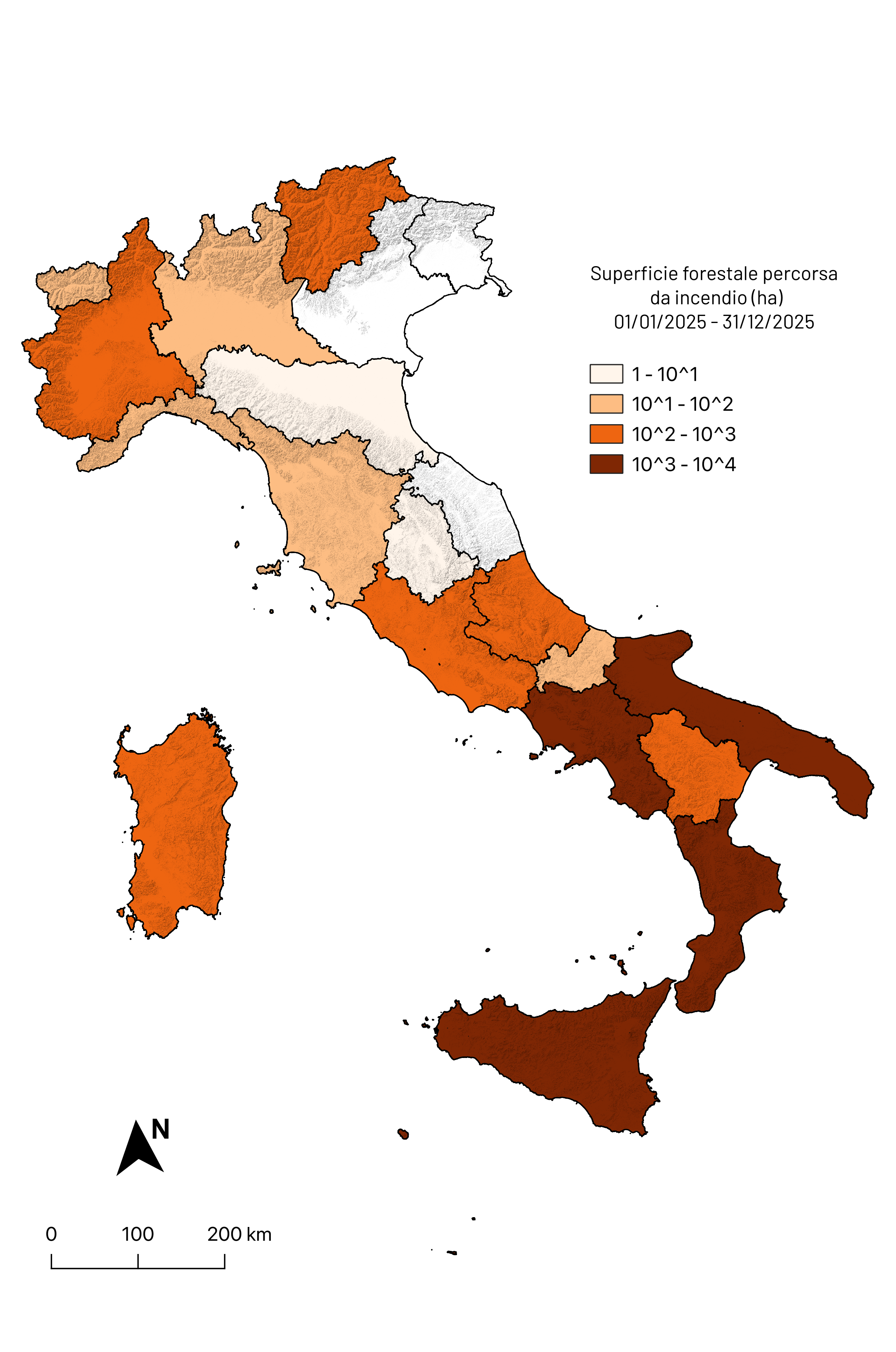
The indicator examines the series of forest areas affected by large fires on a national, regional and protected area scale in the period between 2018 and 2025.
The distribution and extension of these surfaces generally shows significant interannual variability. 2025, in particular, was a year seriously affected by an extension of the forest areas affected by fires, greater than the previous year. Furthermore, the forest area burned is only lower than that burned in 2021, 2022 and 2023.
In 2025, the most affected regions were: Sicily (3,967 hectares - ha), Calabria (2,892 ha) and Campania (1,835 ha), which together represent 71% of the forest area at national level affected by fire.
The forest classes most affected are evergreen broad-leaved trees (e. g. Holm oak forests and tall scrub), followed by deciduous broad-leaved trees (e. g. Oak and beech forests) and decidedly less so by conifers (e. g. Pine forests, fir forests and larch forests).
The linear regression analysis of the national forest cover data series affected by fire does not show an increasing trend, although the length of the series does not allow medium and long-term evaluations. On the contrary, a statistically significant positive trend was observed for the regions of Puglia, Basilicata and Calabria.
The Natura 2000 Network, established under the Habitats and Birds Directives (known as the Nature Directives), consists of 2,649 sites in Italy, covering a total area, net of overlaps, of 5,844,888 hectares on land, equal to 19.4% of the national territory, and a marine area of 2,344,963 hectares, equal to 6.5% of the waters under national jurisdiction (territorial waters and EPZ) (2025 data, transmitted to the Commission in January 2026). The Network is fundamental for the implementation of the Nature Directives, but it is also important in relation to the targets of the European and National Biodiversity Strategies for 2030 (EBS2030 and NBS2030), which call for expanding protected zones to at least 30% of the land surface and 30% of marine waters; in addition to the N2000 Network sites, all areas subject to protection, including National and Regional Parks and all other protected areas, contribute to this target. In the Italian regions and autonomous provinces, the Network has a heterogeneous extension, with percentages of protected regional territories and waters ranging from 12% (Emilia-Romagna) to 36% (Abruzzo) on land and from less than 1% (Marche) to 31% (Puglia) at sea.
To date, there are 63 Italian wetlands included in the official list of sites of the Ramsar Convention, recognized by the Ramsar Secretariat as wetlands of international importance, covering a total of 81,091 hectares. Overall, the 66 Italian Ramsar sites (63 designated by the Convention Secretariat and 3 in the process of designation) are distributed across 15 regions. The regions with the largest and most numerous areas are Emilia-Romagna (10 sites, with an area equal to 23,112 ha), Tuscany (11 sites with an area equal to 20,755 ha), and Sardinia (9 sites, with an area equal to 13,308 ha). The level of implementation of protection and management instruments for these areas, necessary to ensure the conservation of habitats, flora, and fauna linked to aquatic ecosystems, is not sufficiently known.
The wildfire phenomenon, analyzed on the basis of data collected from 1970 to 2024 by CUFA of the Carabinieri Corps (formerly the State Forestry Corps), shows a fluctuating trend, with peak years (1993, 2007, 2017, 2021) alternating with periods of decline (2013, 2014, 2018, 2024).
Wildfires occurring within Protected Areas (recorded since 2003), although showing annual fluctuations, remain at high levels, with an average of 11,000 hectares burned over the last three years.
The incidence of deliberately caused fires is very high, representing about half of all recorded events and exceeding 60% in some years.
Land fragmentation is the process that leads to a progressive reduction in the surface area of natural and semi-natural environments and to an increase in their isolation. This process, which transforms large territorial patches into smaller and more isolated units, is mainly driven by urban expansion—implemented through more or less sustainable development patterns—and by the growth of infrastructure networks aimed at improving connectivity between urbanized areas through linear works. In 2024, 42.41% of the national territory was classified as having high or very high fragmentation. The regions with the largest share of very highly fragmented land are Veneto (39.73%), Lombardy (33.73%), Emilia-Romagna (25.22%), Puglia (25.22%), and Campania (25.76%). These figures confirm the close relationship between fragmentation and urbanization density.
Both the number of protected areas and the extent of protected marine surface have steadily increased over time. At present, 30 Marine Protected Areas (MPAs) have been established in Italy, across 10 Italian regions, along with a further 10 areas protecting coastal marine stretches.
Sicily and Sardinia host the largest share of marine protected areas, both in terms of number and area of protected surface. Between 2012 and 2023, at the national level, the surface of Marine Protected Areas (MPAs) increased by 3.1%, following the establishment in 2018 of the two MPAs of Capo Testa–Punta Falcone in Sardinia and Capo Milazzo in Sicily, and in 2023 of the Capo Spartivento MPA in Sardinia.
The European Commission adopted the EU Biodiversity Strategy for 2030 (EBS 2030, COM(2020) 380 final), which calls on Member States to protect at least 30% of national land territory and 30% of marine areas, with at least one third of these areas under strict protection. These objectives have been incorporated into the Italian National Biodiversity Strategy for 2030 (NBS 2030).
This indicator integrates spatial data relating to the main biodiversity protection systems in Italy (protected areas and the Natura 2000 Network). It calculates the extent of Italian territory currently protected on land and at sea, assesses changes from 1991 to 2024, and shows the gap between the percentage of protected land and marine areas and the 30% target set by the EBS 2030.
After removing overlaps between protected areas and Natura 2000 sites, national protected coverage currently amounts to approximately 4,071,482 hectares at sea, corresponding to 11.6% of Italian territorial waters and the Ecological Protection Zone (EPZ), and about 6,532,887 hectares on land, corresponding to 21.7% of Italian territory. The extent of overlapping areas—those falling both within a protected area and a Natura 2000 site—has increased over time, reaching 893,839 hectares at sea and 2,447,065 hectares on land in 2024. Trends show that the national percentage of protected surface has stabilised since 2006 for marine areas and since 2011 for terrestrial areas. To achieve the 30% target set by the EBS 2030, an additional gap of about 18% of marine surface still needs to be protected (around 6,600,000 hectares), along with 8% of terrestrial surface (around 2,500,000 hectares).
The indicator quantifies soil consumed as a result of a change from a non-artificial soil cover to an artificial soil cover, according to the principle of net land take, i.e. net of transformations from consumed soil back to non-consumed soil (generally the restoration of construction sites and other areas that in the previous year fell under reversible soil consumption).
Gross soil consumption recorded in 2024 affected 8,370 hectares of territory, causing the often irreversible loss of natural, semi-natural, and agricultural areas and their related ecosystem services.
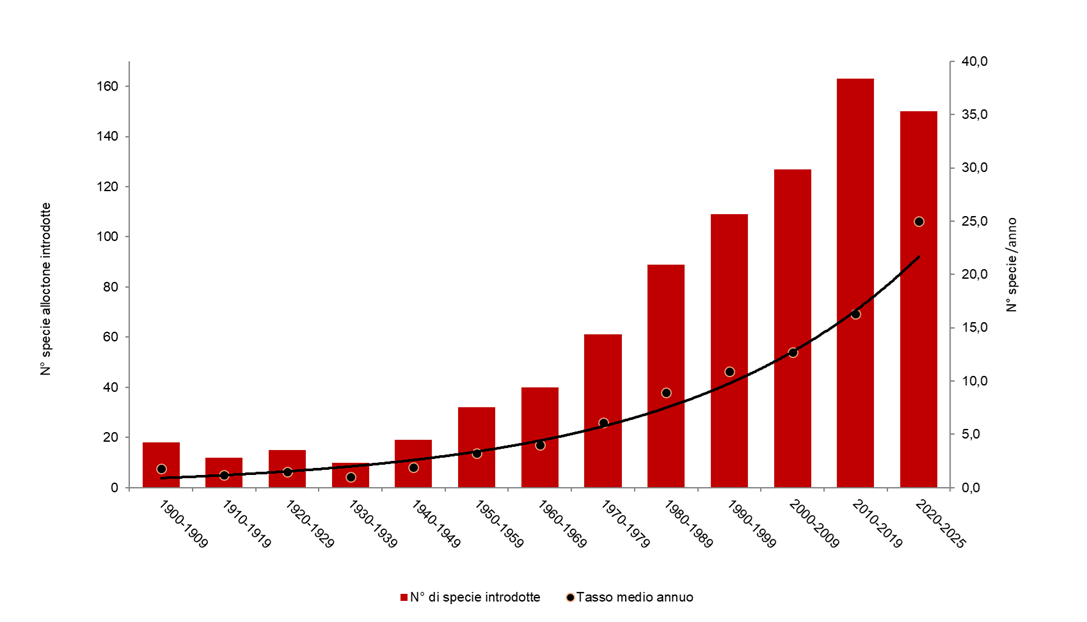
The indicator provides an overview of the current presence of alien animal and plant species in Italy, describing their numbers and trends in introductions over the past century. It reports the average annual introduction rate (the mean number of new alien species introduced each year), the main pathways of introduction (according to CBD categories), and the distribution of invasive alien species of Union concern.
The number of alien species in Italy is steadily and continuously increasing. Based on the data currently available, more than 3,800 alien species have been introduced into the country, of which 3,699 are currently established in the territory. The average number of species introduced per year has grown exponentially over time — from 6 species per year in the 1970s, to 16 per year in the previous decade, and reaching 25 per year in the current one. The cumulative number of alien species introduced in Italy since 1900 also confirms this exponential trend, showing an increase of over 500% in 120 years.
In Italy, a total of 843 terrestrial protected areas (including those with a coastal component) have been established to date, covering more than 3 million hectares, equivalent to about 10.5% of the country’s land surface. An analysis of the historical series (1922–2024) shows consistently positive trends—particularly from the mid-1970s—in both the number and the extent of terrestrial protected areas, while growth trends have tended to stabilize since 2008–2009.
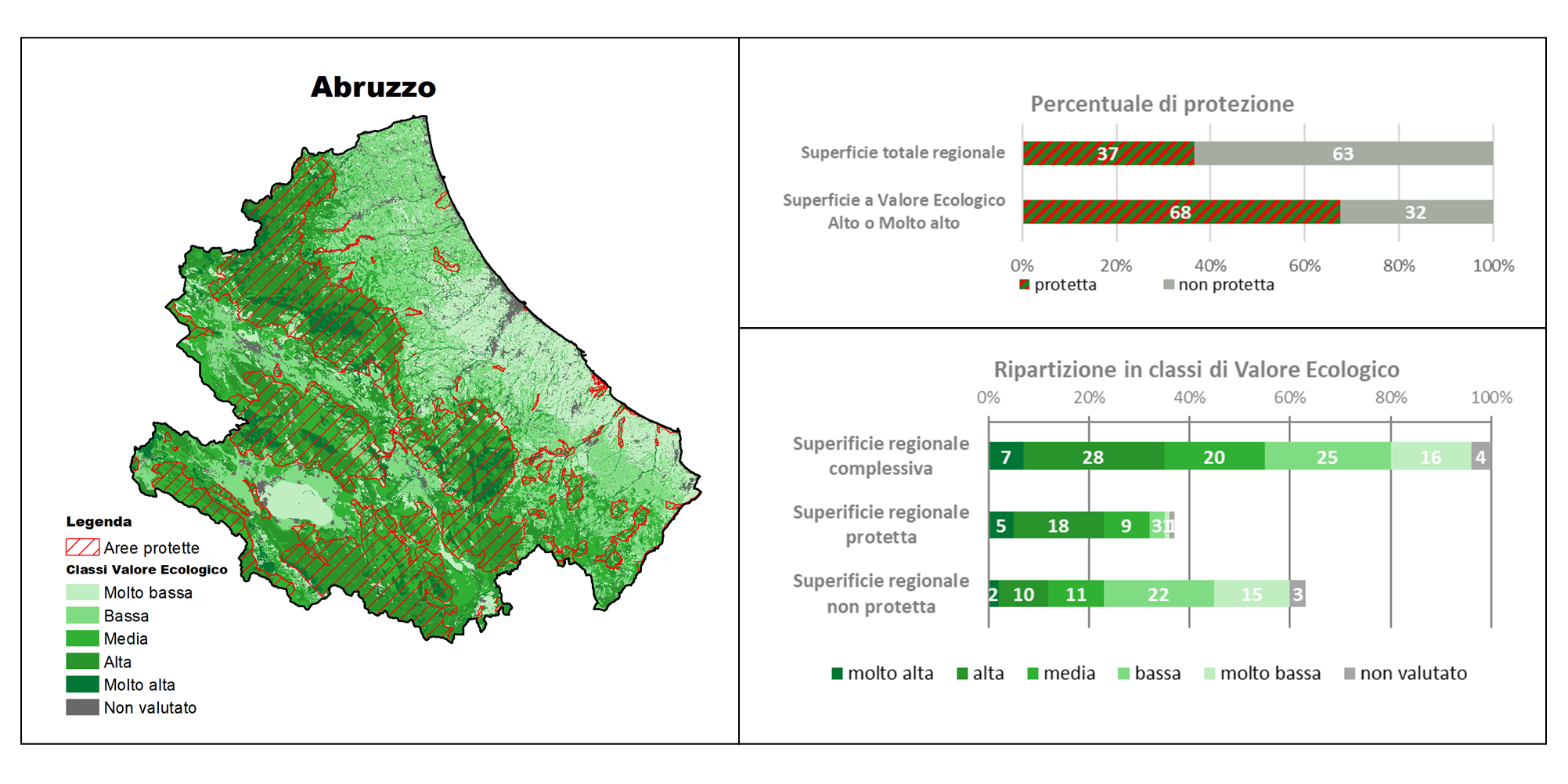
The indicator, based on data processed within the Carta della Natura project, shows the distribution of Ecological Value (VE) across 17 Italian regions, providing a representation categorized into different classes. Ecological Value is understood as a synonym for natural significance and is calculated—starting from the regional habitat maps—for each mapped polygon, excluding those referring to built environments and fully urbanized areas. This indicator offers an overview of the environmental mosaic within various regional contexts, highlighting high-value areas, including their protection status. The analysis presents the percentage of protected areas in each region and the composition of protected and unprotected zones in terms of Ecological Value. The protected areas system (EUAP areas, Natura 2000 sites, and Ramsar areas) covers territories characterized by the highest Ecological Value classes but still leaves significant portions outside protected areas.
This indicator provides a national overview of the conservation status of 268 breeding bird species assessed in the reporting under Article 12 of the Birds Directive 2009/147/EC. The assessment includes species of community interest listed in Annexes I and II of the Directive, as well as those that justify the designation of Special Protection Areas (SPAs).
At the national level, the percentage of species with a favourable conservation status increased from 51% (reporting period 2007-2012) to 56% (reporting period 2013-2018). However, this increase was insufficient to meet the target set by the EU Biodiversity Strategy 2020 (76%).
The short-term population trends, which reflect processes occurring in the last decade, indicate that 46% of species are increasing or stable, while nearly 25% of species are in decline (the population trend of the other 33% remains unknown). Regarding short-term trends in distribution range, the proportion of declining species is lower, as only the most severe declines result in range contractions: 21% of species show a contraction, while the remaining 79% have stable or expanding ranges.

The index evaluates the percentage of vegetation cover in mountain areas, defined according to the six altitude classes with elevations above 300 m above sea level proposed by FAO in 2015 (UNEP-WCMC). The data is expressed in terms of total mountain vegetation area and with reference to the distinction between natural and agricultural areas.
The analysis reveals a significant presence of vegetated areas, especially in classes 5 and 6, which are between 300 and 1,500 m above sea level. The changes observed are mostly associated with a reduction in vegetated areas, while increases are recorded in higher altitude bands, with a maximum of just over 1,800 hectares in Veneto and slightly more than 1,000 hectares in Lombardia. Significant increases in mountain vegetation cover are also found in Marche and Tuscany, which, together with Lombardia and Veneto, are the only regions showing an overall increase in mountain green areas, net of reductions.
Italy hosts a remarkable floristic heritage, both in terms of species and subspecies richness (2,815 lichens, 1,209 bryophytes, and 8,241 native vascular entities) and biogeographical value. Of the 8,241 Italian vascular plant,1,702 species (equal to 20.65%) are endemic, meaning they exist exclusively in the country. Among these, 1,128 species are regionally endemic, with their range restricted to a single Italian region (data updated to April 2024).
The indicator also highlights the IUCN risk status of 2,430 vascular plant entities (representing 29.5% of Italy’s vascular flora), identifying the main threats affecting them. Unfortunately, the overall conservation status cannot be considered satisfactory: 2.2% (54 species) of the 2,430 evaluated entities are extinct or likely extinct; 24.3% (590 species) are at risk of extinction.
Human-induced pressures related to land-use changes represent a major driver of plant species extinction risk. The Red List of vascular flora identifies the most critical pressures affecting species: Modification of natural systems (39% of the 2,430 assessed taxa are subject to this pressure);
Agricultural development (27%); Residential development (27%); Direct human disturbance in natural environments (20%).
In order to assess whether protected areas have been designated based on scientific criteria, including ecologically representative areas (Margules & Pressey, 2000; Maxwell et al., 2020), the overlap between terrestrial protected areas in our country and Key Biodiversity Areas (KBA, IUCN, 2016) has been calculated. The protected areas considered include those in the data bank of the Common Database on Designated Areas (CDDA) (now Nationally designated areas of Europe - NatDA), and the Natura 2000 Network. KBAs identify key areas for biodiversity conservation and, according to the European Commission’s guidance document on achieving the 30% target ("Criteria and guidance for protected areas designations," Brussels, 28/1/2022), are among those to be considered for designation as protected areas. The indicator used corresponds to the one adopted internationally to evaluate progress toward the Sustainable Development Goals (SDGs) for 2030 (SO4-3.T1: National estimates of the average proportion of Terrestrial KBAs covered by protected areas in %).
The results indicate that, after accounting for overlaps between CDDA protected areas and Natura 2000 sites, 75.20% of the national terrestrial protected area overlaps with KBAs identified at the national level, demonstrating a fair inclusion of important biodiversity areas.
The Italian fauna is estimated to include over 58,000 species, with the total number reaching approximately 60,000 taxa when considering subspecies. However, this biodiversity is under threat, as indicated by IUCN assessments and population trends. Among the 672 species of Italian vertebrates (576 terrestrial and 96 marine), 6 are extinct in Italy, and 161 are threatened with extinction (accounting for 28% of the assessed species). Different vertebrate groups show varying percentages of risk: 2% for marine bony fish, 19% for reptiles, 21% for cartilaginous fish, 23% for mammals, 36% for amphibians, and up to 48% for freshwater bony fish (considering the CR+EN+VU IUCN categories). Additionally, terrestrial and marine vertebrate populations are generally declining by 27% and 22%, respectively.
Breeding birds are the only group for which two IUCN assessments have been conducted, seven years apart. Of the 278 species assessed in the latest 2019 evaluation, 5 are extinct, and 67 are threatened (compared to 76 in 2013), representing 26% of the evaluated species. Half of Italy's breeding bird species are not at immediate risk of extinction.
Among invertebrates, 9% of corals, 11% of dragonflies, 21% of saproxylic beetles, 6% of butterflies, and 11% of assessed bees are threatened with extinction. Invertebrates also show negative trends; for example, 16% of dragonfly populations are in decline, five times higher than those increasing.

Soil degradation refers to the reduction in the biological productivity of soil resources. This process is often intrinsically linked to biodiversity loss and the impacts of climate change. Assessing soil degradation requires considering multiple interdependent factors, each contributing differently to the phenomenon.
In recent years, Italy has participated in the pilot project on Land Degradation Neutrality (LDN), promoted by the United Nations Convention to Combat Desertification (UNCCD), and in the LDN Target Setting Programme, which supports countries in identifying voluntary LDN targets and defining associated measures to achieve Sustainable Development Goal (SDG) 15.3. This goal is monitored through the "Proportion of degraded land over total land area" (SDG Indicator 15.3.1).
For the assessment of this indicator in Italy, three sub-indicators proposed by UNCCD under the LDN framework have been adopted:
- Land cover change
- Soil productivity index
- Soil organic carbon content
Additionally, further indices and parameters relevant to the Italian context and available at the national level have been considered. The results show that in 2019, the proportion of degraded land in Italy, excluding water bodies, was 17.4%, according to the UNCCD methodology. Furthermore, nearly 56,000 km² (approximately 18.5% of the national territory) experienced increased degradation between 2006 and 2019.