Antonio Brunori (PEFC Italy), Ilaria Dalla Vecchia (FSC), Andres Ortolano Tabolacci (FSC), Valerio Silli, Giovanni Tribbiani (PEFC Italy)
The anthropogenic pressure exerted on forest ecosystems in recent decades, driven in part by the increasing use of woody biomass for bioenergy, technical applications, and construction, has led to the degradation of many natural and semi-natural systems, particularly in tropical regions. These phenomena are frequently associated with the unsustainable and/or illegal exploitation of forest resources. The harvesting, processing, and transportation of wood and its derivatives can generate significant negative impacts on the environment, as well as at local and global economic and social levels. Over the last twenty years, focus has turned toward the sustainable use of forest biomass, stimulating concrete actions and effective tools aimed at preventing such impacts and mitigating their effects. These virtuous initiatives have involved political decision-makers, private companies, associations, and individual citizens. Forest certification emerged as a tool designed to prevent negative impacts and threats to national and international forest heritage through the adoption of appropriate practices based on the careful planning and monitoring of woody biomass management and use.
In Italy, as of 31 December 2024, the forest area certified under the Programme for the Endorsement of Forest Certification (PEFC™) scheme reached 1,061,059 hectares (representing an increase of nearly 8% compared to 2023). Meanwhile, the area certified under the Forest Stewardship Council® (FSC®) scheme totaled 115,118 hectares (a 35% increase over the previous year)
The growing interest of many companies in certification schemes has fostered the development of public-private partnerships and collaborations, mainly aimed at promoting information and awareness-raising activities, as well as the dissemination of voluntary tools to support sustainable forest management and the adoption of corporate social responsibility (CSR) practices—also as a strategy to counter illegal practices.
Among these important tools are forest certification schemes, which refer both to forest management at national and international scales, and to chain of custody (CoC) certification, to which ecosystem services certification targeting forest and semi-natural ecosystems has also emerged as an additional instrument in recent years. These certifications aim to ensure compliance with core environmental principles of conservation and natural resource management, the maximization of ecosystem services and benefits, and the traceability of forest-based products across all stages of the value chain: from sourcing and processing to trade and distribution within the forest–wood/paper supply chain.
Certification is a voluntary process through which an independent third-party body—a nationally or internationally accredited certification entity—issues a certificate of forest management or chain of custody. In the case of forest management certification, the certificate confirms that management practices for a given forest area comply with specific environmental protection, social equity, and economic efficiency requirements, as defined by a national reference standard. In the case of chain of custody certification, the certificate confirms that the path taken by a product—from the forest, or in the case of recycled materials, from the point of recovery—through to its final processing, labeling, and sale, follows international standards that ensure traceability and transparency of wood origin and flow.
Provide a summary picture of the sustainability of forest resources at a national level, through the updating and analysis of data relating to the certified forest area provided for by the two international schemes of the Forest Stewardship Council® (FSC®) and del Program for Endorsement of Forest Certification schemes™ (PEFC™).
To obtain certification, compliance with applicable international, national, and regional legislation related to the forest sector is required. In particular:
- Regulation (EU) No 995/2010 and its implementing acts (EU Timber Regulation – EUTR);
- A new EU Forest Strategy: for forests and the forest-based sector, COM(2013) 659 final;
- Italian Legislative Decree of 3 April 2018, No. 34, “Consolidated Law on Forests and Forest Supply Chains”.
For the FSC® National Forest Management Standard, reference is made to Annex A (List of applicable laws, regulations, and treaties, conventions and international agreements ratified at national level), which includes a list of legal requirements at national, EU, and international levels.
As of 1 December 2024, the new FSC® National Forest Management Standard for Italy (FSC-STD-ITA-02-2024 V2-0) officially entered into force and will remain valid until its revision. Starting from this date, a one-year transition period was established, during which certified companies have the opportunity to comply with the new version, abandoning the previous standard (FSC-ITA-01-2017 V1-0). Six months after this transition period, certificates issued according to the old version will no longer be considered valid. New entities wishing to become certified from 1 December 2024 must use the provisions of the new Standard.
For the PEFC™ standard, compliance is explicitly required with the UN Declaration on the Rights of Indigenous Peoples, all fundamental International Labour Organization (ILO) Conventions on Forest Management, and ILO Convention No. 169 on Indigenous and Tribal Peoples.
In 2025, new updated national standards were approved and published in Italy—specifically the PEFC ITA 1001 series—which are broader and aligned with current challenges, with a transition from the 2015 version becoming mandatory from August 2027. Also in 2025, reference practices for nurseries (UNI/PdR 182-1:2025) and updates for Ecosystem Services were introduced to respond to current sustainability needs and regulations such as the EUDR (European Union Deforestation Regulation).
Accredia, PEFC Gestione Forestale Sostenibile (GFS) Servizio Certificazioni di prodotti e servizi (https://www.accredia.it/servizio-accreditato/pefc-gestione-forestale-sostenibile-gfs-2/).
Arma dei Carabinieri, “Foreste D’Italia Inventario Forestale Nazionale”, 2023.
ASI - Assurance Services International was officially established as the accreditation body for FSC in 2006 (https://www.asi-assurance.org/s/post/a1J1H000002JgxN/p0168).
CREA, Terzo inventario forestale nazionale (INFC2015) https://www.sian.it/inventarioforestale/index.do?idNews=10
Forest Stewardship Council® (FSC®), https://it.fsc.org/it-it
FSC Annual Reports, https://fsc.org/en/fsc-annual-reports
FSC Report 2024; https://it.fsc.org/it-it/newsfeed/certificazione-fsc-in-italia-il-report-2024
FSC Infografica 2024, https://it.fsc.org/sites/default/files/2025-01/FSC_Infografica%20report%202024.pdf
FSC Bilancio Sociale 2024; https://drive.google.com/file/d/1vW7WKQ6ClcXCe3QNmYzRxTba1CRUjxVy/view
FSC Italia, Certificazione di Gestione Forestale (FM) https://it.fsc.org/it-it/certificazioni/certificazione-di-gestione-forestale
FSC Italia, Certificazione FSC in Italia: il report 2023, https://it.fsc.org/it-it/newsfeed/certificazione-fsc-in-italia-il-report-2023
PEFC Italia, Standard di gestione forestale PEFC Italia https://www.pefc.it/per-le-aziende/documenti/standard-di-gestione-forestale-sostenibile-e-gestione-sostenibile-delle-piantagioni-arboree
PEFC, Report PEFC Italia, venti anni di attività 2001-2021 (https://cdn.pefc.org/pefc.it/media/2021-07/5aca8bc2-677c-46da-872e-0cc0513906c2/c65e5a61-9373-5d7b-95db-9ff2fae8ffc2.pdf)
PEFC, Report PEFC Italia attività 2022, https://cdn.pefc.org/pefc.it/media/2023-03/a8a221e9-085d-44cc-bc8c-09e150bc3197/89991e88-3808-5196-9dc0-af677345857c.pdf
PEFC, Report triennale PEFC 2023, https://cdn.pefc.org/pefc.it/media/2023-12/9a5016c7-eb6a-4648-b31a-dcc05171e738/962289ee-2454-52ae-8353-10c1117bf147.pdf
PEFC, Report PEFC Italia attività 2024, https://cdn.pefc.org/pefc.it/media/2024-03/cd6f09db-d54c-4e90-b518-63f6eaf207d6/8daa550a-0be6-55d8-89e4-5e3e6419196a.pdf; https://www.google.com/url?sa=t&source=web&rct=j&opi=89978449&url=https://cdn.pefc.org/pefc.it/media/2024-03/9b66f5d5-1c9f-47f8-965b-4cc0ae2d8360/f8820d8c-5e4b-5230-a962-c4b64b8aecb7.pdf&ved=2ahUKEwj_iu2NttmJAxWRg_0HHZWbG2EQFnoECCUQAQ&usg=AOvVaw05dplGWVDXZQiqNMMgjYmj
PEFC, Report PEFC Italia, attività 2025, https://cdn.pefc.org/pefc.it/media/2025-02/2caf2c8f-0cd6-4beb-9e61-38c1a5ebadc3/571c4ed9-aa61-5cc2-9f50-206fdd06a0f2.pdf
PEFC, Statistiche PEFC in Italia, https://www.pefc.it/scopri-il-pefc/il-pefc-italia/statistiche-pefc-in-italia
Programme for Endorsement of Forest Certification schemesTM (PEFCTM), https://www.pefc.it/
SGS - Servizi di ispezione, verifica, analisi e certificazione. FSC™ forest management certification services are carried out by SGS (https://www.sgs.com/it-it/services/fsc-certificazione-di-gestione-delle-foreste).
WWF, 2015. Foreste che proteggono, Foreste da difendere, a cura di Isabella Pratesi. WWF Italia. Roma (https://wwfit.awsassets.panda.org/downloads/dossier_foreste.pdf)
"The two forest management certification systems, although aligned in their overarching goal of safeguarding forest resources and preventing illegality, adopt distinct criteria and standards to define Sustainable Forest Management (SFM). As a result, certain data and parameters, such as Chain of Custody (CoC) procedures, are not directly comparable across schemes, which may limit the integration or harmonization of reported information.
Provide additional insights into the governance-based distribution of certified forest areas under the two main certification schemes in Italy.
FSC ( Forest Stewardship Council )
PEFC ( Pan-European Forest Certification Council )
Information relating to certifications can be acquired directly from the certifying bodies, through reports, dedicated publications, press releases and annual social reports, present on the relevant official websites of: Forest Stewardship Council ® (FSC®) e Program for Endorsement of Forest Certification schemes ™ (PEFC™).
https://www. pefc. it/scopri-il-pefc/il-pefc-italia/statistiche-pefc-in-italia
https://it. fsc. org/it-it/newsfeed/certificazione-fsc-in-italia-il-report-2024
https://fsc. org/en/fsc-annual-reports
https://www. pefc. it/news/rappello-pefc-2025-record-per-la-sostenibilita-forestale-in-italia
https://cdn. pefc. org/pefc. it/media/2025-02/2caf2c8f-0cd6-4beb-9e61-38c1a5ebadc3/571c4ed9-aa61-5cc2-9f50-206fdd06a0f2. pdf
National
1998-2024
Update and analysis of the time series (1998-2024) on the evolution of certified forest area, along with data regarding chain of custody and ecosystem services certification, according to the two international schemes applied in the Italian context: Forest Stewardship Council® (FSC®) and Programme for the Endorsement of Forest Certification schemes (PEFC™)"
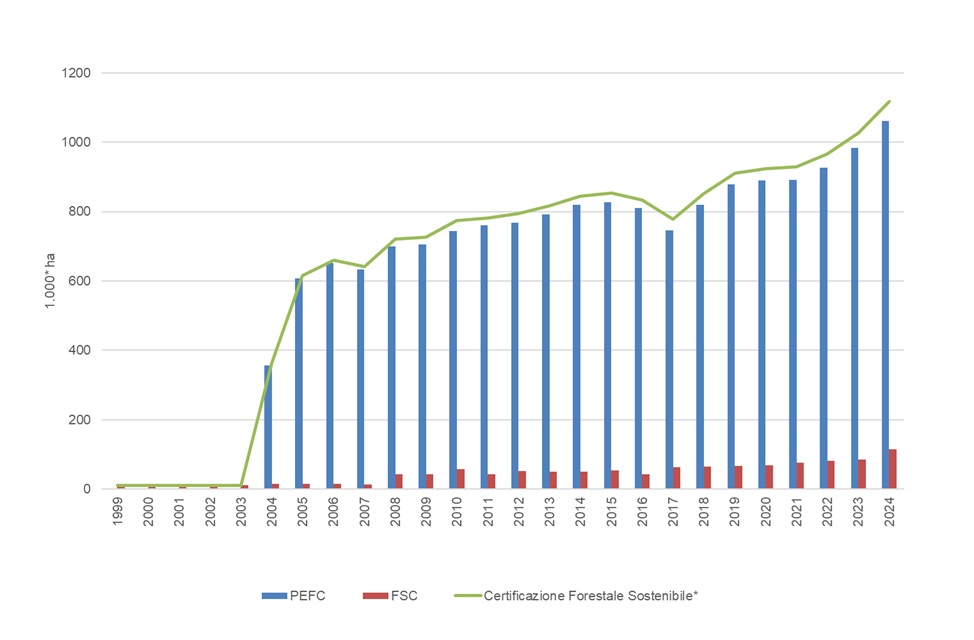
IIn Italy, as of 31 December 2024, the forest areas certified under the PEFC and FSC schemes amounted to 1,061,059 ha and 115,118 ha, respectively. In 2024, the PEFC-certified area increased by nearly 8% compared to the previous year, while the FSC-certified area showed an increase of over 35% (Figure 1). Assuming some overlap between schemes—since some companies are certified under both—and considering the relative proportions, the purely indicative estimate of the total certified forest area (calculated as the midpoint between the theoretical minimum and maximum values) is approximately 1,119 thousand hectares. Overall, based on the estimated national forest area of 11,054,458 hectares (Carabinieri, 2023), the national forest area that has obtained certification is equal to approximately 10%.
A growing trend in the certified forest area is observed, attesting to the greater sustainability of the production processes of companies in the sector; specifically, an increase of approximately 82% can be observed from 2005 to 2024 (Figure 1). In particular, for PEFC, there was an almost constant increase in certified forest area until 2015 (with the exception of 2007), followed by a decline during 2016–2017. An upward trend has been observed again since 2018, resulting in an increase of over 42% in 2024 compared to 2017. The FSC-certified area has shown a generally increasing trend, reaching a record value of approximately 115,000 hectares in 2024
| Data |
|---|
Thumbnail
Headline
Figure 1: Forest areas certified in Italy under the PEFC and FSC schemes Data source
ISPRA processing of FSC (Forest Stewardship Council) Italy data and PEFC (Programme for the Endorsement of Forest Certification) Italy data.
Data legend
*The purely indicative estimate of the total certified forest area for Italy is obtained as the midpoint of the interval between the theoretical minimum and maximum values (where min = complete overlap and max = zero overlap). |
he indicator in question is part of the core set of SDG indicators, specifically Target 15.2.1 – 'Progress towards sustainable forest management', which includes forest area certified under independently verified forest management certification schemes (UN SDG Database). The foundation of international certification systems lies in the shared interest and promotion of initiatives and actions by governments, non-governmental organizations (NGOs), the general public, and companies, aimed at protecting forest ecosystems and ensuring the legal and sustainable use of woody biomass.
The Forest Stewardship Council® (FSC®) is a non-governmental organization established in 1993 in the aftermath of the 1992 United Nations Conference on Environment and Development (UNCED) in Rio de Janeiro, with the mission of promoting responsible forest management globally. The other certification scheme, the Programme for the Endorsement of Forest Certification schemes™ (PEFC™), is based on the Criteria and Indicators initially defined during the Ministerial Conferences on the Protection of Forests in Europe held in Helsinki (1993) and Lisbon (1998). These conferences launched the so-called "Pan-European Process," a high-level political initiative aimed at ensuring the protection and sustainable management of European forests.
In Italy, the first FSC certification was granted in 1997 to the Magnifica Comunità di Fiemme in Trentino. The first PEFC certification followed in 2004, awarded to the Regional PEFC Association of Friuli-Venezia Giulia, which represented 38 forest owners covering a total area of 67,348 hectares.
As of 31 December 2024, the total forest area certified under the FSC® scheme reached 115,118 hectares, covering 32 certified entities across 10 Italian regions, diverse in both location and type. Notable new certifications include the Municipality of Acceglio (CN, 496.30 hectares), the Community Cooperative "Ecosistema Comunale di Castell’Azzara" (GR, 99.73 hectares), the Union of Municipalities of Amiata Val D'Orcia (2,617 hectares), and the Union of Municipalities of Pratomagno (4,074 hectares). At the regional level, the distribution of certified areas is primarily concentrated in the North (Trentino-Alto Adige, Lombardy, Veneto, and Friuli-Venezia Giulia) and the Center (Tuscany). Since 2023, the establishment of a new group certification by Etifor s.r.l. Società Benefit has been significant, with its certified area growing from just under 100 hectares at its inception to approximately 2,800 hectares by the end of that year. Furthermore, in 2024, the certificate for "Compagnia le foreste del Benso" (SV, 623 hectares) was reactivated following a suspension period required for documentation updates.
Finally, there is a confirmed increase in companies' interest in supporting FSC-certified forest areas, driven by investments in Ecosystem Services (ES). This trend reflects the positive outcome of verification procedures for Ecosystem Services by certified entities and external stakeholders interested in nature-based solutions (NBS), which are increasingly viewed as effective tools for addressing climate and economic crises. The five identified and quantifiable categories of Ecosystem Services are: carbon sequestration and storage, biodiversity conservation, watershed services, soil conservation, and recreation and ecotourism.
In 2024, the number of forest managers who verified the positive impacts of their active management on Ecosystem Services rose to 19. During the same year, ecosystem services verification was extended to 73% of FSC-certified forest areas in Italy—totaling nearly 84,000 hectares (a 41% increase)—across seven regions: Trentino-Alto Adige, Veneto, Lombardy, Piedmont, Tuscany, Emilia-Romagna, and Sardinia. Additionally, the number of verified positive impact "claims" reached 79 units in 2024. This confirms that nature-derived benefits are highly valued by forest managers and civil society, offering opportunities for companies and partners to invest as sponsors.
Since December 2021, FSC Italy has also been engaged in reviewing and updating the national forest management standard. This new standard is tailored to the specific needs and opportunities of the Italian forestry landscape and comprises 184 indicators covering environmental, social, and economic interests. The system mandates standard review sessions at regular intervals, typically every five years, to ensure alignment with national contexts and global challenges. Furthermore, 2024 represented a milestone for FSC Chain of Custody (CoC) certification in Italy, with a 6.2% increase compared to the previous year, reaching 3,733 active certificates and over 4,800 production sites. This reflects the steady growth that has made Italy a leader in Europe.
As with the FSC scheme, an increase in PEFC-certified forest area was observed during 2024 (+7.8%), extending to 14 regions with at least one certified forest area. Trentino-Alto Adige continues to lead the ranking of regions with the largest certified surface area, followed by Friuli-Venezia Giulia and Piedmont. Veneto remains the region with the highest number of certificates (326), followed by Lombardy (263) and Trentino-Alto Adige (234). In terms of new participants, 2024 highlights that Piedmont recorded the highest growth (+70 new companies), ahead of Lombardy (+52) and Trentino-Alto Adige (+42). In Central-Southern Italy, Tuscany stands out with 87 certified companies, 23 more than in 2023. Key sectors driving this growth include construction and wood packaging, with significant increases in panel production (+26.6%), sawmills (+16%), and glulam (laminated wood) (+28.7%), as well as carpentry (+43%), flooring (+40%), and fixtures (+71%). Group certification played a vital role, representing 53.4% of new memberships in 2024—a model that simplifies certification access for small businesses. Regarding ecosystem services, 15 new certificates were issued in 2024, 14 of which are linked to carbon offsetting and one to biodiversity protection. Overall, PEFC ecosystem services certificates now cover 27,856 hectares, demonstrating growing interest in biodiversity conservation and the promotion of forest-based tourism and well-being. One of the most significant projects is the support from Carte d'Or for biodiversity certification in the Cansiglio area, managed by Veneto Agricoltura.
The number of companies with PEFC Chain of Custody (CoC) certification recorded a growth of 16.8% in 2024, with 236 new members, bringing the total to 1,585 companies. This increase in certifications reflects the growing awareness of the importance of responsible and sustainable forest management (SFM) and the traceability of raw materials. Chain of Custody certification ensures transparency across all stages of the value chain, from the forest to the finished product. Wooden construction and packaging have emerged as key sectors, with significant growth in the panel production, sawmill, and laminated wood categories.
It is worth noting that new PEFC Chain of Custody standards were introduced in 2020, further strengthening sustainability criteria and supporting global forest conservation. Furthermore, PEFC aligns with the vision of the United Nations 2030 Agenda, aiming to contribute tangibly to the achievement of the SDGs through the promotion of sustainable forest management (SFM), support for responsible and transparent supply chains, the protection of biodiversity, and the valorization of ecosystem services.
Forests represent a strategic resource for humanity, ensuring livelihoods for over a billion people and providing food, wood, and renewable energy resources. They play a critical role in mitigating the effects of climate change, safeguarding water quality, and offering shared spaces for well-being, health, and socialization within communities