Susanna D'Antoni, Silvia Properzi
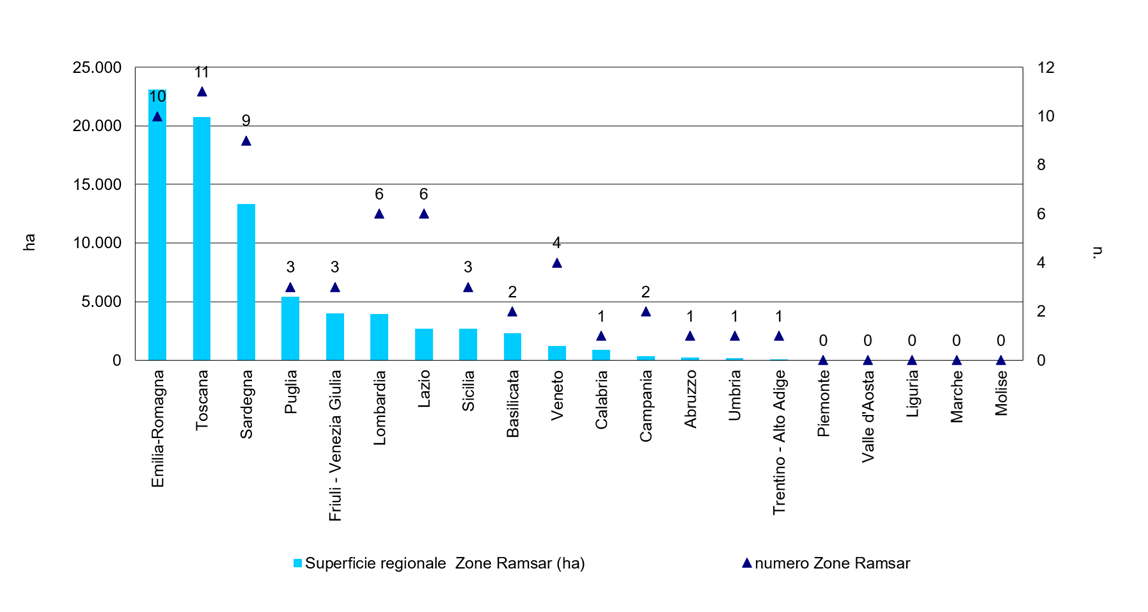
To date, there are 63 Italian wetlands included in the official list of sites of the Ramsar Convention, recognized by the Ramsar Secretariat as wetlands of international importance, covering a total of 81,091 hectares. Overall, the 66 Italian Ramsar sites (63 designated by the Convention Secretariat and 3 in the process of designation) are distributed across 15 regions. The regions with the largest and most numerous areas are Emilia-Romagna (10 sites, with an area equal to 23,112 ha), Tuscany (11 sites with an area equal to 20,755 ha), and Sardinia (9 sites, with an area equal to 13,308 ha). The level of implementation of protection and management instruments for these areas, necessary to ensure the conservation of habitats, flora, and fauna linked to aquatic ecosystems, is not sufficiently known.
Response indicator showing the number and extension of the surfaces classified as wetlands of international importance based on the criteria of the Ramsar Convention, their distribution in the Italian territory, as well as the temporal trend of the cumulative number and cumulative surface of the Ramsar areas established starting from 1976, the year of Italy's accession to the Convention.
Assess distribution and coverage of Italian Ramsar zones and the level of implementation of the Convention in Italy.
The Convention relating to wetlands of international importance signed on 2 February 1971 in Ramsar (Iran) during the "International Conference on the Conservation of Wetlands and Waterbirds", aims to achieve the international protection of wetlands through their identification and delimitation, the study of their characteristic aspects (in particular of avifauna) and the implementation of programs that guarantee the conservation of habitats, flora and fauna.
The subject of the Convention are a great variety of wetlands: swamps and marshes, peat bogs, natural or artificial water basins, permanent or transitory, with stagnant or flowing water, fresh, brackish or salty, including expanses of sea water, the depth of which, during low tide, does not exceed six metres. Also included are riparian, river or marine areas, adjacent to wetlands, islands or expanses of sea water with a depth greater than six meters, during low tide, located within the boundaries of wetlands, in particular when such areas, islands or expanses of water are important as a habitat for aquatic birds, ecologically dependent on the wetlands.
The Ramsar Convention was ratified and enforced by Italy with Presidential Decree n.448 of 13/03/1976 and with the subsequent Presidential Decree n.184 of 11/02/1987. The implementation tools provide, in addition to participation in the common international activities of the Convention, a series of national commitments such as: identification and designation of new wetlands pursuant to Presidential Decree no. 448 of 13/03/1976; monitoring and testing activities in the wetlands designated pursuant to Presidential Decree no. 448 of 03/13/1976; preparation of a National Report for each Conference of the Parties.
To date, 172 countries have signed the Convention and overall 2,527 Ramsar sites have been designated for a total area of 253,182,428 hectares (data https://www. ramsar. org/ last accessed March 2026).
-
The indicator provides only quantitative information, without evaluating the effectiveness of protection and management and environmental conditions in Ramsar sites.
-
MASE (Ministry of the Environment and Energy Safety)
https://www. mase. gov. it/portale/web/guest/editore-delle-zone-umide
National, Regional
1976-2026 (April)
Data sorted into tables and processed with Excel program.
The status cannot be defined as although 66 Ramsar sites have been designated in Italy (63 designated and 3 awaiting official designation by the Secretariat of the Convention), for a total of 81,091 hectares, the level of implementation of the protection and management tools for these areas is not fully known.
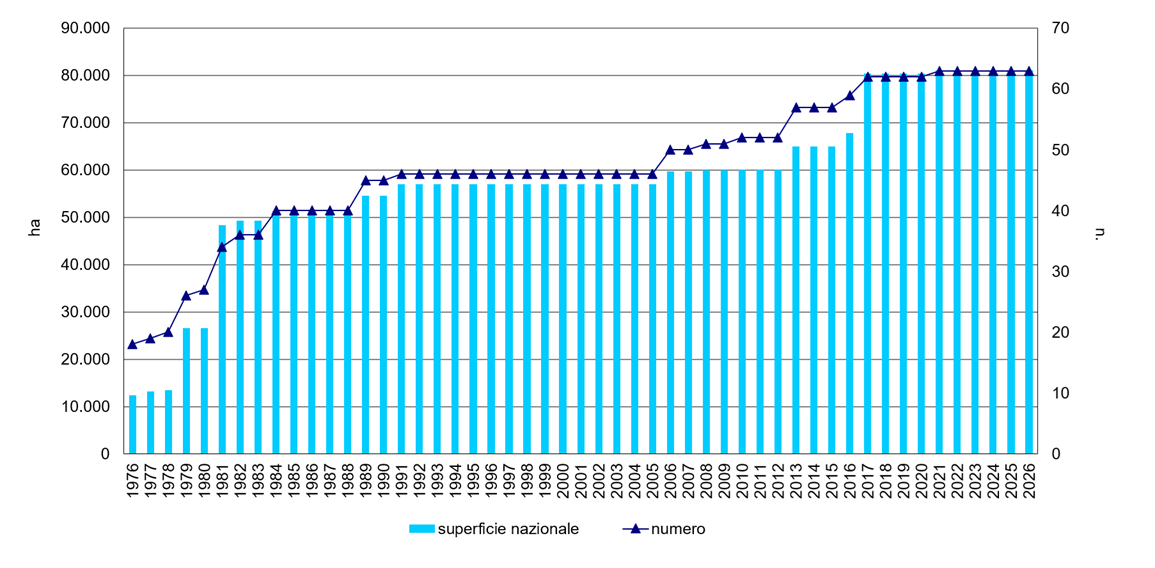
The Ramsar Convention was ratified and enforced by Italy with the Presidential Decree of 13 March 1976 and in the same year 18 areas were designated in our country (Table 2) with a total surface area of 12,563 hectares. Over the years, the number and surface area have increased significantly, going from 13,426 hectares in 1978 to over 57,075 in 1991, with the number of areas more than doubling (from 20 to 46) (Figure 1). This value remained unchanged for several years until 2005, then increasing more slowly starting from 59,734 hectares (50 areas) in 2006 up to 60,161 hectares in 2012. Despite the declaration of international importance of 11 other areas from 2013 to 2021, their recognition by the Secretariat of the Convention has stalled, so much so that the number of Ramsar sites of international importance it remained stuck at 57 areas for a long time. Currently, 6 other areas have been recognized by the Secretariat, already declared Ramsar Zones by Italy in 2013 (5) and 2016 (Foce dell'Isonzo - Isola della Cona). Of these 6 areas, 4 were recognized in July 2025 (Former lake and marshland of Bientina; Lake of Sibolla; Orti-Bottagone marshes and Foce dell'Isonzo - Isola della Cona) and 2 in January 2026 (Fucecchio marshes and Scarlino marshes). In addition to the 63 areas designated so far by the Secretariat, 3 other areas in Sicily (Coastal Marshes of Capo Feto, Margi Spanò, Margi Nespolilla and Margi Milo; Lakes of Murana, Preola and Gorghi Tondi and Stagno Pantano Leone), for a total of approximately 418 hectares, await the end of the long international recognition process.
| Allegati |
|---|
Headline
Table 1: Number and Area of Italian Wetlands of International Importance under the Ramsar Convention, by Region (updated April 2026) Data source
ISPRA analysis based on MASE data |
Headline
Table 2: List of the 66 Italian wetlands of international importance under the Ramsar Convention, sorted by date of designation. The list includes the 63 sites already designated and the 3 currently undergoing designation by the Convention Secretariat (updated April 2026) Data source
ISPRA analysis based on MASE data Note
The areas are taken from the RIS (Ramsar Information Sheets). For sites 64, 65, and 66, which are in the process of being designated by the Convention Secretariat, the dates and areas indicated in the decrees published in the Official Gazette are provided for informational purposes. |
Thumbnail
Headline
Figure 1: Changes in the number and area of the 63 Italian Ramsar Sites recognized by the Convention Secretariat (April 2026) Data source
ISPRA analysis based on MASE data Note
For processing purposes, the dates of issuance of the ministerial decrees are used, rather than the dates of recognition by the Ramsar Convention Secretariat; at present, the procedure for the international recognition of three additional areas that have not been included is underway. To calculate the areas, the data provided in the establishing decrees or in the RIS data sheets were used. |
Thumbnail
Headline
Figure 2: Breakdown by region of the number and area of Italy’s 63 Ramsar Sites of International Importance (April 2026) Data source
ISPRA analysis based on MASE data |
Thumbnail
Headline
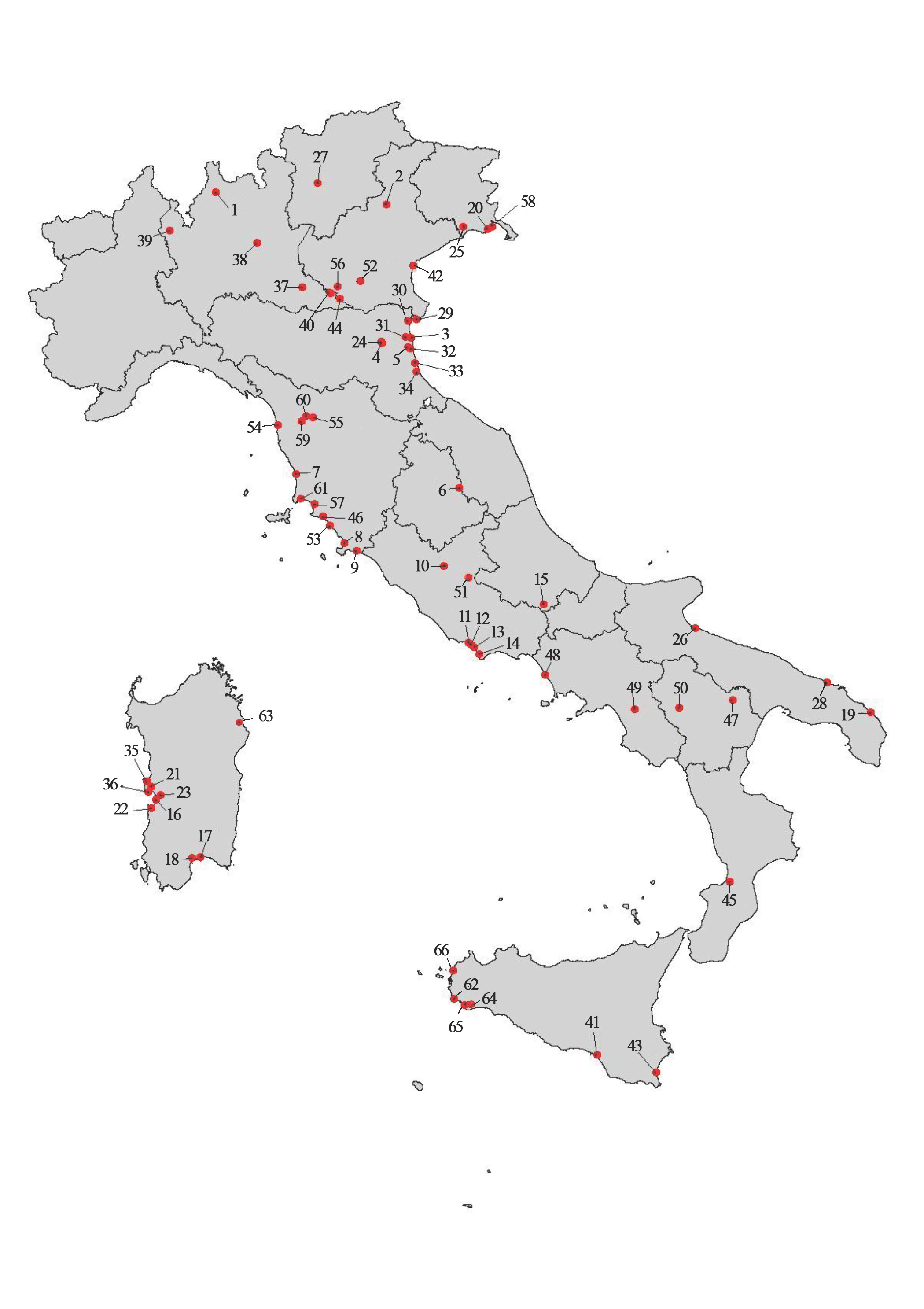
Figure 3: Geographic Distribution of Italy’s 66 Ramsar Sites (April 2026) Data source
MASE Data legend
1 Pian di Spagna - Lago di Mezzola; 2 Vincheto di Cellarda; 3 Sacca di Bellocchio; 4 Valle Santa; 5 Punte Alberete; 6 Palude di Colfiorito; 7 Palude di Bolgheri; 8 Laguna di Orbetello; 9 Lago di Burano; 10 Lago di Nazzano; 11 Lago di Fogliano; 12 Lago dei Monaci; 13 Lago di Caprolace; 14 Lago di Sabaudia; 15 Lago di Barrea; 16 Stagno di S'Ena Arrubia; 17 Stagno di Molentargius; 18 Stagno di Cagliari; 19 Le Cesine; 20 Valle Cavanata; 21 Stagno di Cábras; 22 Stagno di Corru S'Ittiri, Stagni di San Giovanni e Marceddì; 23 Stagno di Pauli Maiori; 24 Valle Campotto e Bassarone; 25 Laguna di Marano: Foci dello Stella; 26 Saline di Margherita di Savoia; 27 Lago di Tovel; 28 Torre Guaceto; 29 Valle di Gorino; 30 Valle Bertuzzi; 31 Valli residue del comprensorio di Comacchio; 32 Piallassa della Baiona e Risega; 33 Ortazzo e Ortazzino; 34 Saline di Cervia; 35 Stagno di Sale Porcus; 36 Stagno di Mistras; 37 Valli del Mincio; 38 Torbiere d'Iseo; 39 Palude Brabbia; 40 Palude di Ostiglia; 41 Biviere di Gela; 42 Laguna di Venezia: Valle Averto; 43 Vendicari; 44 Isola Boscone; 45 Bacino dell'Angitola; 46 Palude della Diaccia Botrona; 47 Lago di San Giuliano; 48 Oasi di Castelvolturno o Variconi; 49 Oasi del Sele-Serre Persano; 50 Pantano di Pignola; 51 Lagustelli di Percile; 52 Palude del Brusà - Le Vallette; 53 Padule della Trappola - Foce dell'Ombrone; 54 Lago e padule di Massaciuccoli; 55 Palude del Busatello; 56 Saline di Trapani e Paceco; 57 Foce del Rio Posada; 58 Paludi Costiere di Capo Feto, Margi Spanò, Margi Nespolilla e Margi Milo; 59 Laghi di Murana, Preola e Gorghi Tondi; 60 Stagno Pantano Leone; 61 Ex lago e Palude di Bientina; 62 Lago di Sibolla; 63 Padule di Fucecchio; 64 Padule Orti-Bottagone; 65 Padule di Scarlino; 66 Foce dell’Isonzo - Isola della Cona. Note
This includes both the 63 Ramsar sites of international importance already recognized by the Convention Secretariat and the 3 currently undergoing the recognition process. |
The wetlands of international importance currently included in the official list of sites of the Ramsar Convention for Italy are 63, distributed in 15 regions, for a total of 81,091 hectares (Table 1). Table 2 reports the complete list of sites, in chronological order of designation starting from 1976 until 2021, including a further 3 sites identified (in Sicily) by Ministerial Decree in 2011, and currently awaiting official designation by the Secretariat of the Convention. For each site they can be downloaded from the MASE website ( https://www. mite. gov. it/pagina/editore-delle-zone-umide ) the founding decrees and the official technical sheet required by the Convention (RIS-Information Sheet on Ramsar Wetlands) with all the relevant information.
The regions where Ramsar areas are most extensive and numerous are Emilia-Romagna, with 10 areas (23,112 ha), Tuscany with 11 areas (20,755 ha), and Sardinia with 9 areas (13,308 ha), while no sites are present in 5 regions (Figure 2 and Table 1). It is interesting to observe the distribution of the areas across the Italian territory in Figure 3, which shows the areas most affected by the presence of these wetlands to be protected, which probably does not entirely correspond to the actual distribution of wetlands that could be protected under the Ramsar Convention. This verification can be carried out when an inventory of wetlands surveyed uniformly using satellite imagery across the entire national territory becomes available.