MUNICIPALITIES WITH ESTABLISHMENTS WITH A RISK OF MAJOR ACCIDENT
Data aggiornamento scheda:
The indicator identifies areas with a high concentration of major-accident risk establishments, providing useful information for land use planning, particularly regarding land use and allocation. In 2026, there were 30 municipalities with four or more major-accident risk establishments, spread across 13 regions: they account for approximately a quarter of all major-accident risk establishments in Italy. The regions with the highest number of these municipalities are Lombardy (5), Sicily (4), Lazio (4), and Piedmont (4). Municipalities with a high number of establishments include Ravenna with 29, Genoa with 13, followed by Trecate, Venice, Catania, Naples, and Filago with nine, and Augusta, Anagni, Brindisi, and Livorno with seven each.
SAFETY OF CHEMICALS: REACH
Data aggiornamento scheda:
Over the last hundred years, global production of chemicals has increased exponentially, going from 1 million tons in 1930 to several hundred million tons today. The European Union (EU) is the world's second largest producer after China and it is estimated that there are more than 100,000 chemicals on the European market. Italy, with a production value of over 65 billion euros, is the third European producer, after Germany and France, and the tenth globally. There are approximately 2,800 chemical companies active in Italy and they employ over 113,000 people, but the use of chemical products affects all production sectors. European regulation of chemicals is probably the most ambitious in the world, its aim is to ensure a high level of protection of human health and the environment. The main reference standards are the REACH Regulation ( Registration, Evaluation, Authorization and Restriction of Chemicals ) and the CLP Regulation ( Classification, Labeling and Packaging ). Safety in the management of chemical substances is primarily the responsibility of the companies that produce, import or use them. ECHA ( European Chemicals Agency ) and the competent authorities of the EU Member States carry out a control activity on the obligations of companies and can intervene with specific measures if it is demonstrated that the risk of the substances for humans and the environment is not adequately controlled. The indicator, through the monitoring of regulatory processes, provides the elements to evaluate progress in achieving the safety objectives established by the legislation.
USE AND RISK OF CHEMICAL PLANT PROTECTION PRODUCTS
Data aggiornamento scheda:
The European strategy Farm to Fork sets two objectives to be achieved by 2030, which consist of reducing the use and risk of chemical pesticides by 50% and reducing the use of the most dangerous pesticides by 50%. In order to measure the progress made towards these objectives, two indicators have been defined based on the sales of active substances contained in plant protection products and on the dangerous properties of these substances. The indicators described represent the European and national trend of progress towards the pesticide reduction objectives of the strategy Farm to Fork. In 2023, the use and risk of chemical pesticides, both at European and national level, will be reduced, compared to the reference period 2015-2017, beyond the set target, with decreases corresponding to 58% and 64% respectively. As regards the use of the most dangerous pesticides, however, the trend towards the objective of 50% reduction is slower, in fact in 2023 the European reduction will reach 27%, that of Italy 29%.
WATER QUALITY – PESTICIDE POLLUTION
Data aggiornamento scheda:
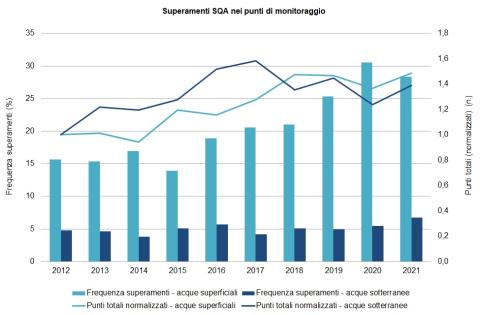
The indicator allows for the assessment of surface and groundwater contamination by pesticide residues released into the environment. Monitoring pesticide presence in water is complex due to the number of substances involved and their diffuse use. Measured levels are compared with the concentration limits established by current regulations. The presented indicators provide an analysis of the evolution of contamination over the 2012–2021 decade, in terms of the frequency of pesticide detection in water, as well as the environmental risks arising from their use. Data from 2021 confirm a state of contamination already reported in previous years, with exceedances of legal limits particularly in surface waters (28.3% of monitoring points); in groundwater, 6.8% of points exceed regulatory limits.