FARMLAND BIRD INDEX (FBI) - MONITORING OF BIRDS IN AGRICOLTURAL AREAS
Data aggiornamento scheda:
Farmland birds represent effective indicators of environmental quality due to their sensitivity to habitat changes and the feasibility of monitoring their populations using standardized methodologies on a large scale. Owing to these characteristics, the Farmland Bird Index is adopted by the European Commission as a context indicator of the Common Agricultural Policy to assess the state of biodiversity in agroecosystems and the effectiveness of conservation and rural land management measures.
The national indicator, calculated on the basis of the trend of 28 species typical of farmland environments over the 2000-2025 period, highlights an overall decline of 33.49%, with 71% of the considered species in decrease. The indicator relating to species typical of mountain grasslands (FBIpm), calculated on the trend of 13 species, also shows a reduction of 29.90%, with 46% of the species in decline. The results reveal a persistent deterioration of biodiversity associated with Italian farmland environments and the need to strengthen the conservation measures provided for by national and European biodiversity strategies.
CONSERVATION STATUS OF SPECIES UNDER THE HABITATS DIRECTIVE 92/43/EEC
Data aggiornamento scheda:
The indicator illustrates the trends and conservation status of the over 340 Italian species protected by the Habitats Directive 92/43/EEC and is based on the results of the last three Italian reports pursuant to art. 17, coordinated by ISPRA on behalf of MASE and transmitted to the European Commission in 2013, 2019 and 2025. The data from the latest report (referring to the period 2019-2024 and delivered in 2025) are presented in detail, in which the 346 species of community interest present in our territory and in our seas were evaluated (226 animal species and 120 plant species), creating 344 distribution maps and 580 reporting sheets (one for each species in each biogeographical region of presence).
The results show that in 2025, 29% of species are in poor conservation status (SC) and 20% are in bad conservation status, meaning they are in worrying conditions and at risk of extinction. Terrestrial and freshwater fauna is the group with the highest percentage of species in bad SC (22%), followed by terrestrial flora (16%) and marine species (11%).
Comparing the results of the V Report with the previous ones (III Report-2013, IV Report-2019) no improvements in the SC emerge for most species, even if there was an increase in knowledge for marine species. The percentages of change in the SC of the species between IV and V Report show 74% of the assessments in which the SC of the species remains unchanged, 10% in which the SC improves, 11% of assessments in which the SC worsens and a remaining 5% in which the assessments in the two reports are not comparable.
The data presented confirm the urgency of implementing the actions envisaged by the EU Regulation 2024/1991 for the Restoration of Nature and by the European and National Strategies for Biodiversity to 2030, whose targets provide that at least 30% of species and habitats in unfavorable SC improve their status by 2030 or show at least an improvement trend.
CONSERVATION STATUS OF HABITATS UNDER DIRECTIVE 92/43/EEC
Data aggiornamento scheda:
The indicator describes the conservation status of the 132 habitats protected by the Habitats Directive 92/43/EEC, one of the main pillars of community policy for nature conservation. The indicator is based on the results of the Italian reports (III Report-2013, IV Report-2019, V Report 2025) drawn up pursuant to art. 17 of the Directive, coordinated by ISPRA on behalf of MASE and officially transmitted to the European Commission.
Specifically, the sheet presents the results of the fifth report in which distribution maps were produced for 124 terrestrial and inland water habitats and 8 marine habitats. Furthermore, 262 reporting forms have been updated, each referring to a habitat in the respective biogeographical regions of presence. In 2025, 42% of habitats are in poor conservation status (SC) (U1), while 48% are in bad conservation status (U2), meaning they are in worrying conditions. Comparing the results of the V Report with the previous ones (III-2013, IV-2019) no improvements in the SC emerge for most of the habitats, even if there was an overall increase in knowledge. The percentages of change in the habitat SC between the 4th and 5th reports show 71% of the assessments in which the habitat SC remains unchanged, 7% in which the SC improves, 19% of assessments in which the SC worsens and a remaining 3% in which the assessments in the two reports are not comparable. The data presented confirm the urgency of implementing the actions envisaged by the EU Regulation 2024/1991 for the Restoration of Nature and by the European and National Strategies for Biodiversity, whose targets envisage that at least 30% of species and habitats in unfavorable SC improve their status by 2030 or show at least a trend of improvement.
CITES CONTROLS
Data aggiornamento scheda:
The number and outcomes of inspections carried out over the last 14 years (2010-2023) to verify compliance with the Washington Convention on International Trade in Endangered Species of Wild Fauna and Flora (CITES) are analyzed. The indicator shows a marked increase in the number of detected offences starting from 2018. In the same year, the total amount of imposed fines also rose sharply, averaging approximately €2,091,126 per year between 2018 and 2024, compared with an average of €611,013 during the 2010–2017 period.
In 2024, a total of 6,170 inspections were carried out, identifying 556 offences and resulting in total fines amounting to €1,728,543. Most violations concerned fauna species (258 offences, €1,137,800 in fines) and flora species (279 offences, €550,737).
SPREAD OF ALIEN SPECIES
Data aggiornamento scheda:
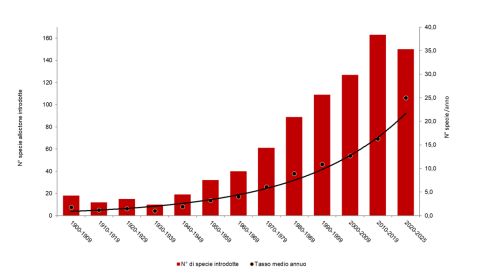
The indicator provides an overview of the current presence of alien animal and plant species in Italy, describing their numbers and trends in introductions over the past century. It reports the average annual introduction rate (the mean number of new alien species introduced each year), the main pathways of introduction (according to CBD categories), and the distribution of invasive alien species of Union concern.
The number of alien species in Italy is steadily and continuously increasing. Based on the data currently available, more than 3,800 alien species have been introduced into the country, of which 3,699 are currently established in the territory. The average number of species introduced per year has grown exponentially over time — from 6 species per year in the 1970s, to 16 per year in the previous decade, and reaching 25 per year in the current one. The cumulative number of alien species introduced in Italy since 1900 also confirms this exponential trend, showing an increase of over 500% in 120 years.
FRAGMENTATION OF NATURAL AND AGRICULTURAL LAND
Data aggiornamento scheda:
Land fragmentation is the process that leads to a progressive reduction in the surface area of natural and semi-natural environments and to an increase in their isolation. This process, which transforms large territorial patches into smaller and more isolated units, is mainly driven by urban expansion—implemented through more or less sustainable development patterns—and by the growth of infrastructure networks aimed at improving connectivity between urbanized areas through linear works. In 2024, 42.41% of the national territory was classified as having high or very high fragmentation. The regions with the largest share of very highly fragmented land are Veneto (39.73%), Lombardy (33.73%), Emilia-Romagna (25.22%), Puglia (25.22%), and Campania (25.76%). These figures confirm the close relationship between fragmentation and urbanization density.
HEALTH STATUS OF MIGRATORY BIRD POPULATIONS
Data aggiornamento scheda:
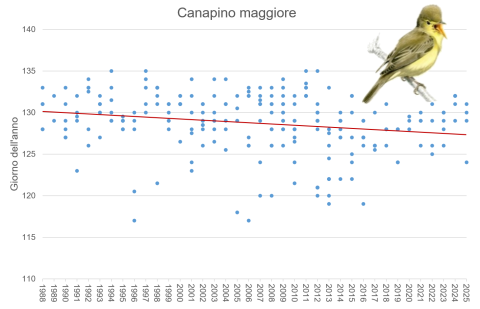
This indicator provides an overview of the health status of common migratory passerine bird populations in Europe by assessing the resilience of migratory species to climate change. Rising spring temperatures due to global warming lead to an earlier onset of vegetation growth and, consequently, an earlier peak in insect abundance. As a result, if migratory birds do not arrive at their breeding sites earlier by the same degree, they will not find an abundance of prey when they need to feed their chicks. Failure to bring forward the migration date results in low resilience of migratory populations to climate change, with negative effects on their survival. We therefore analyzed the temporal variation in the arrival dates of migratory passerines at stopover sites used after crossing the Sahara and the Mediterranean Sea during their spring journey from Africa to European breeding grounds. Based on an analysis of the migration dates of 10 bird species recorded at 26 banding stations participating in ISPRA’s Small Islands Project during the period 1988–2025 (38 years), it was found that 80% of the species considered show a shift in migration dates that is too slow (approximately 1 day every 7+ years) to be considered sufficient to counteract the effects of climate change.
DISTRIBUTION OF ECOLOGICAL VALUE ACCORDING TO CARTA DELLA NATURA
Data aggiornamento scheda:
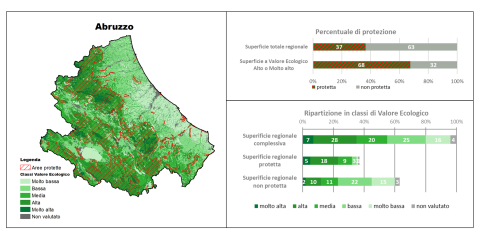
The indicator, based on data processed within the Carta della Natura project, shows the distribution of Ecological Value (VE) across 17 Italian regions, providing a representation categorized into different classes. Ecological Value is understood as a synonym for natural significance and is calculated—starting from the regional habitat maps—for each mapped polygon, excluding those referring to built environments and fully urbanized areas. This indicator offers an overview of the environmental mosaic within various regional contexts, highlighting high-value areas, including their protection status. The analysis presents the percentage of protected areas in each region and the composition of protected and unprotected zones in terms of Ecological Value. The protected areas system (EUAP areas, Natura 2000 sites, and Ramsar areas) covers territories characterized by the highest Ecological Value classes but still leaves significant portions outside protected areas.
PRIMARY EXPENDITURE FOR ENVIRONMENTAL PROTECTION, USE, AND MANAGEMENT OF NATURAL RESOURCES WITH REFERENCE TO BIODIVERSITY
Data aggiornamento scheda:
In 2022, Italy's primary environmental expenditure increased by 163% compared to 2021, reflecting a greater political interest in environmental issues. However, the share of key sectors (biodiversity and landscape protection, forest and wildlife management) in total environmental spending declined from 9.1% to 4.2%.
Despite the increase in available resources, spending capacity varies across sectors, with efficiency rates ranging from 88.5% for biodiversity to 69.1% for forest management. This trend highlights the need to optimize investments to ensure the protection of natural heritage, in alignment with the sustainable development goals of the 2030 Agenda.
MOUNTAIN GREEN COVER INDEX
Data aggiornamento scheda:
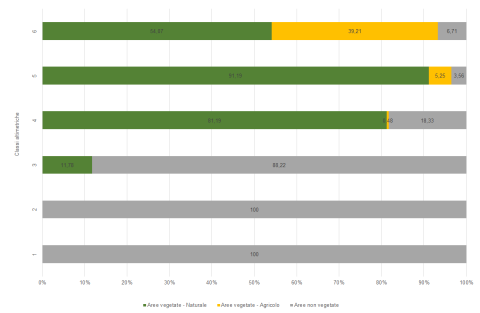
The index evaluates the percentage of vegetation cover in mountain areas, defined according to the six altitude classes with elevations above 300 m above sea level proposed by FAO in 2015 (UNEP-WCMC). The data is expressed in terms of total mountain vegetation area and with reference to the distinction between natural and agricultural areas.
The analysis reveals a significant presence of vegetated areas, especially in classes 5 and 6, which are between 300 and 1,500 m above sea level. The changes observed are mostly associated with a reduction in vegetated areas, while increases are recorded in higher altitude bands, with a maximum of just over 1,800 hectares in Veneto and slightly more than 1,000 hectares in Lombardia. Significant increases in mountain vegetation cover are also found in Marche and Tuscany, which, together with Lombardia and Veneto, are the only regions showing an overall increase in mountain green areas, net of reductions.
CONSERVATION STATUS OF SPECIES PROTECTED UNDER THE BIRDS DIRECTIVE (2009/147/EC)
Data aggiornamento scheda:
This indicator provides a national overview of the conservation status of 268 breeding bird species assessed in the reporting under Article 12 of the Birds Directive 2009/147/EC. The assessment includes species of community interest listed in Annexes I and II of the Directive, as well as those that justify the designation of Special Protection Areas (SPAs).
At the national level, the percentage of species with a favourable conservation status increased from 51% (reporting period 2007-2012) to 56% (reporting period 2013-2018). However, this increase was insufficient to meet the target set by the EU Biodiversity Strategy 2020 (76%).
The short-term population trends, which reflect processes occurring in the last decade, indicate that 46% of species are increasing or stable, while nearly 25% of species are in decline (the population trend of the other 33% remains unknown). Regarding short-term trends in distribution range, the proportion of declining species is lower, as only the most severe declines result in range contractions: 21% of species show a contraction, while the remaining 79% have stable or expanding ranges.
RICHNESS AND RED LIST STATUS OF PLANT SPECIES
Data aggiornamento scheda:
Italy hosts a remarkable floristic heritage, both in terms of species and subspecies richness (2,815 lichens, 1,209 bryophytes, and 8,241 native vascular entities) and biogeographical value. Of the 8,241 Italian vascular plant,1,702 species (equal to 20.65%) are endemic, meaning they exist exclusively in the country. Among these, 1,128 species are regionally endemic, with their range restricted to a single Italian region (data updated to April 2024).
The indicator also highlights the IUCN risk status of 2,430 vascular plant entities (representing 29.5% of Italy’s vascular flora), identifying the main threats affecting them. Unfortunately, the overall conservation status cannot be considered satisfactory: 2.2% (54 species) of the 2,430 evaluated entities are extinct or likely extinct; 24.3% (590 species) are at risk of extinction.
Human-induced pressures related to land-use changes represent a major driver of plant species extinction risk. The Red List of vascular flora identifies the most critical pressures affecting species: Modification of natural systems (39% of the 2,430 assessed taxa are subject to this pressure);
Agricultural development (27%); Residential development (27%); Direct human disturbance in natural environments (20%).
RELATIVE RICHNESS AND ABUNDANCE OF BIRDS IN ITALY
Data aggiornamento scheda:
The indicator measures the abundance and diversity of bird populations in Italy throughout the year, based on bird ringing data. This assessment helps define Italy’s role in the spatial-temporal distribution of European avifauna. Data from 2019-2020 confirm Italy’s crucial importance as a major migration corridor between Europe and Africa and contribute to identifying critical periods for bird species, which is essential for conservation and management purposes.
RICHNESS AND RED LIST STATUS OF ANIMAL SPECIES
Data aggiornamento scheda:
The Italian fauna is estimated to include over 58,000 species, with the total number reaching approximately 60,000 taxa when considering subspecies. However, this biodiversity is under threat, as indicated by IUCN assessments and population trends. Among the 672 species of Italian vertebrates (576 terrestrial and 96 marine), 6 are extinct in Italy, and 161 are threatened with extinction (accounting for 28% of the assessed species). Different vertebrate groups show varying percentages of risk: 2% for marine bony fish, 19% for reptiles, 21% for cartilaginous fish, 23% for mammals, 36% for amphibians, and up to 48% for freshwater bony fish (considering the CR+EN+VU IUCN categories). Additionally, terrestrial and marine vertebrate populations are generally declining by 27% and 22%, respectively.
Breeding birds are the only group for which two IUCN assessments have been conducted, seven years apart. Of the 278 species assessed in the latest 2019 evaluation, 5 are extinct, and 67 are threatened (compared to 76 in 2013), representing 26% of the evaluated species. Half of Italy's breeding bird species are not at immediate risk of extinction.
Among invertebrates, 9% of corals, 11% of dragonflies, 21% of saproxylic beetles, 6% of butterflies, and 11% of assessed bees are threatened with extinction. Invertebrates also show negative trends; for example, 16% of dragonfly populations are in decline, five times higher than those increasing.