Pierangela Angelini, Emanuela Carli, Laura Casella, Gabriele La Mesa, Francesca Pretto
The indicator describes the conservation status of the 132 habitats protected by the Habitats Directive 92/43/EEC, one of the main pillars of community policy for nature conservation. The indicator is based on the results of the Italian reports (III Report-2013, IV Report-2019, V Report 2025) drawn up pursuant to art. 17 of the Directive, coordinated by ISPRA on behalf of MASE and officially transmitted to the European Commission.
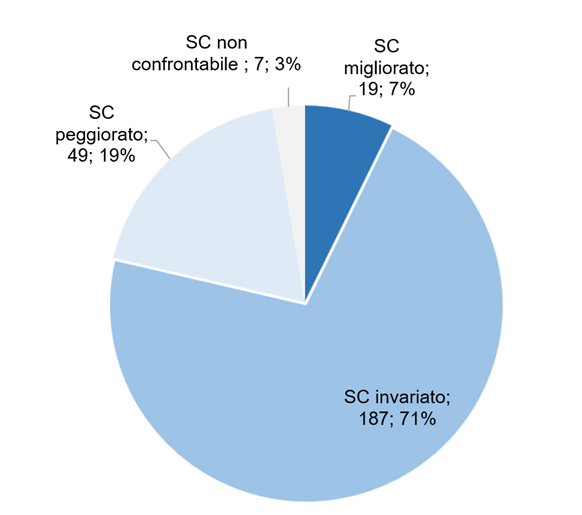
Specifically, the sheet presents the results of the fifth report in which distribution maps were produced for 124 terrestrial and inland water habitats and 8 marine habitats. Furthermore, 262 reporting forms have been updated, each referring to a habitat in the respective biogeographical regions of presence. In 2025, 42% of habitats are in poor conservation status (SC) (U1), while 48% are in bad conservation status (U2), meaning they are in worrying conditions. Comparing the results of the V Report with the previous ones (III-2013, IV-2019) no improvements in the SC emerge for most of the habitats, even if there was an overall increase in knowledge. The percentages of change in the habitat SC between the 4th and 5th reports show 71% of the assessments in which the habitat SC remains unchanged, 7% in which the SC improves, 19% of assessments in which the SC worsens and a remaining 3% in which the assessments in the two reports are not comparable. The data presented confirm the urgency of implementing the actions envisaged by the EU Regulation 2024/1991 for the Restoration of Nature and by the European and National Strategies for Biodiversity, whose targets envisage that at least 30% of species and habitats in unfavorable SC improve their status by 2030 or show at least a trend of improvement.
Status indicator that illustrates the conservation status of the 132 habitats present in Italy and protected by Annex I of Directive 92/43/EEC. The indicator is based on reporting pursuant to art. 17 which requires Member States, every 6 years, to draw up a national report that provides an updated distribution map of habitats and detailed information useful for assessing the state of conservation (overall assessment) and the trend (overall trend) in a standardized way in the reference period for each habitat in each biogeographical region. The results of the last report delivered by Italy in 2025 (V report, relating to the period 2019-2024) are shown, comparing them with those of the IV report (2013-2018) and the III report (2007-2012).
Evaluate the level of implementation and success of the Habitats Directive, showing the state of conservation of habitats in Italy and its variations over time, measuring progress towards the targets of the European and National Biodiversity Strategies.
The Habitats Directive (92/43/EEC) represents one of the main pillars of EU policy for nature conservation. Article 1 establishes as a general objective for the Member States of the European Community the achievement of a Favorable Conservation State (SC, FV) for all types of habitats, listed in Annex I, present on the national territory. The Directive became implemented and regulated in Italy by the Presidential Decree. 8 September 1997, n. 357 (Official Journal 23 October 1997, n. 248, S. O.). Favorable Conservation State represents the situation in which a habitat thrives in terms of the quality and extent of the area it occupies, and there are good prospects for these conditions to remain stable in the future. The favorable situation must therefore be defined, achieved and maintained. The Directive requires surveillance (Article 11) of species and habitats to be implemented through monitoring, and the preparation of national reports on the implementation of its provisions (Article 17).
The European and National Biodiversity Strategies for 2030 contain specific commitments linked to the SC of species and habitats of community interest, in particular they ask that a deterioration of the SC does not occur and that at least 30% of the species/habitats with unfavorable SC reach a favorable SC by 2030, or at least show a trend of improvement.
The EU Nature Restoration Regulation 2024/1991 creates a common legal framework for the restoration of degraded ecosystems, habitats and species across the EU's land and seas, building on and complementing existing EU legislation. The Regulation aims to ensure the long-term recovery of biodiversity through the restoration of degraded ecosystems, contribute to the achievement of EU objectives regarding mitigation and adaptation to climate change and neutrality of land degradation, and contribute to compliance with international commitments. The overall goal at EU level is to implement restoration measures on at least 20% of Europe's land and at least 20% of its marine areas by 2030, and on all ecosystems in need of restoration by 2050.
Following the adoption of the Regulation, all member states of the European Union, including Italy, are asked to develop their own National Recovery Plan (NRP) to illustrate how the country intends to achieve the objectives established by the regulation. States must also monitor progress and report on the effectiveness of restoration interventions based on EU-level biodiversity indicators.
- Angelini P., Casella L., Grignetti A., Genovesi P. (ed.), 2016. Manuals for the monitoring of species and habitats of community interest (Directive 92/43/EEC) in Italy: habitat. ISPRA, Manuals and Guidelines Series, 142/2016
- DG Environment. 2023. Reporting under Article 17 of the Habitats Directive: Guidelines on concepts and definitions – Article 17 of Directive 92/43/EEC, Reporting period 2019-2024. Brussels. Pp 104.
- La Mesa G., Paglialonga A., Tunesi L. (ed.), 2019. Manuals for the monitoring of species and habitats of community interest (Directive 92/43/EEC and Directive 09/147/EC) in Italy: marine environment. ISPRA, Manuals and guidelines series, 190/2019.
- http://cdr. eionet. europa. eu/help/habitats_art17
- https://www. eea. europa. eu/themes/biodiversity/state-of-nature-in-the-eu/article-17-national-summary-dashboards/conservation-status-and-trends
- https://eur-lex. europa. eu/LexUriServ/LexUriServ. do? uri=CONSLEG:1992L0043:20070101: IT: PDF
- https://www. mase. gov. it/portale/monitoraggio-e-rendicontazione
- https://www. mase. gov. it/portale/strategia-nazionale-per-la-biodiversit%C3%A0-al-2030
- https://eur-lex. europa. eu/legal-content/IT/TXT/HTML/? uri=OJ: L_202401991
- https://www. mase. gov. it/portale/il-ripristino-della-natura
- https://www. mase. gov. it/portale/il-piano-nazionale-di-ripristino-pnr-dell-italia
- https://www. isprambiente. gov. it/it/ripristino-della-natura
While there are important improvements in habitat knowledge, complete reliability of the data can only be achieved through standardization in the collection of basic data carried out by Regions and Autonomous Provinces and the creation of ad hoc long-term monitoring plans. In particular, the creation and updating of habitat distribution maps at a detailed scale requires coordination at a national level to make the interpretations and assembly of the same homogeneous in the reporting phase. There remains a need for in-depth research and monitoring to identify threshold values for assessing the state of conservation of the "structure and functions" parameter and to address the quantification of favorable reference values, fundamental elements for the assessments.
The systematization of data collection and processing activities as part of a national monitoring plan for habitats of community interest.
Data III, IV, V Italian Report pursuant to art 17 can be consulted and downloaded from the ISPRA website https://reportingdirettivahabitat. isprambiente. it/
Complete V Report data (Italy and Member States) downloadable from the Reportnet EU website https://reportnet. europa. eu/public/dataflow/1525
National
2007-2012, 2013-2018, 2019-2024
n. of habitats, n. of assessments.
Pursuant to Article 17 of the Habitats Directive, each Member State must provide every 6 years an assessment at a national biogeographical level of the conservation status (CS) of all habitats of community interest present in its territory. In Italy the data must be collected by Regions and Autonomous Provinces. ISPRA, which has been coordinating data collection since 2011 on behalf of the Ministry of the Environment, has also drawn up manuals with the monitoring methodologies of species and habitats shared at national level and has created a website with sections dedicated to both consultation and downloading of reporting data and supporting technical documentation ( https://reportingdirettivahabitat. isprambiente. it/downloads ).
For the six-yearly report, the updated distribution map of the habitats and the standardized data useful for evaluating the conservation status and the trend in the reference period for each habitat in each biogeographical region must be provided. In Italy there are 4 biogeographical regions: Alpine (ALP), continental (CON), Mediterranean (MED) and Mediterranean marine (MMED). The overall SC (overall conservation status) is the synthetic result of the reporting and is obtained through an evaluation process carried out using the data of four parameters: range, area, structure and functions and future prospects. The SC categories are: favorable (FV), unfavorable-inadequate (U1), unfavorable-bad (U2), unknown (XX). For habitats with marginal presence in a certain biogeographical region, the compilation of the reporting form is not required. By providing a standardized methodology, reporting allows comparisons between subsequent cycles and it is therefore possible to identify improvements in the SC (from U1 to FV, from U2 to U1/FV), worsening in the SC (from FV to U1, from FV/U1 to U2) or stable conditions, when no changes are recorded. The changes in the SC between one reporting cycle and another, however, are not always due to a real improvement/worsening of the state since the reasons for change envisaged by the reporting system, which must be included in the forms together with the assessment of the SC, can be numerous. The following categories are foreseen: genuine change , improved knowledge/more accurate data , use of different methods (including taxonomical change or use of different thresholds), nature of change is unknown , other reasons .
Complete information on the methodologies imposed at European level for reporting is available in the dedicated EIONET portal ( https://cdr. eionet. europa. eu/help/habitats_art17).
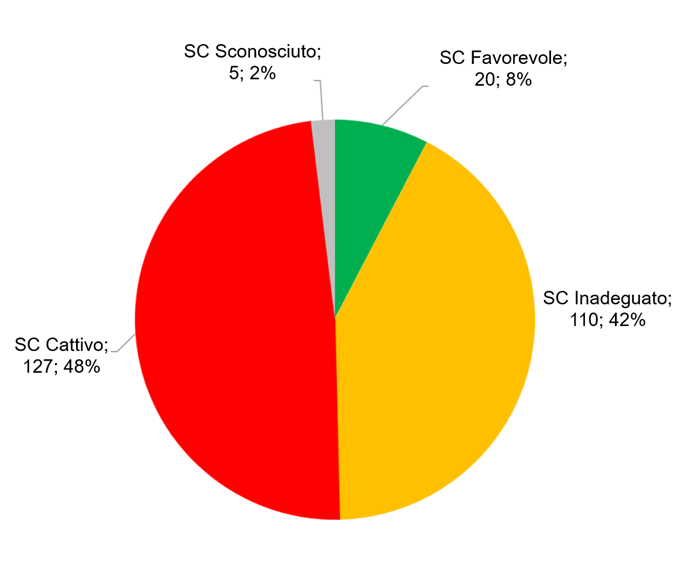
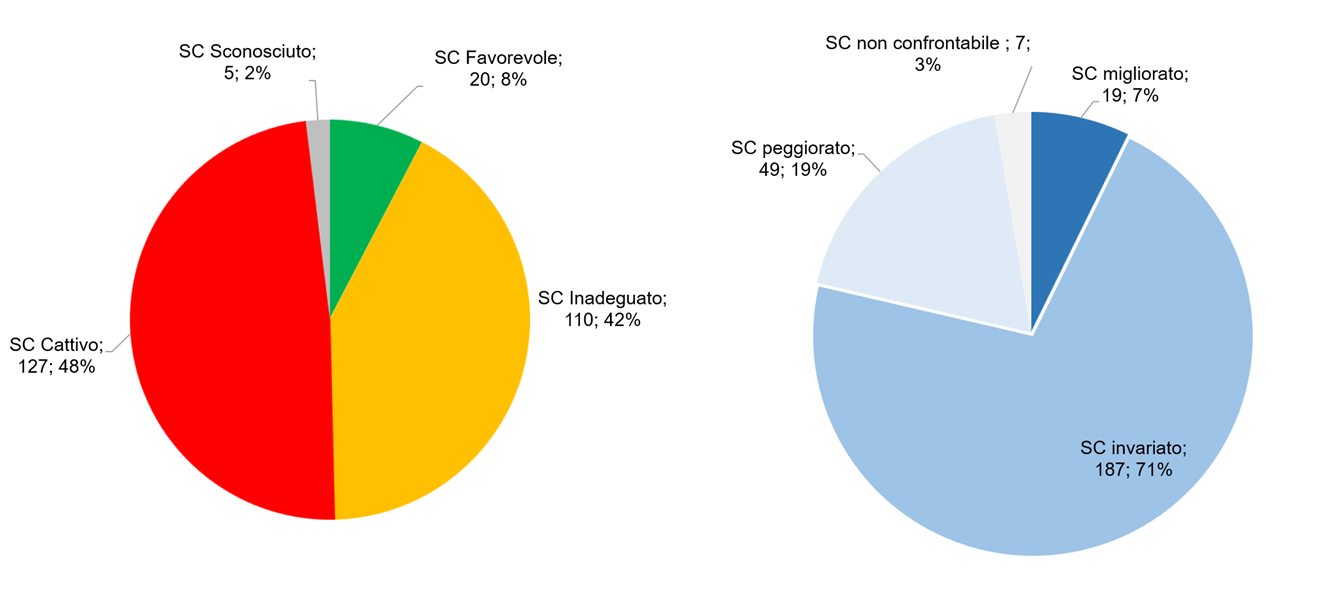
The conservation status of the 132 terrestrial, inland water, and marine habitats of community interest provided for by the Habitats Directive in Italy is overall worrying. In fact, 90% of the assessments highlight an unfavorable conservation status: specifically, 42% of habitats present an inadequate conservation status (U1) while 48% present a bad status (U2), indicating extremely critical conditions and a high risk of disappearance (Figure 1).
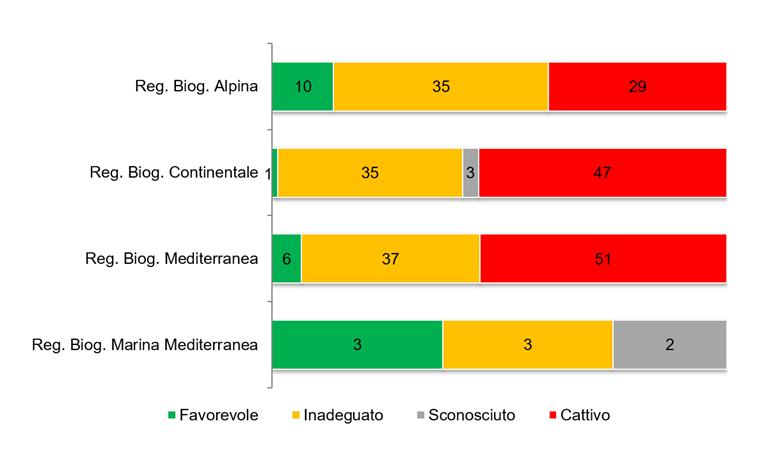
Analyzing data by biogeographical region (Figure 2), it is noted that the highest number of assessments resulting in an unfavorable (U1) and bad (U2) conservation status is present in the Mediterranean region. The Continental region also shows a problematic picture: only 1 habitat turns out to be in a favorable status, while 35 are classified as inadequate and as many as 47 in a bad status. The Continental region also presents the 3 habitats with an unknown conservation status. In the marine environment, the number of habitats in an inadequate status (3) is balanced by that of habitats in a favorable status, but there still remain 2 habitats whose conservation status remains unknown.
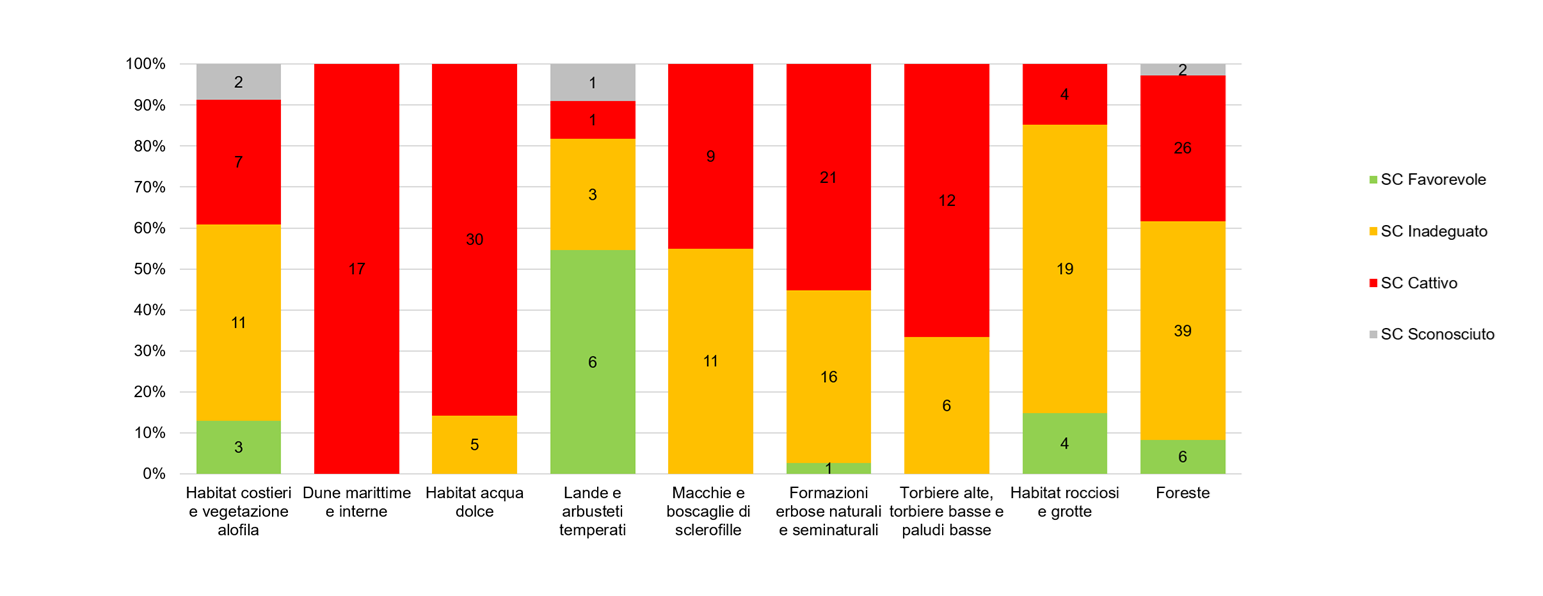
The macrocategory of habitats (Figure 3) showing the worst conditions is that of maritime and inland dunes, for which 100% of assessments fall into bad CS. Freshwater habitats, mires, bogs and fens, and natural and semi-natural grassland formations also present high percentages of bad CS. The objective set by the Habitats Directive of achieving favorable CS for all habitats of community interest is to be considered very far away, as are the targets of the European and National Biodiversity Strategies for 2030 and of the Restoration Regulation.
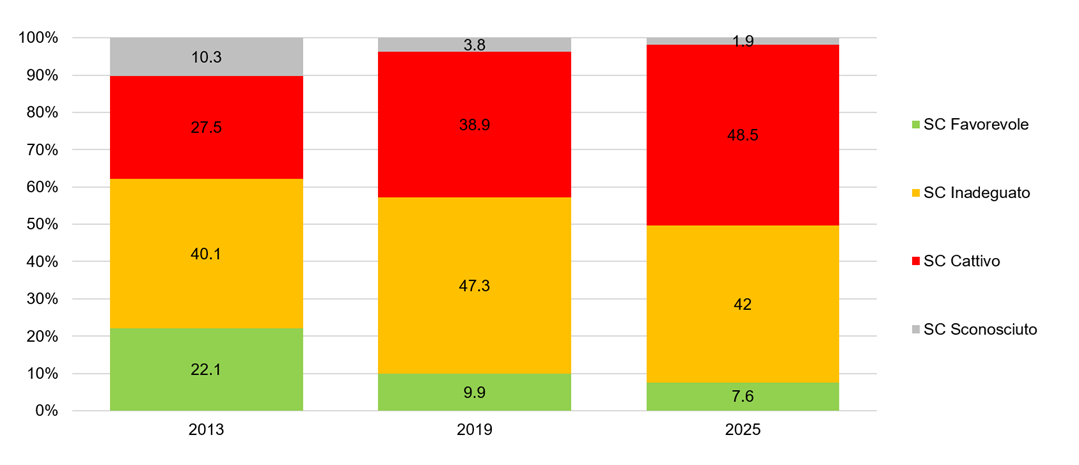
The comparison between the last three national reports (2013, 2019, and 2025) highlights a progressive worsening of the conservation status of habitats (Figure 4). The percentage of habitats in a favorable conservation status (CS) has indeed drastically reduced, dropping from 22.1% in 2013 to 9.9% in 2019, down to 7.6% in 2025. Parallelly, habitats in bad CS increased from 27.5% to almost 39%, exceeding 48% in the latest report. The share of habitats in inadequate CS also remains high, standing at 42% in 2025.
Overall, the trend appears clearly negative, since over the course of the last three reporting cycles no general improvement in the conservation status of habitats of community interest is observed. On the contrary, a progressive increase in assessments in bad CS and a constant reduction of habitats in favorable conditions emerge.
A positive element concerns, however, the sharp decrease in cases with unknown CS, which went from 10.3% in 2013 to 3.8% in 2019, down to 1.9% in 2025.
Analyzing the variations in the conservation status (CS) of terrestrial, inland water, and marine habitats between the IV and V reports (Figure 5), an overall negative picture emerges, in which the 19 cases of improvement are clearly lower than the 49 cases of worsening, while the majority of habitats (187 cases) maintain an unchanged condition.
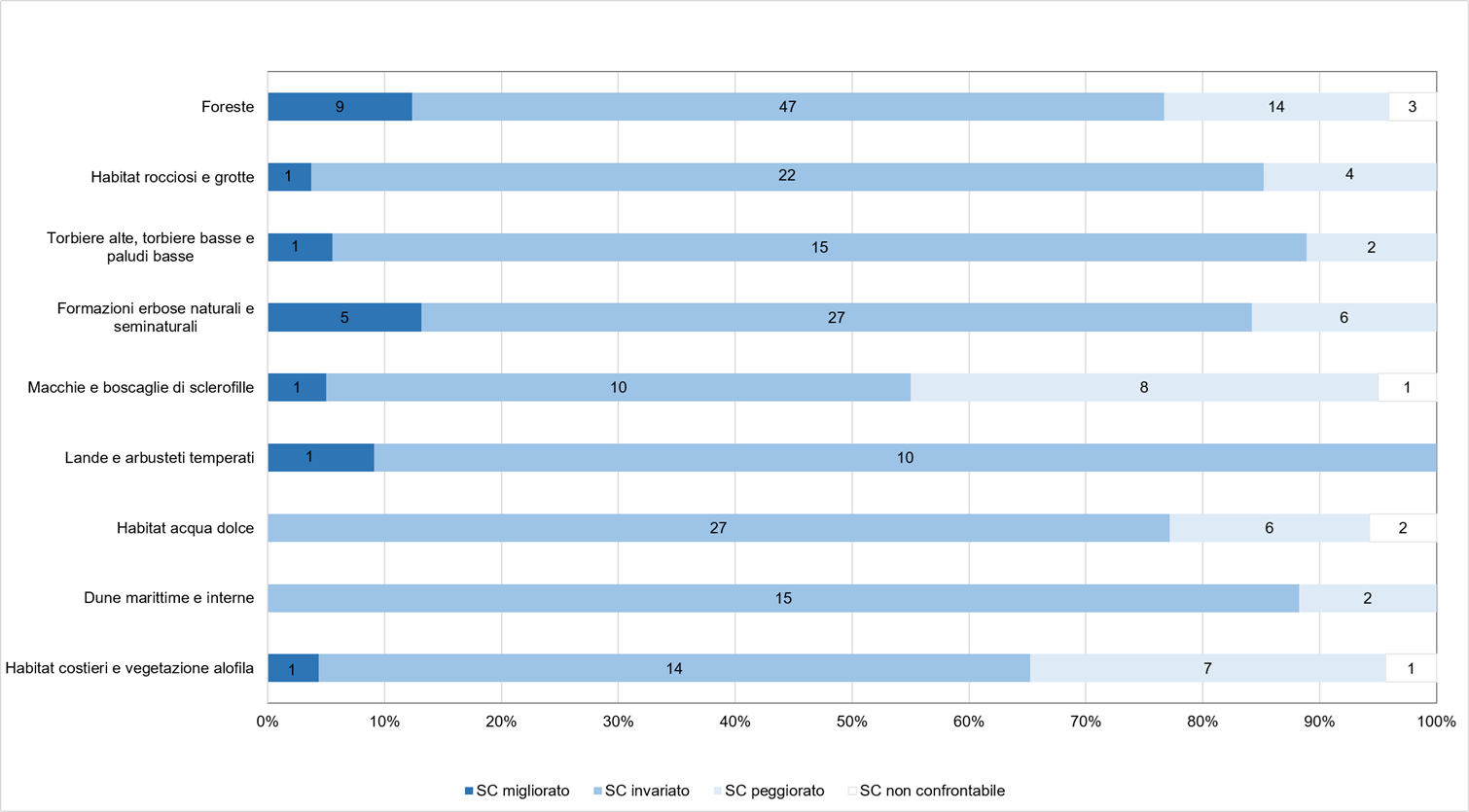
Regarding the variations in conservation status expressed as number of assessments (Figure 6), positive signals concern mainly forests, which record the highest number of improvements (9 cases), and natural and semi-natural grassland formations (5 cases). However, forests also represent the macrocategory with the highest number of worsenings (14 cases), highlighting a situation that is still highly critical and non-homogeneous. Significant worsenings are also observed in sclerophyllous scrub (8 cases), coastal habitats and halophytic vegetation (7 cases), and freshwater habitats (6 cases), ecosystems that are particularly vulnerable to anthropogenic pressures and the effects of climate change. Overall, the results confirm the absence of significant progress in achieving the conservation objectives set by the Habitats Directive.
| Allegati |
|---|
Thumbnail
Titolo
Figure 1: Conservation status of the 132 Italian terrestrial, inland water, and marine habitats covered by the Directive, as assessed in the fifth report pursuant to Article 17 (updated 2025) Fonte
ISPRA analysis of data from the V Report Note
For each SC category, the number of assessments and the percentage calculated based on the total number of assessments are reported (reporting forms completed for each habitat in each biogeographic region where it occurs). |
Thumbnail
Titolo
Figure 2: Conservation status of terrestrial, inland water, and marine habitats under Directive 92/43/EEC by biogeographic region: number of reporting forms for each conservation status category in each biogeographic region Fonte
ISPRA analysis of data from the V Report |
Thumbnail
Titolo
Figure 3: Conservation status of the various groups of terrestrial, inland water, and marine habitats in the Fifth Report Fonte
ISPRA analysis of data from the V Report Note
Number of assessments (reporting forms completed for each species in each biogeographic region where it occurs) |
Thumbnail
Titolo
Figure 4: Conservation status of terrestrial, inland water, and marine habitats under the Habitats Directive: comparison of the last three reports (III, submitted in 2013, covering the period 2007–2012; IV, submitted in 2019, covering the period 2013–2018; and V, to be submitted in 2025, covering the period 2019–2024) Fonte
ISPRA analysis of data from the last three Italian reports pursuant to Article 17 Note
Percentage values calculated based on the number of assessments (reporting forms completed for each habitat in each biogeographic region where it occurs) |
Thumbnail
Titolo
Figure 5: Change in conservation status (CS) between the Fourth Report (2019) and the Fifth Report (2025) pursuant to Article 17 for terrestrial, inland water, and marine habitats Fonte
ISPRA analysis of data from the V Report Legenda
Improved SC: SC changed from U2 to U1/FV or from U1 to FV Note
Changes in the SC do not always correspond to genuine changes resulting from actual improvements or deteriorations during the reporting period. In fact, the reporting system provides for several reasons for change that can be reported in the forms along with the SC assessment: genuine change, improved knowledge or more accurate data, use of a different method (including taxonomic changes or the use of different thresholds), the nature of the change is unknown, or other reasons. |
Thumbnail
Titolo
Figure 6: Changes in conservation status (CS) between the 4th report (2019) and the 5th report (2025) pursuant to Article 17, shown as the number of assessments, broken down by the 9 major habitat categories Fonte
ISPRA analysis based on data from the fourth and fifth reports Legenda
Improved SC: SC changed from U2 to U1/FV or from U1 to FV Unchanged SC: SC remained stable; this includes assessments that remain in SC FV/U1/U2/XX SC worsened: SC changed from U1 to U2 or from FV to U1/U2 SC not comparable: SC changed from XX to FV/U1/U2, or SC changed from FV/U1/U2 to XX Note
Changes in the SC do not always correspond to genuine changes resulting from actual improvements or deteriorations during the reporting period. In fact, the reporting system provides for various reasons for change that can be reported in the data sheets along with the SC assessment: genuine change, improved knowledge/more accurate data, use of a different method (including taxonomic changes or the use of different thresholds), nature of change is unknown, other reasons. The graph does not include habitats with marginal occurrence in a biogeographic region. Changes in the overall trend are not considered in this analysis. |
Thumbnail
Titolo
Abstract |
In Italy, there are currently 262 assessments relating to habitats of community interest, distributed across the three terrestrial biogeographical regions: Alpine (ALP), Continental (CON), and Mediterranean (MED), and in the Marine Mediterranean biogeographical region (MMED). For the production of the V report, between 2024 and 2025, distribution data were updated and reporting formats were filled out for each habitat and biogeographical region of presence, through an extensive collaboration network coordinated by ISPRA and SINANET. Overall, 132 distribution maps and 262 reporting sheets were produced.
The V report highlights overall critical conditions for Italian habitats, since 90% of assessments present an unfavorable conservation status (CS): 42% result as inadequate (U1) and 48% as bad (U2), while only 8% show a favorable status (FV) (Figure 1).
At the level of biogeographical regions, the Continental and Mediterranean are those with the highest number of habitats in inadequate and bad conditions (Figure 2).
Observing the different macrocategories of habitats, it emerges that the worst conditions concern maritime and inland dunes, for which 100% of assessments fall into bad CS. Particularly critical situations are also found in freshwater habitats, in mires, bogs and fens, and in natural and semi-natural grassland formations, characterized by high percentages of bad CS. Relatively better conditions are instead observed in temperate heath and scrub and in some forest types, despite widespread criticalities remaining (Figure 3).
Comparing the last three reporting cycles (2013, 2019, and 2025), no significant improvements in the conservation status of habitats emerge. The share of habitats in favorable CS has indeed reduced from 22.1% in 2013 to 7.6% in 2025, while habitats in bad CS increased from 27.5% to 48.5% (Figure 4). A positive element concerns, however, the progressive decrease in cases with unknown CS (XX), which went from 10.3% in 2013 to 1.9% in 2025, thanks to the improvement of knowledge and monitoring activities.
Data relating to the change in the conservation status (CS) of habitats were obtained by comparing, for each habitat and biogeographical region of presence, the assessments of the IV report with those of the V report (Figure 5 and Figure 6). From this comparison derive the percentages of variation in CS between the two reporting cycles. Overall, 71% of assessments show an unchanged conservation status (CS remaining FV/U1/U2/XX), while in 7% of cases an improvement is observed (transitions from U2 to U1/FV or from U1 to FV). Conversely, 19% of assessments highlight a worsening (from FV to U1/U2 or from U1 to U2). The remaining 3% includes assessments that are not comparable between the two reports.
The work carried out at the national level over the last 15 years allows for a clear picture of the situation of habitats under Directive 92/43/EEC in Italy, with three repetitions of their CS assessment carried out according to European standards and produced by ISPRA with comparable methodologies.