UN - SDG Goals
Goal 13: Climate action
Adottare misure urgenti per combattere il cambiamento climatico e le sue conseguenze.

The indicator describes the trend of average temperatures in Italy. The increase in average temperatures recorded in Italy over the last thirty years is often greater than the global average on land. In 2025, the anomaly, compared to the 1991-2020 climatological average, in the average temperature in Italy (+1.03 °C) was greater than the global average on land (+0.85 °C). In Italy, 2025 was the fourth warmest year in the entire annual series since 1961. Since 2000, anomalies compared to the 1991-2020 climatological baseline have always been positive, with the exception of four years (2004, 2005, 2010, and 2013).
The indicator represents, over the period 1990 - 2024, the trend in greenhouse gas emissions in Italy per inhabitant and compared to GDP. There is a decrease for both, accentuated by the growth of population and GDP, which therefore highlights a decoupling between determinants and pressures.
The indicator represents the projections of national greenhouse gas emissions up to 2055, considering the scenario based on current policies as of 12/31/2022, therefore including those of the PNRR and the scenario with the additional policies and measures defined by the Integrated National Energy and Climate Plan (PNIEC). The scenario was calculated starting from the latest consolidated historical data relating to 2024, as well as from the expected evolution of the main macroeconomic drivers according to the indications provided to the European Commission. The information available for 2025, as well as the data relating to the first months of 2026, were also taken into consideration. The expected reductions in total greenhouse gas emissions (including LULUCF) estimated for 2030, compared to 1990, in the scenario with current policies and in the scenario with additional policies are equal to -44% and -55% respectively.
The indicator represents the historical series of national greenhouse gas emissions from 1990 to 2024, by sector of origin. The analysis of the data shows, in 2024, a significant reduction in emissions compared to 1990 (-30.2%), explained by the economic recession which has slowed down consumption in recent years but also by a greater use of renewable energy, with a consequent reduction in CO emissions 2 of the energy sector (-30.2% compared to 1990).
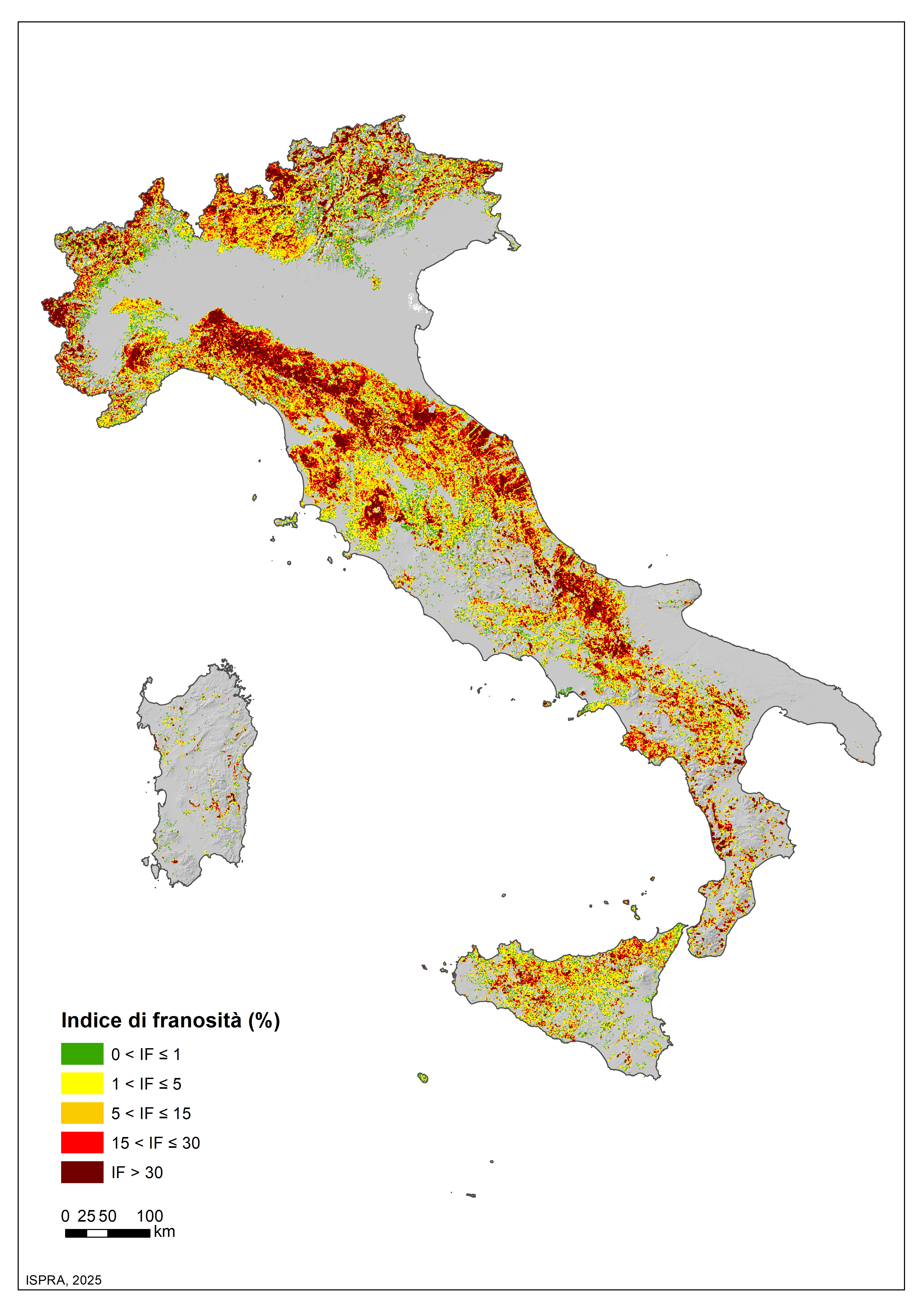
The indicator provides information on the number and distribution of landslides in Italy. More than 636,000 landslides have been recorded (reference period 1116–2025), affecting an area of over 25,100 km², equivalent to 8.3% of the national territory.
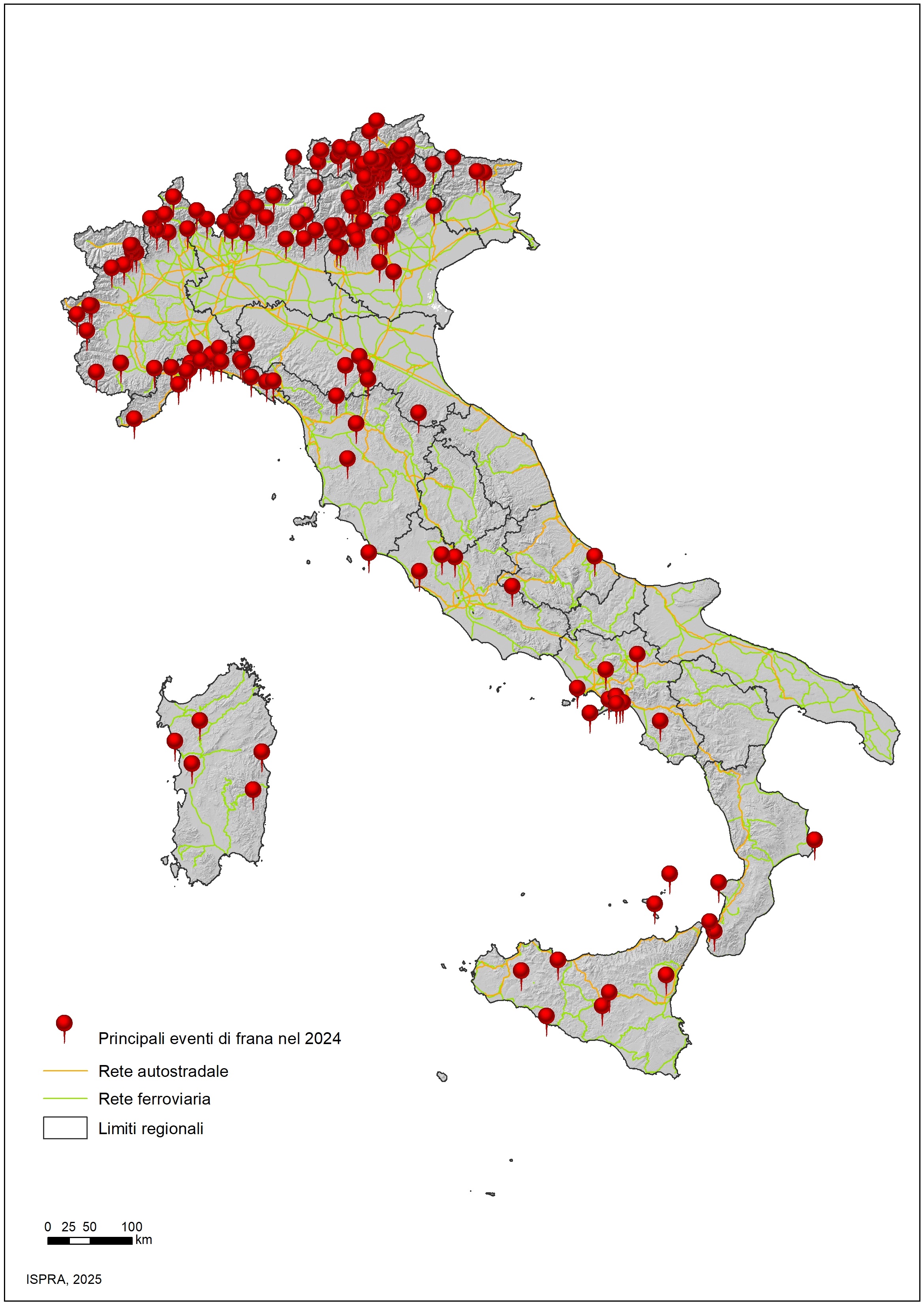
The indicator provides information on the main landslide events that caused fatalities, injuries, evacuations, and damage to buildings, cultural heritage assets, primary linear communication infrastructures, and service networks across the national territory over the past year. In 2024, there were 185 major landslide events, resulting in 5 deaths, 18 injuries, and predominantly causing damage to the road network and buildings.

The indicator is defined as the number of volcanic eruptions that produced significant impacts on human activities during the year.
In 2024, both Etna and Stromboli were active, with the most pronounced peaks occurring between July and August.

The indicator provides an estimate of the population at risk of landslides (risk of personal injury: dead, missing, injured, evacuated) on a national, regional, provincial and municipal basis. In Italy, the population at risk of landslides residing in areas with high and very high PAI danger (P3+P4) amounts to 1,284,960 inhabitants, equal to 2.2% of the total.

The indicator analyzes the distribution of large and small dams in relation to the seismic classification of the national territory (Map of seismic zones OPCM March 20, 2003, n. 3274 and subsequent integrations), the Landslide Index of the IFFI Project (Italian Landslide Inventory), and the distribution of landslide-prone areas. For the year 2024, the indicator shows that the water surface of artificial and heavily modified natural lakes (the water perimeter for large and small dams) in areas with a null Landslide Index (IF) constitutes 71.6%, while only 1.8% falls in areas with a higher IF (IF>30). In terms of seismic activity, 7.4% of large dams and 2.2% of small dams are are located in the most dangerous area (seismic zone 1), while 20.6% and 11.9%, respectively, are in the least dangerous area (seismic zone 4). Due to incomplete data on the distribution of small reservoirs at the national level, the result is considered partial.

In 2023, Italy experienced one of the hottest years in the last 150 years, second only to 2022. The average and maximum temperatures reached new records with October recording temperatures more than 3°C higher than the 1991-2021 average, marking the highest value since 1961. During the summer, intense heatwaves affected the country, with record temperatures of 48.2°C recorded on July 24 in Jerzu and Lotzorai in Sardinia, and 41.2°C in Rome in early August. Drought continued to be a significant problem, with Northern and Central Italy experiencing severe drought conditions in the first four months of the year, which later eased. However, in the last three months of the year, Sicily and parts of Ionian Calabria suffered from extreme drought with a significant precipitation deficit.
Extreme weather events affected several regions, causing severe damage. In May, Emilia-Romagna was devastated by two exceptional rainfall events, leading to flooding, landslides, and 17 fatalities. On November 2, heavy thunderstorms in Tuscany caused flooding and 8 deaths, with exceptional rainfall recorded in the provinces of Pisa, Livorno, Pistoia, and Prato.
In summary, 2023 was characterized by record temperatures, persistent drought, and extreme weather events that had a significant impact on various italian regions.

This indicator provides an overview of the population residing in flood-prone areas (population exposed to flood risk) at the national, regional, provincial, and municipal levels. In Italy, the population residing in areas with high hazard/probability is 4.1% of the total national population (2,431,847 people); those exposed to medium hazard/probability are 11.5% (6,818,375 people), while the population in areas with low hazard/probability is 20.6% (12,257,427 people).