ECOLOGICAL STATUS OF INLAND SURFACE WATERS
Data aggiornamento scheda:
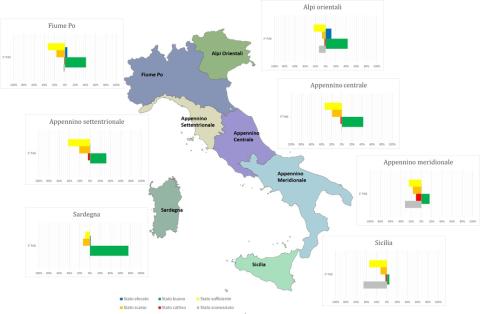
The ecological status of surface waters reflects the quality of the structure and functioning of aquatic ecosystems. Directive 2000/60/EC (transposed in Italy with Legislative Decree 152/2006) mandates the achievement of "good" quality status for water bodies, which is determined by the assessment of both ecological and chemical status. The indicator provides an evaluation of the ecological status of surface water bodies—specifically inland waters—based on classification data from the WISE 2022 Reporting related to the 3rd Water Management Plan. At the national level, comparing the ecological quality status data between the 2nd and 3rd Management Plans shows a reduction in water bodies with unknown status, from 18% to 10%, though they are still present. In general, the ecological status has not significantly changed from the previous management cycle, except for the percentage of lakes in good status, which has increased from 17% to 35%.
SOIL DEGRADATION
Data aggiornamento scheda:
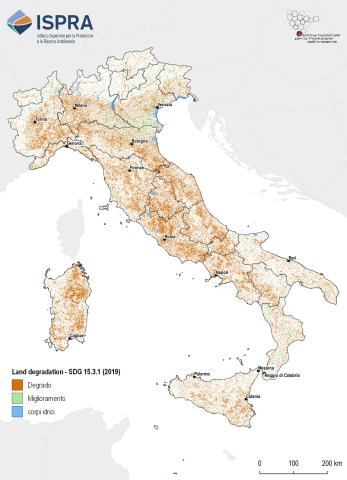
Soil degradation refers to the reduction in the biological productivity of soil resources. This process is often intrinsically linked to biodiversity loss and the impacts of climate change. Assessing soil degradation requires considering multiple interdependent factors, each contributing differently to the phenomenon.
In recent years, Italy has participated in the pilot project on Land Degradation Neutrality (LDN), promoted by the United Nations Convention to Combat Desertification (UNCCD), and in the LDN Target Setting Programme, which supports countries in identifying voluntary LDN targets and defining associated measures to achieve Sustainable Development Goal (SDG) 15.3. This goal is monitored through the "Proportion of degraded land over total land area" (SDG Indicator 15.3.1).
For the assessment of this indicator in Italy, three sub-indicators proposed by UNCCD under the LDN framework have been adopted:
- Land cover change
- Soil productivity index
- Soil organic carbon content
Additionally, further indices and parameters relevant to the Italian context and available at the national level have been considered. The results show that in 2019, the proportion of degraded land in Italy, excluding water bodies, was 17.4%, according to the UNCCD methodology. Furthermore, nearly 56,000 km² (approximately 18.5% of the national territory) experienced increased degradation between 2006 and 2019.
CHEMICAL STATUS OF TRANSITIONAL WATERS
Data aggiornamento scheda:
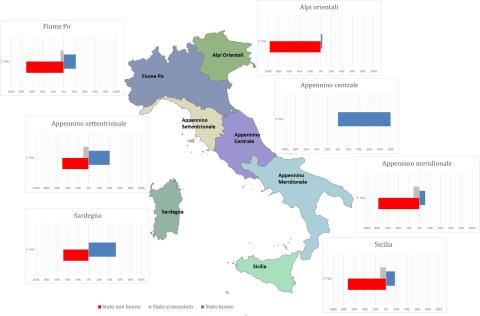
The legislation (Legislative Decree 152/2006) mandates achieving good status of water bodies (chemical + ecological) by the deadlines established by the current legislation. The analysis of chemical status shows heterogeneous values among the districts, with 100% of water bodies in good status only for the Central Apennines and 52% for Sardinia. In all other districts, the percentage of water bodies in good status never exceeds 50% and ranges from 3% in the Eastern Alps to 40% in the Northern Apennines.
A comparison between the status in the 2nd Water Management Plan (WMP) cycle and that in the 3rd cycle shows maintenance of good chemical status for 100% of the water bodies in the Central Apennines, an improvement for those in the Northern Apennines (from 30% to 40%), Sardinia (from 12% to 52%), and Sicily (from 11% to 17%), and a worsening for the water bodies in the Eastern Alps District (from 51% to 3%), Po River (from 65% to 23%), and Southern Apennines (from 18% to 11%).
At the national level, the number of water bodies in good status is 56 out of 172 (33%) in the 2nd WMP cycle, while in the 3rd cycle it is 42 out of 146 (29%).
QUANTITATIVE STATUS OF GROUNDWATER (SQUAS)
Data aggiornamento scheda:
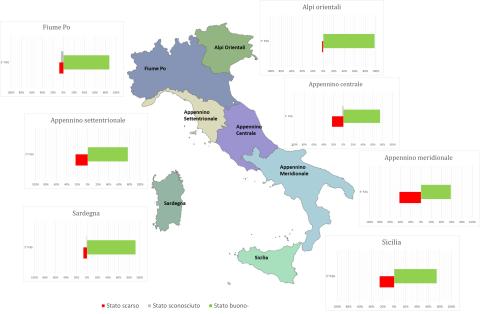
The quantitative status of groundwater describes the balance of a water body in terms of the relationship between extraction and natural replenishment of the water resource. A groundwater body is defined as being in "good quantitative status" if groundwater levels ensure that the annual average withdrawals for long-term anthropogenic activities do not exhaust the available groundwater resources, do not cause damage to surface waters and connected ecosystems, and do not lead to saline intrusion or other types of contamination.
This indicator has been derived from the classification data of water bodies in the WISE Reporting of the 3rd Water Management Plan (WMP). Nationally, during the 2016-2021 classification period under the 3rd WMP, an increase in groundwater bodies classified as being in "good quantitative status" was observed, reaching 79% of the total (compared to 61% in the 2nd WMP). The percentage of groundwater bodies in "poor" status is 19%, while 2% remain unclassified. At the district level, the percentages of water bodies achieving "good quantitative status" range from 98% in the Eastern Alps District to 58% in the Southern Apennine District.