Stefano Bataloni, Giuseppe Trinchera, Claudia Virno Lamberti, Silvia Ceracchi
Regasification terminals convert liquefied natural gas (LNG) transported by sea into natural gas (NG), which is then fed into the national distribution network. For terminals located in marine environments, seawater can be used in the regasification process because it transfers heat to the liquefied gas, bringing it back to the gaseous phase. The seawater used is subsequently discharged back into the sea after undergoing a temperature decrease (negative thermal delta) and after being treated with chlorine as an anti-fouling agent. The main environmental impact that may occur during the operation of offshore regasifiers is therefore related to the discharge of these cold, chlorinated heat-exchange waters.
In Italy, the first offshore terminals to enter operation—and for which time series data on process water are available to assess the environmental pressure exerted by these facilities—are the regasification terminals located off Porto Viro and Livorno.
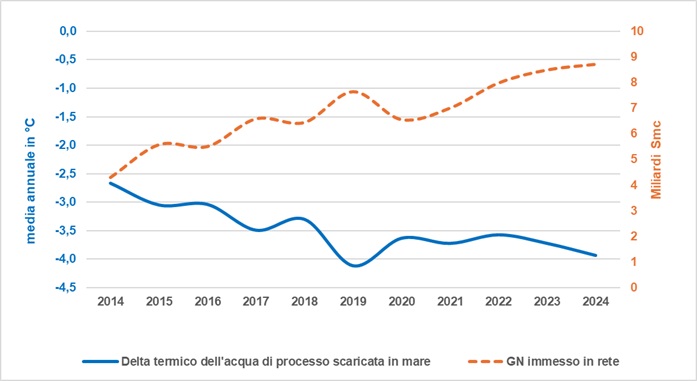
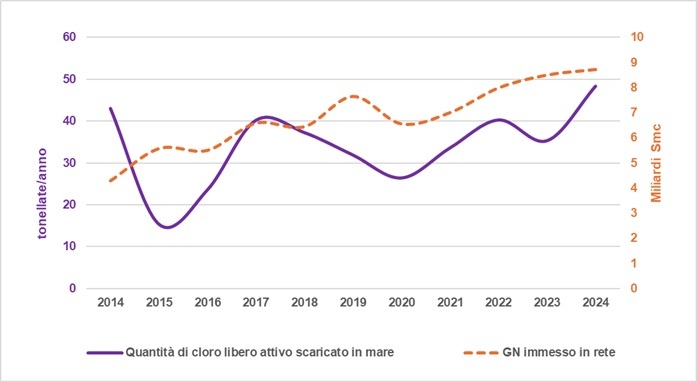
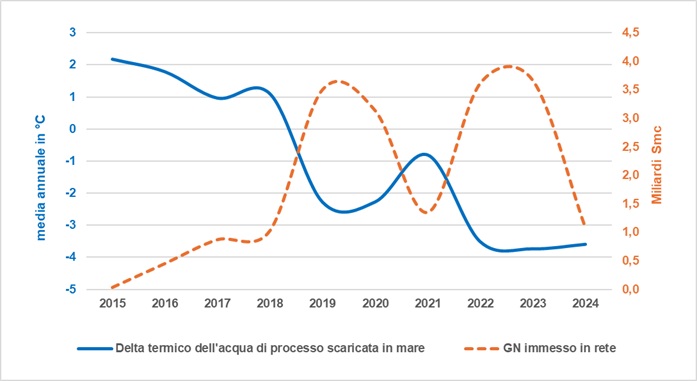
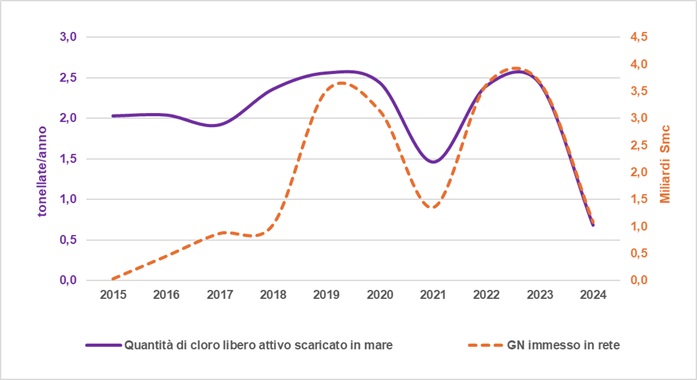
For both terminals, over the period 2014–2024, the thermal delta trend was closely correlated with the quantity of NG fed into the network, with larger absolute values and negative sign (around -4°C) in years with higher NG output, while always remaining within the limits set by the relevant authorisation decrees. The amount of chlorine contained in the process water discharged into the sea also showed good correlation with the quantity of NG fed into the network, with values between 10–50 tonnes/year for the Porto Viro terminal, with NG injected ranging between 4 and 9 billion standard cubic metres (Smc), and between 0.5–2.5 tonnes/year for the Livorno terminal, with NG injected ranging between 1 and 4 billion Smc. In both cases, chlorine releases in discharged process water always complied with the limits set by applicable legislation and operating permits.
Natural gas is one of the most widely used energy sources worldwide, and its supply—also for Italy—plays a crucial role in the energy system, ensuring a stable, secure, and efficient provision for electricity and heat production, both for domestic consumption and industrial uses. Demand for gas in Italy is covered only to a limited extent by domestic production and mostly by imports, delivered through pipelines (gaseous form) and LNG carrier ships (liquid form). Gas transported in liquid form is converted back into gaseous form through a regasification process which, in marine settings, may take place via thermal exchange with seawater; this process results in the production and subsequent discharge into the sea of cold, chlorinated waters.
In Italy, four marine regasification terminals are in operation: three are offshore facilities—the Adriatic Liquefied Natural Gas (ALNG) terminal (Gravity Based Structure, GBS) off the coast of Porto Viro (RO), the Offshore LNG Toscana (OLT) terminal (Floating Storage and Regasification Unit, FSRU) off the coast of Livorno, and the SNAM FSRU terminal off the coast of Ravenna—while the fourth terminal, also SNAM and FSRU-type, is located within the port of Piombino (LI).
Operation of these terminals is authorised through permitting decrees (Integrated Environmental Authorisation—AIA, Environmental Impact Assessment—VIA, and Single Authorisation—AU) issued under Legislative Decree No. 152/2006. These permits require specific environmental monitoring and set reference limits for the thermal delta of process water and the amount of chlorine discharged to sea. The thermal delta represents the temperature difference between seawater withdrawn from the marine environment for regasification and the water subsequently discharged back to sea; chlorine (in particular the “active” fraction, i.e. chlorine not yet chemically bound to other molecules and therefore with very high oxidising and disinfectant capacity) is added to process waters for anti-fouling purposes.
These two parameters are therefore useful indicators to describe pressures on the marine environment associated with offshore regasifier operations. For the ALNG Porto Viro and OLT Livorno terminals, sufficient data are available to assess this pressure, as the Ravenna and Piombino terminals entered operation only recently (between 2023 and 2025).
For the ALNG Porto Viro terminal, the authorisation decrees set reference limits for thermal delta and chlorine in process water at -4.6°C (annual mean) and 0.2 mg/L (three-hourly limit), respectively; for the OLT terminal, the limits are -6.0°C (hourly limit) and 3.6 tonnes/year, respectively.
Legislative Decree 152/2006, EIA authorization decrees and AIA authorization decrees.
- Linee guida SNPA 53/2024. Linee guida per la verifica degli eventuali impatti sull’ambiente marino dei terminali di rigassificazione e gasdotti di collegamento. IBN 978-88-448-1230-0, ottobre 2024.
- Virno Lamberti C., Gabellini M., Maggi C., Nonnis O., Manfra L., Ceracchi S., Trabucco B., Moltedo G., Onorati F., Franceschini G., Di Mento R., 2013. An environmental monitoring plan for the construction and operation of a marine terminal for regasifying Liquefied Natural Gas (LNG) in the North Adriatic Sea C. Book: “Mediterranean Sea: Ecosystems, Economic Importance and Environmental Threats”, Ed. Terrence B. Hughes, 2013, Nova Science Publisher, Inc.
- Virno Lamberti C., Tomassetti P., Ceracchi S. and Gabellini M, 2020. Water Column Study in the Monitoring Plan of the First Italian Offshore LNG Terminal. Int. J. Environ. Sci. Nat. Res. 2020; 26 (3): 556187. DOI:10.19080/IJESNR.2020.26.556187.
At present, the indicator does not provide information for all offshore regasification terminals in Italy, but only for those with a consolidated data base, in relation to the start of the operational phase.
With the start of the operational phase for the Piombino and Ravenna FSRU terminals, data from these energy infrastructures may also be used, expanding the spatial coverage of the indicator.
Companies that own the regasification terminals , MASE, ISPRA.
Data are held by the respective terminal operating companies, by MASE, and by ISPRA.
Regional (Adriatic Sea and Tyrrhenian Sea)
2014-2024
For each year in the period considered, starting from monthly average data provided by the terminal operating companies, annual averages of the thermal delta (expressed in °C and referred to the temperature of seawater withdrawn by the terminal) of the process waters discharged into the sea were calculated. The annual cumulative value of the quantity of NG injected into the grid (expressed in billions of Smc) and of active chlorine in the process waters (expressed in tonnes) was obtained from the companies and reported as provided.
In 2024, the Porto Viro terminal injected 8.72 billion Smc of natural gas into the grid (Table 1), a slight increase compared with the previous year. Against this, the average thermal delta of process water discharged to sea was -3.9°C, slightly lower than in 2023 and still below the reference limit. In connection with increased regasification activity over the last two years, the amount of active chlorine also rose in 2024 to 48.4 tonnes.
The Livorno terminal, by contrast, experienced a reduction in regasification activity in 2024 and therefore injected 1.08 billion Smc of natural gas into the grid (Table 2), a sharp decrease compared with the previous year; however, the average thermal delta of discharged process water was -3.6°C, essentially unchanged from 2023. The amount of active chlorine in 2024 therefore decreased to 0.7 tonnes, well below the reference limit.
The pressure exerted on the marine environment by both regasification terminals therefore remained within the limits set by the operating authorisation decrees.
Natural gas output from the Porto Viro terminal increased substantially over 2014–2024, from 4.3 to 8.72 billion Smc, despite a shutdown in 2021. Accordingly (Figure 1), the average thermal delta of process waters increased from -2.7°C to -3.9°C, while always remaining below the reference limit (-4.6°C annual mean). The quantity of chlorine discharged to sea (Figure 2), after a sharp reduction from 43 tonnes in 2014 to 15.4 tonnes in 2015, then increased—despite some fluctuations—in parallel with NG injected into the grid, reaching a maximum in 2024 of 48.4 tonnes.
For the Livorno terminal, NG output increased slightly in the early operating period (2015–2018), then rose markedly in 2019 to 3.51 billion Smc, decreasing to 3.14 in 2020. In 2021, activities declined, then output reached a maximum in 2023 of 3.67 billion Smc, followed by a further decrease in 2024 (in conjunction with an extraordinary shutdown for maintenance of the FSRU mooring system). The thermal delta of discharged waters (Figure 3) followed the NG output trend, with positive annual mean values in 2015–2018 (between 1 and 2.2°C) and negative annual mean values from 2019 onwards. The minimum value (-3.7°C) occurred in 2023, corresponding to the peak NG injection. The amount of active chlorine released to sea (Figure 4) also followed NG output—except in the initial operating phase—reaching a maximum in 2019 of 2.6 tonnes, which is below the reference limit (3.6 tonnes/year).
Overall, the trend of pressure exerted on the marine environment by both regasification terminals remained stable and within the limits set by operating authorisation decrees.
| Data |
|---|
Headline
Table 1: Volumes of NG injected into the network, thermal delta and active chlorine in the process water discharged into the sea from the ALNG regasification terminal in Porto Viro (RO) Data source
ALNG data |
Headline
Table 2: Volumes of NG injected into the network, thermal delta and active chlorine in the process water discharged into the sea from the OLT regasification terminal in Livorno Data source
OLT data |
Headline
Figura 3: GN immesso in rete e delta termico dell'acqua di processo scaricata in mare (OLT Livorno) Data source
Elaborazione su dati OLT |
Thumbnail
Headline
Figure 1: NG injected into the network and thermal delta of the process water discharged into the sea (ALNG Porto Viro) Data source
ISPRA processing on ALNG data |
Thumbnail
Headline
Figure 2: NG injected into the network and active chlorine in the process water discharged into the sea (ALNG Porto Viro) Data source
ISPRA processing on ALNG data |
Thumbnail
Headline
Figure 3: NG fed into the network and thermal delta of the process water discharged into the sea (OLT Livorno) Data source
ISPRA processing on OLT data |
Thumbnail
Headline
Figure 4: NG injected into the network and active chlorine in the process water discharged into the sea (OLT Livorno) Data source
ISPRA processing on OLT data |
For both regasification terminals, an increase in NG injected into the grid corresponds to a lower (more negative) average thermal delta of discharged heat-exchange waters, and to an increase—though with some fluctuations—in the quantity of chlorine released to sea.
The general reduction in NG consumption linked to the Covid-19 emergency in 2021 caused, for both infrastructures, a drop in NG output and consequently in thermal delta and the amount of chlorine discharged to sea.
In 2024, the substantial decrease in NG production for OLT is linked to extraordinary maintenance that made the terminal non-operational from 22/02/2024 to 24/11/2024. For the same installation, similarly limited NG production is observed in 2014 due to lower gas demand from the National Gas Pipeline Network during that period.
It should be noted that the thermal delta of discharged process waters may also be influenced by interannual variability in the temperature of seawater withdrawn for heat exchange with LNG; from an environmental standpoint, the “cold” discharge may generate a cold plume with potential effects on marine life.
Regarding chlorine in discharged heat-exchange waters, it should be recalled that in its “active” form chlorine is extremely reactive and unstable, readily reacting with organic matter to form organo-halogen by-products, which are toxic to marine organisms and persistent in marine ecosystems.
Both parameters of discharged process waters are continuously monitored by terminal operating companies to ensure that environmental pressure remains within legal limits, irrespective of annual fluctuations; Legislative Decree No. 152/2006 and the authorisation decrees set hourly or three-hourly limits for these parameters, and the companies state that these limits are never exceeded.
Overall, for both terminals and for the period analysed, the pressure exerted on the marine environment by regasification activities remains within the limits set by the issued environmental authorisations.
From a technical-methodological perspective, the National System for Environmental Protection (SNPA) developed and approved the Guidelines for verifying potential impacts on the marine environment of regasification terminals and connecting pipelines (SNPA 53/2024), defining principles used by ISPRA and regional agencies when assessing potential impacts related to the construction and operation of LNG regasification terminals and connecting pipelines. These guidelines, in addition to identifying parameters to be monitored (e.g., physical, chemical, and biological parameters), also define methods, frequencies, and sampling locations, to ensure coherent and comparable data analysis and accurate assessment of environmental effects of regasification activities.