UN - SDG Goals
Goal 14: Life below water
Conservare e utilizzare in modo durevole gli oceani, i mari e le risorse marine per uno sviluppo sostenibile.

The quality of bathing water is essential for safeguarding the health of citizens and also plays an important role in protecting the natural environment and the economic aspects of the tourism sector. For this reason, specific monitoring is carried out throughout the bathing season. For the 2025 bathing season, over 36,505 sea and lake water samples were collected and analyzed from a total of over 6,900 km of bathing coastline. A total of 5,535 sampling points, representative of an entire bathing area, were collected. The monitoring results guarantee the suitability of the water for bathing during the season and are used at the end of the season to classify the water. The classification was based on the results of the monitoring conducted during the 2025 bathing season and those of the three previous seasons (2022, 2023, and 2024). At the national level, most waters are classified as excellent (90%), however, critical issues remain due to the presence of waters classified as poor (1%) and unclassifiable (1%), for which it is not possible to express a quality assessment. At the regional level, the percentage of waters classified as excellent is the highest, exceeding 90% in 10 regions.
The indicator estimates the scale of national aquaculture in terms of the number of active facilities, production volumes, and growth trends, with reference to the objectives set out in the 2021–2027 Strategic Plan for Aquaculture and in the Operational Programme of the European Maritime, Fisheries and Aquaculture Fund (EMFAF) 2021–2027. Italian aquaculture production recorded for 2023 amounts to 129,746 tonnes, of which 61% consists of molluscs and 39% of fish. Crustacean farming remains a marginal sector, with a production of only 5.4 tonnes. Exotic species account for 45% of total national production.
In 2023, Veneto remains the leading Italian region in terms of number of facilities (23%), while Emilia-Romagna ranks first for production volumes (25%). Five regions (Veneto, Emilia-Romagna, Friuli Venezia Giulia, Sardinia, and Apulia) host 68% of aquaculture facilities. Emilia-Romagna, Veneto, and Friuli Venezia Giulia are confirmed as the main production hubs and, together with Marche and Tuscany, account for 68% of national output. In most coastal regions, brackish/saline water resources prevail, with facilities located in transitional, coastal, and marine environments.
Any solid material, manufactured or transformed by man, abandoned or lost in the marine and coastal environment, or which reaches the sea in any way, is defined as marine waste. Italy, with Legislative Decree no. 190/2010 transposing the Framework Directive on the Strategy for the Marine Environment, has been carrying out an intense monitoring program of marine waste since 2015, including beached waste. Twice a year, in spring and autumn, the coastal Regional Environmental Protection Agencies (ARPA) carry out solid waste monitoring in the sample areas of 69 reference beaches along the national coast. To evaluate the degree of beach cleanliness based on the density of waste in the monitored sample areas, the Clean Coast Index (CCI), an indicator developed and applied internationally, was calculated.
In 2024, the CCI was calculated for 66 beaches in spring and 69 in autumn. In spring, 80% of the beaches monitored were clean or very clean, compared to 8% dirty or very dirty. In autumn, 81% of beaches were clean or very clean, while 9% were dirty or very dirty. The rest of the beaches were quite clean. Compared to the previous year, the percentage of clean or very clean beaches increased in autumn (77% in 2023), while in spring it remained almost unchanged. In both spring and autumn there was a decrease in dirty and very dirty beaches, from 12% to 8% and from 12% to 9%, respectively.
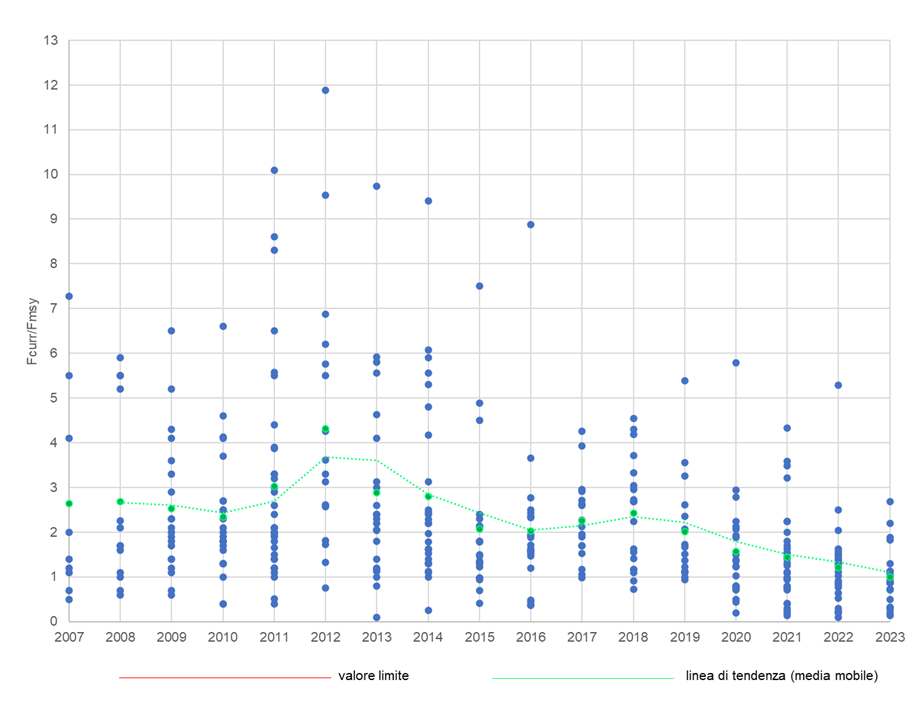
During the period considered (2007–2023), the average exploitation rate of fish stocks — expressed as the mean ratio between current fishing mortality and that corresponding to the Maximum Sustainable Yield (Fcurr/FMSY) — remained generally above the sustainability threshold.
The indicator, derived from analytical stock assessments validated at the international level, describes the overall trend in fishing pressure exerted on commercially exploited stocks.
Within the time series, 2023 stands out as the only year in which the Fcurr/FMSY value fell below the threshold of 1 (0.99), confirming the progressive downward trend observed in recent years for this indicator.
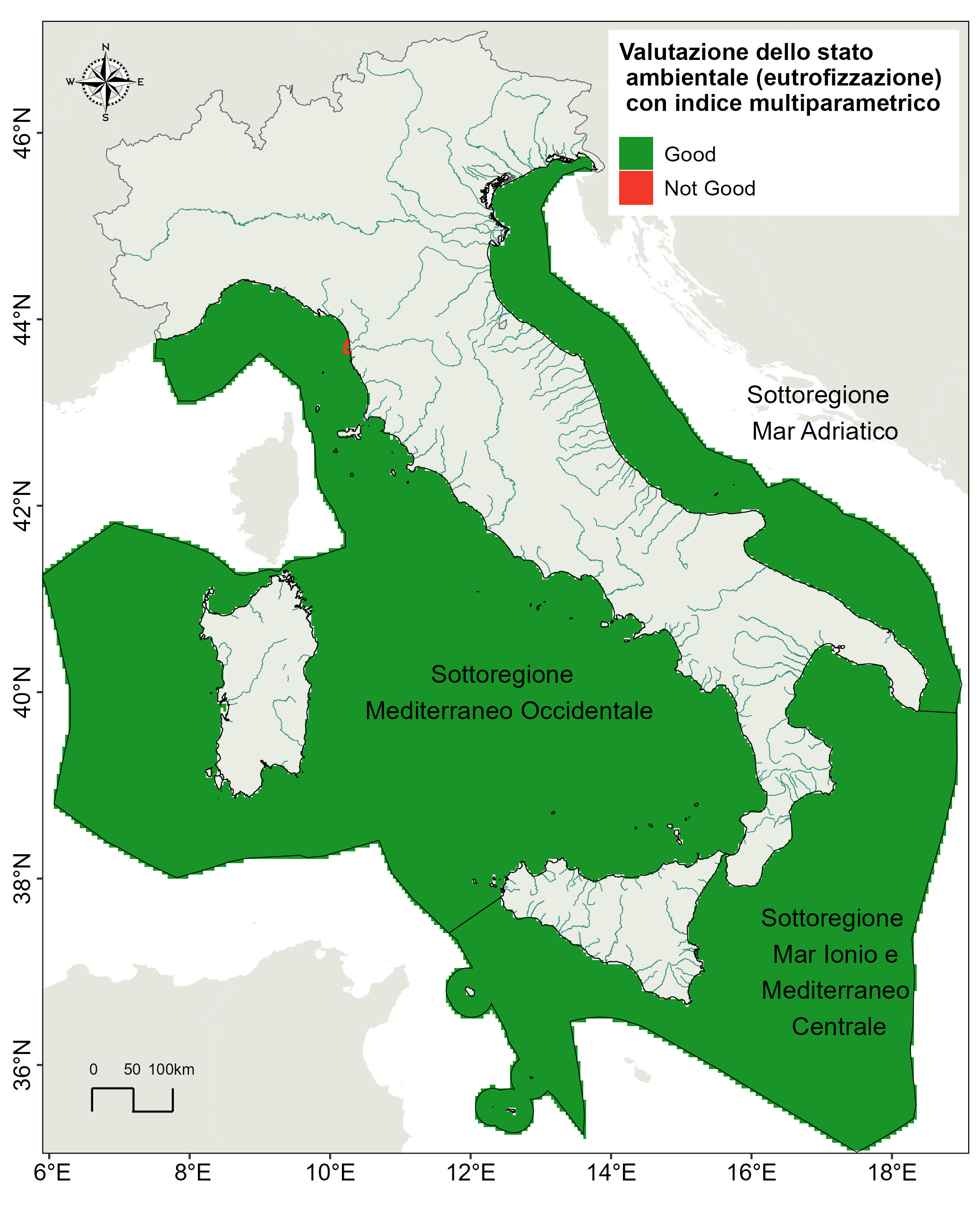
Eutrophication is a process caused by the enrichment of nutrients, in particular nitrogen and phosphorus compounds, which determines an increase in primary production and algal biomass with consequent alteration of benthic communities and, in general, a decrease in water quality. The release of nitrogen and phosphorus into the marine and coastal environment can derive from diffuse sources (river loads, main collectors of agricultural activities and civil discharges) and from point sources (discharges deriving from wastewater treatment plants, industrial and deriving from aquaculture activities).
The assessment of eutrophication of marine waters according to the Marine Strategy is carried out every six years using a combination of information on nutrient levels (concentrations in the marine environment), the primary effects of nutrient enrichment (chlorophyll 'a' concentration as an indicator of algal biomass) and the secondary effects of nutrient enrichment (impacts on organisms caused by hypoxia and/or anoxia phenomena in bottom waters) that are ecologically relevant.
The most recent assessment transmitted by Italy to the European Commission (October 2024) refers to the six-year period 2016-2021 and highlighted the achievement of Good Environmental Status. The analysis of 2022 monitoring data confirms this indication.
Since 2015, Italy, in implementation of the Marine Strategy Framework Directive (2008/56/EC), has implemented an extensive marine litter monitoring program, including microlitter present in the surface layer of the water column. The activity is conducted by the National System for Environmental Protection (SNPA), with the coordination of the Ministry of the Environment and Energy Security (MASE). Microwaste, particles of anthropic origin smaller than 5 mm, derive from both primary sources (industrial pellets, cosmetic microgranules, abrasives) and secondary sources (fragmentation of macrowaste). Their composition, quantity and distribution constitute a key parameter for assessing the good environmental status of marine waters. The processing of data collected from 2015 to 2024 highlights a stable median density of 0.04 microparticles/m² (approximately 40,000 microparticles/km²), with interannual and spatial variations linked to the different hydrodynamic conditions and anthropic pressures of the Italian marine subregions. In 2024 there is an increase in concentrations in the Adriatic Sea and a decrease in the Ionian Sea and the western Mediterranean. At Mediterranean level, the Barcelona Convention has defined a threshold value of 0.000845 microparticles/m² (845 microparticles/km²) for achieving good environmental status: the values found in Italian seas, although stable in recent years, are still significantly higher.
The Marine Strategy (Directive 2008/56/EC) represents an important governance tool for the sea system, promoting the adoption of strategies aimed at safeguarding the marine ecosystem aimed at achieving Good Environmental Status. Good Environmental Status is assessed on the basis of 11 qualitative descriptors and, among these, Descriptor 10 provides that the properties and quantities of marine waste do not cause damage to the coastal and marine environment. Since 2015, Italy has been implementing an extensive monitoring program for marine litter, including beached macro-litter. In 2024, the median of total marine waste stranded on Italian coasts was equal to 252 waste per 100 m, a value similar to that of the previous year (250 waste per 100 m). This is a density that confirms the decreasing trend of beached waste since monitoring was carried out, although still significantly higher than the threshold value of 20 waste per 100 m, established at European level as a requirement for achieving Good Environmental Status. As in previous years, single-use plastics are the most common beached waste, representing approximately 28% of the total, followed by smoking-related waste (mainly cigarette butts), equal to 9% of the waste recorded along the Italian coasts.
The indicator provides an estimate of the input and removal of nitrogen and phosphorus, respectively produced by farmed fish and cultivated mussels, in the coastal marine environment where aquaculture activities take place.
The balance between nutrient inputs from farmed fish and nutrient removal by molluscs allows the estimation, at the regional scale, of the net quantitative contribution of aquaculture to trophic processes along the Italian coastline.
At the national level, compared with the 2021–2022 biennium, 2023 shows a reduction in nitrogen and phosphorus inputs, but also a decrease in the removal of these nutrients due to a decline in the production of both marine fish and farmed mussels.
At the regional level, in Veneto, Emilia-Romagna, Abruzzo, Molise and Marche, nitrogen and phosphorus removal by mussels exceeds nutrient inputs from fish farming, owing to the presence of numerous mussel farming facilities and the absence of intensive fish farming activities.
Over the period considered (2007–2023), the status of assessed fish stocks has shown an overall improvement: the proportion of nationally managed stocks subject to overfishing has declined, reaching its lowest level (44.4%) in 2023. Although fishing mortality remains critical in several cases, it has exhibited a downward trend in recent years, progressively approaching levels compatible with the long-term sustainable exploitation of resources under average environmental conditions.
The indicator, based on analytically assessed stocks validated at the international level, reflects the overall dynamics of the exploitation status of commercially fished stocks, highlighting the gradual improvement of exploited marine resources. It is also associated with the percentage coverage of landings for which stock assessment data are available, with analyses conducted at both the national and subregional levels according to the geographic subdivision established by the Marine Strategy Framework Directive.

Coastal marine waters are “surface waters located inside an imaginary line, every point of which is one nautical mile seaward from the nearest point of the baseline used to determine the limit of territorial waters, and which may extend up to the outer limit of transitional waters” (Paragraph 1 of Article 74 of Legislative Decree 152/2006). The legislation (Legislative Decree 152/2006) mandates the achievement of a “good” status of water bodies (chemical + ecological) by the dates set by current legislation; failure to achieve environmental objectives results in the implementation of remediation measures. Based on the analysis of data reported by the Districts in the 3rd Reporting to the European Commission for the 2016–2021 six-year period (3rd RBMP), the chemical status of Italian coastal marine waters appears heterogeneous. This heterogeneity is evident both in terms of the number of water bodies identified per district and their classification. The Eastern Alps and Po River Districts have all water bodies in a “not good” chemical status, while in Sicily and the Southern Apennines District, over 60% of the water bodies are in a “not good” status. The Northern Apennines, Central Apennines, and Sardinia Districts, instead, register more than 50%, more than 90%, and more than 80%, respectively, in a “good” chemical status. At the national level, 51% of coastal marine water bodies are in good chemical status. Comparing the 2nd and 3rd RBMPs, in the 2nd RBMP, water bodies with unknown chemical status amounted to 26% (147 out of 561), whereas in the 3rd RBMP, only one water body has an unknown status. Generally, water bodies in good chemical status are comparable between the two RBMPs—52% and 51%, respectively—while water bodies in not good chemical status increased in the 3rd RBMP (49%).
Coastal marine waters are defined as “surface waters situated inside an imaginary line one nautical mile away, at every point, on the outer side from the nearest point of the baseline used to define the territorial sea limit, and potentially extending to the outer boundary of transitional waters.” The legislation (Legislative Decree 152/2006) mandates achieving "good" status (ecological + chemical) for water bodies by the deadlines set by current regulations; failure to meet environmental goals entails remediation measures. Based on the analysis of data reported by Districts in the 3rd Reporting to the European Commission for the six-year period 2016–2021 (3rd WMP), the ecological status of Italian coastal marine waters is heterogeneous. This heterogeneity is expressed in both the number of water bodies identified per district and their ecological classification. The Eastern Alps, Northern Apennines, Central Apennines, Sicily, and Sardinia Districts show a percentage of water bodies in good and high ecological status greater than or equal to 70%. Specifically, in the Sardinia District, more than 40% of water bodies are in high status. Nationally, more than 60% of water bodies (261 out of 394 total) are in good and high ecological status. Comparing data from the 2nd WMP and the 3rd WMP shows that in the 2nd WMP, 27% of water bodies had unknown ecological status (149 out of 561 total), while in the 3rd WMP, only one water body is in unknown ecological status. In general terms, the proportion of water bodies in good and high ecological status increased from 55% in the 2nd WMP to 66% in the 3rd WMP.