Valeria Donadelli, Stefania Chiesa
The indicator estimates the scale of national aquaculture in terms of the number of active facilities, production volumes, and growth trends, with reference to the objectives set out in the 2021–2027 Strategic Plan for Aquaculture and in the Operational Programme of the European Maritime, Fisheries and Aquaculture Fund (EMFAF) 2021–2027. Italian aquaculture production recorded for 2023 amounts to 129,746 tonnes, of which 61% consists of molluscs and 39% of fish. Crustacean farming remains a marginal sector, with a production of only 5.4 tonnes. Exotic species account for 45% of total national production.
In 2023, Veneto remains the leading Italian region in terms of number of facilities (23%), while Emilia-Romagna ranks first for production volumes (25%). Five regions (Veneto, Emilia-Romagna, Friuli Venezia Giulia, Sardinia, and Apulia) host 68% of aquaculture facilities. Emilia-Romagna, Veneto, and Friuli Venezia Giulia are confirmed as the main production hubs and, together with Marche and Tuscany, account for 68% of national output. In most coastal regions, brackish/saline water resources prevail, with facilities located in transitional, coastal, and marine environments.
The indicator estimates the scale of national aquaculture in terms of the number of active facilities and production from fish farming, mollusc farming, and crustacean farming. It considers total production for the main species and for exotic species farmed in aquaculture. Production is also analysed in relation to the water resource used for farming (freshwater or saline/brackish water). The indicator is developed on the basis of data collected by the Ministry of Agriculture, Food Sovereignty and Forests (MASAF) pursuant to Regulation (EC) No 762/2008 on the collection and annual transmission of aquaculture statistics by Member States (EUROSTAT).
To provide up-to-date data and historical series on the scale and status of aquaculture in Italy in order to assess development trends and progress towards sector growth objectives, as defined in the 2021–2027 Strategic Plan for Aquaculture (SPA, MiPAAF 2021) and in the Operational Programme (OP) of the European Maritime, Fisheries and Aquaculture Fund (EMFAF) 2021–2027 (EC Decision C(2022) 8023), and to estimate potential environmental impacts.
European objectives for growth and sustainable development are set out in the Common Fisheries Policy (Regulation (EU) No 1380/2013, CFP) and aim to promote growth and increase aquaculture production in Member States, strengthen sector competitiveness through innovation, ensure long-term environmental sustainability, reduce European dependence on imports of fishery products, and foster aquaculture development in coastal and rural areas.
At national level, aquaculture growth objectives are defined in the National Strategic Plans for Aquaculture (SPA), drawn up pursuant to Article 34 of the CFP. Current objectives are outlined in the 2021–2027 SPA and implemented through the Operational Programme of the European Maritime, Fisheries and Aquaculture Fund (EMFAF, Regulation (EU) No 1139/2021), approved by the European Commission with Decision C(2022) 8023 final and updated in 2024 (Decision C(2024) 3582 final).
Aquaculture is specifically supported under Priority 2 of the EMFAF OP through, inter alia, simplification of administrative procedures, planning and management of marine space, and decarbonisation of aquaculture activities (for example, promotion of low-impact aquaculture activities such as mollusc farming).
The indicator is increasingly relevant in relation to new blue growth strategies set out in European Commission communications: Strategic guidelines for a more sustainable and competitive EU aquaculture for the period 2021–2030 (COM/2021/236), A new approach for a sustainable blue economy in the EU (COM/2021/240), and strategies for energy transition and sustainable development (Green Deal, 2019; Farm to Fork Strategy COM/2020/381; Food 2030 Pathways for Action 2.0), which align with UN Agenda 2030 Goal 2 (“Zero Hunger”), with a specific focus on innovation.
Aquaculture makes use of exotic species that contribute to diversification of national production. The use of exotic and locally absent species in aquaculture is regulated at EU level by Regulations (EC) Nos 708/2007, 535/2008, 506/2008, (EU) No 304/2011, together with Regulation (EU) No 1143/2014 on the prevention and management of the introduction and spread of invasive alien species.
Pursuant to Regulations (EC) Nos 708/2007 and 535/2008, which require the establishment of a register of exotic and locally absent species, Italy has activated the Aquaculture Alien Species Register (Registro Acquacoltura Specie Aliene – https://www.registro-asa.it/) through the competent authority (MASAF). The register is managed and implemented by ISPRA and allows operators to apply for the introduction of exotic and locally absent species for aquaculture purposes. The Aquaculture Exotic Species Committee, established by MASAF under Ministerial Decree No 0148431 of 01/04/2025, issues opinions on applications for the introduction of exotic species on the basis of Environmental Risk Assessment (ERA), pursuant to Article 9 and Annex II.
Exotic (non-indigenous) species are also addressed under Descriptor 2 of the Marine Strategy Framework Directive (Directive 2008/56/EC), which, among the new criteria and methodologies for assessing Good Environmental Status (GES) and environmental targets, identifies introduction pathways such as aquaculture as major factors (Decision (EU) 2017/848; Ministerial Decree MATTM of 15 February 2019).
Chiesa S., Petochi T., Boscolo Brusà R., Raicevich S., Cacciatore F., Franceschini F., Antonini C., Vallini C., Bernarello V., Oselladore F., Ciani M., Di Blasio L., Campolunghi M. P., Baldessin F., Boldrin L., Marino G. 2025. Impacts of the blue crab invasion on Manila clam aquaculture in Po Delta coastal lagoons (Northern Adriatic Sea, Italy). Estuarine Coastal and Shelf Science 312, 109037. https://doi. org/10.1016/j. ecss.2024.109037
European Commission: Directorate-General for Research and Innovation, Food 2030 – Pathways for action 2.0 – R&I policy as a driver for sustainable, healthy, climate resilient and inclusive food systems, Publications Office of the European Union, 2023, https://data. europa. eu/doi/10.2777/365011
FAO. 2024. The State of World Fisheries and Aquaculture. 2024 - Blue transformation in action. Rome. https://doi. org/10.4060/cd0683en
ISPRA, various years, Environmental data yearbook
-
Implement digital and innovative systems for the transmission of production data from enterprises to competent authorities, reducing resource use and improving the reliability of data collected for technical–production aquaculture statistics.
Strengthen monitoring activities related to the introduction of exotic species for aquaculture purposes, one of the main introduction pathways in Europe and globally, and develop a traceability system for the movement of bivalve molluscs.
EUROSTAT (Statistical Office of the European Communities)
MASAF (Ministry of Agriculture, Food Sovereignty and Forestry)
The indicator uses MASAF data surveyed pursuant to Regulation (EC) no. 762/2008, and data published by the Statistical Office of the European Union (Eurostat)
National, Regional (20/20)
1994-2023
Data collection for 2023 (Regulation (EC) No 762/2008) used the enterprise as the reference unit, defined as a legal entity duly registered with the Chamber of Commerce, Industry, Crafts and Agriculture, and the facility as the unit of analysis, i.e. the production unit belonging to an enterprise. Each enterprise may consist of one or more facilities. Production trends for the period 1994–2020 were developed using data collected for MiPAAF by ICRAM (1994–2002), Idroconsult (2002–2006), UNIMAR (2007–2014), GRAIA (2015–2016), and CREA (2017–2023). For the years 2015–2018, ISPRA revised data collected by GRAIA and CREA, integrating information provided by national producer associations API and AMA. Production volumes (t) are reported by production type (fish farming, mollusc farming, crustacean farming) and by region; production volumes (t) for the main farmed species; production volumes (t) of exotic species; and the number of active facilities by type of water resource (freshwater or marine/brackish) and by region.
National aquaculture production recorded for 2023 amounts to 129,746 tonnes (t), including 79,160 t of molluscs (61%), 50,553 t of fish (39%), and 5.4 t of crustaceans, with an overall value of EUR 618 million. In 2023, a small production of algae (27.5 t) was also recorded.
In 2023, mollusc farming remained the most significant production segment of Italian aquaculture, with an output of 79,160 tonnes and a total value of EUR 286 million.
Freshwater fish farming ranked second, with a production of 37,304 t (28.8% of national output), while marine fish farming produced 13,249 tonnes, 93% of which consisted of European seabass (Dicentrarchus labrax) and gilthead seabream (Sparus aurata).
Crustacean farming remained marginal, with a production of 5.4 tonnes in 2023, attributable solely to the common prawn (Palaemon serratus).
In 2023, microalgae (27.5 t), mainly Spirulina, were produced, primarily for the nutraceutical market.
A total of 656 facilities were recorded in 2023. Of these, 47% were dedicated to fish farming, 52% to mollusc farming, and only three facilities farmed crustaceans. More than 60% of national production is concentrated in Northern Italy, both in terms of facilities (66%) and production volume (63%).
Exotic species are commonly used in aquaculture and represent an important source of diversification and growth for the sector. In 2023, 58,597 tonnes of exotic species were produced, accounting for 45% of national output. Production is largely based on two species: rainbow trout (Oncorhynchus mykiss, 34,143 t) and Manila clam (Ruditapes philippinarum, 21,547 t).
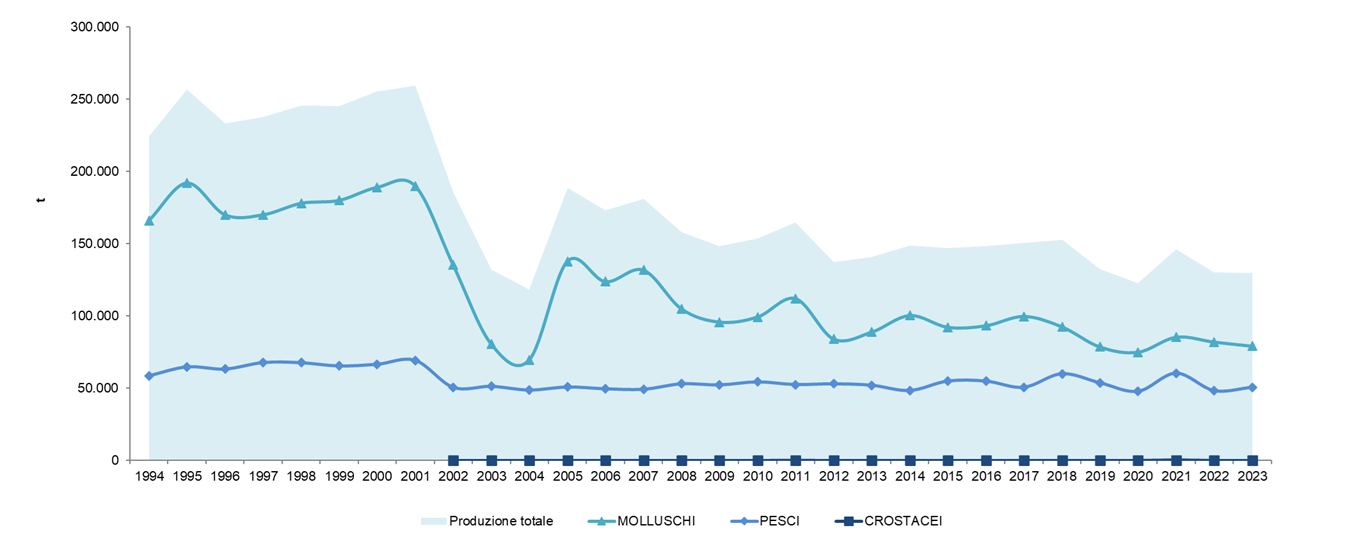
The trend of Italian aquaculture is negative compared to 2019 (-2%) and 2021 (-11%) (Figure 3): in particular, in the last three years the decline has affected all production sectors and main productions without distinction (mollusc farming, freshwater and marine fish farming).
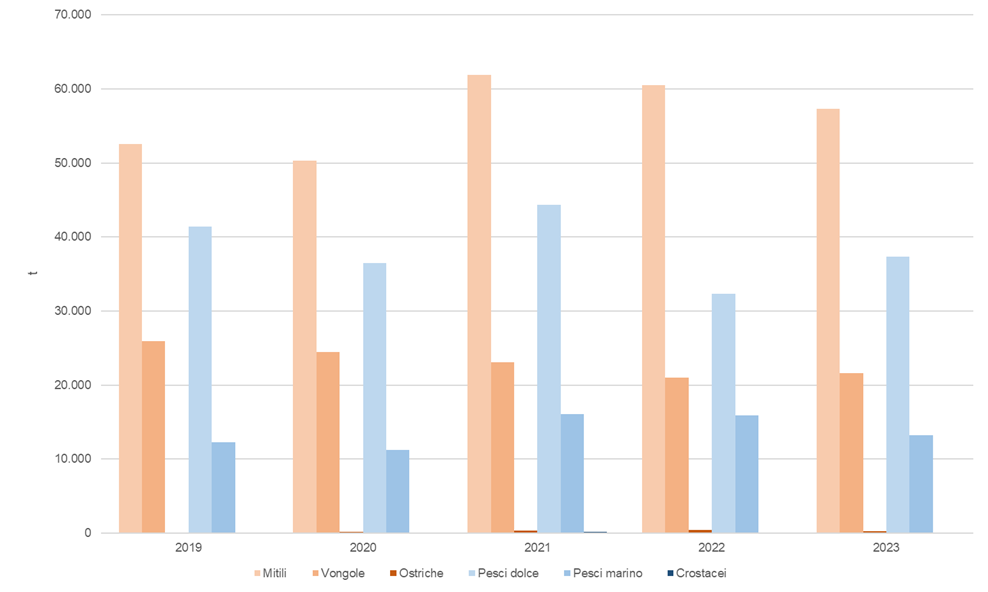
Marine fish farming recorded a growth of 8% compared to 2019 and a decrease of 17% compared to 2021 (Figure 4). The freshwater sector shows an overall negative trend (-10% compared to 2019 and -16% compared to 2021).
The sector is still affected by problems linked to the difficulties in issuing new state concessions to be allocated to aquaculture for marine fish farming and the difficulties associated with the water crisis linked to climate change and the new water protection plans for freshwater fish farming.
Shellfish farming was the sector with the most fluctuating performance. In 2023, production grew by 0.7% compared to 2019, thanks to greater mussel production, while it decreased by 7.3% compared to 2021, in contrast to what was expected. The decline is driven in particular by the clam crisis, whose production is progressively decreasing: -4,378 t compared to 2019 and -1,505 t compared to 2021. The crisis in the sector is related to three main factors: i) the increase in temperature and extreme marine weather events linked to climate change; ii) the reduction of environmental quality in shellfish farming areas, due to anthropic impacts (e. g. Microbiological contamination) and climatic events (e. g. Algal blooms); iii) the bureaucratic-administrative difficulties in issuing/renewing maritime state concessions.
Another factor of recent onset, decisive for the crisis of the sector, is represented by the emergency due to the invasion of the blue crab ( Callinectes sapidus ), which exploded in the summer of 2023. This non-native and invasive species is having a devastating impact on clam farming in Italy, especially in the lagoon areas of the Upper Adriatic, Veneto and Emilia-Romagna, the main production centers for shellfish farming (Chiesa et al., 2025). Although in 2023 the collapse in production was contained thanks to the massive harvesting of current production, the forecasts for 2024 are instead negative, due to the almost total predation of clam seed that occurred in 2023, which compromised the entire production cycle for the following year.
As regards the value of aquaculture production, which in 2023 exceeded 600 million euros, it is increasing compared to both 2019 (+38%) and 2023 (+13%), despite the decline in production. The reduction in the number of plants from around 800 registered in 2014 to the current 656 is a consequence of the reorganization adopted by companies and the closure of some plants.
The historical production series shows a decrease in production capacity for the fish farming sector after 2001, attributable to a reduction in the number of plants and intensive eel production and to a significant decrease in traditional extensive valley production of sea bass, sea bream and eel ( Eel eel ) and mullet not compensated by other innovative systems and productions.
The production of exotic species reflects the negative trend of Italian aquaculture. Production volume decreased by 12% compared to both 2019 and 2021.
| Data |
|---|
Headline
Table 1: Italian aquaculture in numbers: number of facilities, production, and main species farmed in 2023 Data source
ISPRA processing of MASAF-CREA and EUROSTAT data Note
In the breakdown by sector, farms that breed both shellfish and fish were counted twice. |
Headline
Table 2: Production (t) of exotic species (2023) Data source
ISPRA processing of MASAF-CREA and EUROSTAT data Data legend
Symbol “*” for species not subject to derogation pursuant to Regulation (EC) No. 708/2007, Annex IV, Part A. |
Thumbnail
Headline
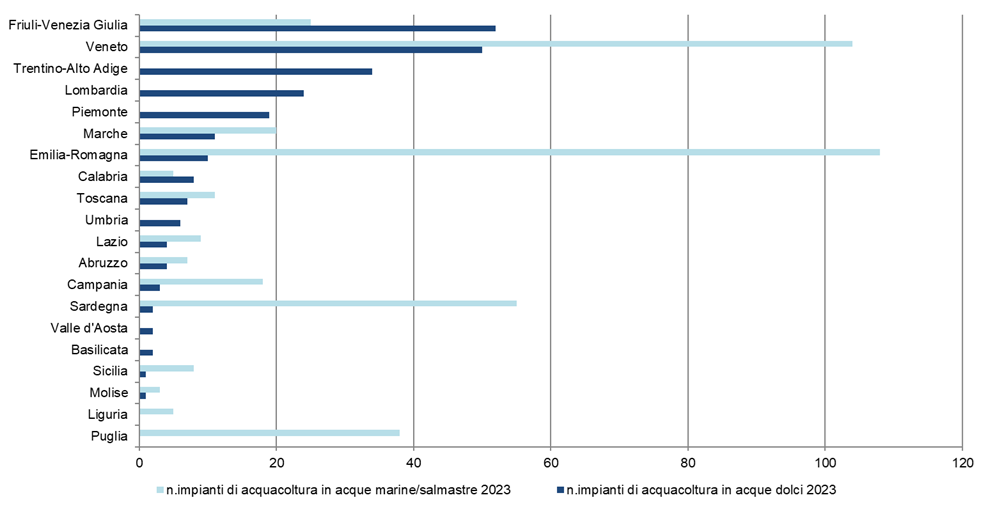
Figure 1: Number of aquaculture facilities in freshwater and brackish/marine waters (2023) Data source
ISPRA elaboration based on MASAF–CREA data |
Thumbnail
Headline
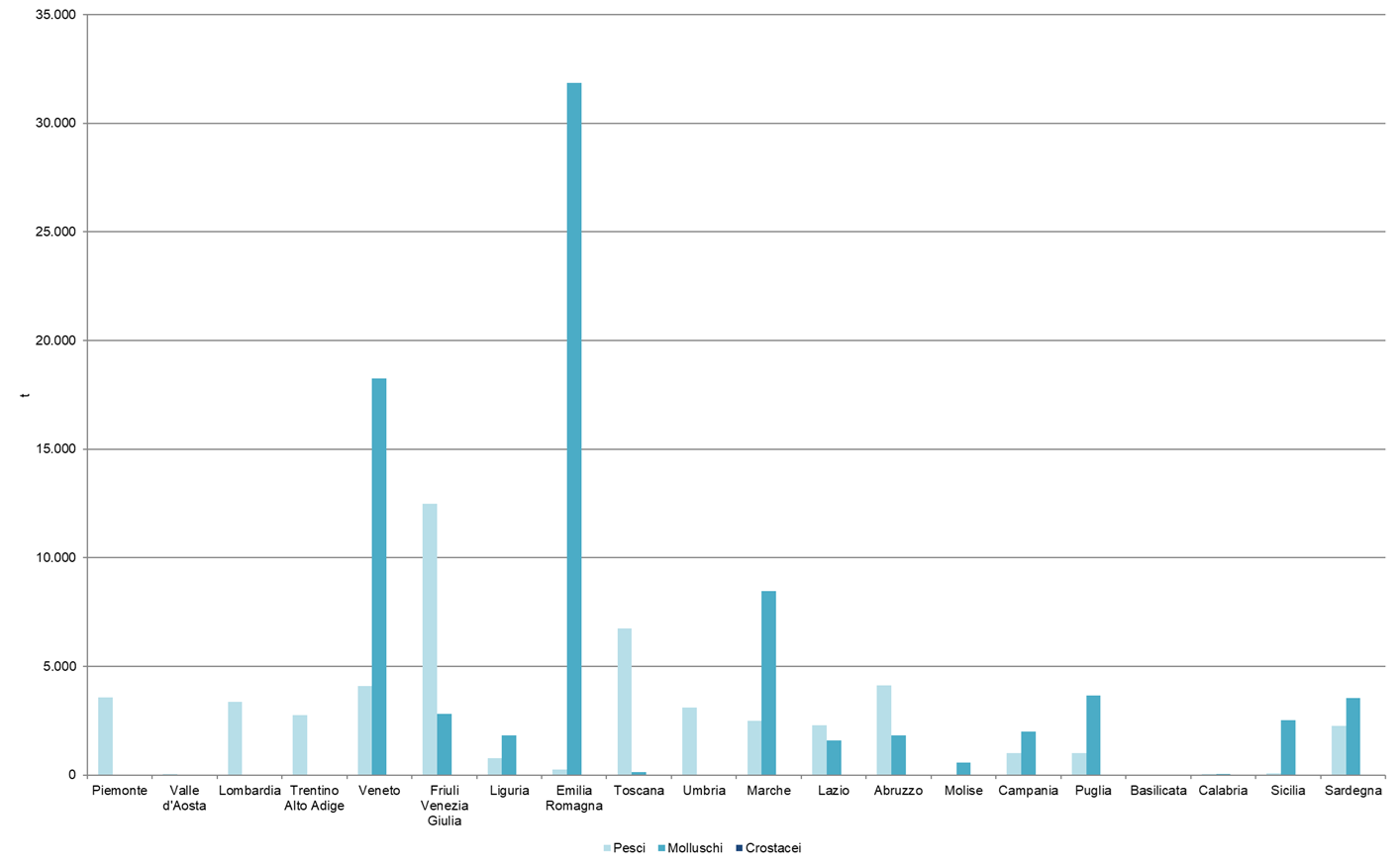
Figure 2: Aquaculture production by region (2023) Data source
ISPRA elaboration based on MASAF–CREA and EUROSTAT data |
Thumbnail
Headline
Figure 3: Time series (1994–2023) of national aquaculture production of fish, molluscs, and crustaceans Data source
ISPRA elaboration based on MiPAAF–ICRAM (1994–2001), IDROCONSULT (2002–2006), UNIMAR (2007–2014), MiPAAF–GRAIA–API–AMA (2015–2016), MiPAAF–API–AMA (2017–2018), MASAF–CREA (2019–2023) Note
Mollusc production data for the period 1994–2001 also include harvesting from natural beds |
Thumbnail
Headline
Figure 4: Time series (2019–2023) of the main national aquaculture productions Data source
ISPRA elaboration based on EUROSTAT data (2019–2023) |
In 2023, Veneto confirms itself as the first region in Italy for the number of aquaculture plants (23%) (Figure 1), while Emilia-Romagna is the first region for production volumes (25% of the total) (Figure 2). Five regions (Veneto, Emilia-Romagna, Friuli-Venezia Giulia, Sardinia, Puglia) host 68% of the plants.
Emilia-Romagna, Veneto and Friuli-Venezia Giulia confirm themselves as the main production hubs and together with Marche and Tuscany they cover 68% of national production.
The relationship between production volumes and number of plants varies from region to region, in particular depending on the number of intensive, semi-intensive and extensive fish farming plants.
In most coastal regions, the use of brackish/salt water resources prevails, with plants located in transitional, coastal and marine environments (Figure 1).
All the regions that include coastal areas produce both fish and shellfish (Figure 2), with the exception of Basilicata, whose production can only be ascribed to freshwater fish farming.
Mussel and trout farming are the most important farming systems (Table 1), representing 44% and 26% of national production respectively.
For shellfish farming, the largest productions are in Emilia-Romagna and Veneto, which together contribute to 63% of the national production of the sector (Figure 2). Other significant productions are found in Puglia, Marche, Sardinia, Friuli-Venezia Giulia and Sicily (Figure 2).
For fish farming, 54% of national production is concentrated in 4 regions: Friuli-Venezia Giulia, Abruzzo and Veneto, mainly in freshwater systems, and Tuscany in a marine environment. Marine fish farming is almost entirely based on the farming of two species, sea bream and sea bass, with a total production in 2023 of 12,303 t which represents over 93% of marine fish farming and 9.5% of national production (Table 1). Tuscany represents the main production center for marine fish farming, followed by Sardinia, Lazio, Campania and Puglia.
In fish farming, exotic species (Table 2) are raised almost exclusively in fresh water and represent 73% of total fish production. The ocellated croaker ( Sciaenops ocellatus ) is the only exotic marine species bred in Italy since 2022. In the case of shellfish farming, exotic species ( R. Philippinarum and Magallana gigas ) contribute 28% to the total volume of the sector (Table 1).
In 2023, no exotic species of crustaceans appear to have been bred (Eurostat data).
ISPRA is engaged in studies aimed at verifying the presence of exotic species and associated species for an assessment of risks and potential impacts and at developing a traceability system for the movement of bivalve molluscs.
Overall, both in the short term (2021-2023) and in the medium term (2019-2023), we observe a situation of stagnation in the sector in terms of production volumes (Figures 3 and 4), contrary to what was recorded for the value of production which, in 2023, exceeded 600 million euros (Table 1).
The shellfish farming sector is the one that presents the greatest critical issues and fluctuations in production volumes and requires specific support actions.
The data referring to production volumes from 1994 to 2001 (Figure 3) include in the calculation, in addition to farmed molluscs, also bivalve molluscs collected on natural beds, for an annual production estimated at around 30,000 tonnes in the period. However, even without considering the molluscs collected on natural beds, the production volumes of farmed molluscs have shown important and continuous fluctuations in the last 20 years.
In addition to the historical critical issues linked to the environmental quality of the waters intended for the life of molluscs, the impacts of climate change and the bureaucratic-administrative difficulties for the release of state concessions, the blue crab emergency has been added as a new threat to the sector ( Callinectes sapidus ).
Faced with the dramatic explosion of this highly invasive alien species in 2023, with direct impacts on fishing and clam production, the Italian Government has allocated specific funds. These measures include support measures for affected operators and the financing of extraordinary containment plans based on the capture and marketing of the crustacean, aiming to reduce predatory pressure on production, in particular venericulture (Ordinance no. 3 of 21 July 2025, "Implementation of the intervention plan to contain and combat the phenomenon of the spread and proliferation of the blue crab species ( Callinectes sapidus )”).
Given the strategic role of shellfish farming, as a source of proteins with a low environmental footprint ("Farm to Fork Strategy", 2020) and as a provider of ecosystem services, such as those regulating the coastal marine environment (see Nitrogen and Phosphorus Balance Indicator), the reduction in the production of molluscs, both clams and mussels, which has occurred in recent years deserves attention from political decision makers and actions to support the sustainable development of the sector.
The problems that emerged, in particular the vulnerability of shellfish farming, the persistent bureaucratic difficulties and the dependence on a few species (bream, sea bass, trout, mussels), represent challenges well highlighted in the previous community programming cycle (PSA and OP EMFF 2014-2020), but still not resolved. It is hoped that the new programming cycle (PSA and OP EMFF 2021-2027) which provides, among others, direct investments to support sustainable aquaculture activities (Priority 2.1), in particular for shellfish farming and integrated systems for multitrophic aquaculture, achieves the expected objectives.