Giovanni Finocchiaro, Silvia Iaccarino
Italian parks host within their territories approximately 21.7% of the total accommodation establishments and 24.4% of the total bed places available in Italy. In 2025, the municipalities affected by national and regional parks account for a total of 160,270 accommodation establishments and approximately 1.88 million bed places.
The indicator provides an analysis of accommodation supply, tourism flows and tourism intensity in the territories of national and regional parks, with the aim of highlighting the pressure exerted by tourism on areas characterised by high natural value. In 2025, the overall ratio between tourist overnight stays and the resident population in the municipalities affected by parks reached 10.1 overnight stays per inhabitant, increasing compared with 2024.
The European Charter for Sustainable Tourism in Protected Areas (ECST) has been obtained by 19 of the 26 national parks, equal to 73.1%, and by 21 of the 147 regional parks, equal to 14.3%, highlighting a still markedly differentiated level of uptake between the two types of protected area.
The indicator examines accommodation supply, in terms of the number of establishments and bed places, tourism flows, expressed through arrivals and overnight stays, and tourism intensity, calculated as the ratio between overnight stays and the resident population, in municipalities whose territory falls wholly or partly within the areas occupied by national and regional parks.
Data relating to provincial capital municipalities are excluded where the corresponding tourism cannot be attributed predominantly to the presence of the park. The analysis considers 26 national parks and 147 regional parks listed on www.parks.it.
The European Charter for Sustainable Tourism in Protected Areas (ECST) is also considered. It is a methodological tool and certification coordinated by the EUROPARC Federation, aimed at improving the management of protected areas through a shared strategy for sustainable tourism development. The central element of the Charter is cooperation among stakeholders to develop a common strategy and an action plan for tourism development, based on an in-depth analysis of the local situation. The objective is to protect natural and cultural heritage and to continuously improve tourism management in the protected area for the benefit of the environment, the local population, businesses and visitors. The growing importance of sustainable tourism development as an issue of international interest has also been emphasised in the “Guidelines for International Sustainable Tourism” of the Convention on Biological Diversity.
Provide some of the key information on both the supply side (accommodation capacity) to assess the size of a location's tourism sector, and the demand side (tourist flows) to provide an idea of the strain endured by the area and its facilities.
The indicator has no reference legislation or related objectives.
www.parks.it
Istat
www.istat.it
National, Regional
2017-2025
Average municipal number of beds, ratio of presence/resident population by type of natural park
- Data includes total numbers, percentages, and ratios.
- Regional parks that include provincial capitals are excluded, as tourism in these cities is not solely linked to parks.
- 144 regional parks are analyzed instead of 147 (as per www.parks.it).
In 2025, the municipalities affected by Italian parks host a total of 160,270 accommodation establishments and 1,876,057 bed places. National parks account for 41,917 establishments and 527,491 bed places, while regional parks account for 118,353 establishments and 1,348,566 bed places (Table 1, Table 2).
Accommodation supply is therefore particularly significant in protected-area territories. In national parks, there are on average 73.8 establishments and 928.7 bed places per municipality, while in regional parks the corresponding values reach 85.1 establishments and 970.2 bed places per municipality (Table 1). Across all parks, the average is approximately 81.9 establishments and 958.1 bed places per municipality.
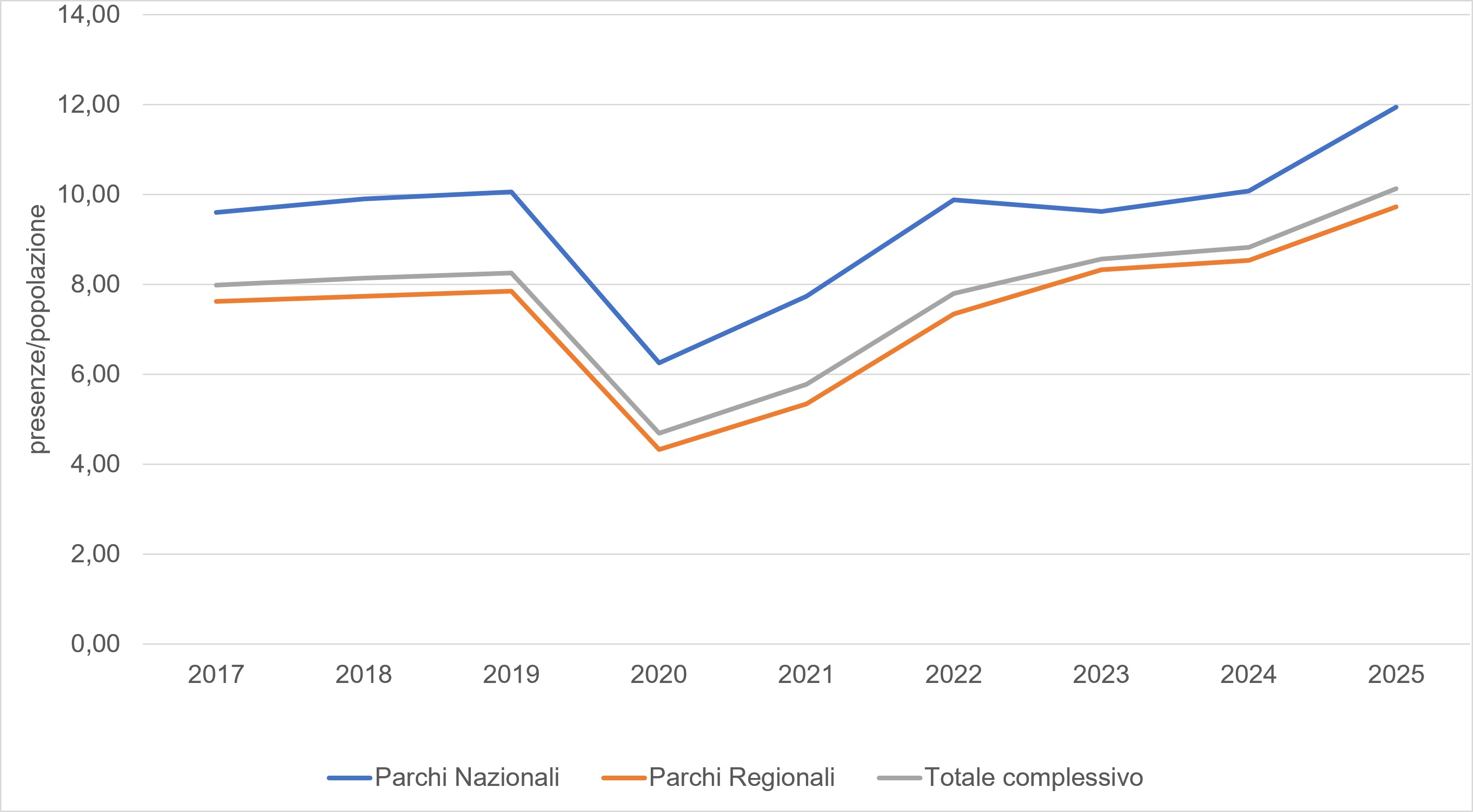
Pressure arising from tourism flows is also significant. In 2025, approximately 120.8 million overnight stays were recorded in park municipalities, corresponding to 10.1 overnight stays per inhabitant. In national parks, the ratio reaches 11.9, while in regional parks it stands at 9.7 (Table 3, Figure 2).
The territorial situation is highly differentiated. Among national parks, the highest tourism intensities are recorded in Cinque Terre National Park (124.1 overnight stays per inhabitant), Tuscan Archipelago National Park (121.7) and Stelvio National Park (97.2) (Table 3). In regional park territories, Trentino-Alto Adige stands out with 142.9 overnight stays per inhabitant, followed by Marche (29.6) and Valle d’Aosta (23.2) (Table 4; Figure 5).
With regard to sustainable management, the ECST is present in 19 national parks and 21 regional parks (Table 5). Certification is therefore relatively widespread among national parks, whereas it remains more limited among regional parks.
Overall, the state can be assessed as moderate from an environmental perspective: the high natural value of the areas concerned and the growing diffusion of sustainable management tools represent positive elements, but the high tourism intensity in numerous territories generates significant pressures on natural resources and local services. The situation therefore does not indicate an unequivocal environmental improvement.
In the period preceding the pandemic, between 2017 and 2019, tourism pressure in park territories increased: the overall ratio between overnight stays and the resident population rose from approximately 8.0 in 2017 to 8.3 in 2019. In 2020, the value fell to 4.7 as a result of mobility restrictions, before progressively increasing again: 5.8 in 2021, 7.8 in 2022, 8.6 in 2023, 8.8 in 2024 and 10.1 in 2025 (Figure 2).
The 2025 value therefore exceeds both pre-pandemic levels and the level recorded in the previous year. In national parks, the overnight stays/population ratio increased from 10.1 in 2024 to 11.9 in 2025, while in regional parks it rose from 8.5 to 9.7.
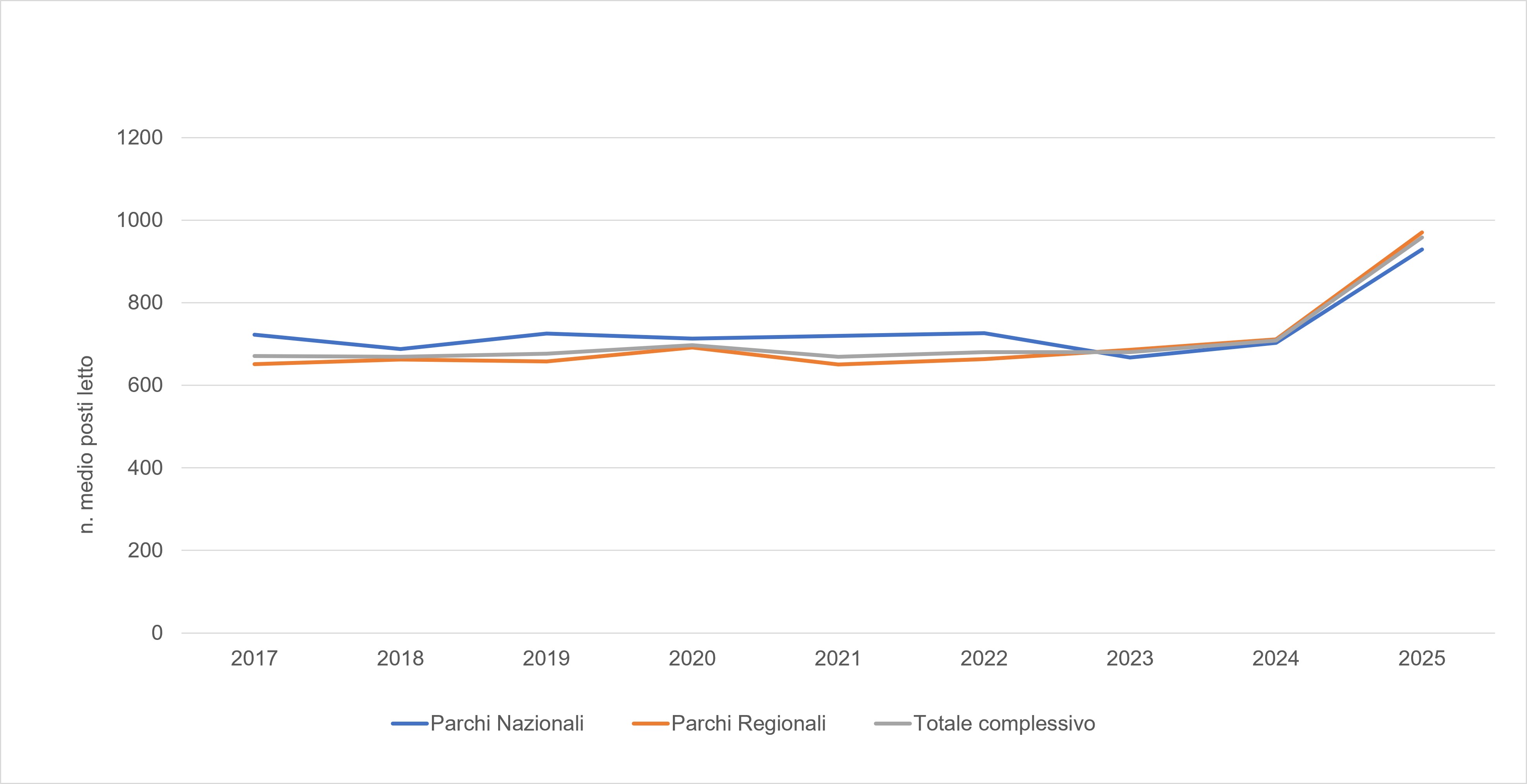
At the same time, the average accommodation capacity of park territories also increased. Overall, the average number of bed places per municipality rose from 680.2 in 2023 to 708.8 in 2024 and to 958.1 in 2025; in national parks it reached 928.7 bed places per municipality and in regional parks 970.2 (Figure 1).
The particularly marked increase recorded in 2025 should, however, be interpreted with caution. As already highlighted for the “Tourism infrastructure” indicator, from 2025 onwards the expansion of the survey coverage of rented accommodation has a significant impact on the number of complementary accommodation establishments and their related bed places; consequently, the change in accommodation supply compared with previous years cannot be attributed entirely to actual growth in accommodation establishments.
Overall, the long-term trend is assessed as negative from an environmental perspective: the increase in tourism intensity and in pressure on protected territories increases the potential impacts on ecosystems, natural resources, mobility and local services. The trend therefore does not move in the environmentally desirable direction, despite the increasing diffusion of sustainable management tools such as the CETS.
| Data |
|---|
Headline
Table 1: Reception capacity in national parks (2025) Data source
ISPRA processing based on ISTAT and www.parks.it data |
Headline
Table 2: Reception capacity in regional parks (2025) Data source
ISPRA processing based on ISTAT and www.parks.it data Note
For some municipalities, the number of arrivals and presences was estimated based on the percentage distribution of bed spaces. On the Parks.it website, the number of regional parks is 147. For the purposes of the calculation, according to the methodology used, three parks were excluded as they include provincial capital municipalities: the "Bosco e Paludi di Rauccio Regional Natural Park", which includes only the provincial capital of Lecce; the "Bosco Incoronata Regional Natural Park", which includes only the provincial capital of Foggia; and the "Salina di Punta Contessa Regional Park", which includes only the provincial capital of Brindisi. |
Headline
Table 3: Tourism intensity in national parks (2025) Data source
ISPRA processing based on ISTAT and www.parks.it data Note
For some municipalities, the number of arrivals and presences was estimated on the basis of the percentage distribution of bed spaces |
Headline
Table 4: Tourism intensity in regional parks (2025) Data source
ISPRA processing based on ISTAT and www.parks.it data Note
On the Parks.it website, the number of regional parks is 146. In this case, they are 143 because 3 regional parks were excluded because they included the provincial capitals (excluded from the methodology used): - The “Bosco e Paludi di Rauccio Regional Natural Park” includes only the provincial capital of Lecce; - The “Bosco Incoronata Regional Natural Park” includes only the provincial capital of Foggia; the “Salina di Punta Contessa Regional Park” includes only the provincial capital of Brindisi. |
Headline
Table 5: Italian Parks with CTES certification "European Charter for Sustainable Tourism in Protected Areas" (2025) Data source
ISPRA processing based on data from www.parks.it |
Thumbnail
Headline
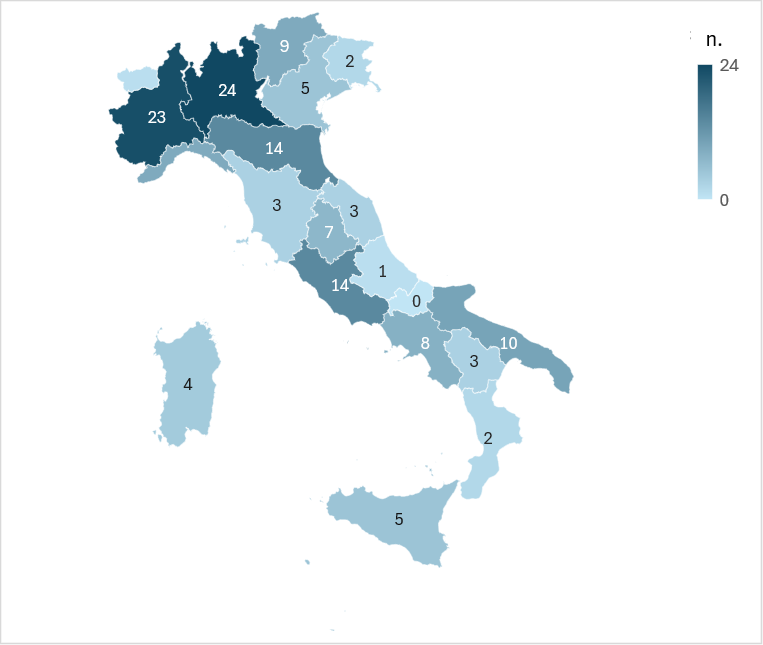
Figure 3: Total number of regional parks by region (2025) Data source
ISPRA processing based on ISTAT.it and parks.it data |
Thumbnail
Headline
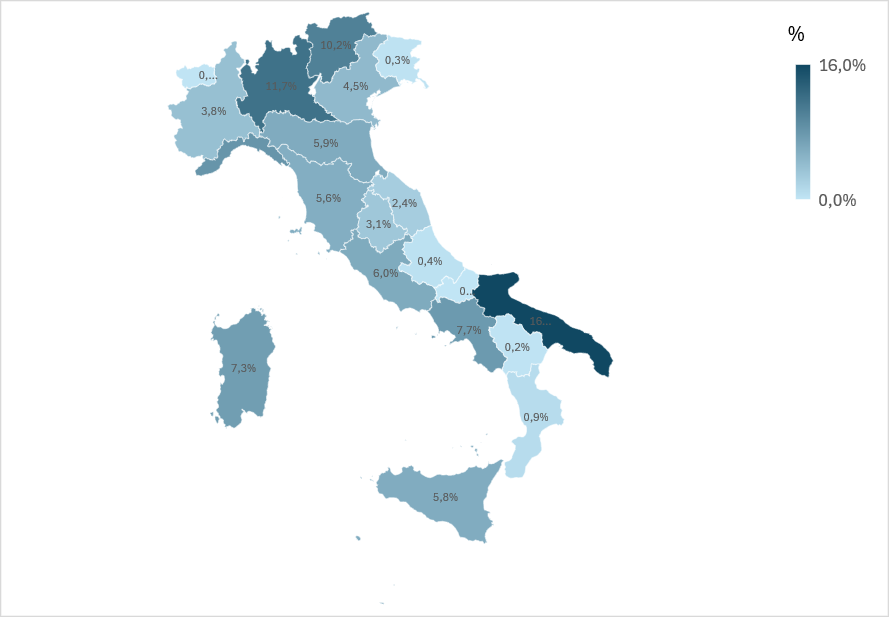
Figure 4: Percentage distribution of accommodation facilities in regional parks in Italy (2025) Data source
ISPRA processing based on ISTAT.it and parks.it data |
Thumbnail
Headline
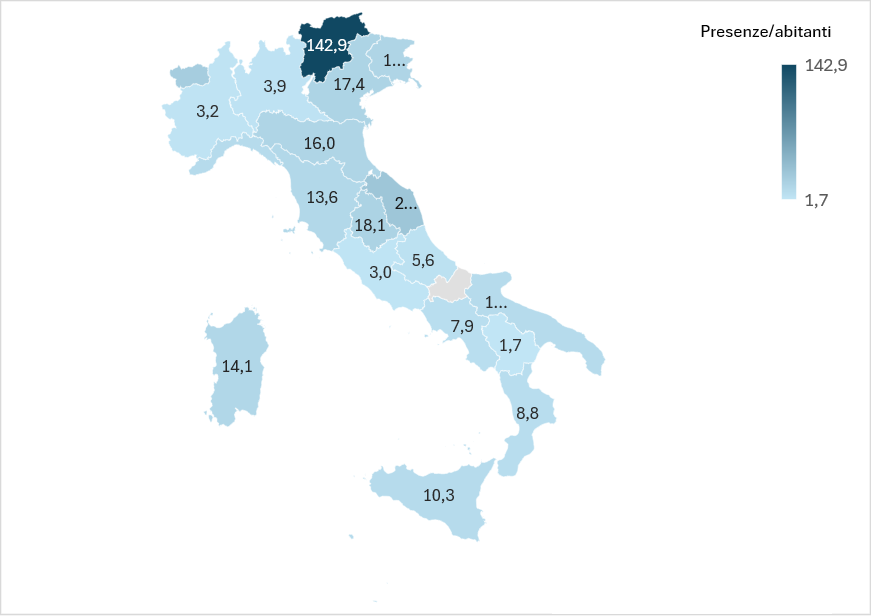
Figure 5: Tourism intensity in regional parks (2025) Data source
ISPRA processing based on ISTAT.it and parks.it data |
Thumbnail
Headline
Figure 1: Distribution of the average number of beds per municipality in regional and national parks Data source
ISPRA processing based on Istat and parks.it data |
Thumbnail
Headline
Figure 2: Distribution of the presence/resident population ratio by type of natural park Data source
ISPRA processing based on Istat and parks.it data |
In 2025, the analysis covers 26 national parks and 147 regional parks. The latter are more heavily concentrated in Lombardy, which hosts 24 parks, equal to 16.3% of the total, and in Piedmont, with 23 parks (15.6%); Emilia-Romagna and Lazio follow, both with 14 parks, equal to 9.5% (Figure 3).
In regional parks, accommodation supply shows marked territorial differences. Apulia accounts for the largest number of accommodation establishments, with 18,970 establishments, equal to approximately 16.0% of the total for regional parks; it is followed by Lombardy with 13,899 establishments (11.7%) and Trentino-Alto Adige with 12,109 (10.2%) (Table 2, Figure 4). In terms of bed places, the highest value is instead recorded in Trentino-Alto Adige, with 193,403 bed places, equal to 14.3% of the total, followed by Apulia with 176,571 (13.1%) and Lombardy with 157,151 (11.7%).
Some average municipal values are also particularly high. In regional parks, Sardinia records approximately 476.9 establishments per municipality, Apulia 395.2, Tuscany 330.7 and Marche 315.9 (Table 2). In terms of average bed places per municipality, the highest values are observed in Tuscany (4,161), Marche (4,034), Sardinia (3,830) and Apulia (3,679).
With regard to tourism intensity, Trentino-Alto Adige stands out markedly with 142.9 overnight stays per inhabitant in municipalities affected by regional parks, followed by Marche (29.6), Valle d’Aosta (23.2), Umbria (18.1) and Veneto (17.4) (Table 4; Figure 5). These values show how, in some areas, tourism flows result in a very substantial temporary increase in the population actually present in the territory.
Among national parks, the largest number of accommodation establishments is recorded in Cilento, Vallo di Diano and Alburni National Park, with 7,259 establishments, equal to approximately 17.3% of the total, followed by Tuscan Archipelago National Park (15.8%) and Stelvio National Park (13.0%) (Table 1). Gargano National Park instead records the largest number of bed places, with 105,712 units.
Tourism intensity in national parks reaches particularly high values in Cinque Terre National Park (124.1 overnight stays per inhabitant), Tuscan Archipelago National Park (121.7) and Stelvio National Park (97.2), highlighting territories in which the management of tourism flows is particularly important for ecosystem conservation and for the quality of life of local communities (Table 3).
Finally, the European Charter for Sustainable Tourism in Protected Areas has been obtained by 19 national parks out of 26 and by 21 regional parks out of 147 (Table 5). The diffusion of the ECST represents a positive response to the pressures generated by tourism, but the gap between national and regional parks still indicates considerable room for improvement in the uptake of structured sustainable management models.