OVEREXPLOITED FISH STOCKS
Data aggiornamento scheda:
Over the period considered (2007–2023), the status of assessed fish stocks has shown an overall improvement: the proportion of nationally managed stocks subject to overfishing has declined, reaching its lowest level (44.4%) in 2023. Although fishing mortality remains critical in several cases, it has exhibited a downward trend in recent years, progressively approaching levels compatible with the long-term sustainable exploitation of resources under average environmental conditions.
The indicator, based on analytically assessed stocks validated at the international level, reflects the overall dynamics of the exploitation status of commercially fished stocks, highlighting the gradual improvement of exploited marine resources. It is also associated with the percentage coverage of landings for which stock assessment data are available, with analyses conducted at both the national and subregional levels according to the geographic subdivision established by the Marine Strategy Framework Directive.
FISHING EXPLOITATION RATE OF NATIONAL FISHERY RESOURCES
Data aggiornamento scheda:
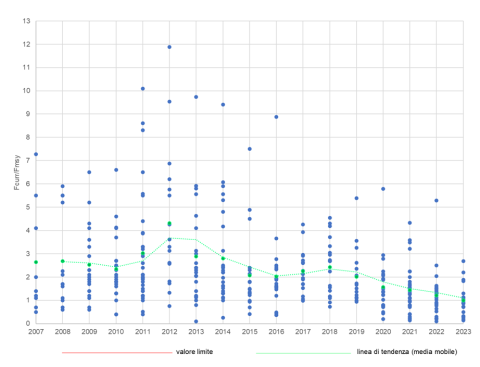
During the period considered (2007–2023), the average exploitation rate of fish stocks — expressed as the mean ratio between current fishing mortality and that corresponding to the Maximum Sustainable Yield (Fcurr/FMSY) — remained generally above the sustainability threshold.
The indicator, derived from analytical stock assessments validated at the international level, describes the overall trend in fishing pressure exerted on commercially exploited stocks.
Within the time series, 2023 stands out as the only year in which the Fcurr/FMSY value fell below the threshold of 1 (0.99), confirming the progressive downward trend observed in recent years for this indicator.
MEAN TEMPERATURE OF THE CATCH (MTC) IN ITALIAN SEAS
Data aggiornamento scheda:
Ocean warming is causing a geographical and depth shift in marine species more sensitive to temperature changes. In temperate zones, such as the Mediterranean, this phenomenon results in a northward expansion of warm-affinity species. Consequently, the composition of marine communities changes, affecting commercial fishery landings.
This phenomenon is described by an indicator known in scientific literature as the “Mean Temperature of the Catch (MTC),” which represents the average thermal affinity of commercial fishing catches. In the Adriatic Sea (FAO Division 37.2.1), the average thermal affinity of the catches of Italian fleets increased from 19.2 °C (average 1987–1996) to 20 °C (average 2013–2023), with a significant annual increase of 0.03 °C; in the Ionian Sea – Central Mediterranean (FAO Division 37.2.2), it increased from 20.3 to 22.2 °C, with a significant annual increase of 0.07 °C; in the Sea of Sardinia – Western Mediterranean (FAO Division 37.1.3), from 20.5 to 22.5 °C, with a significant annual increase of 0.07 °C.