Antonio Caputo
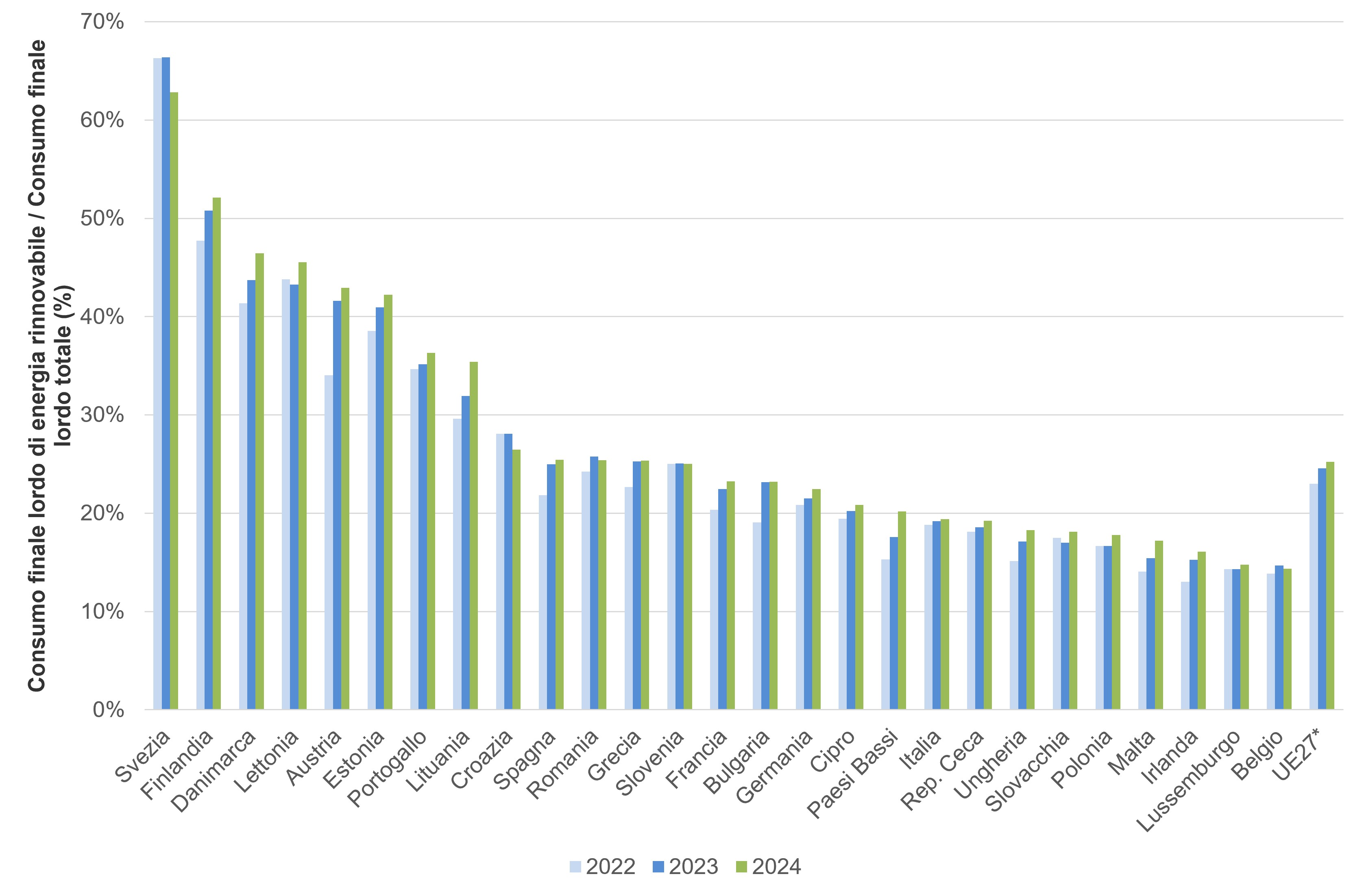
The share of energy from renewable sources in gross final consumption in European Union countries over the twenty-year period considered grew in Italy, reaching 19.4% in 2024. This figure is still far from the 38.7% target to be reached by 2030. The country currently ranks below the EU27 average (which reached 25.2% in 2024) and significantly behind leading countries such as Sweden (62.8%), Finland (52.1%), and Denmark (46.5%). The target that the EU27 should reach is around 42.5%.
The indicator measures the share of energy from renewable sources in gross final consumption, and is based on the methodology established by Directive 2009/28/EC (Renewable Energy Directive) on the promotion of the use of energy from renewable sources for the years up to 2020 and on the methodology established by Directive (EU) 2018/2001 from 2021. It is calculated on the basis of data collected under Regulation (EC) No 1099/2008 (as amended by Regulation (EU) 2022/132) on energy statistics and supplemented by additional specific data transmitted by national administrations to Eurostat.
Evaluate the contribution of clean and inexhaustible energy sources to final energy consumption, with a view to increasing their use.
Directive 2009/28/EC establishes the share of energy from renewable sources in gross final consumption for each European Union country by 2020; these shares include both electricity generation and heating and transport. It also provides for the possibility of concluding agreements for the statistical transfer of a certain amount of energy from renewable sources from one Member State to another and for cooperation among themselves, or with third countries, for the production of energy from renewable sources. The renewable energy consumption target assigned to Italy was 17% of gross final consumption in 2020. Legislative Decree 28/2011 for the implementation of Directive 2009/28/EC on the promotion of the use of energy from renewable sources establishes the criteria for the development of renewable sources essentially through the incentive and simplification of authorization procedures.
As part of the Green Deal, Europe has updated the strategic climate framework by setting the target of reducing greenhouse gas emissions by 55% by 2030 compared to 1990, a share of at least 42.5% of renewable energy (as established by the new Directive 2023/2413/EU (so-called RED III) which followed up on the provisions of the REPower EU Plan adopted by the European Commission in May 2022 (COM(2022) 230), with the intention of aim for 45% and an improvement of at least 36% in energy efficiency, in terms of reduction in final energy consumption and of at least 39% in terms of reduction in primary energy consumption compared to the baseline scenario (Primes 2007 Model).
The measures necessary to achieve the European objectives linked to the European Green Deal and RePowerEU were considered in the National Recovery and Resilience Plan (NRRP) sent to the European Commission in 2021 and subsequently integrated into the National Integrated Plan for Energy and Climate (PNIEC) with a horizon to 2030 sent to the European Commission on 1 July 2024.
The target for the national share of energy from renewable sources in relation to gross final consumption for 2030 assigned to Italy by the National Integrated Plan for Energy and Climate is equal to 38.7%.
Eurostat (Statistical Office of the European Communities)
Eurostat (https://ec.europa.eu/eurostat/data/database)
National
2004-2024
Percentage of energy from renewable sources in final consumption (%).
Energy data are communicated by member countries to Eurostat through the Annual Joint Questionnaire (Eurostat/IEA/UNECE). The calculation is carried out according to the methodology established by Directive 2009/28/EC.
As of 2024, Italy will cover less than a fifth (19.4%) of its gross final consumption with renewable energy. Although significant growth is evident compared to the starting levels of 2004 (+13.1 percentage points), the current situation is lagging behind both the European leading group and the national target set for 2030 (38.7%, as reported in the Integrated National Energy and Climate Plan submitted to the European Commission on 1 July 2024). (Table 1 and Figure 1) The gap to be filled is approximately 19.3 percentage points.
The use of renewable energy has increased continuously in the EU27, with the 2024 share more than doubling since 2004, when renewables accounted for 9.6% of gross final energy consumption. Italy's evolution over time can be divided into two distinct phases. A first phase of rapid expansion occurred between 2004 and 2015, when the share increased from 6.3% to 17.5% thanks to the boost provided by government incentives for photovoltaic and wind power. A second phase, between 2016 and 2024, shows a substantially flat trend, with minimal variations ranging from 17.8% to 19.4% (with the exception of the statistical anomaly of 2020). This slowdown in the trend indicates that the annual pace of installation of new renewable capacity has so far been insufficient to ensure the acceleration trajectory needed for the next decade (Table 1 and Figure 1). Furthermore, a cyclical peak was reached in 2020 (20.4%), facilitated by the contraction in overall energy consumption during the COVID-19 pandemic, followed by a return to stable values around 18.8%-19.4% in the following four years.
| Allegati |
|---|
Titolo
Table 1: Share of energy from renewable sources in final consumption for European countries Fonte
ISPRA processing based on EUROSTAT data |
Thumbnail
Titolo
Figure 1: Share of energy from renewable sources in final consumption for European countries Fonte
ISPRA processing based on EUROSTAT data |
The data highlights the need for a structural shift in the Italian energy system. The 38.7% target requires nearly doubling the current share within a few years. The stagnation observed over the last decade demonstrates that spontaneous market dynamics and delays in authorization and bureaucracy have slowed the energy transition. To reverse this trend and realign with the standards of the most advanced European countries, the effective implementation of the PNRR measures, the simplification of authorization processes for industrial-scale plants, and the rapid development of energy communities and storage systems will be crucial.