Geneve Farabegoli, Paola Giorgioli, Federica Principato
In 2025, the number of state-regulated installations subject to an Integrated Environmental Authorization (IEA) remained broadly in line with the 2024 level, reaching 133 installations following the commissioning of a new gas compression station.
The indicator provides information on the inspection and enforcement activities carried out by ISPRA, acting as the Competent Inspection Authority, with the support of the territorially competent Regional and Provincial Environmental Protection Agencies (ARPA/APPA), at industrial installations subject to a State-issued Integrated Environmental Authorization.
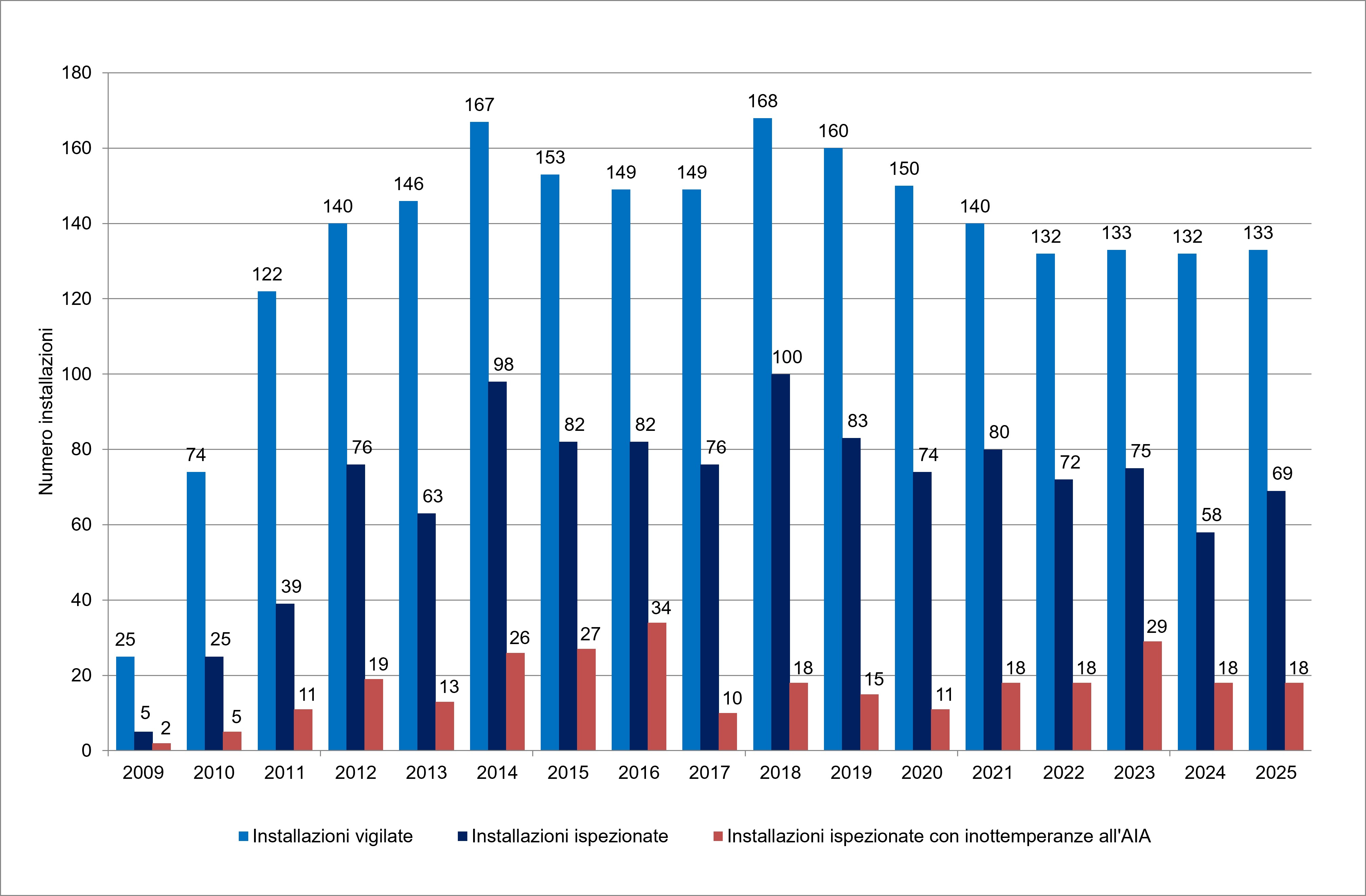
The positive trend observed between 2009 and 2014 underwent a slight reversal in 2015 for reasons unrelated to inspection activities, subsequently stabilised during 2016–2017, increased in 2018 (when the highest number of supervised installations was recorded), declined until 2022, and has remained broadly stable between 2022 and 2025.
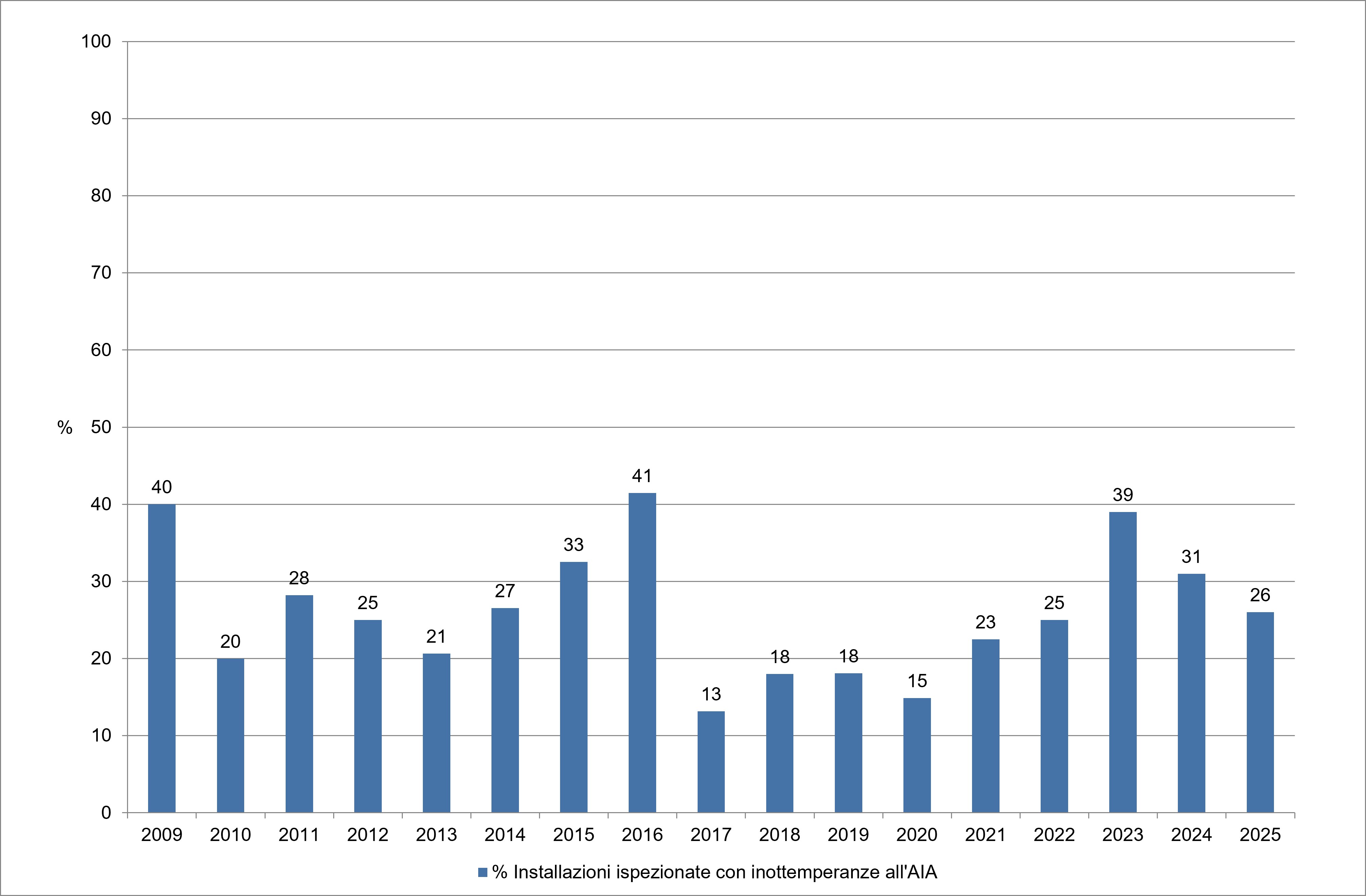
In 2025, 69 installations were inspected, of which 18 were found to be non-compliant with the permit conditions, corresponding to 26% of all inspected installations.
The indicator provides information on the checks carried out by ISPRA at the operational installations subject to compliance with the Integrated Environmental Authorization (IEA) under state jurisdiction. The IEA is "the provision that authorizes the operation of an installation included among those referred to in Article 4, co. 4, letter c), of Legislative Decree 152/2006 and subsequent amendments or part of it under certain conditions which must guarantee that the installation complies with the requirements of Title III-bis for the purposes of identifying the most suitable solutions for pursuing the objectives referred to in Article 4, co. 4, letter c)". An Integrated Environmental Authorization can be valid for one or more installations or parts of them that are located on the same site and managed by the same manager (See: art.5, co.1, letter o-bis) of Legislative Decree 152/2006 and subsequent amendments). In fact, the IEA, as authorization for the operation of the installations, contains provisions on the control of the various environmental matrices, as well as provisions on the adoption of the best techniques available for the management of industrial processes functional to the prevention and minimization of environmental impacts, including the emission limit values, as well as the monitoring and control plan and the communication obligations on the part of the manager. The manager of these installations, in compliance with the IPPC principles ( Integrated Pollution Prevention and Control ), therefore has the obligation to carry out self-monitoring of the emissions of all the systems making up the entire installation and to periodically transmit the results to the Control Bodies. For plants under state jurisdiction, referred to in Annex XII - Part II of Legislative Decree 152/2006, the Control Body is ISPRA, which can make use of ARPA/APPA pursuant to art.29-decies co.11, and the competent Authority is the Ministry of the Environment and Energy Safety (MASE).
The indicator, therefore, provides information on the number of:
- "supervised installations", i. e. The number of installations authorized and subjected to surveillance activities on the documentation transmitted by the manager, regardless of the annual scheduling of the on-site visit;
- "inspected installations", i. e. Those installations which during the reference year were subject to an on-site inspection visit by the Control Bodies;
- "installations inspected with non-compliance with the IEA", i. e. The number of installations in which the control activity has detected non-compliance with the authorization requirements for which these installations have been the subject of a warning issued by the competent Authority (MASE) on the proposal of ISPRA. This indicator was used to highlight the number of installations with non-compliance both by type of activity and by region compared to the total installations in operation subject to IEA.
Please note that the "inspected installations" also include the Acciaierie d'Italia S. p. A. Installation. (formerly ILVA) of Taranto and the ISAB S. r. l. Refinery of Priolo Gargallo (Syracuse) which, being of national strategic interest, are subject, respectively, to four and two annual checks.
Provide information on the surveillance and control activities carried out by ISPRA with the support of ARPA/APPA, at installations under state responsibility.
The reference legislation is Legislative Decree 152/2006 and subsequent amendments, which with the third amendment (Legislative Decree 128/2010) replaced the provisions of Legislative Decree 59/2005 " Full implementation of Directive 96/61/EC on integrated pollution prevention and reduction ", and a series of further updates, the latest of which is Legislative Decree 46/2014 " Implementation of Directive 2010/75/EU on industrial emissions (integrated pollution prevention and reduction)". The latter has modified many aspects regulated by Legislative Decree 152/2006, in particular regarding the application of the sanctioning system to the IEA regime (art. 29- fourteendecies ). The legislation does not set objectives for the control of installations, nor does it report detailed operational methods on their execution, but establishes the criteria for the definition of the annual control plan. Furthermore, with the entry into force of Legislative Decree 46/2014, with art. 29-decies, co.11-ter, the programming criteria have been defined, in particular it has been established that “… the period between two on-site visits must not exceed one year for installations presenting the highest risks, three years for installations presenting less high risks, six months for installations for which the previous inspection has highlighted a serious non-compliance with the permit conditions ". Directive 2024/1785 (IEA 2.0), which amended Directive 2010/75/EU (IEA), maintained the system and criteria linked to the frequencies of environmental controls and risk assessment and tightened the effectiveness and transparency of inspections, extending the application of the IEA to new industrial and livestock sectors and introducing more severe sanctions and more transparent public control procedures in the event of violations.
To understand the indicator, you can refer to the publication on the MASE website of the annual control schedule for the reference year, as well as what is reported in the "R controls contribution 2024 for industrial plants with Integrated Environmental Authorization (IEA) under state jurisdiction", e in the "Environment Report - SNPA n.45 2025 Edition", approved by the SNPA Council, meeting of 10/24/2025 Doc. n.298/2025 - ISBN 978-88-448-1278-2
Since the criminal proceeding has its own specific bureaucratic process at the Prosecutor's Office, the limitation of the indicator is related to the information on the criminal non-compliances detected for which the start of the process is known but not the resolution.
ISPRA/ARPA/APPA
MASE (Ministry of the Environment and Energy Safety)
SNPA (National System for Environmental Protection)
National, Regional
2009-2025
The indicator was constructed on the basis of the information acquired from the MASE website for the number of active (in operation) and supervised installations, taking as reference the administrative documents which certify the supervision and control activity and the data collected by ISPRA/ARPA/APPA relating to the number of inspected installations and the percentage of installations non-compliant with the IEA. The number of supervised installations includes all installations holding a State-issued Integrated Environmental Authorization. In some cases, a single permit covers an entire industrial complex, including directly connected facilities such as power plants or combined-cycle gasification units.
In 2025, 133 installations were subject to supervision, one more than in the previous year. A total of 69 installations were inspected, including Acciaierie d'Italia S.p.A., which underwent four routine inspections, and the ISAB North and South refinery complex, which underwent two routine inspections. Among the inspected installations, 18 were found to be non-compliant with the conditions of their Integrated Environmental Authorization (some installations recorded more than one instance of non-compliance). Consequently, 26% of all inspected installations were found to be non-compliant in 2025 (Table 1; Figure 2).
The number of supervised installations increased from 25 in 2009, when ISPRA began its inspection activities, to 167 in 2014.
A slight decrease occurred in 2015 for reasons unrelated to inspection activities, after which the number stabilised at 149 installations during 2016–2017. The maximum value (168 installations) was reached in 2018, followed by a gradual decline to 160 installations in 2019, 150 in 2020, 140 in 2021, and 133 installations in 2025 (Table 1).
Overall, the trend can be considered stable, since the increase in the number of supervised installations has been accompanied by a substantial rise in inspection activity, with the number of inspected installations increasing from 5 in 2009 to 69 in 2025.
The number of installations found to be non-compliant following on-site inspections, measured by the number of formal enforcement notices issued by MASE (Figure 1), has declined compared with the peak observed in 2023, although remaining broadly consistent with previous years (18 installations in both 2021 and 2022, 29 in 2023, and 18 in 2025). This variability reflects the specific characteristics of individual permits.
Expressed as a percentage of inspected installations, the share of non-compliant installations declined by 13 percentage points between the 2023 peak (39%) and 2025 (26%). Over the last ten years, the average proportion of inspected installations found to be non-compliant has remained broadly stable at around 25%, excluding extreme values (Figure 2).
| Data |
|---|
Headline
Table 1: Inspections of installations under state jurisdiction Data source
ISPRA Data legend
* Installations verified via documentation; ** Installations verified including an on-site visit. |
Thumbnail
Headline
Figure 1: Inspections of installations under state jurisdiction Data source
ISPRA Data legend
Monitored installations (checked via documentation review), Inspected installations (checked including on-site visits), Inspected installations with non-compliance regarding the Integrated Environmental Authorization (IEA) |
Thumbnail
Headline
Figure 2: Percentage of inspected installations with non-compliances with the IEA permit Data source
ISPRA |
Thumbnail
Headline
Figure 3: Number of instances of non-compliance by type of activity (2025) Data source
ISPRA Data legend
Thermal Power Plants; Gas Compression Plants; Platforms; Regasification Plants; Refineries; Chemical Plants; Steelworks. |
Thumbnail
Headline
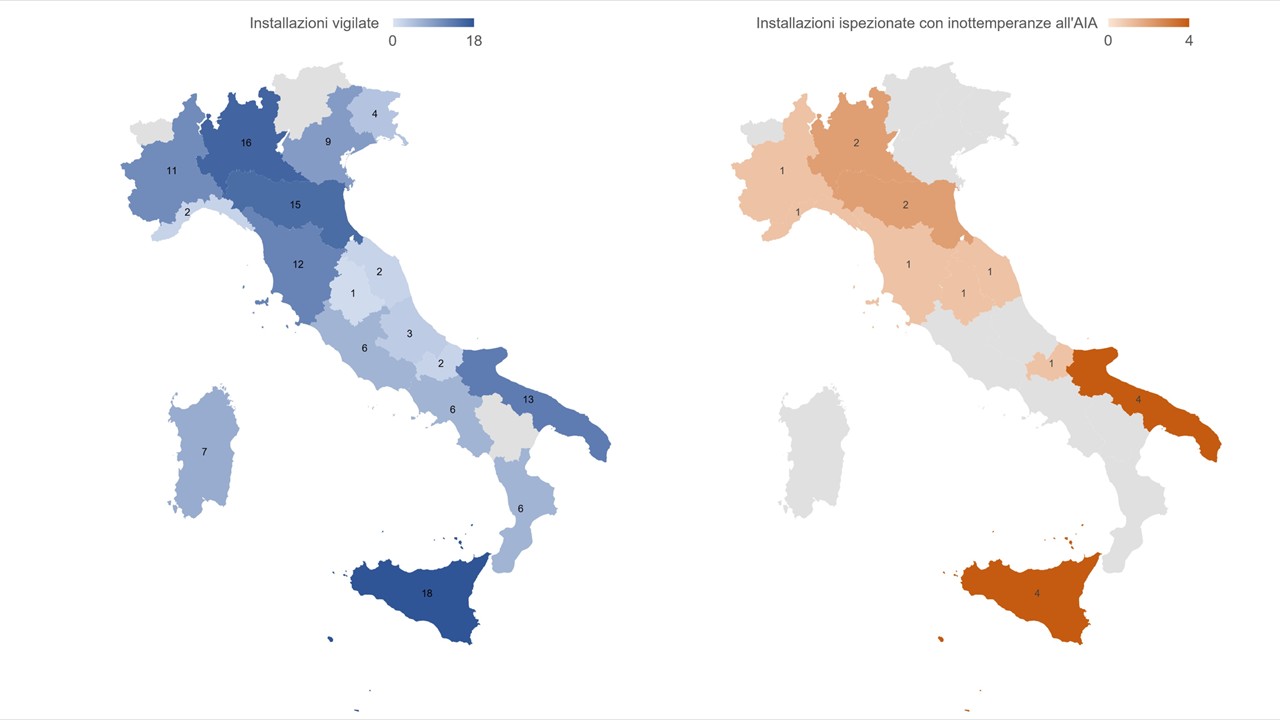
Figure 4: Monitored installations and installations inspected with non-compliance with the IEA permit, by region (2025) Data source
ISPRA |
Thumbnail
Headline
Figure 5: Monitored installations and inspected installations with non-compliance with the IEA permit (2025) Data source
ISPRA |
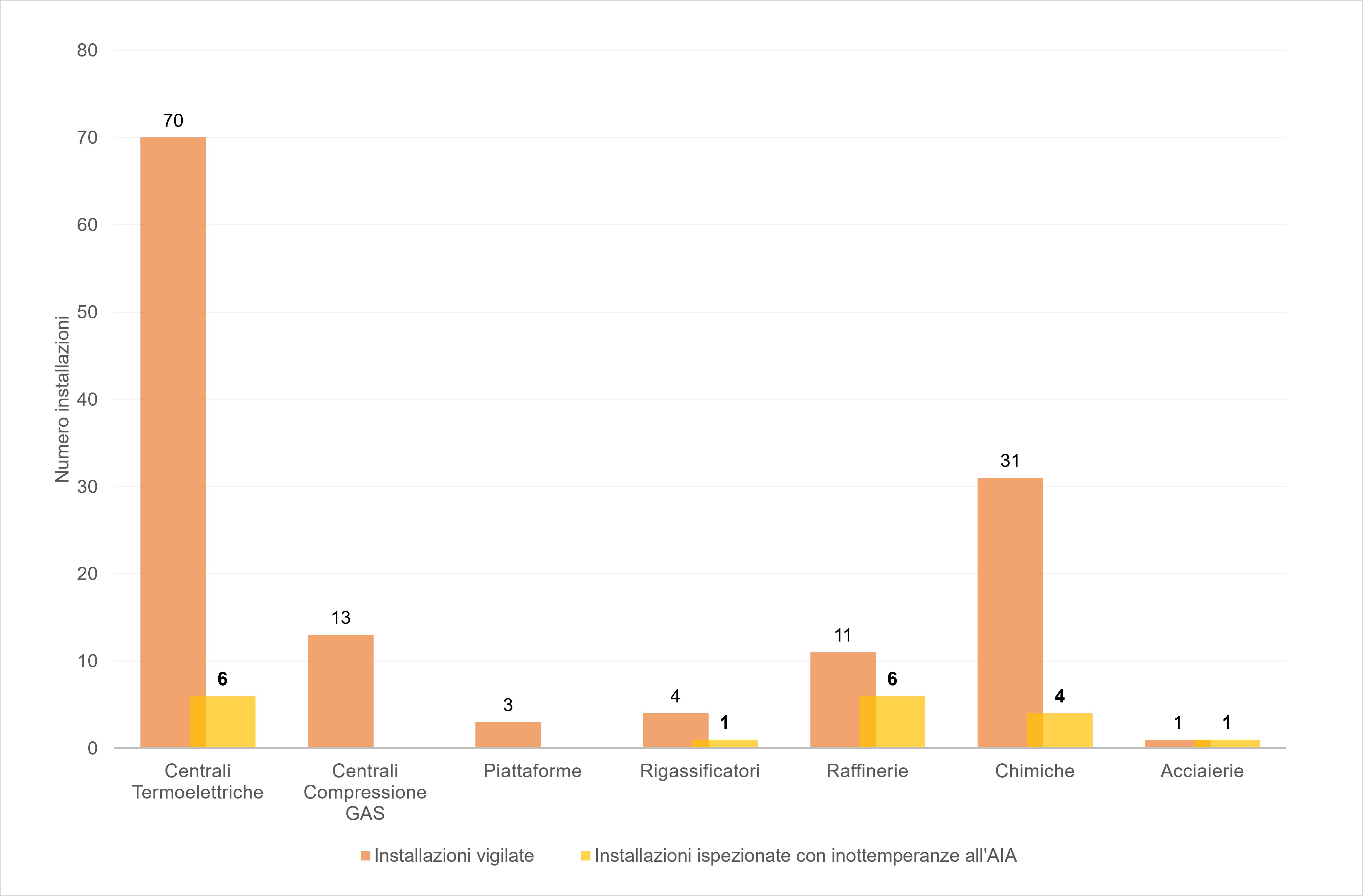
Based on the 133 installations authorized with the state IEA, present and in operation on the national territory by 2025, there is a predominance of the number of thermoelectric power plants (70) and chemical plants (31) compared to other types (Figure 3).
In 2025, the number of installations in which checks revealed non-compliance, divided by type of activity, highlights that 6 thermoelectric power plants, 6 refineries, 4 chemical plants, a regasifier and the steelworks were subject to warnings. Despite the high number of installations belonging to the thermoelectric power plant category, only 6 warnings were notified to these. This is due to the fact that the management of these installations is generally less problematic than that of refineries and chemical plants which, characterized by greater management complexity, present an overall higher number of warnings, equal to 10 out of 42 installations. In 2025, no warnings were notified to the gas compression plants and platforms (Figure 3).
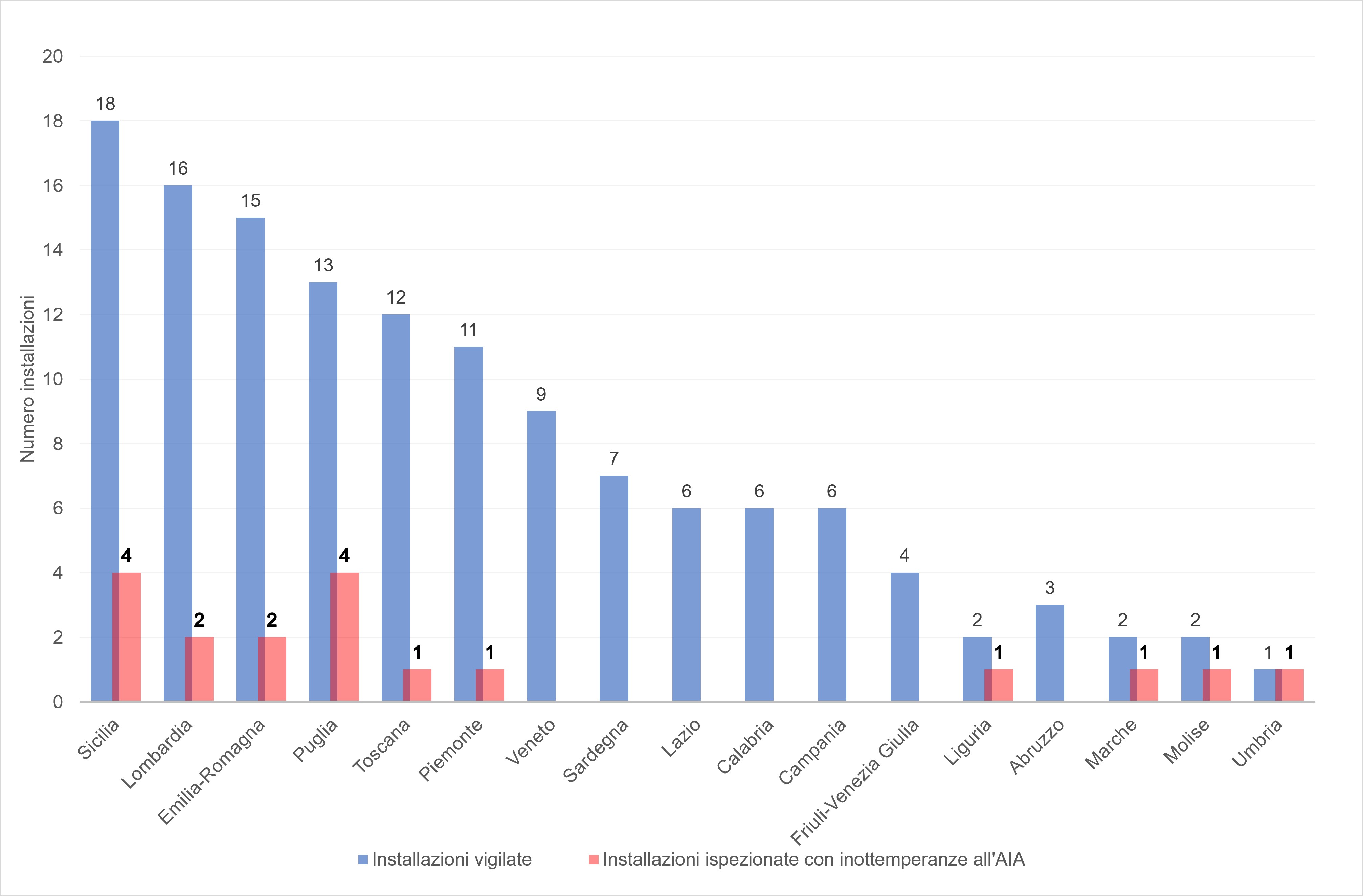
As can be seen from Figure 4, the largest number of installations is concentrated in the following regions: Sicily (18), Lombardy (16), Emilia-Romagna (15), Puglia (13), Tuscany (12), and Piedmont (11). In 2025, installations located in 10 regions out of the 17 in which installations with state IEA fall were warned. A graphic representation on a map of the aforementioned data is also provided (Figure 5), which highlights both the geographical distribution of the installations with state IEA and the regions affected by the presence of installations which, following ordinary/extraordinary checks, were found to be non-compliant during operation.