Francesca Pepe, Fabrizio Vazzana
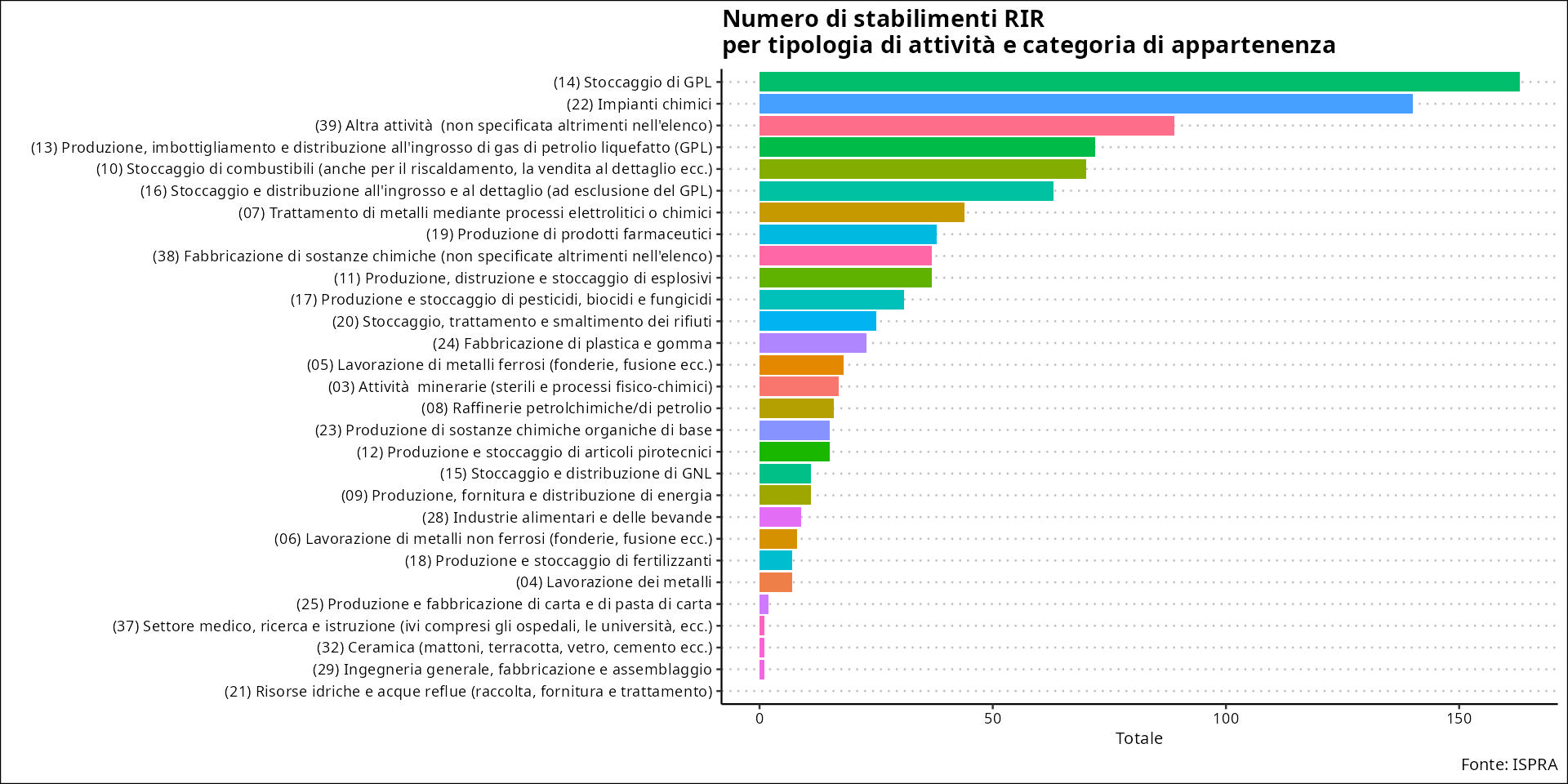
The indicator analyzes the distribution across the national territory of all industrial activities according to the categories defined in Legislative Decree 105/2015 for establishments at risk of a major accident. The analysis of the types of factories allows us to define, albeit in a qualitative way, a mapping of the industrial risk in our country. The legislation divides establishments into 38 activity categories plus a thirty-ninth category (other) including all activities not included in the previous ones, on the basis of the NACE code, a general classification system used to systematise and standardize the definitions of economic/industrial activities in the various member states of the European Union. In particular, on the date of november 30, 2025, it appears that the total number of establishments at risk of a major accident is equal 971, with an increase compared to june 2025 of 39 units. As regards the type of activities present on the national territory, there is a prevalence of deposits of "(14) LPG storage”1st and “(22) chemical plants”2nd . The so-called follow "(39) Other activities, unspecified"3rd , the factories of “(13) production, bottling and wholesale distribution of liquefied petroleum gas (LPG)”4th and the deposits of “(10) Storage of fuels (including for heating, retail etc.)”5th . Together these constitute approximately 50% of the total establishments. The deposits follow "(16) Wholesale and retail storage and distribution (excluding LPG)"6th , the systems of “(07) treatment of metals by electrolytic or chemical processes”7th , systems "(19) production of pharmaceutical products"8th and of “(38) manufacture of chemical substances (not otherwise specified in the list)”9th, of "(11) production, destruction and storage of explosives”10th . Followed by the systems “(17) production and storage of pesticides, biocides and fungicides” 11th and those of “(20) storage, treatment and disposal of waste” 12th .
From the analysis of the types of factories it is possible to obtain important information on the industrial risk map in our country. In fact, the activity of a plant allows you to know in advance, albeit in a qualitative way, the potential associated danger. The new regulation divides the Seveso factories into 38 activity categories plus a thirty-ninth category (other) including all activities not included in the previous ones, based on the NACE code, a general classification system used to systematize and standardize the definitions of economic/industrial activities in the various member states of the European Union. From the belonging of an establishment to one of the categories listed above it is possible to preliminarily know the risks associated with it. The storage depots of fuels and liquefied gases and the depots of explosives and pyrotechnic articles are characterized, for example, by a prevalent risk of fire and/or explosion with effects attributable, in the event of an accident, mainly to more or less high radiation and overpressures and therefore to structural damage to systems and buildings and physical damage to humans. Chemical plants, production plants for pharmaceutical products, storage depots for pesticides, biocides and fungicides associate the risk of fire and/or explosion, like the previous ones, with the risk of diffusion of toxic substances, even at a distance, and therefore the possibility of dangers, immediate and/or deferred over time, for humans and the environment. Metal processing and treatment plants and waste storage, treatment and disposal plants are normally characterized by a prevalent risk of environmental damage and, as a consequence, indirect damage to human health.
Estimate the prevailing nature of the risks to which: humans, air, soil, subsoil, groundwater and surface water are subject, in relation to the presence of certain types of establishments at risk of a major accident.
Legislative Decree 105/2015
ISPRA-MASE, Seveso Inventory ISPRA, Yearbook of environmental data - Various years
Depending on the speed with which the information reaches ISPRA, now subject to evaluation.
none
ISPRA MASE (Ministry of the Environment and Energy Safety)
National inventory of establishments likely to cause major accidents, provided for by article 5, paragraph 3 of Legislative Decree 105/2015. Https://www. rischioindustriale. isprambiente. gov. it/seveso-query-105/Default. php
National
2019-2025
All information is taken from the National Inventory of establishments likely to cause major accidents, provided for by Article 5, paragraph 3 of Legislative Decree 105/2015. The inventory allows the extraction of an Excel file which allows the data necessary to update the indicator to be extrapolated after different steps.
Al november 30, 2025, the number of establishments is equal to 971; those with a lower threshold are equal to 468, while those of a higher threshold are 503.
There are slight variations in the number and type of industries subject to the obligations imposed by the "Seveso" legislation. Al november 2025, the number of establishments shows an increase (971 compared to 933 of the previous year). From 2019 to December 2025 the establishments passed by 991 to 971, with a reduction of approximately 2%.
| Allegati |
|---|
Thumbnail
Titolo
Figure 1 - Type of activity Fonte
ISPRA |
As regards the type of activities present on the national territory, there is a prevalence of deposits of "(14) LPG storage”1st and “(22) chemical plants”2nd . The so-called follow "(39) Other activities, unspecified"3rd , the factories of “(13) production, bottling and wholesale distribution of liquefied petroleum gas (LPG)”4th and the deposits of “(10) Storage of fuels (including for heating, retail etc.)”5th . Together these constitute approximately 50% of the total establishments. The deposits follow "(16) Wholesale and retail storage and distribution (excluding LPG)"6th , the systems of “(07) treatment of metals by electrolytic or chemical processes”7th , systems "(19) production of pharmaceutical products"8th and of “(38) manufacture of chemical substances (not otherwise specified in the list)”9th, of "(11) production, destruction and storage of explosives”10th . Followed by the systems “(17) production and storage of pesticides, biocides and fungicides” 11th and those of “(20) storage, treatment and disposal of waste” 12th . As can be seen from Table 1, the variations are minimal, therefore it seems likely that since the entry into force of Legislative Decree 105/2015, after the passage from Legislative Decree 334/99 which led to a significant decrease in the establishments subject to it, a condition of substantial stability has emerged, albeit with a slight process of reduction over the years.