Giovanni Braca
The indicator provides, for each month and for the entire year, the evaluation of the cumulative monthly and annual water height, expressed in mm, compared to the surface of the national territory which actually transfers into the atmosphere due to the phenomena of evaporation from liquid mirrors and from the ground and transpiration of vegetation and, therefore, does not contribute to the formation of the renewable water resource.
In 2025, the estimated value of the total annual real evapotranspiration was equal to 537.5 mm, with an anomaly of +8.9% compared to the average value of the period 1951–2025 estimated at 493.6 mm.
Evapotranspiration is defined as the quantity of water that transfers into the atmosphere due to the phenomena of direct evaporation from bodies of water, from the soil and from vegetation (interception) and transpiration from vegetation. This is called real evapotranspiration ( actual evapotranspiration ) when it represents the actual quantity of water that is transformed into vapor by the complex of atmospheric factors and vegetation. Unlike potential evapotranspiration, real evapotranspiration depends not only on climatic factors (temperature, wind, relative humidity, etc.), but also on the water content in the soil which can be a consequence of precipitation or artificial irrigation. Actual evapotranspiration, therefore, is always less than or equal to potential evapotranspiration.
The indicator on a monthly scale is evaluated using the BIGBANG hydrological balance model of ISPRA with the Thornthwaite and Mather method which uses a water balance model in the surface layer of the soil where the interactions between the soil and the root system of the plants take place ( root zone ). The annual value is obtained from the sum of the monthly values. Real evapotranspiration constitutes one of the main components of the hydrological cycle. The indicator is transmitted to the European Environment Agency ( European Environmental Agency ) as part of the WISE-SoE data flow ( Water Information System for Europe - State of Environment ).
Provide, as part of the estimate of the available or potential water resource, an evaluation of the quantity of water that passes into the atmosphere through the processes of evaporation and transpiration of vegetation and which, therefore, does not contribute to the formation of the renewable water resource.
Current legislation does not set specific environmental objectives
- Braca, G., Mariani, S., Lastoria, B., Piva, F., Archi, F., Botto, A., Casaioli, M., Forte, T., Marchetti, G., Peruzzi, C., Tropeano, R., Vendetti, C., and Bussettini, M., 2023: National hydrological balance: focus on drought and natural availability of renewable water resources. Update to 2022. Reports no. 388/2023, Rome. Available online at: https://www. isprambiente. gov. it/it/pubblicazioni/rapporti/bilancio-idrologico-nazionale-focus-su-siccita-e-disponibilita-naturale-della-risorsa-idrica-rinnovabile-formazione-al-2022.
- Braca, G., Bussettini, M., Lastoria, B., Mariani, S., and Piva, F., 2021: The Gis BAsed Hydrological Balance at National Scale on Regular Grid – BIGBANG: methodology and estimates. Report on the natural availability of water resources. Reports 339/21, Rome. Available online at: https://www. isprambiente. gov. it/it/pubblicazioni/rapporti/il-bilancio-idrologico-gis-based-a-scala-nazionale-su-griglia-regolare-bigbang .
- Mariani, S., Braca, G., Lastoria, B., Tropeano, R., Casaioli, M., Piva, F., and Bussettini, M., 2024: “The hydrological balance, the availability of water resources and the water balance”, in Drought, scarcity and water crises, Emanuele Romano, Ivan Portoghese (ed.), Habitat signa 1, 29-46. Rome: Cnr Editions. Available online at: https://www. cnr. it/sites/default/files/public/media/attivita/editoria/SiccitaInterattiva_ver2. pdf .
- Moisello, U., 1998, Technical hydrology, La Goliardica Pavese.
- SNPA, 2026: The climate in Italy in 2025, forthcoming .
- Thornthwaite, C. W., and Mather J. R., 1955: The water balance, Laboratory of Climatology, 8, Centerton NJ.
The indicator is estimated on the basis of a mathematical model, implemented in the national hydrological balance model BIGBANG, version 10.0, of ISPRA, and, as such, can therefore only be compared with indicators obtained with the same model. Furthermore, it is estimated on the basis of precipitation and temperatures which in turn are estimated on the basis of a set of pluviometric and thermometric stations which may not be evenly distributed across the territory and whose number may differ from one year to the next. These circumstances, together with the different hydraulic characterization of the soil, suggest particular attention and caution when comparing the indicator in space and time.
The mathematical model does not take into account the different types of vegetation. Furthermore, previously published estimates referring to previous versions of the BIGBANG model may present slight deviations compared to the estimates of the latest available version since some data or schematizations underlying the model may have changed. Correct comparisons between the indicator values must therefore be made using the same version of the BIGBANG model.
Use of a more complex mathematical model to also take into account the type of vegetation.
The temperature data used are mostly those collected and published by the regional and provincial structures to which according to art. 92 of Legislative Decree no. 112 of 31 March 1998, the functions and tasks of the peripheral offices of the National Hydrographic and Mareographic Service (SIMN, now merged into ISPRA) of the Department for National Technical Services were transferred. The temperature data used in the development of the indicator can be accessed by consulting the institutions' websites. The temperature data are also accessible via the ISPRA SCIA portal ( https://scia. isprambiente. it ). The temperature and real evapotranspiration data, aggregated to the monthly scale on the regular BIGBANG grid of 1 km resolution, which covers the entire national territory, are available on the ISPRA Groupware portal ( https://groupware. sinanet. isprambiente. it/bigbang-data/library/bigbang100). Data relating to the hydraulic characteristics of soils are accessible (subject to registration) on the JRC/ESDAC portal ( http://esdac. jrc. ec. europa. eu/content/lucas-2009-topsoil-data ).
National
1951–2025
The calculation method used is that of Thornthwaite and Mather as implemented in the BIGBANG-GIS BAsed Hydrological Balance model at a national scale on a regular grid, version 10.0, developed and implemented in a GIS environment by ISPRA. The BIGBANG model schematizes the volume of land of 1 km x 1 km and 1 m depth as a reservoir, whose maximum available capacity is a function of the soil texture. The reservoir is filled by precipitation and emptied by evapotranspiration. When the tank is full, the excess precipitation turns into runoff and deep infiltration according to the scheme adopted. The actual evapotranspiration remains at the value of the potential one, as long as the accumulation of water in the soil remains above a certain fraction of the value known as "field capacity". Subsequently, the real evapotranspiration decreases linearly to zero when the water content reaches the value known as the "withering point".
In 2025, the estimated value of total annual real evapotranspiration was equal to 537.5 mm, higher than the average value for the period estimated at 493.6 mm.
A value above the average leads to a reduction in the availability of the water resource.
Using the Mann-Kendall test, an increasing trend, statistically significant at 5%, is detected in the period 1951–2025 in the total annual real evapotranspiration calculated with the BIGBANG model, version 10.0.
This trend leads to a reduction in the availability of water resources in the future.
| Data |
|---|
Thumbnail
Headline
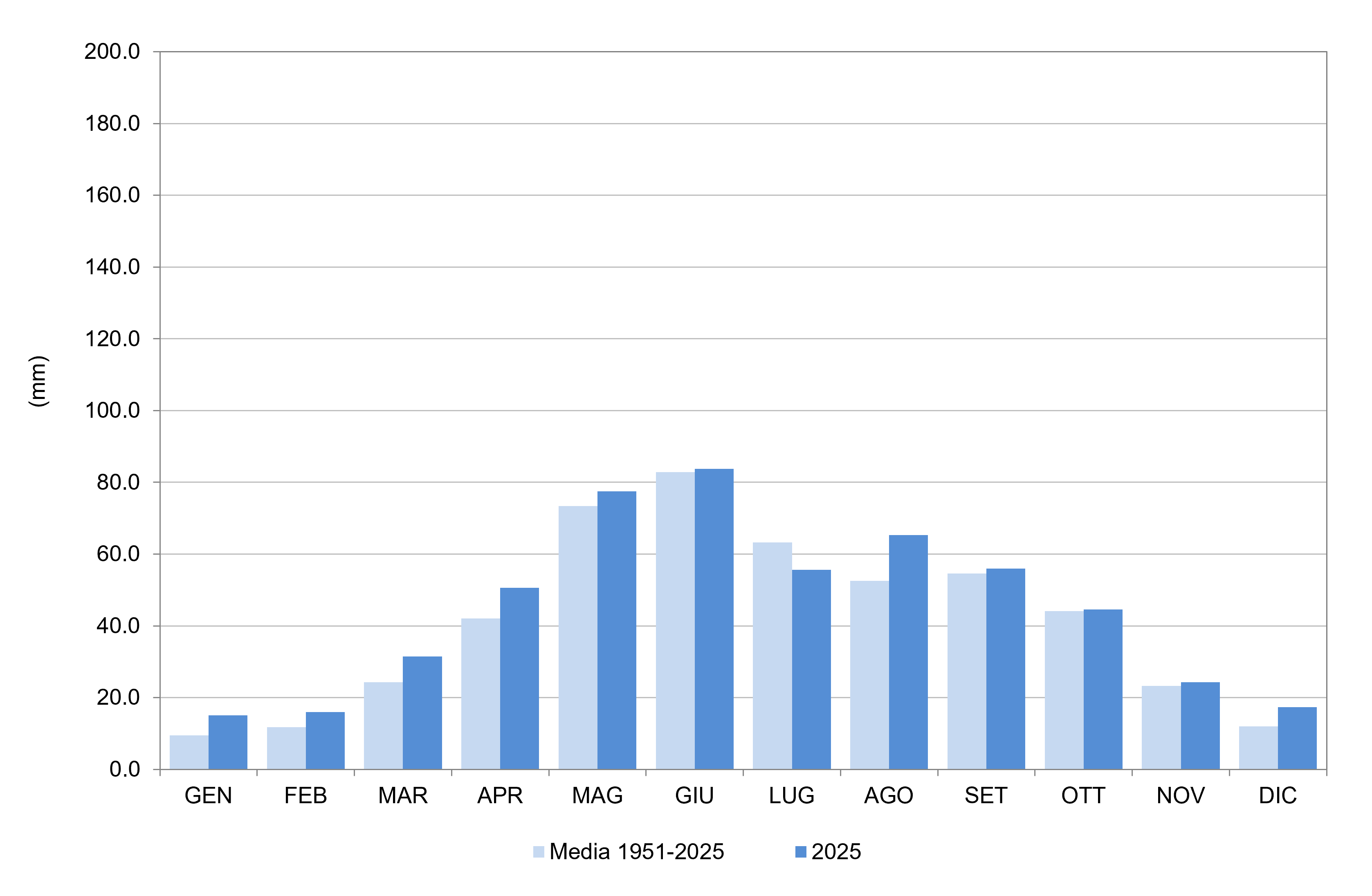
Figure 1: Monthly real evapotranspiration height, adjusted to the national territory for 2025 and average for the period 1951–2025 Data source
ISPRA processing on data from regional hydro-meteorological offices and autonomous provinces and historical data from the SIMN suppressed |
Headline
Dati per Figura 1 Data source
Elaborazione ISPRA su dati degli uffici idro-meteorologici regionali e delle province autonome e su dati storici del soppresso SIMN |
In 2025, at a national level, the estimated value of total annual real evapotranspiration was 537.5 mm, higher than the average value for the period 1951–2025 estimated at 493.6 mm. Monthly values in 2025 were below average only in July, while in all other months values were above average (Figure 1).
The actual evapotranspiration depends not only on climatic factors but also on the precipitation that occurred in the previous months and on the hydraulic characteristics of the soil. Therefore, the trend of the indicator is not directly linked to the temperature alone. The fact that real evapotranspiration is lower than the average may depend not only on a higher than average temperature but also on a lack of precipitation in the previous months