Irma Lupica
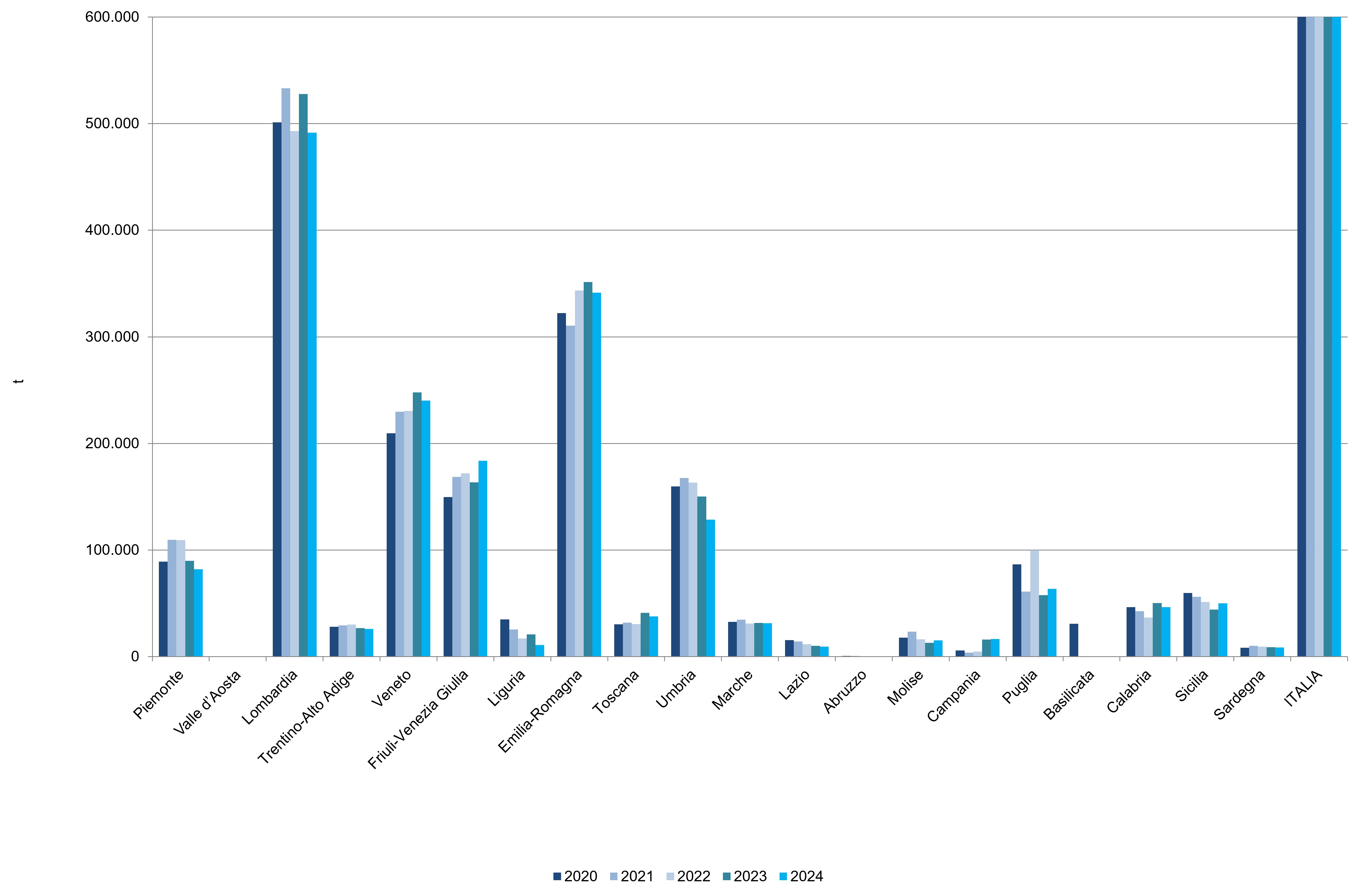
The indicator measures the quantity of Waste from Economic Activities co-incinerated in production plants across the country, totally or partially replacing traditional fuels. In 2024, approximately 1.8 million tons of Waste from Economic Activities were recovered in co-incineration plants. Compared to 2023, the quantities recovered showed a decrease of almost 68,000 tons (-3.7%). With reference to the macro-geographical areas, the data show that the majority of special waste is recovered in the North (77.1% of the total), followed by Central Italy, with 11.6%, and the South with 11.3%.
Pressure and response indicator that measures the quantities of Waste from Economic Activities treated in production plants in total or partial replacement of traditional fuels.
Evaluate the quantities of waste used to fully or partially replace traditional fuels in production plants across the country. This allows for comparisons between regions/provinces/municipalities and provides information to support environmental policy decisions.
The regulatory framework for co-incineration is Directive 2010/75/EU of the European Parliament and of the Council of 24 November 2010 on industrial emissions (integrated pollution prevention and control), transposed into national law in Title III-bis of Part IV of Legislative Decree 152/06 (Environmental Code). This Directive comprehensively regulates the incineration and co-incineration of hazardous and non-hazardous waste, starting from the construction of the plants, including the various phases of the incineration activity from the moment of waste reception to the disposal of the residues. In particular, the decree establishes specific provisions regarding: emission limit values; sampling, analysis, and evaluation methods for pollutants from waste incineration and co-incineration plants; General technical criteria and standards regarding the construction, functional, and management characteristics of incineration and co-incineration plants, with particular reference to the need to ensure integrated environmental protection against emissions from such plants; timing criteria for adapting existing plants to new regulations.
ISPRA - Waste from Economic Activitie Report 2026
No limitations
None
ISPRA Single Environmental Declaration Form (MUD) - Waste Registry (http://www.catasto-rifiuti.isprambiente.it).
National, Regional
2010-2024
Quantity and type of special waste sent to co-incineration plants.
The indicator measures the amount of Waste from Economic Activities coincided in partial or total replacement of traditional fuels. The information is provided disaggregated with respect to the different types of refusal, i. e. Waste from Economic Activities dangerous and Waste from Economic Activities non -hazardous and divided between the different regional contexts. The information base consists of the data contained in the single model of environmental declaration communicated by the subjects identified by article 189 paragraph 3 of Legislative Decree 152/2006, to the Chambers of Commerce, Industry, Crafts and Territorially competent agriculture.
In 2024, approximately 1.8 million tons of hazardous waste were recovered in co-incineration plants. Compared to 2023, the quantities recovered decreased by 68,000 tons (-3.7%) (Table 1). The national plant fleet includes 290 operating plants; of these, 244 treat a quantity of waste greater than 100 tons/year, while the remaining 46 use small quantities of waste exclusively for the recovery of thermal/electrical energy for their production cycle (Table 2).
The quantity of Waste from Economic Activities sent for energy recovery in 2024 shows a 21.5% decrease compared to 2010, corresponding to 487 thousand tons, outlining a decreasing trend (Table 3).
| Allegati |
|---|
Titolo
Table 1: Quantity of Waste from Economic Activities used as an energy source (R1) in Italy, by region Fonte
ISPRA |
Titolo
Table 2: Energy recovery plants by region (2024) Fonte
ISPRA |
Titolo
Table 3: Quantity of Waste from Economic Activities used as an energy source (R1) Fonte
ISPRA |
Thumbnail
Titolo
Figure 1: Quantity of special waste used as an energy source (R1) Fonte
ISPRA |
The regional picture shows that the majority of hazardous waste is recovered in the Northern regions (77.1% of the total), followed by the Central regions with 11.6% and the Southern regions with 11.3%. A regional comparison, in the two-year period 2023-2024, shows that the most significant declines in co-incinerated waste occurred in Lombardy (-36,000 tonnes, -6.8%), Umbria (approximately -22,000 tonnes, -14.5%), Emilia-Romagna (approximately 10,000 tonnes, -2.8%), and Liguria (approximately 10,000 tonnes, -47.2%). However, increases were observed in Friuli-Venezia Giulia (over 20,000 tons, +12.4%), Puglia (6,000 tons, +10.5%), Sicily (almost 6,000 tons, +13.2%), Molise (2,000 tons, +18.3%), and Campania (over 400 tons, +2.7%) (Figure 1).