Giovanni Finocchiaro, Silvia Iaccarino
The indicator monitors the tourism pressure exerted on the territory both in terms of magnitude, expressed by tourist arrivals, and the pressure borne by the territory, represented by tourist overnight stays. In 2025, national values show a marked increase: the arrivals-to-resident population ratio rises to 2.7, while the overnight stays-to-resident population ratio reaches 9.1, further exceeding pre-pandemic levels. Some regions and autonomous provinces record particularly high values: Valle d'Aosta registers 13.0 arrivals and 36.9 overnight stays per resident, while the Autonomous Province of Bolzano reaches 16.7 and 70.6, respectively. These figures highlight particularly intense and geographically concentrated tourism pressure.
In defining tourism intensity, parameters have been considered that help monitor the load tourism places on a territory, particularly the factors responsible for pressure and environmental impacts, which translate into the exploitation of natural resources, waste production, pollution, and more.
The "number of arrivals per resident population" represents the tourism burden on the region, while the "number of overnight stays per resident population" reflects the strain on the territory and its infrastructure. The distribution of "arrivals" and "overnight stays" across the territory and by month highlights particularly "hot spots" and the seasonality of tourist flows.
The "average length of stay," calculated as the ratio between the number of nights spent (overnight stays) and the number of guests arriving at an accommodation facility (arrivals), indicates the pressures on the environment associated with tourism accommodations, such as water consumption, waste disposal, and intensive use of natural resources.
Determine the tourist load acting on the territory.
There are no targets for the indicator. The supporting regulatory references are: Directive 95/97/EC of 23/11/95, L 135/01
Istat, Various Publications
The lack of reference values that allow for a unequivocal assessment of whether the territory's carrying capacity has been exceeded or not represents a limitation of the indicator.
Measurement of the use of natural resources.
Istat (National Institute of Statistics)
https://esploradati.istat.it/databrowser/#/it
http://demo.istat.it/
National, Regional
1991-2025
Presences/inhabitant, arrivals/inhabitant
The average length of stay is calculated as the ratio between the total nights spent and the number of guests arriving at accommodation facilities.
Other variables of interest are presented through ratios, percentage calculations, and indexed variations.
In 2025, tourism intensity increases significantly compared with 2024. At the national level, approximately 160.8 million arrivals and 535.5 million overnight stays are recorded, corresponding to 2.7 arrivals and 9.1 overnight stays per resident, respectively. The average length of stay is 3.33 nights, remaining substantially stable compared with the previous year (Table 1).
Some areas record values well above the national average. The Autonomous Province of Bolzano reaches 16.7 arrivals and 70.6 overnight stays per resident, while Valle d'Aosta records 13.0 arrivals and 36.9 overnight stays per resident, respectively. High values are also observed in the Autonomous Province of Trento, with 10.0 arrivals and 41.3 overnight stays per resident, and in Trentino-Alto Adige as a whole, with 13.4 arrivals and 55.8 overnight stays per resident (Table 2).
The increase in tourist flows highlights growing pressure, particularly in areas with a strong tourism vocation, where the present population may temporarily increase several-fold compared with the resident population.
The state in 2025 is assessed as poor from an environmental perspective: the growth in tourist flows results in increased pressure on natural resources, infrastructure, and local services, highlighting the need to strengthen sustainable management strategies, particularly in areas with the highest tourism intensity.
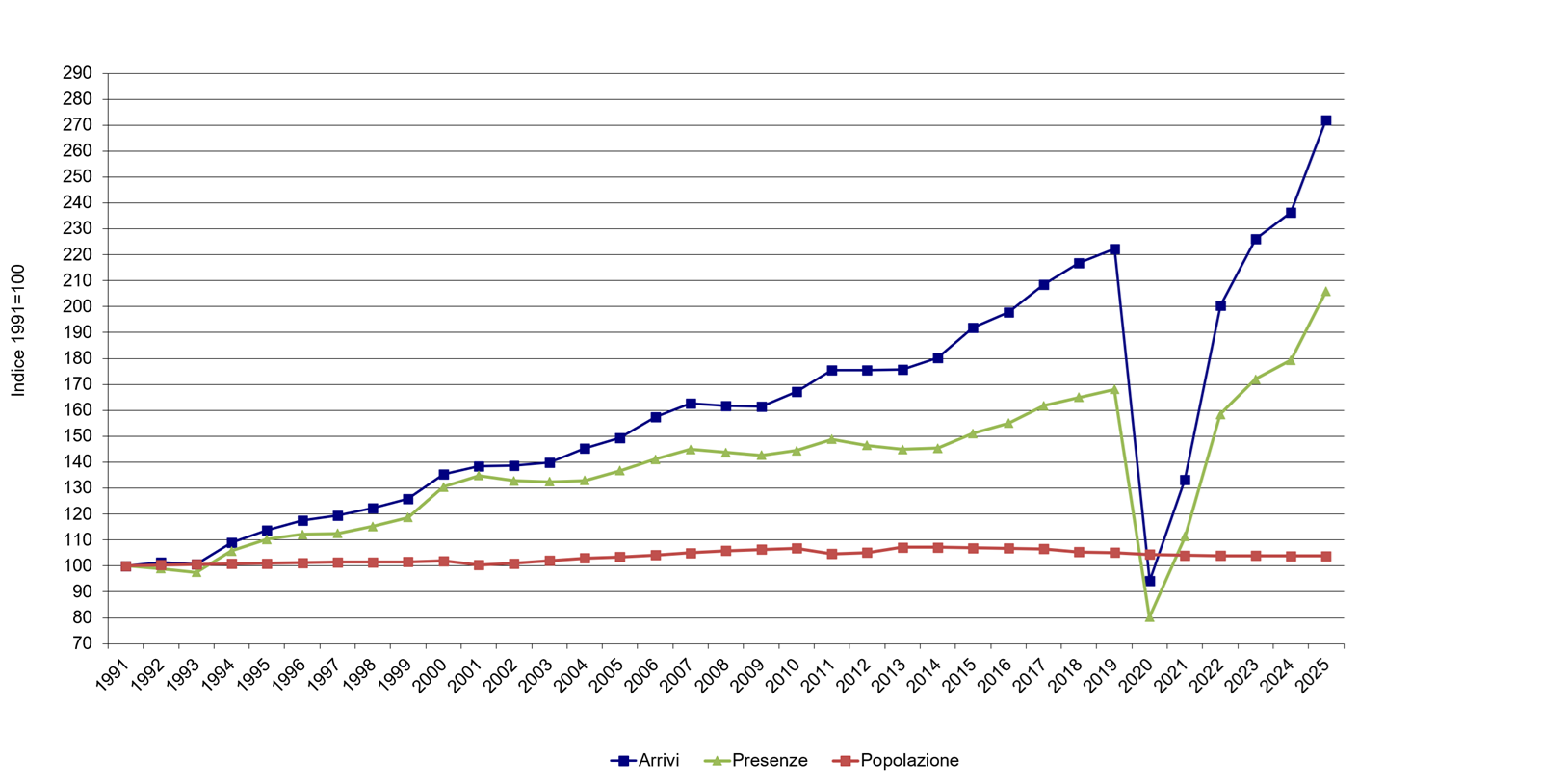
Over the period 2000–2025, tourist arrivals more than doubled, increasing by 100.9%, while overnight stays increased by 58%. During the same period, the resident population grew by only 1.9%. This trend indicates that tourism flows have increased at a much faster rate than the resident population on which many territorial services and infrastructures are sized (Figure 1).
Following the sharp decline recorded in 2020 and 2021 as a result of the COVID-19 pandemic, arrivals and overnight stays recovered rapidly, reaching the highest values of the observed time series in 2025. Seasonality remains pronounced, with the third quarter accounting for 45.2% of annual overnight stays. This share is slightly lower than in 2024 (45.4%), while the share of the fourth quarter increases from 13.8% in 2019 to 15.1% in 2025. This indicates a moderate extension of tourist flows towards the final part of the year, although it does not substantially alter the concentration of tourism during the summer season (Table 3).
Overall, the long-term trend is assessed as negative from an environmental perspective, as the growth in tourism intensity and the persistent seasonal concentration do not yet reflect a development fully consistent with the desired direction. Nevertheless, some signs of a more even distribution of tourist flows throughout the year are emerging and should be reinforced through appropriate management policies.
| Allegati |
|---|
Titolo
Table 1: Tourism intensity in Italy: arrivals, presences, average length of stay in all accommodation establishments Fonte
ISPRA processing based on ISTAT data. |
Titolo
Table 2: Tourism intensity by region: arrivals, presences, average stay in all accommodation establishments (2025) Fonte
ISPRA processing on ISTAT data |
Titolo
Table 3: Attendance at accommodation facilities by quarter and incidence on the total Fonte
ISPRA processing based on ISTAT data |
Thumbnail
Titolo
Figure 1: Variation in tourism intensity in terms of arrivals, presences and resident population Fonte
ISPRA processing based on ISTAT data |
The totals reported in the tables may differ slightly due to rounding.
The overall picture highlights a particularly strong increase in tourism intensity. Compared with 2024, arrivals increased from approximately 139.6 million to 160.8 million, while overnight stays rose from 466.2 million to 535.5 million. Tourism therefore results in an increasingly substantial temporary expansion of the population present within the territory, with potential repercussions for mobility, water and energy consumption, waste generation, wastewater treatment systems, and the availability of public services.
The national average length of stay is 3.33 nights, a value substantially unchanged from 2024. The stability of the average length of stay, combined with the marked increase in arrivals, indicates that the growth in overnight stays is mainly driven by the overall expansion of tourist flows rather than by longer stays. This may also intensify impacts associated with mobility, frequent guest turnover, and the operational management of accommodation establishments.
Seasonality remains a key factor for sustainability. In 2025, approximately 45.2% of overnight stays are concentrated in the third quarter, representing a slight decrease compared with 2024. At the same time, the share of overnight stays occurring in the fourth quarter increases to 15.1%, the highest value in the observed series. This trend indicates an initial extension of the tourism season, although it is not yet sufficient to significantly reduce peak summer pressures.
The regional analysis reveals considerable territorial heterogeneity. In the Autonomous Province of Bolzano, tourist overnight stays are equivalent to approximately 70.6 times the resident population, while in Valle d'Aosta the ratio reaches 36.9. Trento, Veneto, Tuscany, and Sardinia also record values well above the national average. In these contexts, tourism management should be supported by carrying capacity assessments, local monitoring systems, and policies aimed at achieving a more balanced spatial and temporal distribution of tourist flows.