Giovanni Finocchiaro, Silvia Iaccarino
The indicator monitors the spread of agritourism farms, a form of tourism integrated into the local area that helps reduce the impact of infrastructure on biodiversity and the landscape.
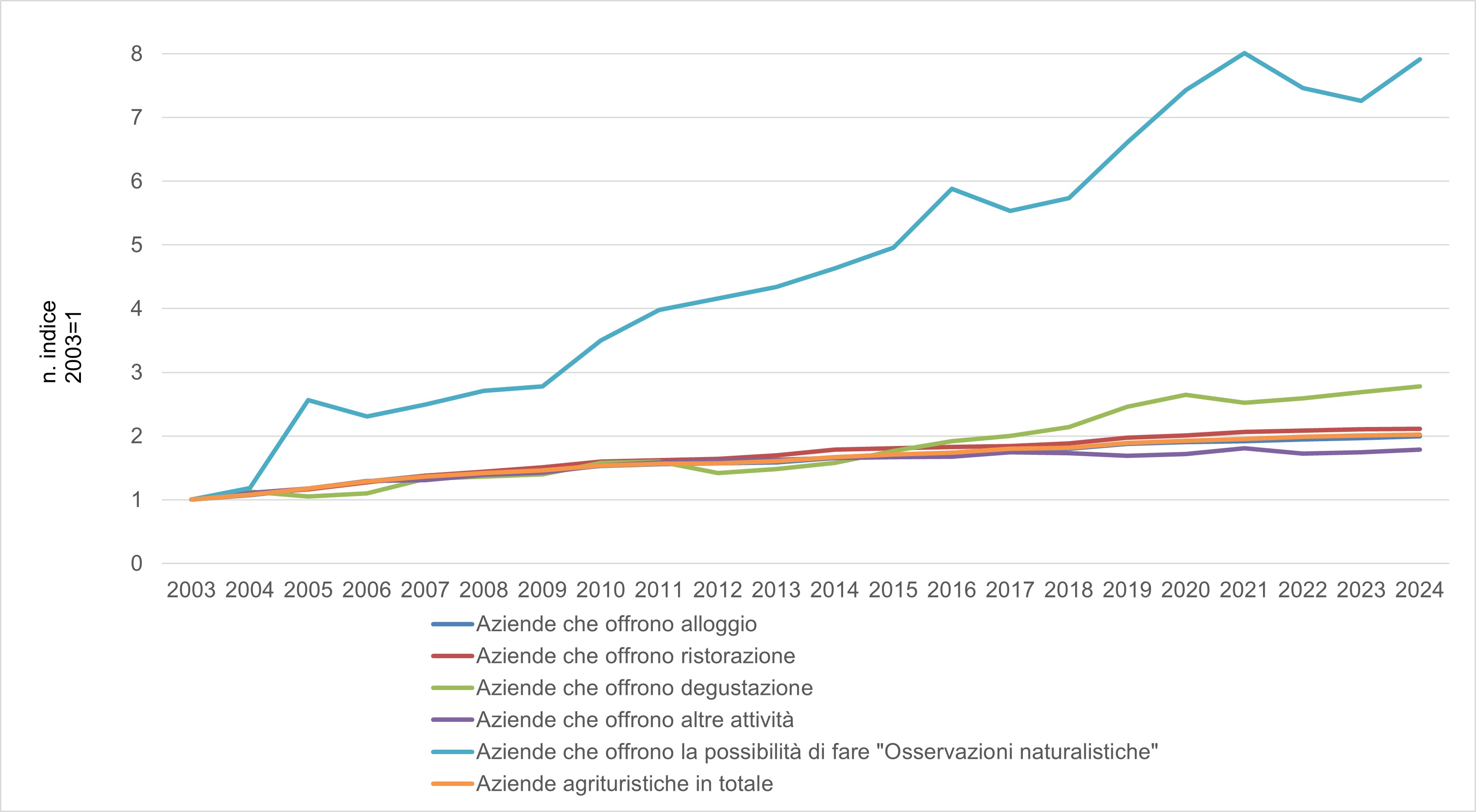
Between 2003 and 2024, the sector grew by 102%, increasing from approximately 13,000 to more than 26,000 agritourism farms. The number of establishments offering accommodation increased by 99%. Agritourism farms offering “green activities”, particularly nature observation activities, also recorded significant growth.
The indicator reports the number of agritourism farms, examining their composition, accommodation capacity and the agritourism activities offered.
Agritourism is defined as the provision of hospitality services by a farm that has obtained the required authorisation and adapted its facilities to carry out such activities.
To quantify the presence of agritourism farms as a form of tourism activity that is integrated into the local area and aimed at reducing the “burden” of infrastructure on biodiversity and the landscape.
In addition, the tourism activities offered—such as hiking, horse riding and cycling—can provide an indication of the solutions adopted to minimise the impacts associated with motorised transport.
The National Agritourism Law was enacted on 20 February 2006 and published in Official Gazette No. 63 of 16 March 2006.
Istat, Statistics report - Agritourism companies in Italy. Year 2024
ISMEA, Report, Agritourism and multifunctionality. Scenario and prospects, 2024
There is no data available on the means of soft mobility available to guests.
Istat (National Institute of Statistics)
National, Regional
2003-2024
Simple calculation operations.
In 2024, the number of authorised agritourism farms reached 26,360, an increase of 0.9% compared with the previous year.
Overall, 81% of establishments offered accommodation services (Table 1), while 45% combined accommodation and food-service activities (Table 3).
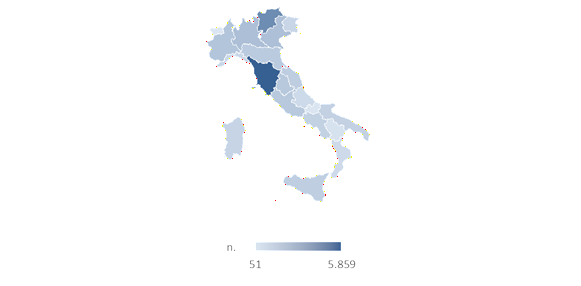
The geographical distribution confirms a particularly high concentration in Tuscany and Trentino-Alto Adige, especially in the Autonomous Province of Bolzano.
Between 2023 and 2024, the Aosta Valley recorded the largest decline in the number of agritourism farms.
Between 2003 and 2024, the agritourism sector recorded steady growth, with a 102% increase in the number of farms.
The number of establishments offering accommodation increased by 99%, while the number offering farm-based food services rose by 111%. Agritourism farms offering food and wine tasting activities almost tripled, increasing from approximately 2,500 to more than 6,700 establishments (Table 1).
Nature observation activities increased from 224 establishments in 2003 to 1,772 in 2024, highlighting strong interest in experiences involving direct contact with nature.
| Data |
|---|
Headline
Table 1: Agrotourism businesses by type* Data source
ISPRA’s analysis based on Istat data Note
*A agricultural enterprise may be authorized to carry out one or more types of agrotourism activities. |
Headline
Table 2: Agrotourism businesses by type of activity * Data source
ISPRA’s analysis based on Istat data Note
* A farm may be authorized to carry out one or more types of agritourism activities |
Headline
Table 3: Agritourism farms by type of accommodation (2024) Data source
ISTAT Note
(*) A farm may be authorized to carry out one or more types of agritourism activities |
Headline
Table 4: Agritourism farms* by type of additional activity (2024) Data source
ISTAT Note
(*) A farm may be authorized to carry out one or more types of agritourism activities |
Thumbnail
Headline
Figure 1: Agritourism farms (2024) Data source
ISPRA elaboration on ISTAT data |
Thumbnail
Headline
Figure 2: Temporal distribution of agritourism farms by main service provided Data source
ISPRA elaboration on ISTAT data |
Agritourism continues to represent a major strength of Italian agricultural multifunctionality, combining tradition and innovation within a sustainable development model.
Growing interest in experiential services and soft mobility has encouraged the diversification of the range of services offered.
In 2024, 21,449 agritourism farms were authorised to provide accommodation, corresponding to 81% of the national total. They offered more than 310,000 bed places, an increase of 2.6% compared with 2023, and more than 15,500 pitches for farm camping (Table 1).
At regional level, the largest increases during the latest year were recorded in Sicily, up 8.9%; Basilicata, up 3.3%; Sardinia, up 2.6%; Campania, up 2.2%; and Piedmont, up 2%. By contrast, the number of establishments decreased in eight regions (Table 2 and Figure 1).
Trentino-Alto Adige and Tuscany recorded the highest proportion of agritourism farms offering accommodation only, at 57%, while the combination of accommodation and food-service activities was most widespread in Tuscany, at 20% (Table 3).
In 2024, 13,265 agritourism farms offered complementary activities. Hiking activities were particularly widespread in Sicily, Trentino-Alto Adige and Campania, while mountain-bike trails were especially common in Piedmont, Tuscany and Umbria.
Approximately 5,100 establishments offered courses, trekking and horse-riding activities, while 1,772 agritourism farms provided nature observation experiences.
In addition, 2,340 agritourism farms operated as educational farms, with particularly high numbers in Tuscany, Piedmont, Lombardy, Emilia-Romagna and Veneto (Table 4).