Cristina Frizza
The indicator analyzes the commercial flows of recyclable materials, highlighting a growth trend of 20% in cross-border movements in the period 2004–2024 (from 12.9 to 15.5 million tonnes). The increase in intra-EU imports stands out (+34.5%), essential for the metallurgical and manufacturing sectors, and the strong expansion of extra-EU exports (+83.4%). In 2024, the national system absorbed 12.7 million tonnes of imports, dominated by ferrous metals (5.9 million tonnes), while it contributed to the global supply with 2.8 million tonnes exported, of which approximately half was made up of paper and cardboard. These dynamics reflect the consolidation of Italian circular supply chains, in full coherence with the European objectives of resource efficiency and reduction of the use of virgin raw materials.
The indicator measures international trade flows of recyclable materials (secondary raw materials), quantifying Italy's imports and exports, with reference to the main flows of waste and materials destined for recovery or recycling. Specifically, it detects the quantities of waste and recyclable scrap, as well as other secondary raw materials (by-products), which are moved between Italy and other EU member states (intra-EU trade) and across the borders of the Union (extra-EU trade).
Measuring progress in the "secondary raw materials" sector. From a circularity perspective, materials deriving from waste are reinjected into the economic system as new resources, guaranteeing benefits such as waste reduction and greater security in the supply of raw materials. The analysis of these flows allows us to: evaluate Italy's role in the global and European recycling market; monitor the competitiveness of the national industrial system and its dependence on or net supply of recyclable materials; support resource efficiency policies and monitoring of the EU Circular Economy Action Plan.
Communication COM (2020) 98 final of 11 March 2020: "A new Circular Economy Action Plan - For a cleaner and more competitive Europe". This plan defines the European action framework for the transition towards the circular economy, in which the monitoring of secondary raw materials is a key element.
Ministerial Decree n. 259 of 24 June 2022: Approval of the National Strategy for the circular economy. This is the national programmatic document that identifies actions, objectives and measures to ensure an effective transition towards a circular economic model in Italy.
EU monitoring framework for the circular economy: The indicator is an integral part of the European framework aimed at measuring progress in the thematic area of "secondary raw materials".
Eurostat, Reference Metadata "Trade in recyclable raw materials": https://ec. europa. eu/eurostat/cache/metadata/en/cei_srm020_esmsip2. htm
EUROSTAT (Statistical Office of the European Communities)
National
2004-2024
The development of the indicator follows a multi-phase procedure based on the harmonization of statistical data on international trade, divided into the following steps:
- Identification of source and flows: The basic data are extracted from the International Trade in Goods Statistics (ITGS) published by Eurostat. Import and export flows for Italy are considered, divided into intra-EU trade (arrivals from member states) and extra-EU (trade with countries outside the Union)
- Product selection (Mapping): The delimitation of the scope of "recyclable raw materials" occurs through the selection of specific codes of the Combined Nomenclature (CN codes). The processing involves the application of a correspondence table that associates the individual product codes with the respective categories of materials (e. g. Paper and cardboard, plastic, ferrous and non-ferrous metals).
- Aggregation and calculation: For each category of material and type of trading partner, the data is aggregated to calculate: Net mass: Sum of physical quantities expressed in tonnes. The indicator total includes the entire list of products defined as "secondary raw materials".
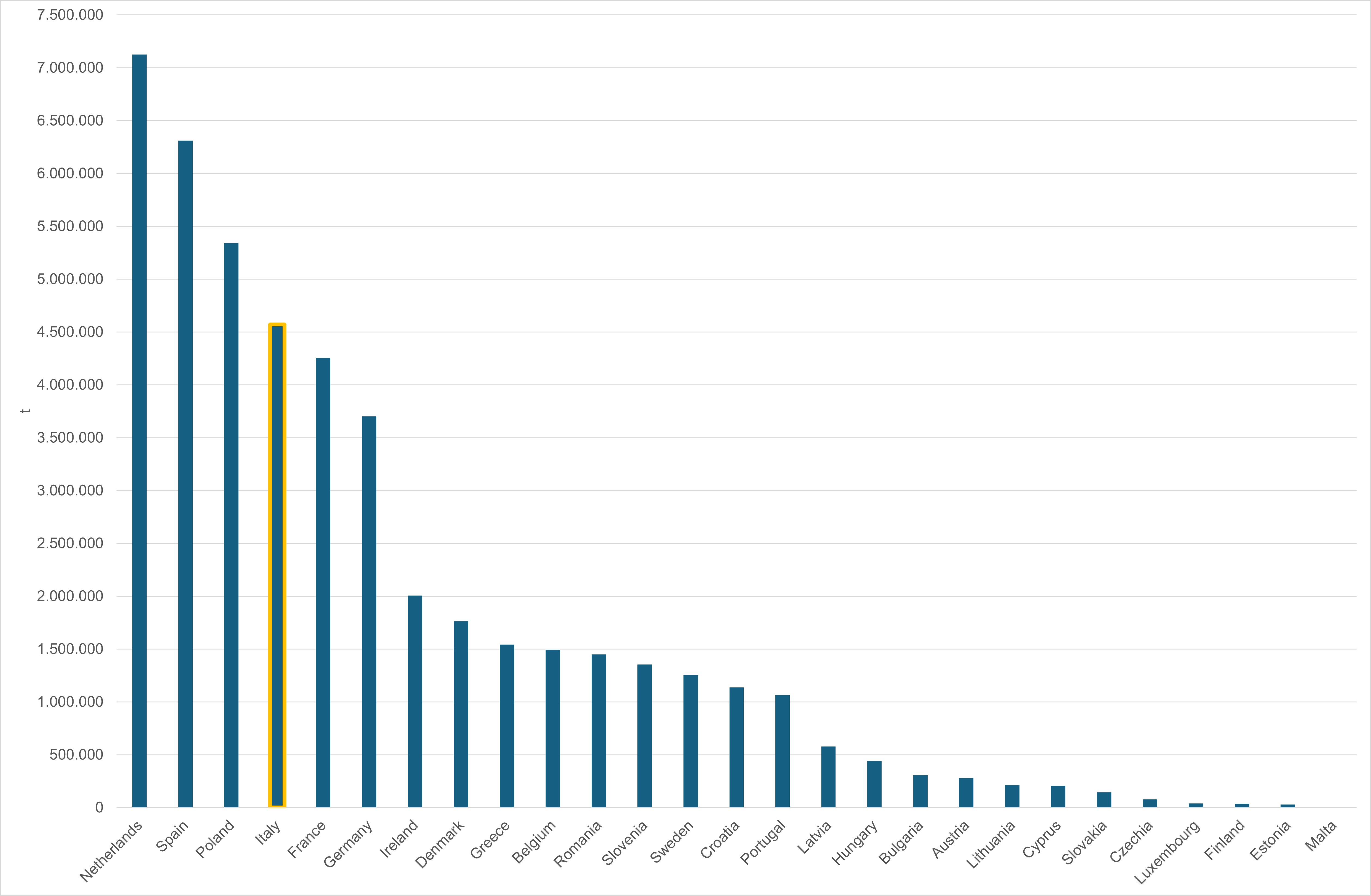
In 2024, the trade of recyclable raw materials confirms Italy's role in the European market of secondary raw materials and the relevance of the national recycling sector within the circular economy. The data highlights a total volume of approximately 12.7 million tonnes of imported recyclable materials, of which over 8.1 million come from European Union countries and approximately 4.6 million from non-EU countries (Tables 1 and 2). These values show a high level of integration of the national production system in the European material recovery chains and the ability of the Italian industry to use secondary materials in production processes. Italy is among the main EU countries for commercial volumes of recyclable materials, in fact, it manages approximately 10% of the extra-EU imports of the entire European Union, confirming a significant role in the international flows of secondary materials. Exports to non-EU countries, equal to approximately 2.8 million tonnes in 2024, also indicate the ability of the national system to contribute to international flows of secondary raw materials, in particular in the paper, cardboard and metal sectors (Table 3).
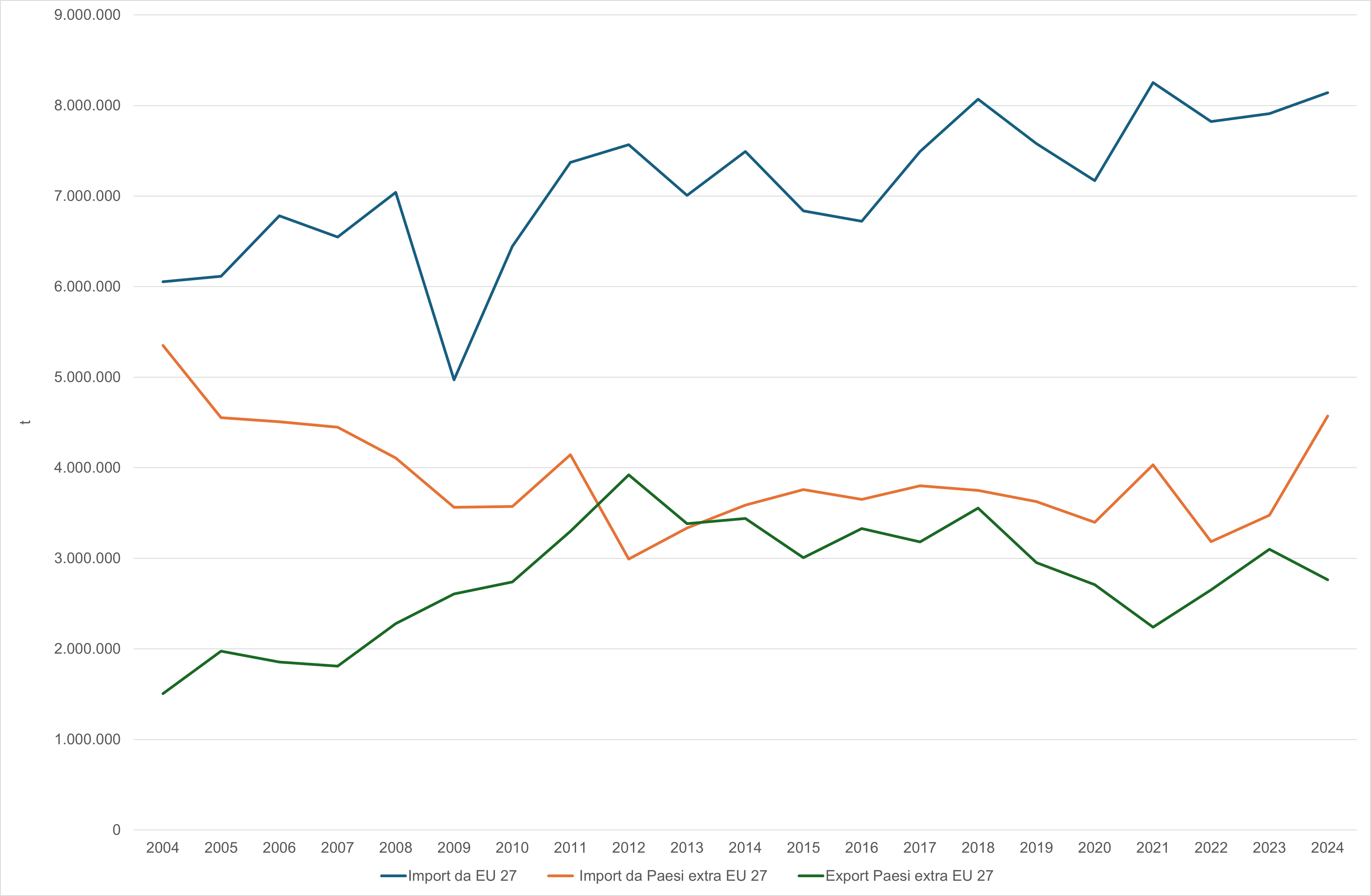
In the period 2004–2024, commercial flows of recyclable materials show positive growth, consistent with the progressive strengthening of the circular economy and material recovery chains. The overall cross-border movements of monitored recyclable materials increased by approximately 20%, from approximately 12.9 to 15.5 million tonnes, highlighting a growing economic and industrial importance of secondary raw materials (Tables 1,2 and 3). The increase in intra-EU imports (+34.5%) reflects the greater use of secondary materials by the national production system, in particular in the metallurgical, paper and manufacturing sectors (Table 1). At the same time, exports to non-EU countries show a significant increase (+83.4%), indicating a strengthening of Italy's role in the international markets of recyclable materials (Table 3).
Overall, the observed trend appears consistent with the European objectives of increasing the circularity of materials and reducing the use of virgin raw materials.
| Data |
|---|
Headline
Table 1: Imports of secondary raw materials into Italy from Europe by material type Data source
Eurostat |
Headline
Table 2: Imports of secondary raw materials into Italy from non-EU-27 countries, by material type Data source
Eurostat |
Headline
Table 3: Exports of secondary raw materials from Italy to non-EU-27 countries by material type Data source
Eurostat |
Thumbnail
Headline
Figure 1: Extra-EU-27 imports of secondary raw materials into Europe (2024) Data source
ISPRA elaboration on Eurostat data |
Thumbnail
Headline
Figure 2: Trend in Italy's trade flows of secondary raw materials Data source
ISPRA elaboration on Eurostat data |
In 2024, overall imports in Italy reached approximately 12.7 million tonnes, of which over 8.1 million came from European Union countries and approximately 4.6 million from non-EU countries, demonstrating the ability of the national industry to use secondary materials in production processes (Tables 1 and 2).
The ferrous metals sector represents the main component of supply flows, with over 5.9 million tonnes imported in 2024, mainly from EU countries. This dynamic reflects the relevance of the national steel supply chain based on the use of scrap metal and the strategic role of recycling in the Italian manufacturing sector. Furthermore, the flows relating to organic materials and mineral materials from non-EU markets are significant, contributing to the availability of secondary materials for national industrial supply chains (Table 1).
During 2024, an increase in intra-EU imports of precious metals intended for recovery is also observed, which could be associated with the strengthening of valorisation activities of the fractions with greater technological and economic content (Table 1).
On the export front, Italy exported approximately 2.8 million tonnes of recyclable materials to non-EU countries. The paper and cardboard sector represents a significant share of export flows, with approximately 1.3 million tonnes (Table 3), confirming the consolidated role of national material recovery chains. Overall, the data highlights an industrial recycling structure developed and consistent with the European and national objectives of circular economy and efficient use of resources.