Fabrizio Vazzana, Francesca Pepe
The indicator allows the number of establishments to be identified, by regional and provincial area, divided by category, based on the obligations established by the legislation to which the plant managers are subject. Al november 30, 2025, the total number of establishments considered dangerous for the purposes of a major accident, present in Italy, is equal to 971. As compared to june 2025, where the number of establishments was equal to 932, there is an increase (39 more). Regarding the distribution of the notified establishments throughout the country, the situation remains almost unchanged, around a quarter is concentrated in Lombardy and in regions with a high presence of industries such as: Veneto, Piedmont and Emilia-Romagna . In almost all Italian provinces there is at least one plant at risk of a major accident.
The data available for this indicator is the number of establishments, by regional and provincial area, divided by category, based on the obligations established by the legislation to which the establishment managers are subject. Legislative Decree 26 June 2015, n. 105, consistently with the European Directive 2012/18/EU relating to the control of the risk of major accidents associated with the possession of dangerous substances, identifies, based on the nature and quantity of the dangerous substances, two different categories of industries with the risk of major accidents, associating certain obligations with each of them. In particular, article 3, paragraph 1 of Legislative Decree 105/15 identifies the following categories of establishments: - "Lower threshold establishment": an establishment in which dangerous substances are present in quantities equal to or greater than the quantities listed in column 2 of part 1 or in column 2 of part 2 of annex 1, but in quantities lower than the quantities listed in column 3 of part 1, or in column 3 of part 2 of annex 1, applying, where applicable, the summation rule referred to in note 4 of Annex 1; - "Upper threshold establishment": an establishment in which dangerous substances are present in quantities equal to or greater than the quantities listed in column 3 of part 1 or in column 3 of part 2 of annex 1, applying, where applicable, the summation rule referred to in note 4 of annex 1. The managers of establishments that meet these characteristics must fulfill specific obligations including preparing technical and information documentation, which differs depending on the category, content and recipients. Specifically, it is mandatory to submit to the competent authorities, including ISPRA, the information referred to in the form of annex 5 of Legislative Decree 105/2015, prepare a "Document of policy for the prevention of major accidents and the adoption of a Safety Management System commensurate with the dangers and complexity of the company and the processes used. The so-called SGS-PIR is mandatory by law, the only case among all the other management systems. For threshold establishments superior, the manager is required to draw up a "Safety Report" to be sent to the competent authority responsible for its evaluation (Regional Technical Committees of the Fire Brigade).
Provide a general picture of the pressures exerted by establishments at risk of a major accident in the area.
Preparation of the national inventory of establishments likely to cause major accidents (art. 5, paragraph 3 of Legislative Decree 105/2015).
ISPRA-MASE, Seveso Inventory ISPRA, Yearbook of environmental data - Various years
None
none
ISPRA MASE (Ministry of the Environment and Energy Safety)
All information comes from the national inventory of establishments likely to cause major accidents, provided for by article 5, paragraph 3 of Legislative Decree 105/15. Https://www. rischioindustriale. isprambiente. gov. it/seveso-query-105/Default. php
National, Regional, Provincial
2023-2025
All information is taken from the National Inventory of establishments likely to cause major accidents, provided for by Article 5, paragraph 3 of Legislative Decree 105/2015. The inventory allows the extraction of an Excel file which allows the data necessary to update the indicator to be extrapolated after different steps.
Al november 30, 2025, the total number of establishments considered dangerous for the purposes of a major accident, present in Italy, is equal to 971. As compared to june 2025, where the number of establishments was equal to 932, there is an increase (39 more).
No significant changes are highlighted considering the trend over the years, although with an increase in the number and type of industries subject to the obligations imposed by the "Seveso" legislation.
| Allegati |
|---|
Thumbnail
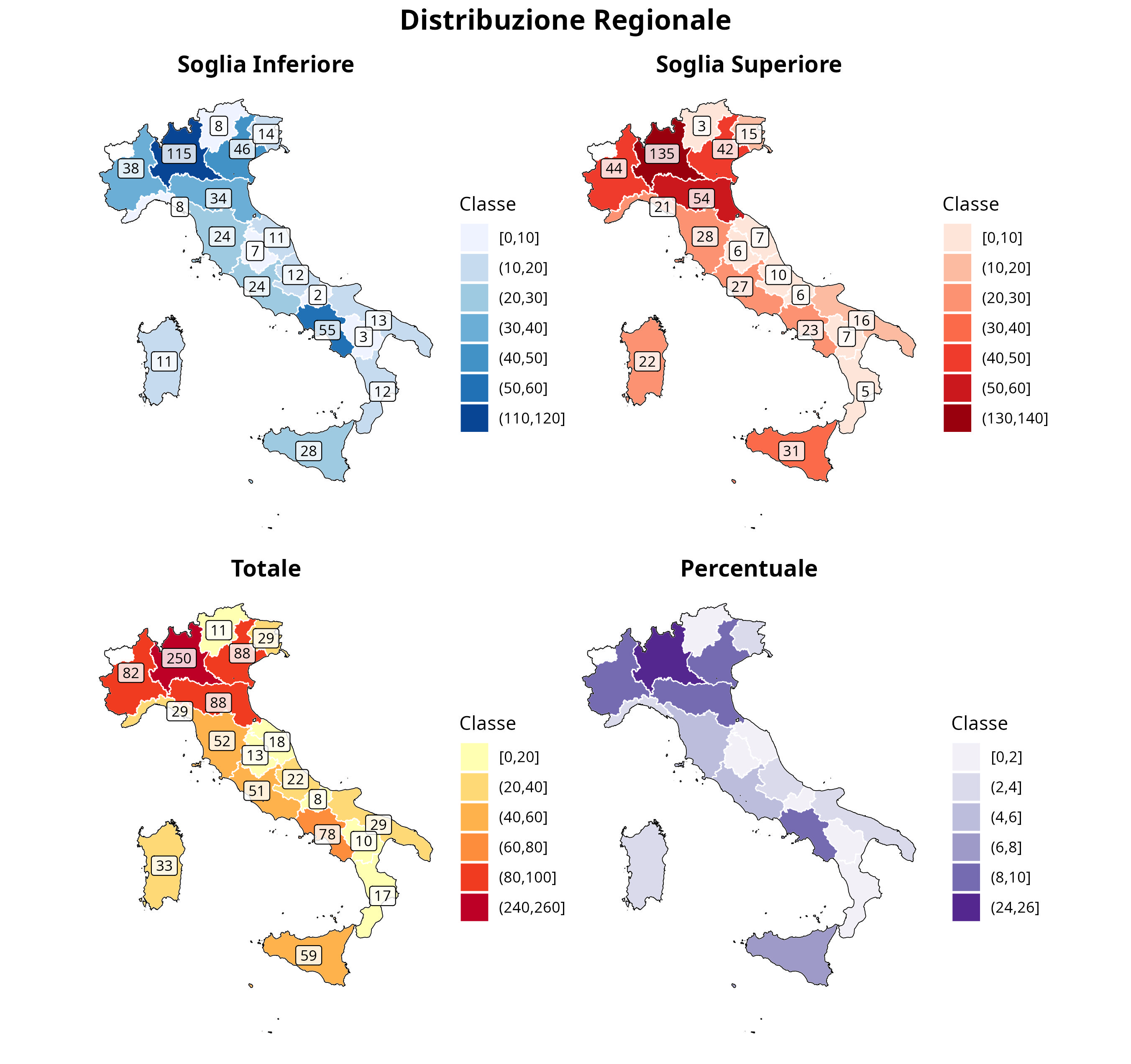
Titolo
Figure 1: Regional distribution of establishments with major accident hazard Fonte
ISPRA |
Thumbnail
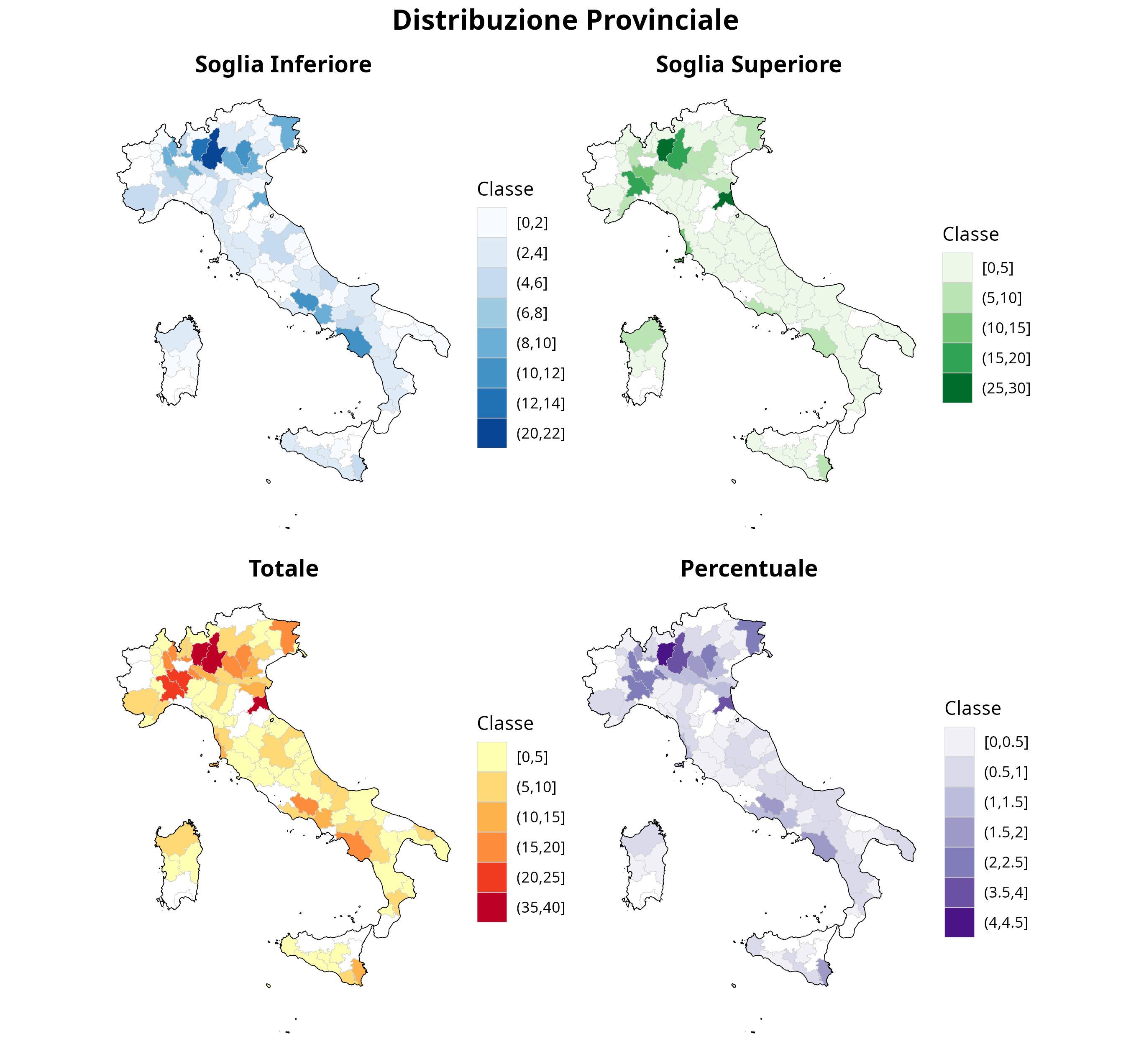
Titolo
Figure 2: Provincial distribution of establishments with risk of major accidents Fonte
ISPRA |
In Table 1, with reference to the updated information a november 30, 2025, the distribution on the national territory of the establishments subject to Legislative Decree 105/2015, belonging to the different categories (upper threshold and lower threshold) and therefore to the obligations referred to in the articles, is summarized. 13 and 15, divided by provinces and regions. Regarding the distribution of the notified establishments throughout the country, approximately a quarter is concentrated in Lombardy. Regions with a high presence of industries at risk are also: Veneto, Emilia-Romagna and Piedmont (all in the North and with 8-9% each). Particular concentrations of industries can be noted in areas coinciding mostly with the petrochemical (formerly Enichem) and refining hubs such as Trecate (in the Novara area), Porto Marghera, Ferrara and Ravenna in the North, Gela (CL), Augusta-Priolo-Melilli-(Syracuse) and Sarroch (CA). Important concentrations of industries are also found in industrial areas in the provinces of Milan, Bergamo, Brescia, Naples, Venice, Pavia, Alessandria, Vicenza. In recent times, thanks to the global economic-industrial crisis and that of the petrochemical industry in particular, some of the aforementioned areas have been partially abandoned or are undergoing industrial transformation (where petroleum chemistry is being replaced with green chemistry). In almost all Italian provinces there is at least one factory at risk of a major accident, and those with a high number of factories are: - in the North: Milan (60 factories), Bergamo (39), Ravenna (38), Brescia (37), Venice (22), Turin (22), Pavia (21), Alexandria (21), Vicenza (20), Novara (20), Udine (20), Lodi (20), Monza and Brianza (17), Varese (17), Bologna (16), Genoa (16), Verona (16), Cremona (13), Padua (12), Ferrara (12), Mantua (10). At the Center: Rome (19), Frosinone (16), Livorno (13), Latin (10), Florence (10). In the South and Islands: Naples (35), Salerno (18), Syracuse (15), Caserta (13), Cagliari (12), Catania (12).