Patrizia D'Alessandro
In 2024, the total amount of municipal waste disposed of in landfills amounted to over 4.4 million tonnes, and the number of operational landfills is equal to 102 plants. There was a reduction, compared to 2023, in the total quantity of urban waste disposed of in landfill equal to 3.7% (-170 thousand tons), and in the number of operational sites equal to 8.9% (-10 facilities).
This indicator represents the amount of municipal waste disposed of in landfills and the number of operational landfill sites handling municipal waste.
To monitor the application of the European waste management hierarchy established by Article 4 of Directive 2008/98/EC and subsequent amendments, which considers landfill disposal as a residual form of waste management. Additionally, to verify the progress toward reducing the biodegradable fraction of municipal waste disposed of in landfills.
Directive 1999/31/EC on the landfill of waste, as amended.
Council Decision 2003/33/EC establishing criteria and procedures for the acceptance of waste at landfills pursuant to Article 16 of, and Annex II to, Directive 1999/31/EC, as amended.
Legislative Decree No. 36/2003 implementing Directive 1999/31/EC on the landfill of waste, as amended.
Legislative Decree No. 152/2006 laying down environmental provisions, Part IV, as amended.
Directive 2008/98/EC on waste, as amended.
Ministerial Decree of 27 September 2010 defining the criteria for the acceptance of waste at landfills, as amended by the Ministerial Decree of 24 June 2015.
Directive (EU) 2018/850 amending Directive 1999/31/EC on the landfill of waste.
Directive (EU) 2018/851 amending Directive 2008/98/EC on waste.
Legislative Decree No. 121/2020 of 3 September 2020 transposing Directive (EU) 2018/850.
Directive 1999/31/EC establishes, for each Member State, that from its date of entry into force, the quantity of biodegradable municipal waste to be landfilled must be reduced within five years to 75% by weight of the total biodegradable municipal waste generated in 1995; within eight years to 50%; and within fifteen years to 35%. This Directive was transposed into national law by Legislative Decree No. 36/2003, which lays down the operational and technical requirements for landfill facilities, defining the procedures, construction criteria and management arrangements for such facilities with the aim of reducing the environmental impact of waste disposal sites. Pursuant to the above-mentioned decree, the Regions, as an integration to the Regional Waste Management Plan, prepared a programme for reducing the biodegradable fraction destined for landfill, in order to achieve the established targets for the disposal of biodegradable waste in the short term, 173 kg/year per inhabitant by 2008, in the medium term, 115 kg/year per inhabitant by 2011, and in the long term, 81 kg/year per inhabitant by 2018.
Directive 2008/98/EC establishes the core principles governing waste management, defining an order of priority intended to promote the environmentally preferable management option. Within this waste hierarchy, landfill disposal represents the least preferred option and is to be used only as a residual form of management.
The criteria for the acceptance of waste at landfills are set out in Legislative Decree No. 36/2003 and, in particular, in the Ministerial Decree of 27 September 2010, which transposes European Commission Decision 2003/33/EC.
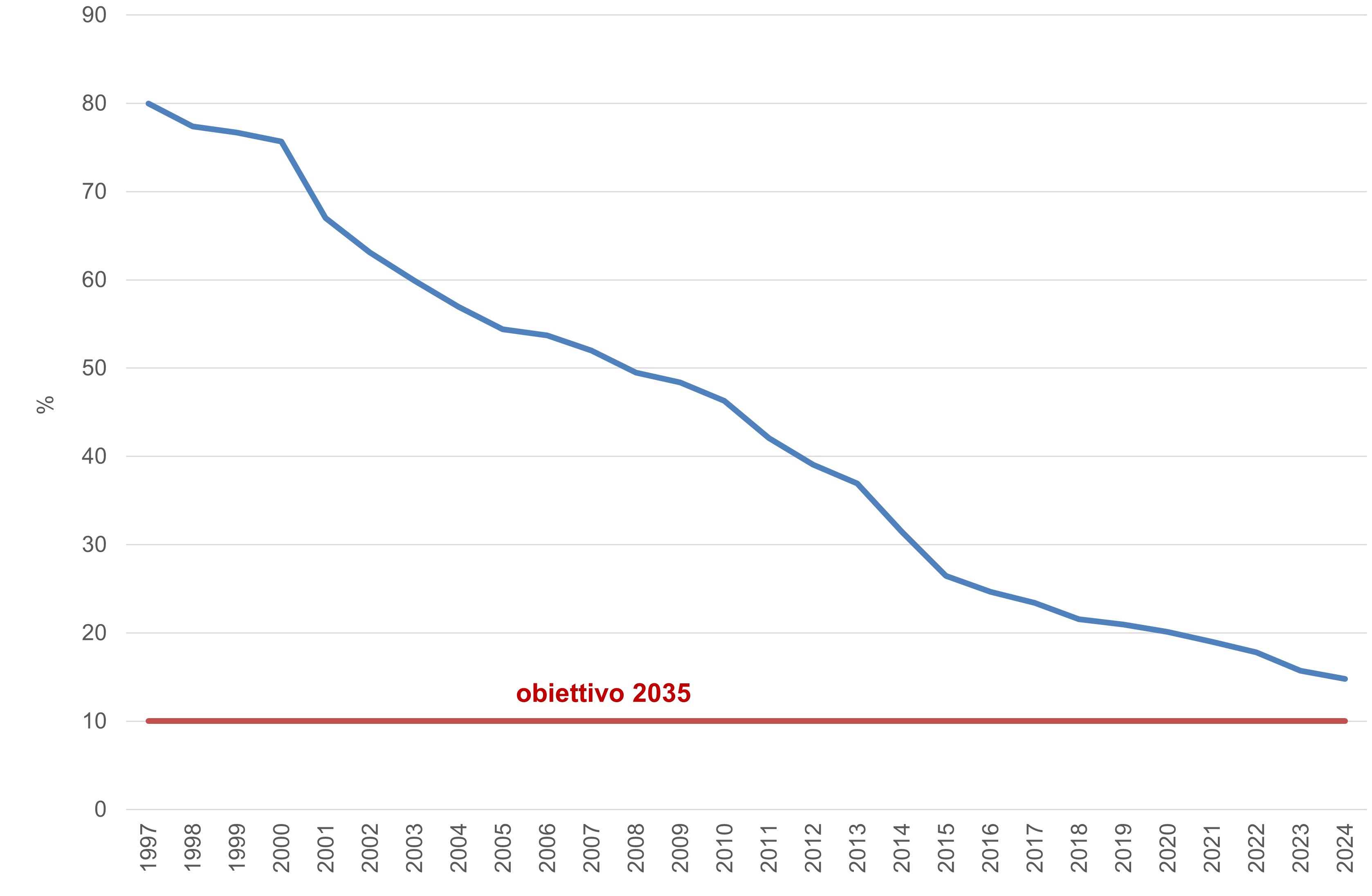
Directive (EU) 2018/850, which entered into force on 4 July 2018 and amended Directive 1999/31/EC, provides for the progressive reduction of municipal waste disposal in landfills, setting a target for 2035 whereby the amount of municipal waste landfilled shall be reduced to 10% of the total municipal waste generated.
Legislative Decree No. 121 of 3 September 2020, amending Legislative Decree No. 152/2006, defines the new recycling targets to be achieved by 2030, namely at least 65%, and the reduction of landfill disposal by 2035 to no more than 10% of the waste generated.
ISPRA, Rapporto Rifiuti Urbani - 2025 Edition (Rapporto n. 419/2025, full version)
https://www. isprambiente. gov. it/it/pubblicazioni/rapporti/rarancio-rifiuti-urbani-editore-2025
ISPRA (Italian Institute for Environmental Protection and Research)
ISPRA - Catasto rifiuti ( http://www. catasto-rifiuti. isprambiente. it)
National (I), Regional (R 20/20)
1997-2024
Percentage of municipal waste disposed of in landfills out of municipal waste produced.
The data on landfill disposal were processed using the information reported in the 2025 MUD declarations, the Italian Single Environmental Declaration Form, referring to the year 2024 for municipal waste, submitted by landfill facility operators. The data were subsequently cross-checked against the information collected through dedicated questionnaires prepared by ISPRA and sent to all competent authorities responsible for permitting and control activities, including Regions, Provinces, Regional and Provincial Environmental Protection Agencies, and Provincial Waste Observatories. During data processing, inconsistencies are often identified, requiring targeted investigations at individual facility level.
The share of biodegradable waste is estimated by ISPRA on the basis of the values relating to the different material fractions present in residual mixed municipal waste disposed of in landfills, as determined through specific survey campaigns.
When landfill disposal data are analysed in relation to total municipal waste generation, amounting to over 29.9 million tonnes, it emerges that 14.8% of the municipal waste generated is still landfilled at national level (Figure 1). Pursuant to Directive (EU) 2018/850, this share must decrease to 10% by 2035.
Over the period 2000-2024, the quantity of municipal waste disposed of in landfills decreased by 79.8%, indicating a positive trend (Table 1). In 2024, in particular, a 3.7% reduction was recorded compared with 2023, together with a decrease in the number of landfill facilities (-10). Specifically, in Northern Italy the number of landfills declined from 49 facilities in 2023 to 45 in 2024; in Central Italy from 24 to 23; and in Southern Italy from 39 to 34 (Table 3).
| Allegati |
|---|
Titolo
Table 1: Municipal waste landfilled, by geographical macro-area Fonte
ISPRA |
Titolo
Table 2: Amount of municipal waste landfilled at the regional level Fonte
ISPRA |
Titolo
Table 3: Number of municipal waste landfills by region Fonte
ISPRA |
Thumbnail
Titolo
Figure 1: Trend of the percentage of municipal waste landfilled relative to the total municipal waste generated Fonte
ISPRA |
Thumbnail
Titolo
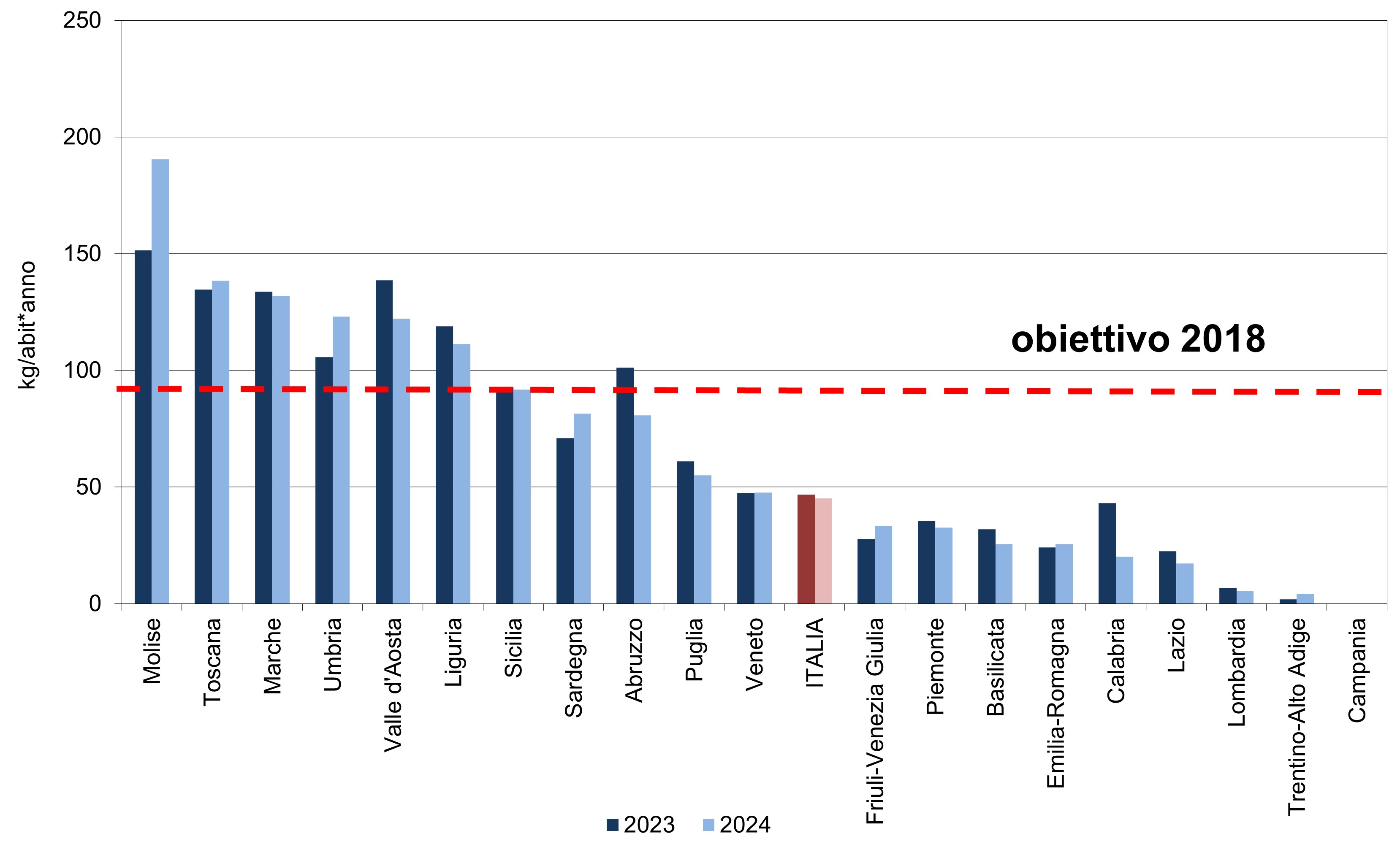
Figure 2: Per capita amount of biodegradable municipal waste landfilled Fonte
Processing by ISPRA based on ISPRA and Istat data |
In 2024, the total quantity of municipal waste disposed of in landfills amounted to over 4.4 million tonnes, with a reduction of approximately 170 thousand tonnes compared with 2023 (Table 1).
Of the total amount landfilled, 28.8%, corresponding to approximately 1.3 million tonnes, was managed in facilities located in Northern Italy; 34.1%, equal to 1.5 million tonnes, was sent for disposal in Central Italy; and 37.1%, corresponding to over 1.6 million tonnes, was disposed of in facilities located in Southern Italy (Table 2).
The analysis of the data shows that, between 2023 and 2024, the quantities disposed of in Northern Italy decreased by 35 thousand tonnes, corresponding to -2.7%. At regional level, reductions were observed in Lombardy (-18.9%; -21 thousand tonnes), Piedmont (-7.9%; approximately -20 thousand tonnes), Liguria (-6.4%; -19 thousand tonnes), and Valle d’Aosta (-12.1%; -3 thousand tonnes). By contrast, an increase was recorded in Emilia-Romagna (+6%), which may be attributed both to higher regional generation of municipal waste and to an increase in waste flows imported from other regions. Increases were also recorded in Friuli-Venezia Giulia and Veneto, equal to 20% (+11 thousand tonnes) and 0.6% (+2 thousand tonnes), respectively. Finally, in Trentino-Alto Adige, where one additional operational facility was present, the quantity of waste disposed of increased from 3,372 tonnes in 2023 to 7,467 tonnes in 2024.
In the central regions, a reduction of approximately 8 thousand tonnes (-0.5%) was observed. The quantities disposed of in Lazio decreased by 23.3%, corresponding to approximately -50 thousand tonnes, also as a result of insufficient treatment and disposal capacity to ensure the full management of the region’s own waste. For this region, waste sent to facilities located in other regions amounted to 171 thousand tonnes, although this value decreased by 21 thousand tonnes compared with 2023. The Marche region also recorded a decrease in the quantities of municipal waste disposed of in regional landfills (-1.6%). Conversely, Tuscany showed an increase of 2.8%, corresponding to approximately +23 thousand tonnes, as did Umbria (+16.2%; +24 thousand tonnes).
In Southern Italy, a reduction of approximately 127 thousand tonnes (-7.2%) was recorded in the quantities disposed of within the macro-area. This decrease is mainly attributable to the lower quantities managed in Calabria, where a reduction of approximately 71 thousand tonnes (-53.5%) was observed, associated with an increase in flows exported outside the region for intermediate treatment and in flows sent abroad, as well as with a slight increase in separate collection. Decreases were also recorded in Abruzzo (-43 thousand tonnes; -20.2%) and Puglia, with approximately -41 thousand tonnes (-10.3%). The quantities disposed of in Puglia include approximately 29 thousand tonnes imported from outside the region. Landfill disposal also decreased in Sicily (-11 thousand tonnes; -1.5%) and Basilicata, with approximately -6 thousand tonnes (-20.4%). Conversely, the quantities disposed of increased in Molise (+25.2%, corresponding to 18 thousand tonnes originating from other regions) and in Sardinia (+14.2%; approximately +26 thousand tonnes).
In Campania, where no operational landfill facilities have been present since 2021, an increase was observed in the quantity of waste sent for disposal outside the regional territory, from approximately 29 thousand tonnes in 2023 to approximately 57 thousand tonnes in 2024. This waste, entirely generated from the treatment of municipal waste, is exclusively identified by European Waste List code 19 12 12 and was disposed of in Puglia (28 thousand tonnes), Emilia-Romagna (9 thousand tonnes), Tuscany (approximately 8 thousand tonnes), Abruzzo (approximately 7 thousand tonnes), Umbria (3 thousand tonnes), Marche (approximately 900 tonnes), and Friuli-Venezia Giulia (828 tonnes).
In 2024, at national level, 102 landfills for non-hazardous waste receiving waste of municipal origin were operational. Compared with 2023, the survey identified a reduction of 10 units in the total number of facilities. In Northern Italy, the number of facilities decreased from 49 to 45; in Central Italy from 24 to 23; and in Southern Italy from 39 to 34 (Table 3). Of the 102 landfills for non-hazardous waste, 21 received municipal waste only, namely 3 facilities in the North, 3 in the Centre, and 15 in the South, while the remaining 81 received both municipal waste and special waste.
Legislative Decree No. 36/2003, as amended, sets progressive reduction targets for the landfill disposal of biodegradable municipal waste (BMW), to be achieved at the level of the optimal territorial area in the short term, 173 kg/year per inhabitant by 2008, in the medium term, 115 kg/year per inhabitant by 2011, and in the long term, 81 kg/year per inhabitant by 2018.
In 2023, the national per capita amount of biodegradable fraction landfilled was 45 kg per inhabitant, below the target established by Italian legislation for 2018, equal to 81 kg/year per inhabitant (Figure 2).
In 2024, 12 Regions achieved the target set for 2018: Trentino-Alto Adige, Lombardy, Lazio, Calabria, Emilia-Romagna, Basilicata, Piedmont, Friuli-Venezia Giulia, Veneto, Puglia, Abruzzo and Sardinia. Campania is not considered, as it has no landfill facilities. Abruzzo and Sardinia both stood at 81 kg/inhabitant, while Sicily, at 92 kg/inhabitant, was slightly above the target.
Per capita values below 130 kg/inhabitant were recorded in Liguria (111 kg/inhabitant), Valle d’Aosta (122 kg/inhabitant), and Umbria (123 kg/inhabitant).
The regions furthest from the target were Molise (191 kg/inhabitant), Tuscany (138 kg/inhabitant), and Marche (132 kg/inhabitant). The values recorded in these latter regions are affected by the contribution of waste quantities originating from outside the region (Figure 2).