Giovanni Finocchiaro, Silvia Iaccarino
The indicator illustrates electricity consumption in the tourism sector, identified by the ATECO branch “Accommodation and Food Service Activities”. In 2024, electricity consumption in the sector amounts to 89,987 GWh, an increase compared to 2023 (87,565 GWh). The trend confirms the recovery in consumption following the pandemic phase. Considering only accommodation activities, consumption shows differentiated dynamics over time and across space, while within the “accommodation” subcategory the contribution of hotels and similar establishments continues to prevail, albeit within a context of gradual diversification of accommodation types.
European literature on the subject (Tourism and Environment, Schmidt, 2002) identifies tourism as a factor impacting electricity consumption levels.
Although it is difficult to quantify the pressure of tourism on the environment, these European reference studies suggest a correlation between electricity consumption and tourism density—higher electricity consumption is recorded in areas with higher tourism density.
The indicator does not aim to confirm or refute this literature but simply presents:
- The electricity consumption of the ATECO category "I - Accommodation and Food Service Activities"
- Its share of total national and regional electricity consumption
To show the trend in electricity consumption for the ATECO category "I - Accommodation and Food Service Activities".
The indicator has no direct references to specific regulatory elements nor regulatory obligations.
H. W. Schmidt, Tourism and the environment
TERNA S. p. A., Statistical data on electricity in Italy, various years
Ministry of Economic Development, National Energy Balance, various years, http://dgsaie. mise. gov. it/dgerm/ben. asphttp://www. sviluppoeconomico. gov. it
It is desirable for the future to be able to have the average consumption of electricity, but also of water and gas by type of accommodation facility.
ISTAT Terna - Rete Elettrica Nazionale S. p. A.
https://www. terna. it/it-it/sistemaelettrico/statisticheeprevisioni/datistatistici. aspx
https://www. terna. it/it/sistema-elettrico/statistiche/economia-mercato-elettrico/download-center
2000-2024
National, Regional
The indicator uses TERNA data for consumption and the incidences are calculated through simple reports.
In 2024, the ATECO sector “Accommodation and Food Service Activities” records electricity consumption of 89,987 GWh, with an increase of about +2.8% compared to 2023 (Table 1). Consumption levels are consistent with the trend observed in the pre-pandemic period and align with the recovery of tourism activities. In light of these elements, the status of the indicator is assessed as “medium”, as the sector shows significant energy consumption but without particularly marked short-term variations.
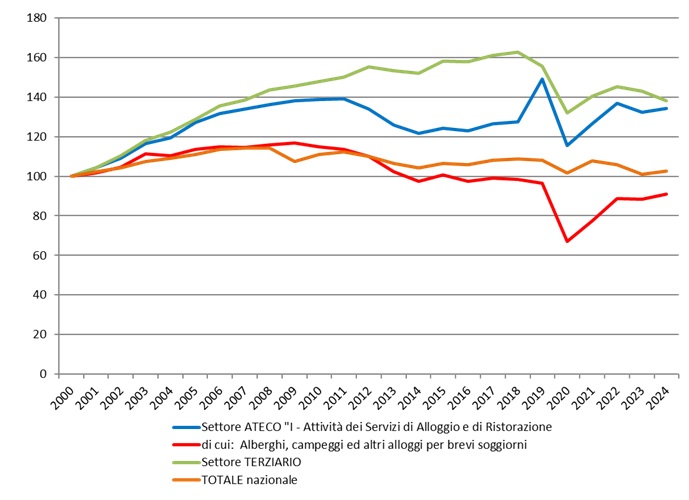
Over the period 2000–2024, electricity consumption in the tourism sector shows overall growth, temporarily interrupted during 2020–2021 (Figure 1). The subsequent increase observed in more recent years, including 2024, indicates a return to levels consistent with long-term dynamics.
Focusing the analysis solely on accommodation facilities, the trend appears more articulated, with a reduction in consumption over the long term, alongside an increase in overall consumption for the tourism sector. This pattern suggests a progressive improvement in energy efficiency in accommodation facilities, albeit within a context of growth in tourism supply. Overall, the trend is assessed as positive, in relation to the recovery of economic activities, while still requiring attention from an energy sustainability perspective.
| Allegati |
|---|
Titolo
Table 1: Electricity consumption for the tourism product sector Fonte
ISPRA processing on TERNA data |
Thumbnail
Titolo
Figure 1: Distribution of electricity consumption for the "tourism" sector, for the tertiary sector and overall Fonte
Source: ISPRA processing on TERNA and ISTAT data |
Thumbnail
Titolo
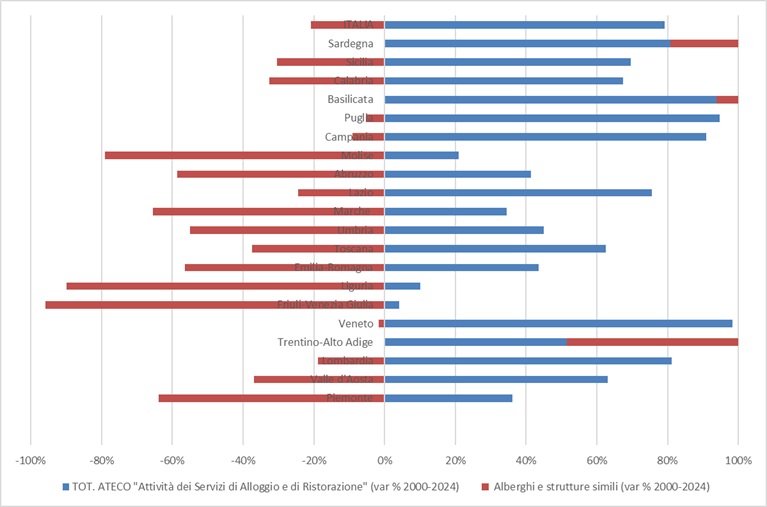
Figure 2: Regional distribution of percentage changes between 2000 and 2024 in the ATECO "tourism" sector and the "hospitality" sub-sector Fonte
ISPRA processing on TERNA data |
Thumbnail
Titolo
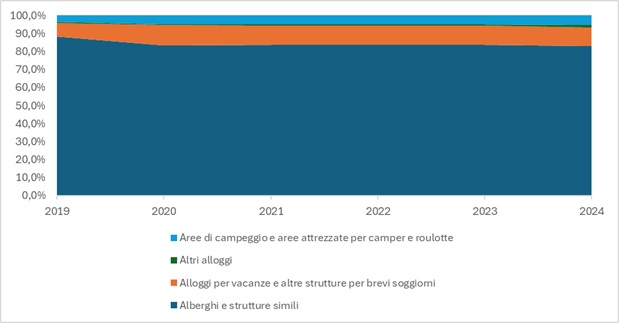
Figure 3: Distribution of the various economic activities belonging to the economic branch "Holiday accommodation and other short-stay facilities" Fonte
ISPRA processing on TERNA data |
From 2000 to 2024, the share of the tourism ATECO sector in total electricity consumption of the tertiary macro-sector shows substantial stability, alongside an overall increase in electricity consumption in the Accommodation and Food Service Activities sector (Table 1 and Figure 1).
Analyzing only the accommodation sector, territorially differentiated trends emerge (Figure 2), with reductions in consumption in some regions and increases in others, highlighting different levels of energy efficiency and non-uniform tourism development models. In several areas, the contraction of electricity consumption in accommodation facilities suggests progress in rationalization processes and energy efficiency improvements.
In the most recent period for which a breakdown by activity type is available (Figure 3), hotels and similar establishments continue to represent the predominant share of electricity consumption within the “accommodation” subcategory, while showing a reduction in their percentage share in favor of holiday accommodations and other short-stay facilities. Overall, 2024 data confirm a gradual evolution of the sector toward more diversified energy consumption models, within a context of recovery and transformation of the tourism supply.