DEFOLIATION OF THE CANOPY OF FOREST SPECIES
Data aggiornamento scheda:
The defoliation values indicate the level of resilience or susceptibility of the species to the impact caused by atmospheric deposition and gaseous pollutants. The data collected over the last 29 years (1997-2025) show a fluctuating trend until 2020, with years of attenuation and years of growth of the phenomenon and greater sensitivity of broad-leaved trees. Starting from 2021, however, a worsening of the phenomenon was recorded, with very high defoliation values, never reached before. These values, in 2023, reached 45% for broad-leaved and needle-leaved trees. This trend eased in 2024 and 2025, the year in which values dropped to 36% defoliation for coniferous trees and 39.7% for broadleaf trees.
FOREST ECOSYSTEM AREAS AFFECTED BY WILDFIRES: STATUS AND CHANGES
Data aggiornamento scheda:
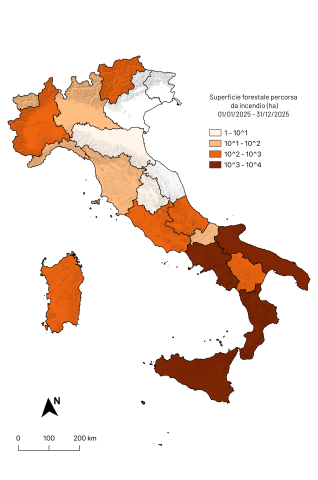
The indicator examines the series of forest areas affected by large fires on a national, regional and protected area scale in the period between 2018 and 2025.
The distribution and extension of these surfaces generally shows significant interannual variability. 2025, in particular, was a year seriously affected by an extension of the forest areas affected by fires, greater than the previous year. Furthermore, the forest area burned is only lower than that burned in 2021, 2022 and 2023.
In 2025, the most affected regions were: Sicily (3,967 hectares - ha), Calabria (2,892 ha) and Campania (1,835 ha), which together represent 71% of the forest area at national level affected by fire.
The forest classes most affected are evergreen broad-leaved trees (e. g. Holm oak forests and tall scrub), followed by deciduous broad-leaved trees (e. g. Oak and beech forests) and decidedly less so by conifers (e. g. Pine forests, fir forests and larch forests).
The linear regression analysis of the national forest cover data series affected by fire does not show an increasing trend, although the length of the series does not allow medium and long-term evaluations. On the contrary, a statistically significant positive trend was observed for the regions of Puglia, Basilicata and Calabria.
EXTENT OF WILDFIRE
Data aggiornamento scheda:
The wildfire phenomenon, analyzed on the basis of data collected from 1970 to 2024 by CUFA of the Carabinieri Corps (formerly the State Forestry Corps), shows a fluctuating trend, with peak years (1993, 2007, 2017, 2021) alternating with periods of decline (2013, 2014, 2018, 2024).
Wildfires occurring within Protected Areas (recorded since 2003), although showing annual fluctuations, remain at high levels, with an average of 11,000 hectares burned over the last three years.
The incidence of deliberately caused fires is very high, representing about half of all recorded events and exceeding 60% in some years.