Stefano Bataloni, Giuseppe Trinchera, Anna Cacciuni
“Produced water” (also referred to as “formation water”) is one of the main effluents associated with the exploitation of hydrocarbon reservoirs in offshore marine environments and may potentially cause disruptive effects on ecosystems. The discharge of these effluents into the sea requires an authorisation, which is conditional upon the assessment of the results of annual monitoring of the environment surrounding the platform.
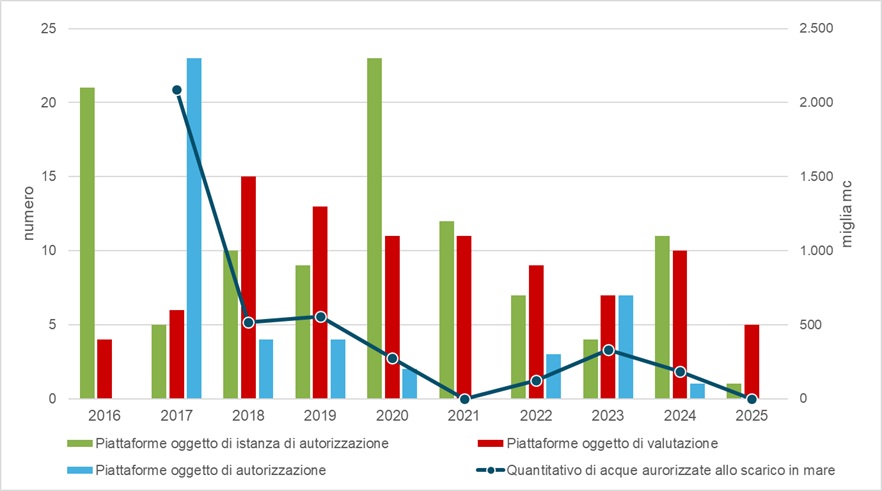
The number of platforms subject to environmental assessment of monitoring outcomes fluctuated between 2016 and 2024 due to variability in the number of discharge authorisation applications submitted, and it decreased in the most recent year. The number of platforms authorised each year declined from 2017 to 2021, then recovered up to 2023, before decreasing again in 2024 and dropping to zero in 2025; a similar trend is observed for the annual volume of produced water authorised for discharge into the sea.
In Italy, the Environmental Consolidated Act (Testo Unico Ambientale, TUA) regulates the management of produced water, allowing offshore platform operators to discharge it directly into the sea, subject to submission of a specific application to the Ministry of the Environment and Energy Security (MASE).
Authorization is contingent on periodic assessment of potential impacts on the marine environment, based on a specific monitoring plan defined according to Guidelines developed by ISPRA and carried out annually in the vicinity of each installation. Since 2016, MASE has periodically requested ISPRA’s technical-scientific evaluation of the monitoring results to support the authorization process.
This indicator describes the temporal trend of environmental assessment activities related to the authorization process, reporting the number of platforms for which discharge applications were submitted, the number of platforms assessed, the number of platforms authorized to discharge, and the total quantities of produced water annually authorized for discharge into the sea.
To provide information on the technical-scientific and management measures adopted to mitigate the effects of produced water discharges into the sea, associated with the exploitation of offshore hydrocarbon fields.
Legislative Decree 152/2006, art. 104 and subsequent amendments.
The indicator does not provide information on all offshore platforms located in Italian seas, but only on those authorized to discharge production water into the sea.
- ISPRA
- MASE (Ministry of the Environment and Energy Security)
The data are available to MASE and ISPRA, some of which can be accessed through the MASE Environmental Assessments and Authorizations Portal (https://va.mite.gov.it/it-IT/Procedure/Provvedimenti19) and in the Marine Platforms section of the Directorate General for Infrastructure and Safety of MASE (https://unmig.mase.gov.it/ricerca-e-coltivazione-di-idrocarburi/piattaforme-marine/).
National
2016-2025 (30.10.2025)
The base data on monitoring, assessment, and authorization activities were derived from technical documentation and administrative records relating to the authorization process under Article 104 of Legislative Decree 152/2006 and subsequently organized by calendar year.
Data on the total annual volumes of produced water authorized for discharge into the sea were taken from the issued authorization decrees.
In 2025, five platforms were subject to environmental assessment in order to contain potential effects associated with offshore hydrocarbon exploitation activities. This figure shows a slight decrease compared with the previous year, but is higher than the number of platforms for which an application for authorisation to discharge produced water was submitted (one). Moreover, no authorisation was issued in 2025, representing a further decline compared with the previous two-year period (in 2023, seven platforms were authorised to discharge).
In 2025, the volume of produced water authorised for discharge into the sea is zero. Overall, therefore, the indicator status can be considered good, since environmental assessment activities continued over the last year despite the reduction in applications for produced water discharge. Furthermore, potential impacts on the marine environment are contained because, compared with the past, the volumes of water authorised for discharge have decreased.
Over the time period considered, the trend in activities assessing the outcomes of environmental monitoring conducted around offshore platforms—preparatory to the discharge of effluents generated by extraction activities—followed the trend of authorisation applications submitted by installation operators.
With the exception of 2016 and 2020 (Table 1), the number of platforms subject to assessment has generally been comparable to the number of platforms for which an application for discharge authorisation was submitted (Figure 1). Consequently, the response of the Public Administration, through ISPRA’s environmental assessment activities, has been adequate in relation to the pressure arising from applications for produced water discharge into the sea.
On the other hand, the number of platforms authorised for discharge decreased markedly from 2017 to 2021, then recovered between 2021 and 2023, before declining again in 2024 and dropping to a single platform in 2025. A similar pattern is observed for the annual volume of produced water authorised for discharge into the sea by the Ministry of the Environment and Energy Security (MASE). Over the years, therefore, the risk of environmental impacts on the marine environment has diminished as a result of the reduction in the quantities of produced water authorised for discharge.
| Data |
|---|
Headline
Table 1: Discharges of production water from offshore platforms into the sea Data source
ISPRA processing on ISPRA and MASE data Data legend
* data update as of October 30, 2025 |
Thumbnail
Headline
Figure 1: Production water discharges into the sea from offshore platforms Data source
ISPRA processing on ISPRA and MASE data |
There are 138 offshore platforms in Italian seas; during the period 2016–2025, applications for authorisation to discharge produced water into the sea were submitted for a total of 42 platforms. Among the remaining platforms, 10 are subject to Integrated Environmental Authorisation (AIA) and are therefore covered by a specific monitoring and control plan; 6 reinject excess water into deep geological formations or are non-producing facilities or dispose of their produced water onshore. For all these platforms, no environmental monitoring activities related to discharge authorisation are required.
It should be noted that each year all (or almost all) of the 42 platforms are subject to environmental monitoring, but applications for renewal of discharge authorisations concern only a subset of them. As a result, ISPRA’s assessments of monitoring outcomes each year involve only part of all monitored platforms. In some years, the number of platforms assessed exceeded the number of platforms applying for authorisation, due to the need to handle a larger backlog of assessment requests from MASE in 2016 and 2020.
The number of authorisation decrees issued annually by MASE is linked to the number of renewal applications submitted by installation operators. Furthermore, authorisations issued by MASE have a four-year duration, specifying the maximum discharge volume allowed for each year of validity. Therefore, the volume of produced water that an operator is authorised to discharge into the sea in a given year depends on the annual maximum volumes specified in authorisation decrees issued in that year, combined with the annual maximum volumes specified in decrees issued during the previous four-year period.