Stefano Bataloni, Anna Cacciuni, Giuseppe Trinchera
"Produced water" or "layer water" is one of the main wastewaters generated by the exploitation of hydrocarbon deposits in offshore marine environments and can potentially disrupt ecosystems. The discharge of such wastewater into the sea requires authorization, subject to evaluation of the results of annual monitoring of the environment surrounding the platform.
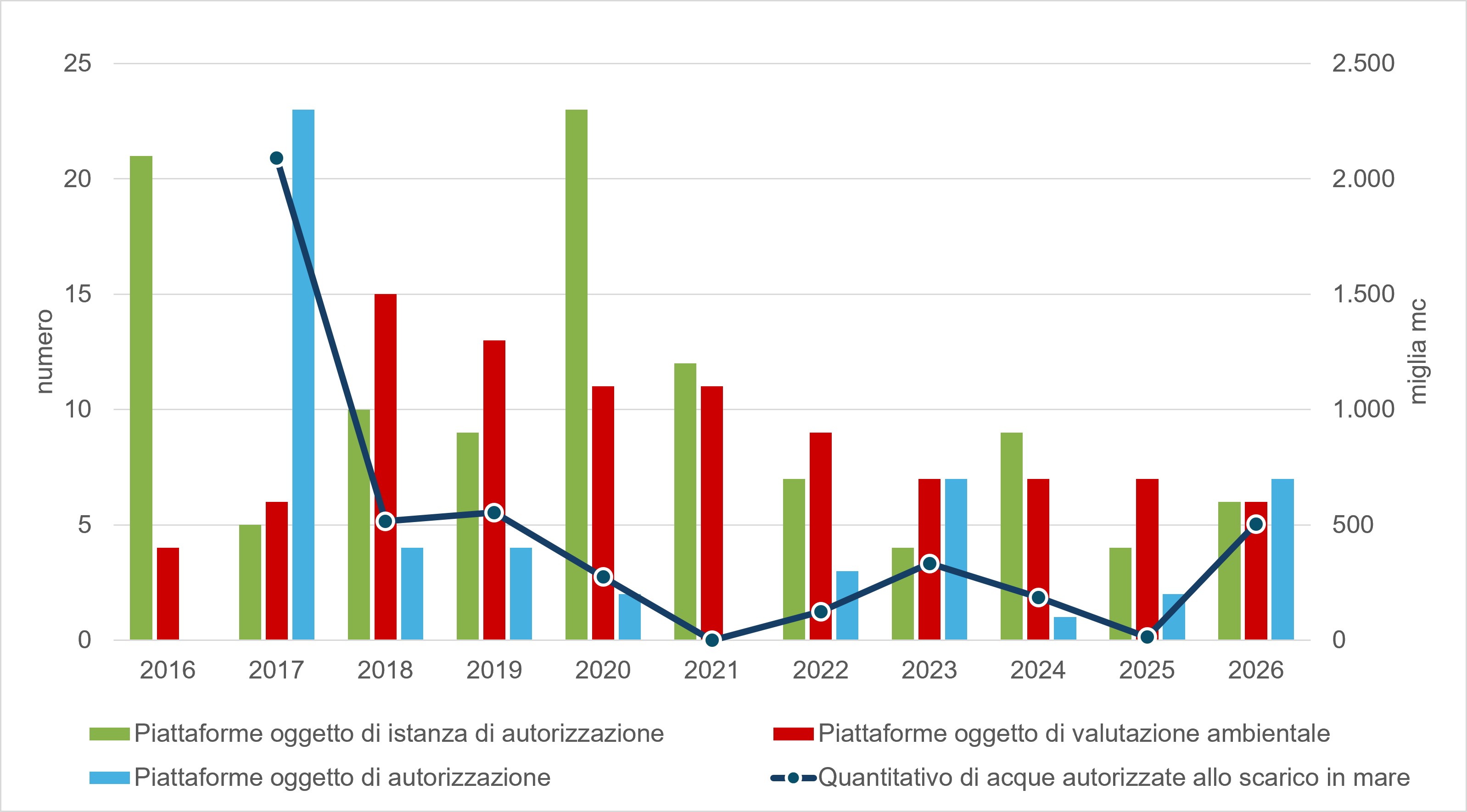
Between 2016 and 2026, the number of platforms subjected to environmental assessments showed fluctuations consistent with the variability of authorization applications submitted, with a slight decline in the last year. The number of platforms authorized each year decreased from 2017 to 2021, rose again until 2023, fell to 2 in 2025, and began to increase again in 2026 (7 platforms). A similar trend characterizes the annual quantity of production water authorized for discharge, equal to 503,686 m³ in 2026.
In Italy, the Consolidated Environmental Act (TUA) regulates the management of production waters, allowing operators of extraction platforms to discharge them directly into the sea, following the submission of a specific application to the Ministry of the Environment and Energy Security (MASE). Authorization is subject to a periodic assessment of the potential effects on the marine environment, through a monitoring plan defined based on Guidelines developed by ISPRA and carried out annually around each installation. Since 2016, MASE has periodically requested ISPRA to provide a technical-scientific evaluation of the results of these monitoring activities, in support of the authorization process. The indicator describes the temporal trend of the environmental assessment activities related to the authorization process, reporting the number of platforms subject to authorization requests, the number of platforms subject to evaluation, the number of platforms authorized for discharge, and the total quantities of produced water authorized for discharge into the sea annually.
Provide information on the measures adoptedboth from a technical-scientific and management perspective, to mitigate the effects of the discharge of production water into the sea associated with the exploitation of petroleum hydrocarbon deposits present in the offshore marine environment.
Legislative Decree. 152/2006, art. 104 and subsequent amendments.
The indicator does not provide information on all offshore platforms in Italian seas, but only on those authorized to discharge production water into the sea.
The data are available to MASE and ISPRA, some of which are accessible through the MASE Environmental Assessments and Authorizations Portal (https://va.mite.gov.it/it-IT/Procedure/Provvedimenti19) and in the Marine Platforms section of the MASE General Directorate for Infrastructure and Security (https://unmig.mase.gov.it/ricerca-e-coltivazione-di-idrocarburi/piattaforme-marine/)
National
2016-2026 (30.09.2026)
Annual number of offshore platforms subject to environmental assessment for the purpose of authorizing the discharge of production water into the sea.
The basic data relating to monitoring, evaluation, and authorization activities are taken from the technical and preliminary documentation relating to the authorization process pursuant to Article 104 of Legislative Decree 152/2006 and subsequent amendments and are then organized by calendar year. The total annual quantities of production water authorized for discharge are taken from the relevant authorization decrees issued.
In 2026, six platforms underwent environmental assessment, a slight decrease from seven in 2025, and an equal number of discharge authorization applications submitted in the same year. Furthermore, seven platforms were authorized for discharge, compared to two in 2025, for a total authorized quantity of produced water equal to 503,686 m³. Overall, the indicator remains rated as good: the environmental assessment activity, despite an increase in the potential pressure associated with authorized discharges compared to 2025, expressed both by the number of authorized platforms and the total authorized quantity, ensured coverage of the applications submitted during the year.
Over the time period considered, the trend in assessment activities for the results of environmental monitoring conducted in the environment surrounding offshore platforms, preparatory to the discharge of wastewater from extraction activities into the sea, followed that of the authorization requests submitted by the installation operator. With the exception of 2016 and 2020 (Table 1), the number of platforms assessed has generally always been comparable to the number of platforms for which applications for discharge authorization have been submitted (Figure 1); Therefore, the PA's response, through ISPRA's environmental assessment activity, was adequate in relation to the pressure arising from requests for authorization to discharge production water into the sea.
On the other hand, the number of platforms subject to authorization for discharge decreased significantly from 2017 to 2021, then recovered between 2021 and 2023, remaining at very low values in the two-year period 2024-2025 and showing a new increase in 2026 with 7 authorized platforms. A similar trend is observed for the annual quantity of produced water authorized for discharge into the sea by MASE: after a peak of over 2 million cubic meters authorized in 2017, a reduction to approximately 500-550 thousand cubic meters was observed in the two-year period 2018-2019, followed by a further reduction, albeit with alternating phases, until 2025. In 2026, a new increase was recorded, to 503,686 cubic meters. Overall, the time series therefore shows marked interannual variability, while maintaining levels in 2026 lower than the maximum recorded in 2017.
| Allegati |
|---|
Titolo
Table 1: Discharges of production water into the sea from offshore platforms Fonte
ISPRA processing of ISPRA and MASE data Note
Data updated as of September 30, 2026 |
Thumbnail
Titolo
Figure 1: Production water discharges into the sea from offshore platforms Fonte
ISPRA processing of ISPRA and MASE data Note
Data updated as of September 30, 2026 |
There are 138 offshore platforms in Italian seas; between 2016 and 2026, applications for authorization to discharge production water into the sea were submitted for a total of 42 platforms. Of the remaining 10, 10 are subject to Integrated Environmental Authorization, and therefore subject to a specific monitoring and control plan. Six reinject the excess water into a deep geological unit, are non-productive, or dispose of their production water on land. No environmental monitoring is required for platforms that reinject, are non-productive, or do not discharge production water into the sea. The 2026 data are updated as of September 30. It should be noted that every year, all (or almost all) of the 42 platforms are subject to environmental monitoring, but authorization renewal applications concern only a portion of them. In this regard, ISPRA's assessment activities each year concern only a portion of all monitored platforms. In some years, the number of platforms assessed exceeds the number of platforms subject to authorization requests due to the need to process the increased volume of assessment requests from MASE, which occurred in 2016 and 2020. The number of authorization decrees issued each year by MASE is linked to the number of renewal requests submitted by the facility operator. Furthermore, it should be noted that authorizations are valid for four years and indicate the maximum quantity that can be discharged for each year of validity of the authorization; therefore, the quantities of production water that the facility operator is authorized to discharge into the sea in a given year depend on the maximum annual quantities indicated in the authorization decrees issued in that year, to which are added the maximum annual quantities indicated in the authorization decrees of the previous four-year period.