Anna Cacciuni, Caterina D'Anna
The environmental conditions are requirements that may be imposed by the screening decision for EIA applicability, relating to the characteristics of the project or to the measures envisaged to avoid or prevent significant and adverse environmental impacts. In the period 2004–2024, an average of 6 environmental conditions per decision is recorded. Environmental conditions whose compliance verification has been assigned to the National System for Environmental Protection (SNPA) represent approximately 32.2% of cases over the period considered.
The indicator represents the total number of environmental conditions contained in state-level EIA screening decisions. It also highlights all environmental conditions whose compliance verification has been assigned to the SNPA.
To provide information on the response of the central public administration with regard to decision-making processes related to environmental assessments.
Legislative Decree 152/2006 and subsequent amendments. Legislative Decree no. 104 of 2017
DL 34/2020 converted with Law 77/2020
DL 76/2020 converted with Law 120/2020
DL 77/2021 Simplification Decree converted into Law no. 29 July 2021, n. 108
DL 92/2021 Urgent measures to strengthen the Ministry of ecological transition and sports.
Law no. 25 of 2022
law no. 91 of 2022
Law no. 6 of 2023
Legislative Decree no. 13 of 2023
-
-
MASE (Ministry of the Environment and Energy Safety)
https://va. mite. gov. it/it-IT
National
2004-2024
Individual EIA screening decisions were analysed and all environmental conditions were identified and counted, distinguishing those falling under the responsibility of the SNPA. All environmental conditions included in screening decisions issued by MASE, the Ministry of Cultural Heritage and Activities (MiBAC), the Regions and local authorities were analysed.
In 2024, out of 52 state-level director-general determinations of non-applicability to EIA, 467 environmental conditions were imposed, with an average of 9 environmental conditions per decision. The average number of environmental conditions per decision increased compared to the previous year (7 vs 9) (Table 1).
In the period 2004–2024, 678 director-general determinations were issued, with 4,089 environmental conditions, corresponding to an average of 6 environmental conditions per decision. The average number of environmental conditions increased from 3 in 2004 to 11 in 2014, and then decreased in subsequent years (Table 1).
The application of the EIA procedure in Italy reflects developments at the European level: the regulatory framework has been strengthened and completed over time through the transposition of European Directives; public participation and administrative transparency have increased; and the quality of environmental impact studies for projects subject to EIA screening has improved.
For these reasons, a positive trend can currently be identified, as in recent years a decrease in the average number of environmental conditions has been observed, indicating greater attention by project proponents to the preparation of environmental impact studies.
| Data |
|---|
Headline
Table 1: Number of director-general determinations for EIA screening, number of environmental conditions, average number of environmental conditions per determination Data source
ISPRA processing based on MASE data Note
1 Positive and partially positive determinations of non-applicability to EIA are considered up to 2017. Following the entry into force of Legislative Decree 104/2017, “partially positive” determinations no longer exist. Environmental conditions may be included only in determinations of non-applicability to EIA. |
Headline
Table 2: Number of environmental conditions included in state-level EIA screening determinations and percentage of environmental conditions whose compliance verification is assigned to the National System for Environmental Protection (SNPA) Data source
ISPRA processing based on MASE data Note
1 Positive and partially positive determinations of non-applicability to EIA are considered up to 2017. Following the entry into force of Legislative Decree 104/2017, “partially positive” determinations no longer exist. Environmental conditions may be included only in determinations of non-applicability to EIA. |
Thumbnail
Headline
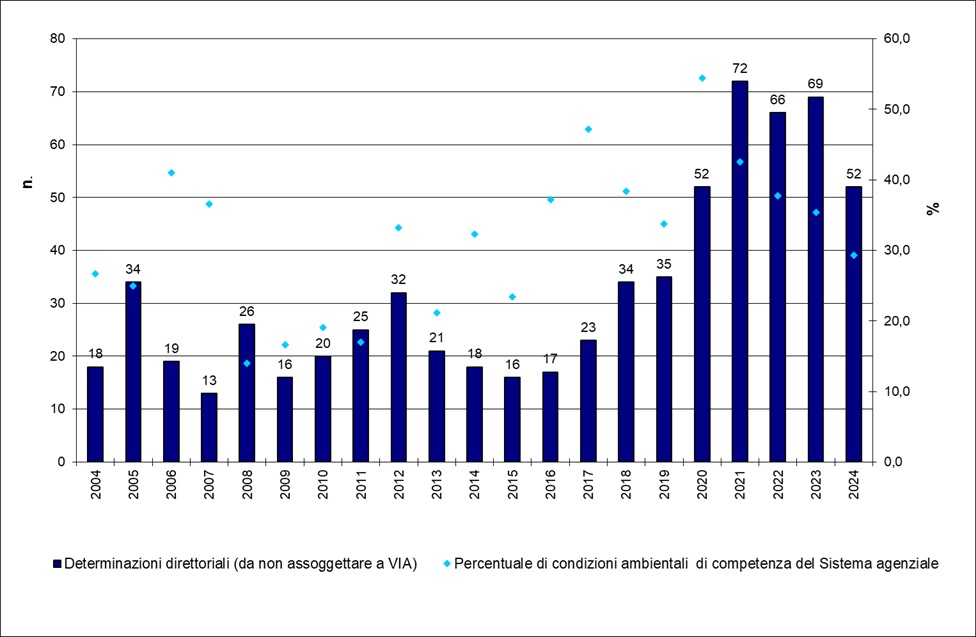
: Figure 1: Number of environmental conditions included in state-level EIA screening determinations and percentage of environmental conditions whose compliance verification is assigned to the SNPA Data source
ISPRA processing based on MASE data |
The number of environmental conditions does not show a constant trend (Table 1 and Figure 1), probably due to the different types of projects subject to the EIA screening procedure, which has been influenced over the years by the introduction of new sectoral regulations. Table 2 identifies all environmental conditions whose compliance verification has been assigned to the National System for Environmental Protection (SNPA); over the period considered, these account for approximately 32.2% of cases.
The highest number of environmental conditions under the responsibility of the SNPA, equal to 161, refers to the years 2021 and 2023. In 2024, 52 director-general determinations of non-applicability to EIA were issued, for a total of 467 environmental conditions, of which 137 (29.3%) were assigned to the SNPA.