Antonio Caputo
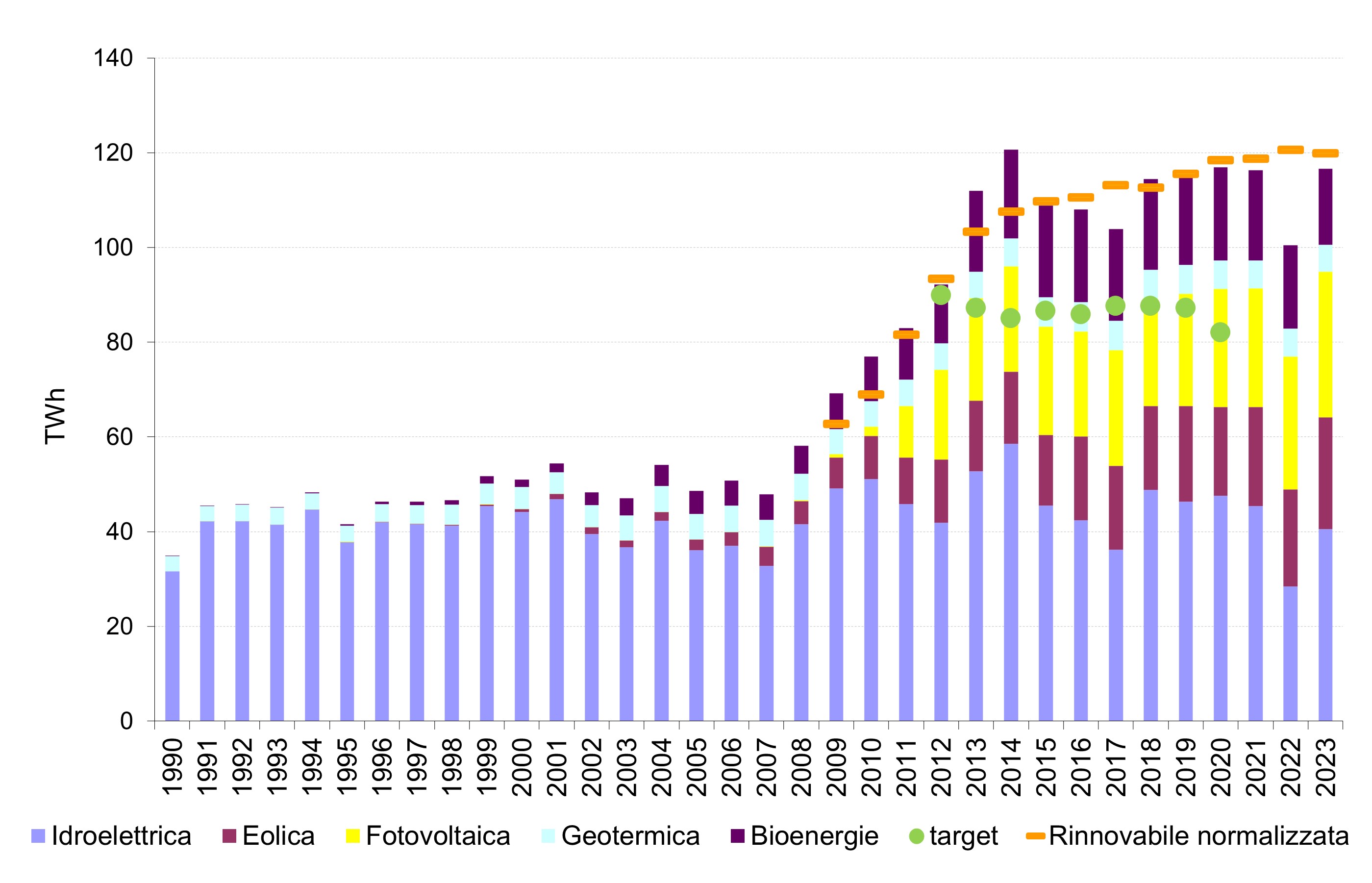
In 2023, with 116.6 TWh of gross electricity production from plants from renewable sources, the contribution to total electricity production was 44.3%, net of production from pumping and accumulations. The contribution of photovoltaic to the total renewable sources is 26.3%. Wind energy represents 20.3%. The share of hydroelectric energy is 34.8%. Bioenergy represents 13.7% and geothermal sources the remaining 4.9%.
The indicator measures the electricity produced by plants powered by renewable sources.
To assess the contribution of clean and non-depletable energy sources to total electricity production, in order to increase their use.
Directive 2009/28/EC, transposed into national law by Legislative Decree No. 28 of 3 March 2011, establishes the shares of energy from renewable sources in gross final energy consumption by 2020 for each European Union country. These shares include both renewable energy consumption for electricity generation and for heating and transport uses.
The indicative target for the electricity sector for 2020, calculated as the ratio between normalized electricity generation from renewable sources and gross inland consumption, was set at 26.4%, while for 2030 the indicative target established by the National Energy and Climate Plan (NECP) is 63%.
Legislative Decree No. 199 of 2021, implementing Directive (EU) 2018/2001 on the promotion of the use of energy from renewable sources, establishes the allocation among regions and autonomous provinces of the minimum capacity of renewable energy installations.
Following the aforementioned legislative decree, the Decree of the Ministry of the Environment and Energy Security (MASE) of 21 June 2024 defines the allocation among regions and autonomous provinces of the national 2030 target for an additional 80 GW of renewable energy capacity compared to 31 December 2020, necessary to achieve the objectives set by the NECP and to respond to the new targets arising from the implementation of the “Fit for 55” package, also in light of “REPowerEU.”
The monitoring and verification of compliance with the obligations established by the Decree of 21 June 2024 are the responsibility of MASE, with the support of GSE and RSE.
TERNA S. p. A., Statistical data on electricity in Italy, various years
Terna - Rete Elettrica Nazionale S. p. A.
TERNA S. p. A, Statistical data on electricity in Italy
National
1990-2023
The data is collected by TERNA
In 2023, the gross electricity production from renewable energy plants amounted to 116.6 TWh. The contribution of photovoltaic power to total renewable sources was 26.3% (Table 1). Wind power accounted for 20.3%. The share of hydropower was 34.8%. Bioenergy represented 13.7%, while geothermal energy made up the remaining 4.9%. The share of electricity generated from renewable sources relative to total electricity production in 2023 was 44.3%, net of production from pumping and storage.
From 1997 to 2023, a particularly strong increase is evident in electricity production from photovoltaic sources (from 0.015 to 30.7 TWh), wind power (from 0.1 to 23.6 TWh), and bioenergy, which includes biomass and waste (from 0.7 to 16 TWh; Table 1), although the latter has shown a significant decline in recent years (–9.1% in 2023 compared to 2022). Electricity production from geothermal sources has also increased since 1997, albeit to a lesser extent than other sources (from 3.9 to 5.7 TWh). Overall, electricity production from renewable sources increased by a factor of 3.3 from 1990 to 2023. Hydropower is characterized by significant volatility related to water availability and was a key factor in the contraction of renewable electricity production recorded in 2022 (–35.6%).
| Allegati |
|---|
Titolo
Gross electricity production from renewable energy plants Fonte
TERNA S.p.A. |
Thumbnail
Titolo
Gross electricity production from renewable energy plants Fonte
TERNA S.p.A. |
In 2023, gross electricity production from renewable energy plants reached 116.6 TWh, accounting for 44.3% of total electricity generation. Gross renewable energy production increased by 16% compared to the previous year.