Antonio Caputo
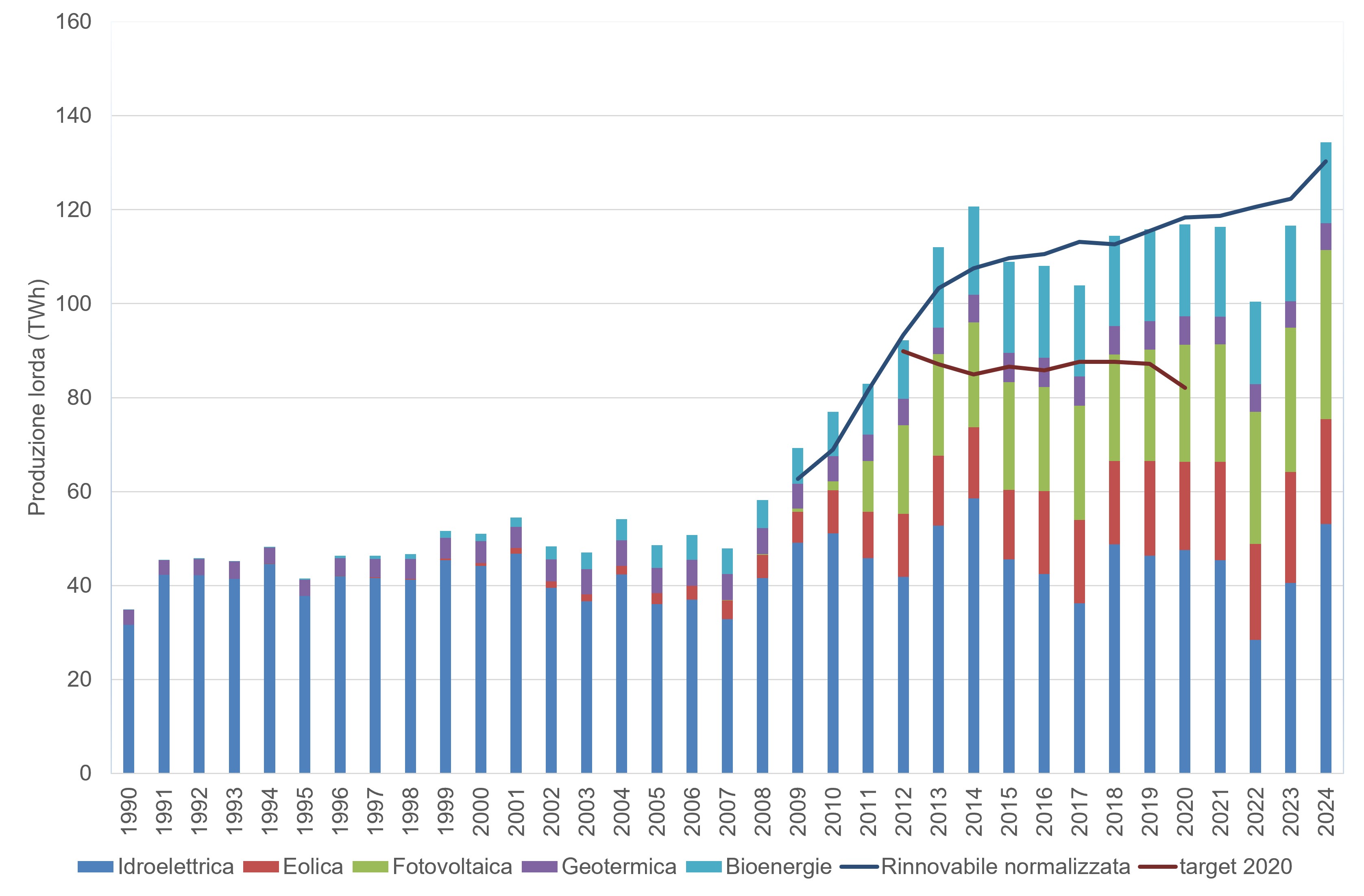
This indicator analyses the trend in electricity generation from renewable sources in Italy from 1990 to 2024 (expressed in TWh), showing the data by type of energy source. Total renewable generation rose from 34.9 TWh in 1990 to 134.4 TWh in 2024, an increase of almost fourfold. The structure of renewable generation has undergone a radical transformation: whilst in 1990 hydroelectric (31.6 TWh) and geothermal (3.2 TWh) power accounted for the entirety of green energy, by 2024 the mix had become significantly more diverse thanks to the contribution of solar photovoltaic (36 TWh), wind (22.3 TWh), bioenergy (17.2 TWh) and hydroelectric power (53.1 TWh). In percentage terms, solar power accounts for 27 per cent, wind power for 17 per cent, hydroelectric power for 40 per cent, bioenergy for 13 per cent and geothermal power for 4 per cent.
The indicator measures the electricity generated by plants powered by renewable sources.
To assess the contribution of clean and renewable energy sources to total electricity generation, with a view to increasing their use.
Directive 2009/28/EC, transposed into national law by Legislative Decree No. 28 of 3 March 2011, sets out the targets for energy from renewable sources as a proportion of gross final consumption by 2020 for each European Union country; these targets include both energy consumption from renewable sources for electricity generation and that for heating and transport. The indicative target for the electricity sector by 2020, calculated as the ratio of normalised electricity generation from renewable sources to gross domestic consumption, stood at 26.4 per cent, whilst the indicative target set by the National Energy and Climate Plan (PNIEC) for 2030 is 63 per cent. Legislative Decree No. 199 of 2021, which implements Directive (EU) 2018/2001 on the promotion of renewable energy, sets out the allocation among regions and autonomous provinces of the minimum capacity of renewable energy plants. Following the aforementioned legislative decree, the decree of the Ministry of the Environment and Energy Security (MASE) of 21 June 2024, sets out the allocation amongst regions and autonomous provinces of the national target for 2030 of 80 GW of additional capacity from renewable sources compared with 31 December 2020, necessary to achieve the targets set by the PNIEC and to meet the new targets arising from the implementation of ‘Fit for 55’, also in light of ‘Repower EU’. The monitoring and verification of compliance with the requirements set out in the Decree of 21 June 2024 are the responsibility of MASE, with the support of GSE and RSE.
Terna - Rete Elettrica Nazionale S. p. A.
Terna S. p. A, Dati statistici sull'energia elettrica in Italia https://www. terna. it/it/sistema-elettrico/statistiche/pubblicazioni-statistiche
National
1990-2024
Il dato è rilevato da Terna S. p. A.
In 2024, gross electricity generation from renewable energy sources reached a record level of 134.35 TWh, surpassing previous historical peaks and showing a decisive boost from solar photovoltaic power and a recovery in hydroelectric generation compared with previous years. Photovoltaics emerged as the leading renewable source after hydroelectric power, with around 36 TWh, followed by wind power (22.3 TWh) and bioenergy (17.2 TWh). In the hydroelectric sector, the power class above 10 MW remains the backbone with 37.8 TWh, supported by a significant contribution from small-scale hydroelectric power (0–1 MW and 1–10 MW), which together produce 15.3 TWh. Photovoltaics account for 27 per cent of total renewable energy generation (Table 1). Wind power accounts for 17 per cent. The share of hydroelectric power is 40 per cent. Bioenergy accounts for 13 per cent and geothermal energy for the remaining 4 per cent. The share of electricity from renewable sources relative to total generation in 2024 is approximately 50 per cent, excluding generation from pumped storage. To bridge the gap from the current 50 per cent to 63.4 per cent by 2030, the national strategy calls for a significant acceleration in the installation of wind and solar power plants (around 7–8 GW of new capacity per year) and a continuous expansion of grid infrastructure and storage systems.
The trend over the past thirty years shows a two-speed trajectory. Until 2007, growth was modest and driven almost exclusively by the conventional hydroelectric sector and geothermal energy. From 2008 onwards, a decisive turning point was observed: photovoltaic energy rose from just 190 GWh in 2008 to 36 TWh in 2024, whilst wind power almost quintupled, rising from 4.9 GWh to 22.3 TWh. Bioenergy has also seen impressive growth, rising from 51.5 GWh in 1990 to stabilise at around 17–19 TWh over the last decade. The overall trend confirms a gradual reduction in reliance on hydroelectric power as the sole renewable source, in favour of a balanced electricity mix that is more widely distributed across the country.
| Data |
|---|
File
Headline
Table 1: Gross electricity generation from renewable energy sources Data source
ISPRA analysis based on Terna data |
Thumbnail
Headline
Figure 1: Gross electricity generation from renewable sources Data source
ISPRA analysis based on Terna data |
An analytical breakdown of renewable electricity generation demonstrates the effectiveness of the incentive schemes adopted in Italy over the last twenty years. Reaching over 134 TWh from renewable sources represents a key milestone for the country’s energy security and decarbonisation. However, in order to maintain the pace required by European targets and the PNIEC for 2030, the challenge in the coming years will not only lie in increasing installed photovoltaic and wind power capacity, but also in managing the integration of these intermittent sources into the electricity grid. It will be essential to speed up the authorisation process, upgrade transmission networks and roll out electrochemical energy storage systems (BESS).