Cristina Frizza
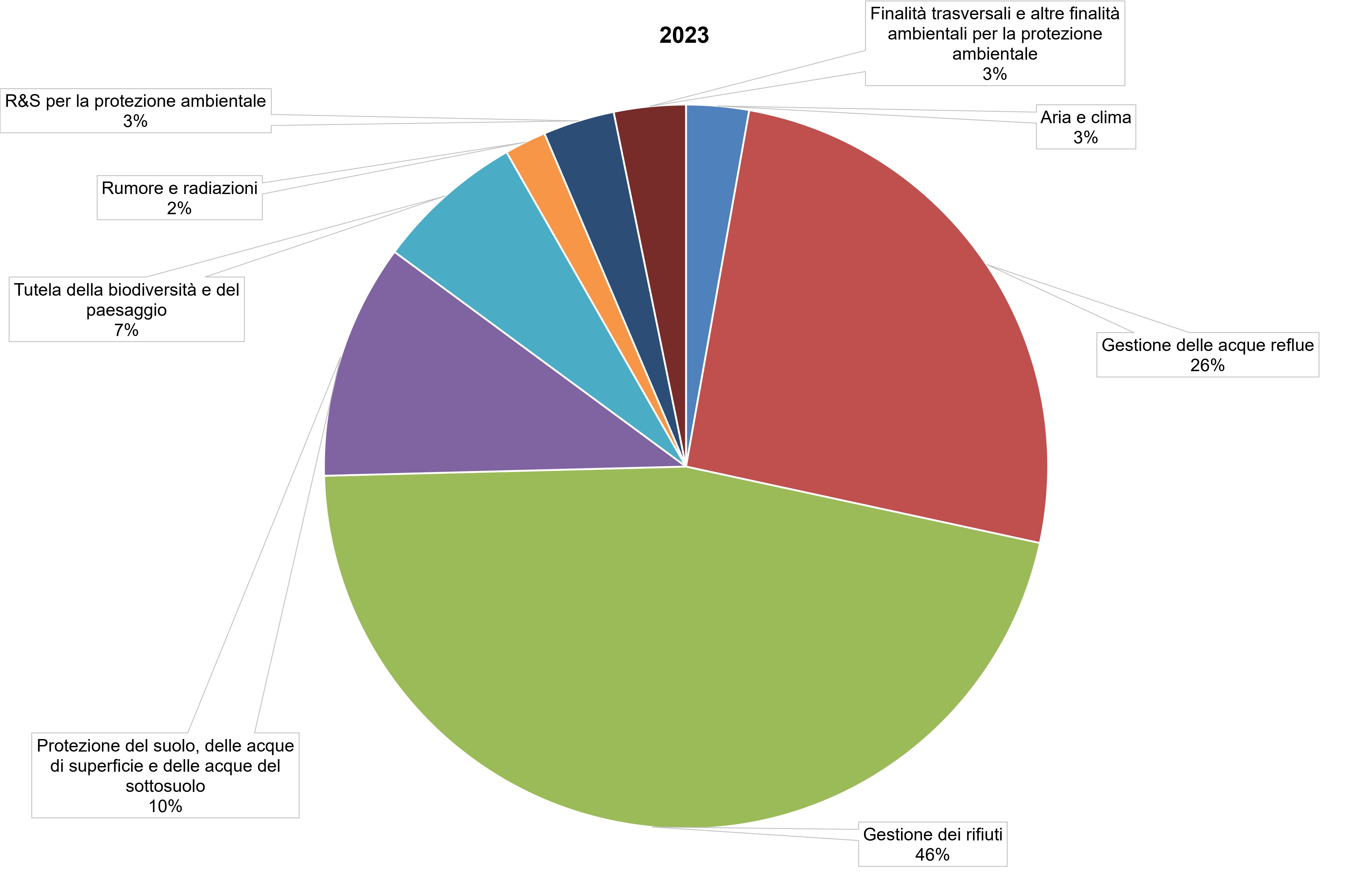
In 2023, total Italian spending on environmental protection will amount to €52.9 billion, equal to 2.5% of Gross Domestic Product (GDP). This figure remained essentially stable over the 2016–2023 period, signaling continued investment in environmental protection. Resources are primarily used for waste management and wastewater management, which represent the two largest expenditure items (46% and 26%, respectively). These are accompanied, to a lesser but still significant extent, by interventions to protect and remediate soil, groundwater, and surface water, safeguard biodiversity and landscape, protect air and climate, as well as noise and vibration abatement (excluding workplaces). Expenditure on environmental research and development and other support activities, which contribute to the dissemination of innovative and sustainable solutions and other environmental objectives, complete the picture.
The indicator measures national environmental protection spending by resident units (public administrations, businesses, and households), in accordance with the European Environmental Economic Accounts. Expenditure includes final consumption, investments, transfers, and other economic components intended for the production and use of environmental protection services. The data are processed within the environmental economic accounts and are classified according to the new Classification of Environmental Purposes (CEP), which replaces the previous CEPA classification.
Monitor the economic resources allocated to environmental protection by resident units, according to a harmonized European methodology, to support environmental policies and sustainable development.
Commission Delegated Regulation (EU) 2022/125 amending the Annexes to Regulation (EU) No 691/2011.[SI1]
Commission Delegated Regulation (EU) 2025/1131 updating the Annexes to Regulation (EU) No 691/2011 by introducing the Classification of Environmental Purposes (CEP).
Eurostat, Environmental Protection Expenditure Accounts (EPEA) – Manual and methodological guidance (latest version available).
United Nations, European Commission, FAO, IMF, OECD, World Bank, System of Environmental-Economic Accounting – Central Framework (SEEA CF), 2012.
Istat, Production and expenditure for environmental purposes – update of the historical series, latest available edition.
Istat, Economy and the environment – Environmental economic accounts, latest available edition.
Eurostat, Environmental Protection Expenditure Accounts (EPEA) – Statistics Explained.
Istat
Istat database - https://esploradati.istat.it/databrowser/#/it/dw/categories--> National accounts --> Environmental accounts --> Environmental protection expenditures
National
2016-2022
Expenditure on environmental protection (€)
The indicator's methodology complies with the methodological framework of the Environmental Protection Expenditure Accounts (EPEA) defined by the United Nations System of Environmental and Economic Accounts (SEEA), the European System of Accounts (ESA 2010), and Regulation (EU) 2024/3024, as amended by Regulation (EU) 2025/1131, which introduces the new Classification of Environmental Purposes (CEP) to replace the previous CEPA classification. The compilation of the accounts also refers to Eurostat's methodological documentation and updates made available in the environmental economic accounts.
Starting from the data referring to 2016, the account is classified according to the new Classification of Environmental Purposes (CEP). The indicator takes into account environmental protection purposes, divided into the following categories: air and climate protection; wastewater management; waste management; soil, surface water, and groundwater protection; noise and radiation; biodiversity, ecosystem, and landscape protection; research and development for environmental protection; and other environmental protection activities.
The 2016-2023 time series were reconstructed by Istat according to the new CEP classification, ensuring methodological consistency with national accounts and the European Environmental Economic Accounts.
In 2023, the level of Italian economic spending on environmental protection will stand at 52.9 billion euros, equal to 2.5% of Gross Domestic Product (Table 1), substantially in line with the European average (2%).
In the period 2016-2023, Italian spending on environmental protection increased by 35% in current value. However, as a percentage of GDP, the spending ratio increased by only 0.2 percentage points, highlighting a substantially stable trend in the economic commitment allocated to environmental protection over the period considered (Table 1).
| Allegati |
|---|
Titolo
Table 1: National expenditure on environmental protection by institutional sector and by CEP, and ratio to GDP Fonte
Istat Note
ISP: private, non-profit social institutions serving families |
Thumbnail
Titolo
Figure 1: National expenditure on environmental protection by environmental purpose (2023) Fonte
ISPRA processing based on Istat data |
In 2023, the majority of national environmental protection spending will be allocated to waste management and wastewater management, accounting for 46% and 26% of the total, respectively (Figure 1). These two items constitute the main areas of intervention, reflecting the central role of sustainable management of resources and basic environmental services. The remaining expenditure is distributed among other environmental objectives, including soil and water protection and restoration, biodiversity and landscape protection, air and climate protection, noise and radiation reduction, as well as research and development and other supporting initiatives. Although less significant in quantitative terms, these areas reflect a growing commitment to a more integrated and preventive management of environmental problems (Table 1 and Figure 1). From the perspective of those supporting the expenditure, in 2023, businesses (companies) will cover more than half of the total (55%), followed by public administrations and private non-profit social institutions (26%), and finally households, with a share of 19%. The distribution of expenditure among the various institutional sectors remained virtually stable in the period 2016–2023, indicating continuity in the roles and responsibilities of economic actors in environmental protection (Table 1). Overall, the data confirm a constant and widespread commitment to financing environmental protection activities, in line with trends observed at the European level.