Patrizia Borrello, Emanuela Spada
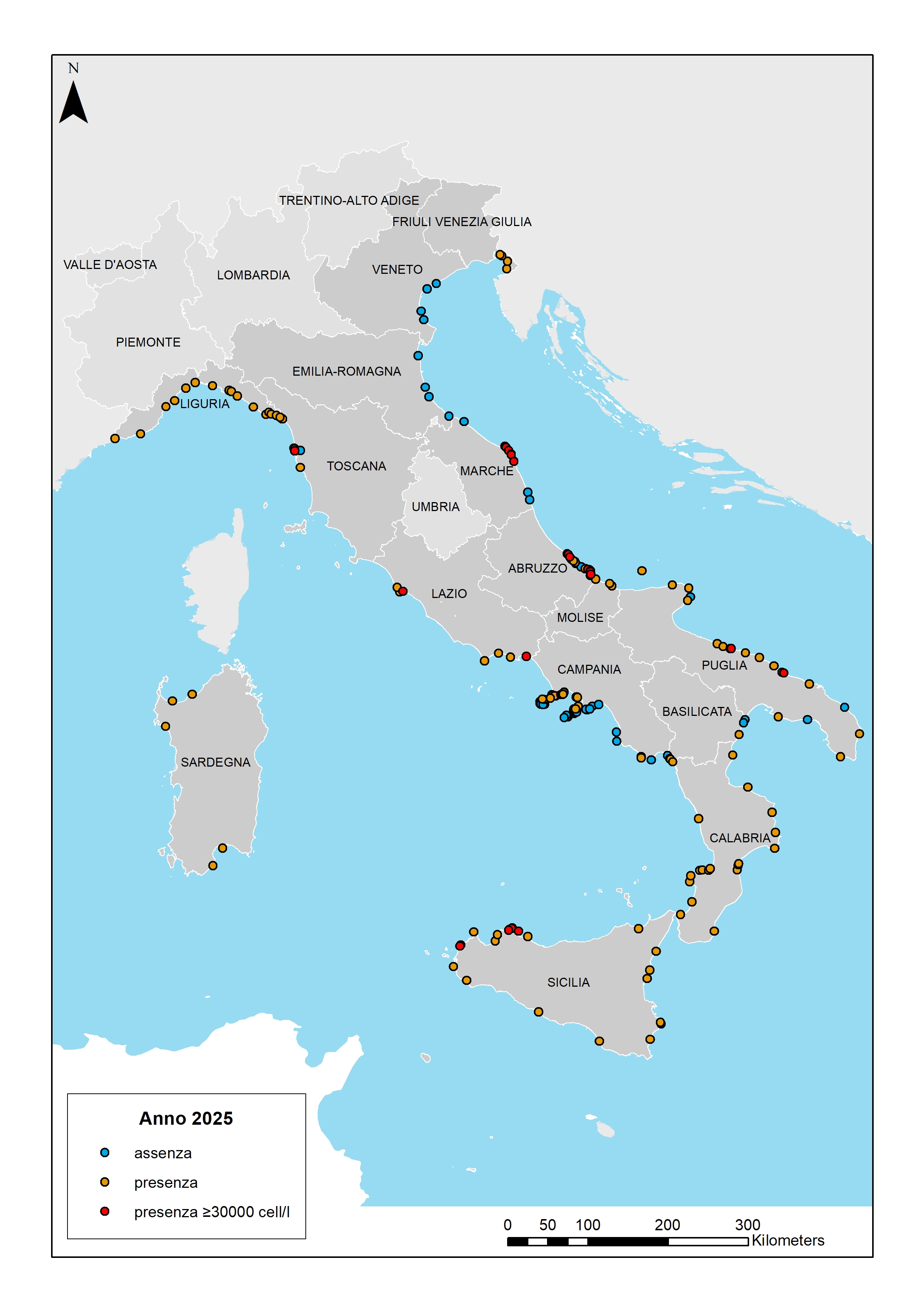
Ostreopsis cf. ovata is a potentially toxic benthic microalgae, present today in most of the Italian coastal regions with blooms that can give rise to phenomena of human intoxication and toxic effects on benthic marine organisms (states of suffering or mortality). The continuous expansion along the Italian coasts of Ostreopsis cf. ovata, its blooms and the health, environmental and economic problems associated with it, has led to the establishment of a monitoring program for the surveillance of microalgae since 2007. This activity is carried out annually in the summer season by the Regional Environment Agencies (ARPA). The data so far provided by ARPA, collected and processed by ISPRA, have clarified the distribution and trend of flowering at national and regional level. To date, microalgae has been found at least once in the monitoring campaigns so far carried out in 13 out of 15 coastal regions. In 2025, the Ostreopsis cf. ovata is present in 13 coastal regions or in 152/202 stations (75%), while it is absent in all samples taken along the coasts of Emilia-Romagna and Veneto.
The indicator measures the trend of the concentration and distribution of Ostreopsis cf. ovata along the Italian marine-coastal areas and contributes to the environmental assessment of bathing water carried out through the drafting of the "Bathing water profiles" (DM 30/3/2010, All. E). It is also associated with the potential toxic and harmful risk on benthic marine biocenoses and humans. Annex C of DM 30/3/2010 used up to the 2018 bathing season shows an alert threshold, corresponding to a concentration in the water column of 10,000 cells. /L (cells per liter), beyond which (emergency threshold) is expected to adopt protective measures. Since the 2019 bathing season, the new reference values for alert or emergency to protect human health have been adopted in the ISS guidelines (ISTISAN Report 14/19) pursuant to DM 19/4/2018. Ostreopsis ovata is a potentially toxic dinoflagellate detected in Italy since 1989, with very high abundances (flowering), especially in the benthic sector. Flowerings can result in cases of suffering or mortality of benthic marine organisms resulting in a qualitative deterioration in water. They occur during the summer and autumn season, often with the concomitant presence of reddish-brown mucilaginous films to widely cover hard bottoms and substrates and the presence of suspended flocculi in the water column. The conditions that seem to favor the development and the blooms are: low water depth, presence of rocky substrates and / or macroalgae, poor hydrodynamics due to the natural morphology of the coast or the presence of brushes and artificial barriers for the containment of coastal erosion, weather-marine conditions of great stability, water temperatures above 25 °C related to climate change in progress.
Evaluate the presence of microalgae, the space-time trend of its proliferation and the potential risk to the benthic marine environment, humans and bathing waters.
Directive Programme Toxic Algae of the Minister for the Environment (GAB/2006/6741/B01); Directive 2006/7/EC; D. Lgs. 152/2006; D. Lgs. 116/2008; DM 30 March 2010; DM 19 April 2018; Directive 2008/56/EC; D. Lgs. 190/2010; RA Agreement. MO. GE (France, Principality of Monaco, Italy).
Since 2006, following the Toxic Algae Program Directive of the Minister of the Environment and the Protection of the Land and the Sea, ISPRA has activated with the coastal ARPAs the working line "Ostreopsis algal blooms ovata along the Italian coasts" in order to identify elements for a common national strategy of sampling, analysis, monitoring, surveillance, information, communication and management of the phenomenon "toxic algae". In parallel, the Ministry of Health has prepared the guidelines for the "Management of the risk associated with the blooms of Ostreopsis ovata in the Italian coasts" (May 2007). Since one of the aims of Directive 2006/7/EC is to preserve, protect and improve the quality of the environment and to protect human health by integrating Directive 2000/60/EC, as well as in its Italian transposition, activities on Ostreopsis were useful for environmental assessments. For this purpose, the blooms are to be indicated in the Annex E "Bathing water profiles" of the DM 30 March 2010 which reports in Article 3 as amended by the DM 19 April 2018 (Article 3 paragraph c) the adoption of the ISPRA operating protocols in the surveillance and monitoring activities and the new reference values reported in the ISS guidelines (ISTISAN Report 14/19) pursuant to the aforementioned DM 19/4/2018.
In particular, the alert phase provides water column density of 10,000-30,000 cells/L, sufficient hydrodynamics and temperatures unfavorable to flowering or density of 30,000-100,000 cells. /L and unfavorable weather conditions for the formation of aerosols and sprays; while, in the emergency phase it involves “Density in water column >30,000 cells. /L and weather-marine conditions conducive to the formation of aerosols and water sprays” or “Density in water column >100,000 cells. /L, regardless of weather conditions.”
The indicator was also used for the Initial Assessment pursuant to the Marine Strategy Framework Directive (2008/56/EC transposed with the D. Lgs. 190/2010). The RA Agreement. MO. GE, with the GdL GIZC- Ostreopsis ovata, has allowed since 2010, Italian, French and Monegasque scholars and health authorities to discuss national surveillance plans, flowering management methods.
ISPRA Rapporti: 127/2010,148/2011, 173/2012, 188/2013, 211/2014, 232/2015, 253/2016, 275/2017, 298/2018, 325/2019, 336/2020, 357/2021, 379/2022, 396/2023, 405/2024, 421/2025.
Report SNPA 21/2021, Rapporto sugli indicatori di impatto dei cambiamenti climatici.
ISPRA, Quaderni Ricerca Marina n. 5, 2012
Linee guida ISS (Rapporto ISTISAN 14/19)
Climate change and harmful benthic microalgae. Patricia A. Tester, R. Wayne Litaker, Elisa Berdalet. Harmful Algae, Vol, 91, 2020 https://doi. org/10.1016/j. hal.2019.101655 https://www. researchgate. net/publication
Stefano Accoroni, Francesca Neri, Marika Ubaldi, Tiziana Romagnoli, Cecilia Totti, 2024. Trend of Ostreopsis cf. ovata (Dinophyceae) along the Conero Riviera (northern Adriatic Sea) over two decades. Phycologia https://doi. org/10.1080/00318884.2024.2318819
S. Accoroni, G. Montali, F. Neri, P. Borrello, E. Spada, E. Berdalet, M. Vila, R. Lemee, J. Davenet, M. Y. Dechraoui Bottein, L. Mangialajo, M. Chiantore, V. Asnaghi, C. Fricano, F. Champion, C. Totti, 2026. The role of sea temperature in Ostreopsis cf. ovata blooms in temperate areas—14 years of data gathered along the Northern Mediterranean coast. Harmful Algae 155 (2006). DOI: 10.1016/j. hal.2026.103107
Lack of an environmental reference threshold value.
Quantitative study of the effects on benthos. Determination of an environmental threshold concentration value.
ARPA Costiere
The data of the coastal ARPAs provided to ISPRA as part of the activity line: "Ostreopsis algal blooms ovated along the Italian coasts" (Dir. Program toxic algae n. GAB/2006/6741/B01) sent in the form of reports and excel tables by e-mail or ISPRA pec and uploaded to SINTAI with specific format.
Coastal regions
2010-2025
Abundances are expressed as cell. /L, cell./g fw or cell./cm 2 respectively for samples taken in water column, on macroalga or on hard substrate. All matrices contribute to indicate the presence of Ostreopsis ovata in the pick-up station, considering as positivity the presence of Ostreopsis at least once in the monitoring campaign. Concentration in cell. /L is compared with the new health reference values reported in the ISS guidelines (ISTISAN Report 14/19) pursuant to DM 19/4/2018. In particular, the emergency phase is reached with density >30,000 cells/L and weather-marine conditions conducive to the formation of aerosols and water sprays. The space-time comparison of abundances shows the trend of flowering at regional, interregional and national level in the reference year and in previous years. In addition, the presence of Ostreopsis also expressed as a percentage of positive sites is reported at regional and national level in the current year and in the observation period.
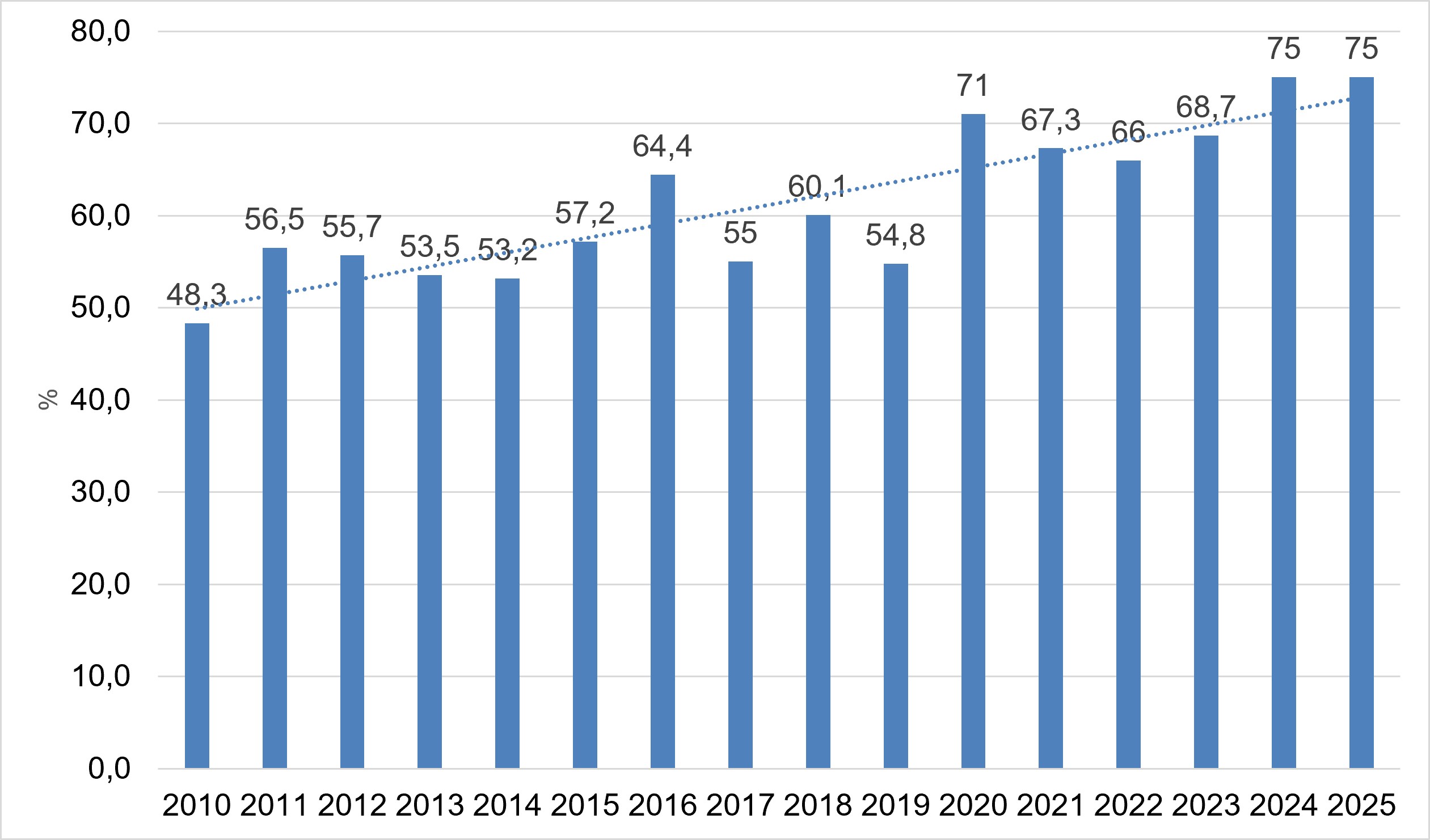
The 2025 monitoring, carried out in 15 coastal regions, made it possible to assess the spatial-time trend of the indicator per single sampling point. In 6 regions there was an over 30,000 cells/l and in 4 of these also exceeded 100,000 cells/L (Table 1). The first is an alert value and the second an emergency value, according to the guidelines of the Ministry of Health. In 2025, no episodes of suffering were observed against marine organisms but only the presence of foam and flocculi in water column (Lazio) and brownish mucilage on the substrates (Friuli-Venezia Giulia), during the peak of the flowering. The percentage of positive sites, which describes the spatial distribution of the indicator, remains stable at 75% as in 2024. It is not currently possible to assess the state from the environmental point of view only on the basis of the presence of the seaweed, as it lacks an environmental reference value that poses a risk to the health of marine-benthic organisms. The Chernoff icon in this case is only assigned on the presence/absence.
A negative trend is attributed because the trend in the 16 years considered does not show a clear turnaround. In fact, since 2010 there has been an increase over time, of more than 27 percentage points, of sites with the presence of Ostreopsis ovata (2010: 48.3%, 2025: 75%) (Figure 2 and Table 3). Minimum changes in the number of sites with the presence of microalgae in the period 2010-2015 and greater between 2016 and 2025 are also observed. The maximum values, equal to 75%, were recorded in 2024 and 2025.
| Data |
|---|
Thumbnail
Headline
Figure 1: Presence of Ostreopsis ovata along the Italian coasts (2025) Data source
ISPRA processing on coastal ARPA data |
Headline
Table 1: Presence of Ostreopsis ovata along the Italian coasts (2025) Data source
ISPRA processing on coastal ARPA data |
Headline
Table 2: Ostreopsis ovata along the Italian coasts Data source
ISPRA processing on coastal ARPA data |
Headline
Table 3: Percentage of sites with presence of Ostreopsis ovata Data source
ISPRA processing on coastal ARPA data Note
n.d. - dati mancanti |
Thumbnail
Headline
Figure 2: Percentage of sites with presence of Ovated Ostreopsis Data source
ISPRA processing on coastal ARPA data |
In 2025, the monitoring activities of the potentially toxic benthic microalgae Ostreopsis ovata were carried out along the coasts of the 15 coastal regions (Table 1 and Figure 1). The surveys were carried out by the Regional Environment Agencies (ARPA) and for the purposes of water control activities intended for bathing, in compliance with current legislation (DM 30/3/2010, DM 19 April 2018 and D. Legislative Decree 116/08 et seq. mm. ii), either as part of ARPA/Regione projects, or as an activity falling within the monitoring of potentially toxic species in mollusc farming waters (Friuli-Venezia Giulia).
202 sampling stations with hydromorphological characteristics suitable for the development of microalgae have been identified and monitored (presence of macroalgae, rocky substrates, shallow water and moderate hydrodynamics, natural reefs and breakwater barriers or brushes) or that have recorded in previous years the presence and / or blooms of the microalgae.
The monitoring was generally carried out in the period June-September 2025, postponed in some cases to October (Campania, Marche and Veneto). The frequency of fortnightly or monthly sampling was intensified in cases of exceeding the reference values (30,000 cell/l, 100,000 cell/l), as indicated in the contingency phases described in the surveillance plans respectively of the Guidelines of the Ministry of Health contained in DM 30/3/2010 and DM 19/4/2018 and in the ISTISAN Report 14/19.
Water and macroalgae samples were taken, according to shared methodologies. The chemical-physical parameters of the water were also detected and recorded on a special field card, information on the sampling site, any signals of manifest microalgal flowering or states of suffering against marine organisms (hedgehogs, mussels, starfish, fish, macroalgae, etc.).
In 2025 Ostreopsis ovata was found in 13 coastal regions, while it is absent in all samples taken along the coasts of Emilia-Romagna and Veneto (Table 2) and is present at least once in 152/202 stations (75%), considering all types of sampled matrices (Table 1 and Figure 1). This means that the sites where the presence of microalgae is detected being "at potential risk of toxic algal proliferation" are to be reported in the environmental profile of bathing water to be monitored through monitoring (DM 30/3/2010 and 19/4/2018). In addition, the health reference value of 30% of 3,000 cell/l was exceeded at least once in 23 monitoring sites (calculation carried out only on the water matrix, Figure 1) and the emergency health value of 100,000 cell/L was exceeded at least once in 8 sites (Lazio 2, Marche 6, Puglia 2, Sicily 1). The first surveys (at low concentrations) are found in June in Puglia, Calabria, Campania, Lazio, Liguria, Sardinia, Sicily and Tuscany, while the highest abundances above 30,000 cells/L are distributed between June and September in Abruzzo, Tuscany, Lazio, Marche, Puglia and Sicily. In particular, in the last four regions mentioned, both the exceedance of 30,000 cells/l and the exceedance of 100,000 cells/L occurred. The maximum concentration value was 2,900,000 cells. /L in the hot-spot site of Passetto elevator (Marche), which then returned to high concentrations after the 2024 break in which Ostreopsis ovata was found to be totally absent. The other hot-spot point that in 2024 had low concentrations compared to previous years, in 2025 reached 208,408 cells/l Hotel Riva del Sole (Apulia) that exceeds the emergency value (100,000 cell/l).
Moreover, based on the data collected in previous years, the duration of the flowering varies from a few days up to 7-10 days but dependent, however, on the environmental conditions that favor and maintain it.