Patrizia D'Alessandro
The indicator shows the quantity of Waste from Economic Activities disposed of in landfills by category and type of waste and the number of landfills. In 2024, the total quantity of Waste from Economic Activities disposed of in landfills amounted to 7.7 million tonnes, equal to 4.1% of the total quantity of Waste from Economic Activities managed nationally (187 million tonnes). Compared to 2023, this represents a decrease of approximately 154,000 tonnes (-2%). The total number of operational landfills is 244: 103 landfills for inert waste (42% of the total operating facilities), 130 landfills for non-hazardous waste (53% of the total), and 11 landfills for hazardous waste (5% of the total). Analyzing the three-year period 2022-2024, there is a progressive a progressive decrease in the total number of operational landfills ranging from 261 in 2022, to 249 in 2023, and 244 in 2024.
It represents the amount of special waste disposed of in landfills by category and by type of waste and the number of operating landfills that dispose of Waste from Economic Activities.
Verify the application of the European "waste hierarchy" on waste management provided for by art. 4 of Directive 2008/98/EC and subsequent amendments, which provides for landfill disposal as a residual management form.
Directive 1999/31/EC on the landfill of waste and subsequent amendments.
Decision 2003/33/EC establishing criteria and procedures for the acceptance of waste in landfills pursuant to art. 16 and Annex II of Directive 1999/31/EC and subsequent amendments.
Legislative Decree 36/2003 implementing Directive 1999/31/EC on the landfill of waste and subsequent amendments.
Legislative Decree 152/2006 environmental regulations - Part IV and subsequent amendments.
Directive 2008/98/EC on waste and subsequent amendments.
Ministerial Decree of 27 September 2010 defining the criteria for the admissibility of waste in landfill, amended by Ministerial Decree of 24 June 2015.
Directive 2018/850/EU amending Directive 1999/31/EC on the landfill of waste.
Directive 2018/851/EU amending Directive 2008/98/EC on waste.
Legislative Decree no. 121/2020 (3 September 2020) which implements Directive 2018/850/EU.
Legislative Decree 36/2003 (implementation of Directive 1999/31/EC on the landfill of waste) which establishes the operational and technical requirements for landfill facilities by defining the procedures, construction criteria and management methods of such facilities in order to reduce the environmental impact of waste collection sites. Landfills are classified into three categories based on the type of waste: inert, non-hazardous, and hazardous. Regarding the criteria for waste admissibility in landfill, the provisions are partly contained in Legislative Decree 36/2003 but, above all, in the Ministerial Decree of 27 September 2010, which transposes European Commission Decision 2003/33/EC concerning the criteria for waste admissibility in different types of landfills. Directive 2008/98/EC establishes the key principles regarding waste, such as the definition of waste, recovery, and disposal, requires authorization for all parties involved in waste management, and requires waste to be treated in a way that avoids negative impacts on the environment and human health, and encourages the application of the "waste hierarchy," which provides for landfill disposal as the residual form of management.
ISPRA, Waste from Economic ActivitiesReport - 2026 Edition.
ISPRA - Waste Registry (http://www.catasto-rifiuti.isprambiente.it).
National (I), Regional (20/20)
1997-2024
Quantity of Waste from Economic Activities disposed of in landfill (tons).
Green Deal
The data on the landfill disposal of Waste from Economic Activities were processed from the reclaimed MUD 2025 database (Single Environmental Declaration Model, reference year 2024), validated, and integrated with information collected through specific questionnaires prepared by ISPRA and sent to all entities in possession of information on the matter (ARPA/APPA, Regions, Provinces, Municipalities), as well as through specific checks on individual plants.
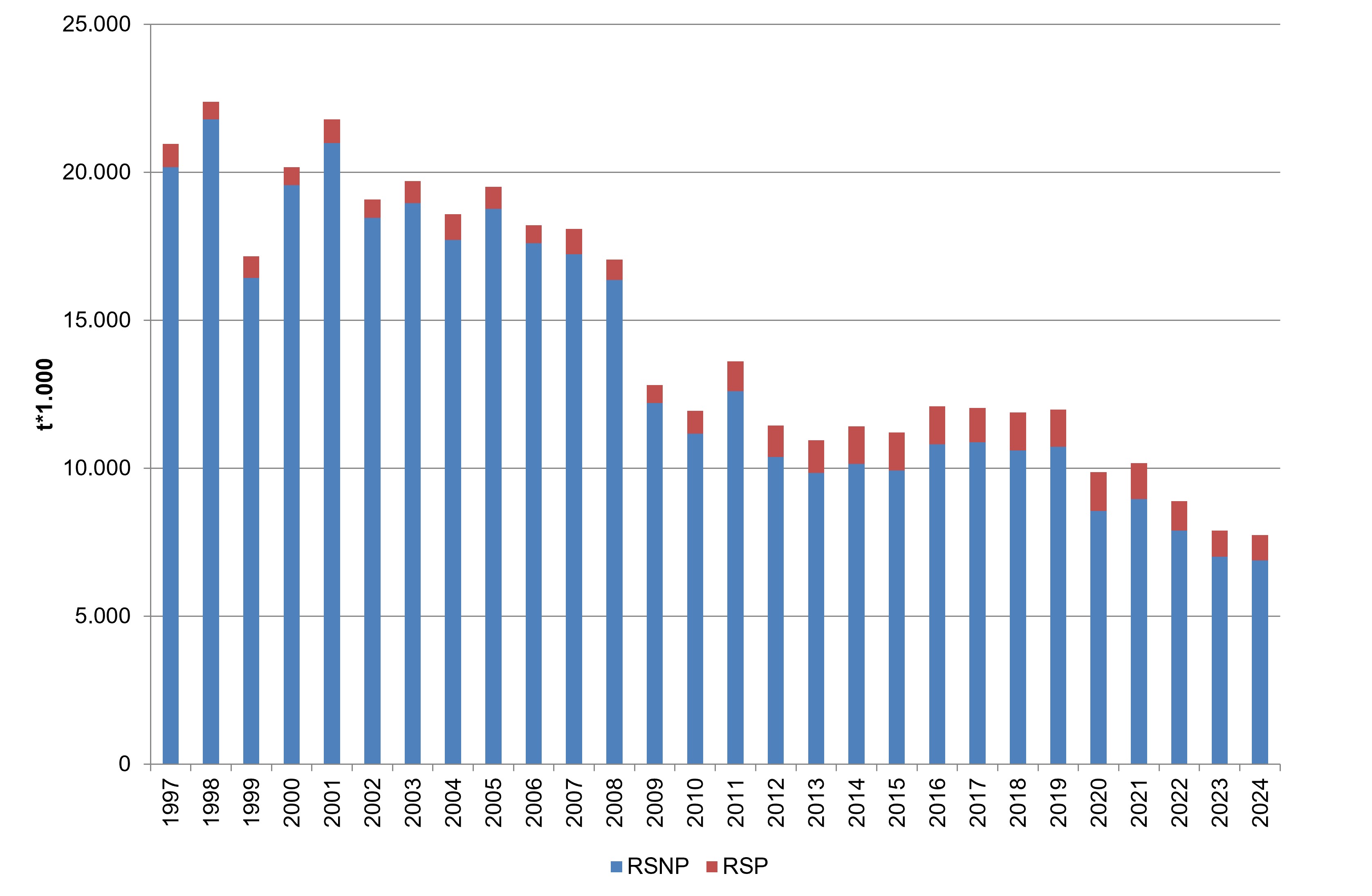
In 2024, the total amount of Waste from Economic Activities disposed of in landfills will amount to 7.7 million tons, equal to 4.1% of the total amount managed nationally (187 million tons). Compared to 2023, this represents a decrease of approximately 154,000 tons (-2%) (Table 1). Along with the amount of special waste disposed of in landfills, the number of facilities will also decrease, going from 249 in 2023 to 244 in 2024 (Table 3).
During the period 1997-2024, the amount of Waste from Economic Activities disposed of in landfills decreased by 63%, thus outlining a positive trend (Table 1 and Figure 1). The number of operational landfills that dispose of special waste also decreased over the years, with a 30% decrease compared to 2016, from 350 facilities to 244 in 2024 (Table 3).
| Allegati |
|---|
Titolo
Table 1: Quantity of Waste from Economic Activities disposed of in landfills in Italy Fonte
ISPRA |
Titolo
Table 2: Quantity of Waste from Economic Activities landfilled by type, at regional level Fonte
ISPRA |
Titolo
Table 3: Number of operational landfills disposing of special waste, by region and by category Fonte
ISPRA |
Thumbnail
Titolo
Figure 1: Trend in the quantity of Waste from Economic Activities landfilled Fonte
ISPRA |
Thumbnail
Titolo
Figure 2: Geographical location and category of operational landfills disposing of Waste from Economic Activities (2024) Fonte
ISPRA |
In 2024, the quantities of non-hazardous Waste from Economic Activities disposed of in landfill amounted to approximately 6.9 million tonnes, representing 89% of the total disposed of in landfill nationwide, while hazardous waste, equal to approximately 855 thousand tonnes, constituted 11%. The analysis of data relating to the two-year period 2023-2024 shows a decrease in the quantities of non-hazardous waste disposed of, which went from just over 7 million tonnes to approximately 6.9 million tonnes (-1.8%, -127 thousand tonnes), while for hazardous waste, a reduction of approximately 28 thousand tonnes was recorded, equal to -3.1% (Table 1 and Figure 1).
In 2024, 54.8% of Waste from Economic Activities was disposed of in plants in the North, for a quantity of just over 4.2 million tonnes, a decrease of 3.5% compared to 2023 (-153 thousand tonnes approximately) (Table 2). The decline mainly affects Lombardy and Veneto, which represent the regions with the largest quantities disposed of (22.8% and 10.9% of the national total): approximately 1.8 million tonnes (-7.2%, equal to -137 thousand tonnes) and 847 thousand tonnes (-22.8%, equal to -251 thousand tonnes), respectively.
Reductions were also recorded in Piedmont (-60 thousand tonnes; -13.3%), Friuli-Venezia Giulia (-25 thousand tonnes; -13.6%), and Valle d'Aosta (-2 thousand tonnes; -2.8%). Conversely, quantities disposed of increased in Trentino-Alto Adige (+140 thousand tonnes), Liguria (+107 thousand), and Emilia-Romagna (+75 thousand).
In Central Italy, where approximately 2.1 million tonnes are disposed of, an overall increase of 3.1% (+61 thousand tonnes) was recorded. In quantitative terms, the greatest change is observed in Umbria, where the percentage increase is equal to 19.4% (+78 thousand tonnes); while a decrease is recorded for Lazio (-16 thousand tonnes, -2.1%), Marche (-1,139 tonnes, -0.8%), and Tuscany (-153 tonnes, -0.02%).
The largest quantities of waste disposed of are found in Lazio (approximately 722 thousand tonnes, equal to 35% of the macro-area and 9.3% of the national total) and Tuscany (717 thousand tonnes, equal to 34.8% of the macro-area and 9.3% of the national total).
In the South, which represents 18.5% of the national total, a decrease of 4.2% (-63 thousand tonnes approximately) is recorded, going from approximately 1.5 million tonnes to 1.4 million tonnes. Sardinia is the region with the largest volumes disposed of (approximately 715,000 tons, equal to 49.8% of the macro-area and 9.2% of the national total), recording an increase of 63,000 tons, or 9.7%. Puglia follows with 424,000 tons disposed of, equal to 29.5% of the macro-area and 5.5% of the national total. Compared to 2023, this region recorded a 1.8% decrease (-approximately 8,000 tons). Sicily follows, disposing of 208,000 tons, equal to 14.5% of the macro-area and 2.7% of the national total; Compared to the previous year, there was a significant change (-92 thousand tons, -30.7%).
Similar trends, although with less significant variations, were seen in Calabria (-23 thousand tons) and Basilicata (-6 thousand tons approximately).
In the remaining regions, there was a reduction of 186 tons in Abruzzo (-4.2%) and an increase of 4 thousand in Molise (+11.5%).
The Campania region does not have any facilities on its territory.
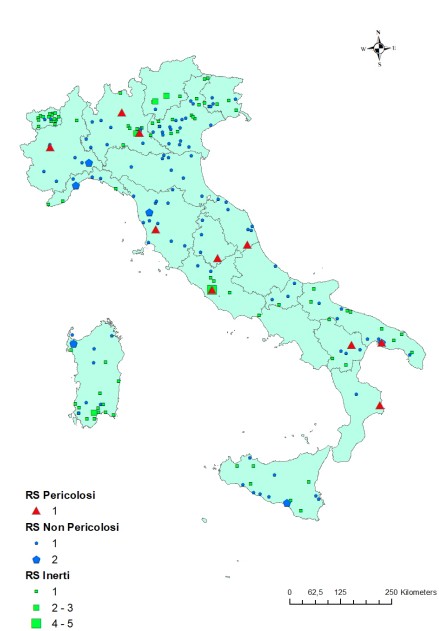
In 2024, the total number of active landfills is 244; according to the classification provided for by Legislative Decree 36/2003 and subsequent amendments, the plant fleet consists of 103 landfills for inert waste (42% of the total operational facilities), 130 landfills for non-hazardous waste (53% of the total) and 11 landfills for hazardous waste (5% of the total). The largest number of landfills is located in the Northern regions, with 128 facilities, while in the Center and South there are 38 and 78 facilities, respectively. A similar geographical distribution is found for landfills for inert waste (57 facilities in the North, 9 in the Center, and 37 in the South) and for those for non-hazardous waste (67 facilities in the North, 25 in the Center, and 38 in the South). Finally, the location of hazardous waste disposal facilities includes 4 facilities in the North, 4 in the Center, and 3 in the South (Table 3 and Figure 2).