Giovanni Finocchiaro, Silvia Iaccarino
The Blue Flag is confirmed as one of the most prestigious international environmental awards for beaches and tourist marinas. In 2025, Italy further consolidates its position among the leading nations in terms of the number of certified locations, reaching 487 Blue Flags for beaches and 84 for tourist marinas. The overall increase compared to 2024 reflects a continuous commitment to the sustainability of coastal and lakeside destinations, as well as a steady improvement in water quality and environmental management of tourist areas.
The indicator shows the number of Blue Flags awarded to various Italian regions for beaches and tourist marinas.
The Blue Flag Program, an International Eco-label for certifying the environmental quality of coastal areas, has gained worldwide recognition among both tourists and tourism operators as a reliable environmental certification associated with sustainable tourism in marine and lake destinations.
The Blue Flag is awarded to coastal tourist locations that meet criteria related to sustainable territorial management.
The Blue Flag Program was established in 1987, the European Year of the Environment. Blue Flags are awarded annually in 49 countries (initially only European, now also non-European) by the FEE (Foundation for Environmental Education), recognized by UNESCO as the global leader in environmental education and sustainable development education.
The program is supported by and involves two United Nations agencies—UNEP (United Nations Environment Programme) and UNWTO (World Tourism Organization)—with which the FEE has signed a global partnership agreement.
The program criteria are periodically updated to encourage participating local administrations to address and improve environmental management challenges over time, ensuring careful environmental protection.
Monitor the spread of sustainable management of the territory in coastal areas, based on political choices focused on attention and care for the environment.
The indicator has no regulatory objectives, as it is a voluntary certification tool.
www. blueflag. global
http://www. bandierablu. org
A new sub-indicator could be created for beaches by calculating the number of blue flags per km of beach.
Foundation for Environmental Education
http://www. bandierablu. org/
www. blueflag. global
National, Regional
2014-2025
The indicator records the total number of beaches and tourist marinas per region, as provided by the FEE.
- A beach can be awarded a Blue Flag if it is officially designated as a bathing area at the national (or international) level, with at least one water quality sampling point.
- The name and boundaries of the beach must match official national designations.
- A tourist marina can be awarded a Blue Flag if it has piers and docks for recreational boats.
- It may be part of a larger port with other activities, provided the marina is clearly separated from other port operations.
- The marina may be located in marine or inland waters.
Both must have the necessary services and meet Blue Flag criteria, fulfilling all mandatory requirements and, ideally, as many guideline requirements as possible.
The requirements are related to:
- Environmental education and training
- Environmental management
- Services and safety
- Water quality
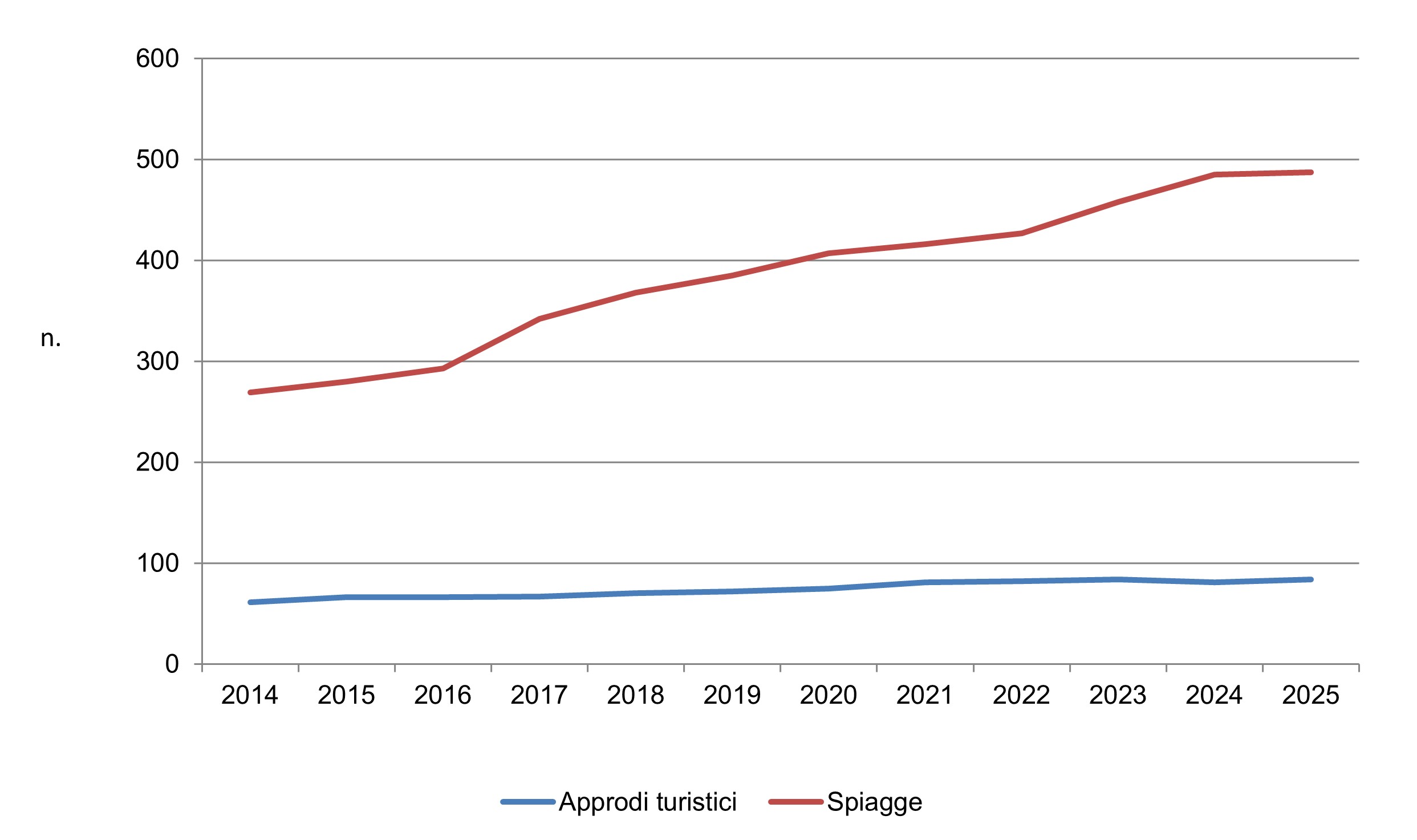
In 2025, a moderate but significant increase is recorded in the number of certified beaches, rising from 485 to 487 (+0.4%), while tourist marinas increase from 81 to 84 (+3.7%) (Figure 1). The geographical distribution of Blue Flag locations remains broad and well balanced across the national territory. Liguria confirms its leading position with 35 awarded municipalities, followed by Apulia (27 municipalities), Calabria (23), Campania and Marche (20), and Tuscany (19) (Table 2).
With regard to tourist marinas, the best results are again recorded in Liguria, which maintains its national lead with 16 certified facilities, followed by Friuli-Venezia Giulia, which, with 14 Blue Flag marinas, stands out for the high density and quality of management of port infrastructures along a relatively limited stretch of coastline (Table 3, Figure 3). Both regions represent a benchmark for the sustainable management of tourist ports, thanks to advanced practices in environmental protection, services for boaters and monitoring of water quality.
Between 2014 and 2025, the total number of Blue Flag beaches in Italy increased from 269 to 487 (+81%), confirming a steady progression over time (Figure 1). Tourist marinas also show a positive trend, increasing from 61 in 2014 to 84 in 2025 (+38%).
After years of sustained growth, the increase recorded in 2025 (+2 beaches and +3 marinas compared to 2024) suggests a transition from an expansion phase to a consolidation phase. Southern regions continue to gain ground thanks to policies aimed at improving environmental quality and bathing services, while in Northern Italy good practices are emerging in the integrated management of tourist ports (Tables 2 and 3).
Overall, the trend remains positive, with a high degree of stability and continued compliance with the standards required by the FEE international programme.
| Allegati |
|---|
Titolo
Table 1: International distribution of "Blue Flag" labels (2025) Fonte
ISPRA processing on data http://www. blueflag. global/ |
Titolo
Table 2: Regional distribution of municipalities with the "blue flag" label Fonte
ISPRA processing on data http://www. bandierablu. org/ |
Titolo
Table 3: Regional distribution of Italian tourist destinations with the "blue flag" label Fonte
ISPRA processing on data http://www. bandierablu. org/ |
Thumbnail
Titolo
Figure 1: Distribution of blue flags (beaches and tourist ports) in Italy Fonte
ISPRA processing on data http://www. bandierablu. org/ |
Thumbnail
Titolo
Figure 2: Distribution of Blue Flags by region and municipality (2025) Fonte
http://www. bandierablu. org/ |
Thumbnail
Titolo
Figure 3: Complete list of Blue Flag beaches (2025) Fonte
http://www. bandierablu. org/ |
Thumbnail
Titolo
Figure 4: Complete list of Blue Flag landing places (2025 Fonte
http://www. bandierablu. org/ |
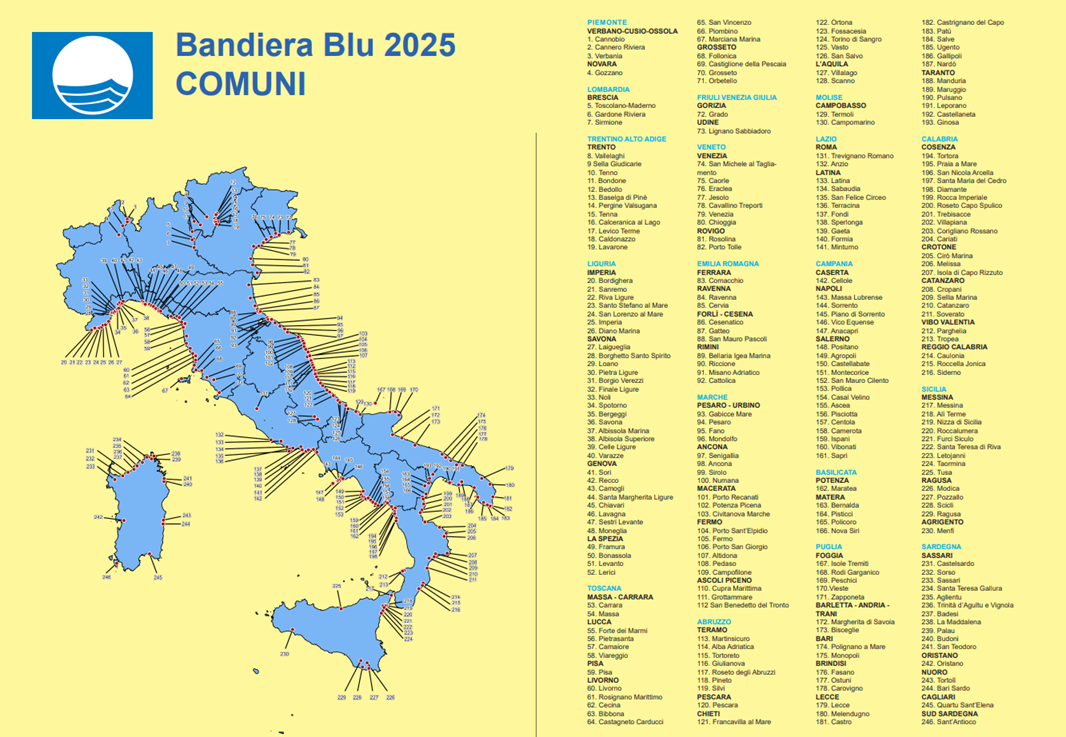
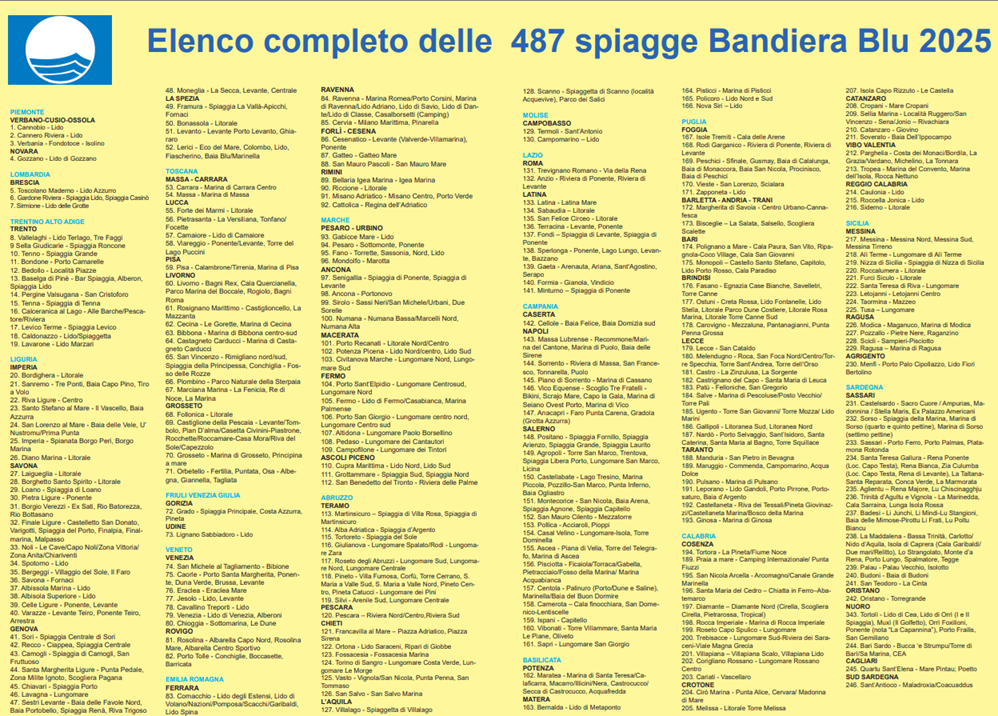
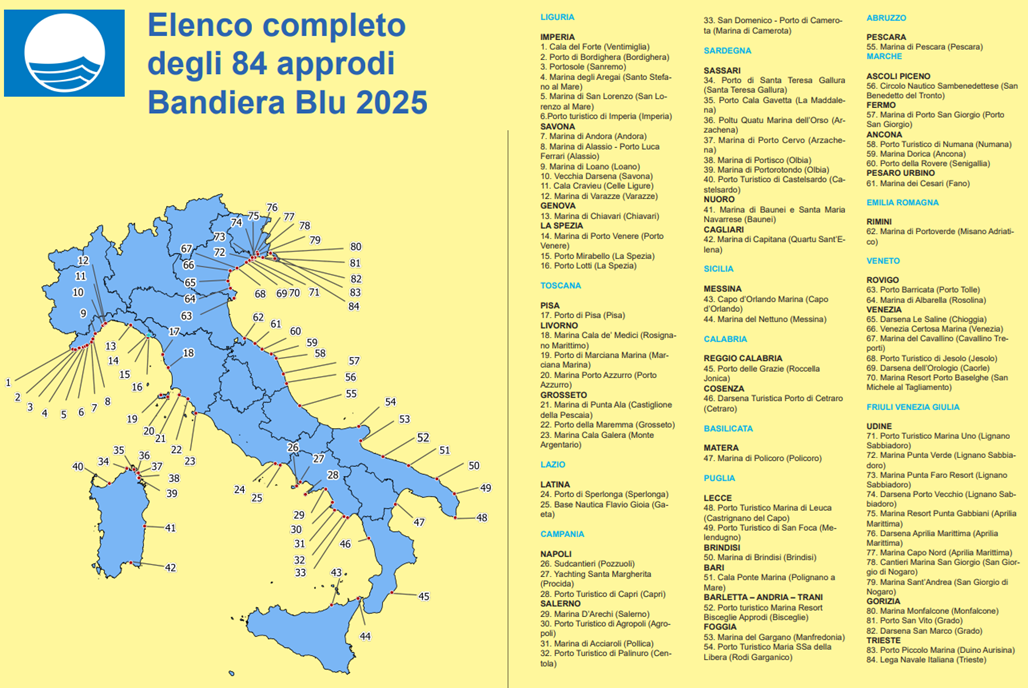
In 2025, with 487 beaches and 84 certified tourist marinas, Italy consolidates its role as a reference point in the Mediterranean for the environmental quality of coastal tourist destinations (Table 1, Figures 3 and 4). At regional level, Liguria maintains its leading position in terms of the number of coastal municipalities (33 municipalities), followed by Apulia (27), Calabria (23), Campania (20), Marche (20) and Tuscany (19) (Table 2, Figure 2).
For tourist marinas, Liguria remains in first place with 16 certified facilities, followed by Friuli-Venezia Giulia (14), Sardinia (9), Veneto and Campania (8) (Table 3, Figure 3). The increase of three marinas compared to 2024 confirms growing attention to the sustainability of nautical tourism, with improvements in port services and waste management in the maritime sector.
At international level, Italy maintains fourth place for the total number of Blue Flags, behind Spain, Greece and Turkey (Table 1).
The award continues to act as a driver for territorial enhancement, promoting tourism that is increasingly oriented towards quality and environmental sustainability.