Stefano Bataloni, Rossella Di Mento, Pasquale Lanera, Giuseppe Trinchera
In Italian seas there are 138 offshore platforms; 42 of them—mostly located in the central and northern Adriatic and mainly used for natural gas extraction—are covered by an environmental monitoring plan. Among the monitored chemical substances are barium and polycyclic aromatic hydrocarbons (PAHs).
Barium is a metal used in the production of fluids required for drilling operations and it can be present in produced waters that are periodically discharged to the sea by platforms, while PAHs are chemical substances whose presence in the marine environment—besides natural factors—is linked to anthropogenic activities.
Barium and total PAH concentrations in surface sediments around platforms are environmental indicators of the pressure resulting from offshore gas field exploitation. Data available for 2008–2024 show a progressive decrease over time in the mean concentrations of these contaminants, with the highest concentrations generally detected close to the platforms.
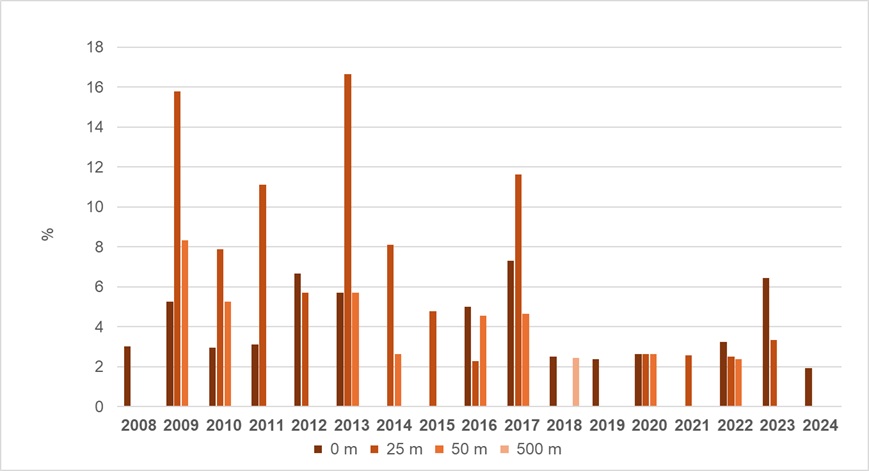
Barium data are above the baseline reference value in the majority of sediment samples analysed in 2008–2014, whereas in 2015–2024 the share of exceedances is close to or below 50%. The percentage of sediment samples with total PAH concentrations above the limit value—an indicator of likely toxic effects on marine organisms—during 2009–2017 in some cases reaches 10–16% at stations 25 m from the platform, but decreases markedly at stations farther from the platform; during 2018–2024 exceedances of the reference value decrease further at all stations.
In Italy, some platforms for offshore hydrocarbon field exploitation are subject to an environmental monitoring plan, generally with annual frequency, aimed at assessing a set of physical and chemical parameters in three environmental matrices: water, sediments, and marine organisms (mussels).
This plan is mandatory to obtain authorization, under Article 104 of Legislative Decree 152/2006, for the discharge into the sea and/or reinjection into deep geological formations of produced water resulting from hydrocarbon extraction activities.
Barium sulfate (barite) is widely used in hydrocarbon extraction activities to increase the density of drilling fluids. These fluids are recovered during the extraction process to prevent their release into the environment; however, barium may still be present in produced water discharged into the sea from platforms and can accumulate near installations (Haanes et al., 2023).
Microparticles of barite, which are poorly soluble, can disperse over long distances before settling on the seabed, where they form complexes with organic matter. In this way, barium becomes non-bioavailable and has low potential toxicity (Neef, 2002; OSPAR Agreement 2014-05).
Nevertheless, knowledge of the distribution of barium levels in marine surface sediments can be used to identify areas affected by discharges from the oil and gas industry.
Marine PAHs derive from both natural phenomena and anthropogenic activities, such as the combustion of organic materials and fossil fuels. Due to their lipophilicity and low solubility in water, PAHs tend to adsorb onto suspended particulate matter and accumulate in marine sediments.
The enrichment of sediments near offshore platforms is only minimally attributable to produced water discharges, since PAH content in treated produced water is generally very low. Rather, enrichment is more likely related to activities preceding the extraction process, which may result in intentional or accidental PAH releases.
This indicator describes the temporal trend of barium and total PAH concentrations in marine sediments surrounding offshore platforms as a function of distance from the installation.
It also illustrates the temporal trend of the percentage of samples exceeding reference values.
For barium, the baseline reference value for marine sediments in the Adriatic Sea—established in scientific literature and confirmed by ISPRA investigations in 2021—is used.
For PAHs, the reference value corresponds to a threshold above which toxic effects on marine organisms are likely.
To provide information on the concentrations of barium and total PAHs, which serve as indicators of environmental pressure from offshore hydrocarbon field exploitation.
Legislative Decree 152/2006, art. 104 and subsequent amendments.
- Dolenec, T., J. Faganeli & S. Pirc (1998): Major, minor and trace elements in surficial sediments from the open Adriatic Sea: a regional geochemical study . Geol. Croat., 51(1): 59-73.
- Buchman, M. F. (2008): National Oceanic and Atmospheric Administration (NOAA) Screening Quick Reference Tables . NOAA OR&R Report 08-1, Office of Response and Restoration Division, National Oceanic and Atmospheric Administration, Seattle, 34 p.
- Neff, J. M., 2002. In: Chapter 4 - Barium in the Ocean, Bioaccumulation in Marine Organisms. Elsevier, Oxford, pp. 79–87.
- Establishment of a list of Predicted No Effect Concentrations (PNECs) for naturally occurring substances in produced water (OSPAR Agreement 2014-05).
The indicator does not provide information on all offshore platforms present in Italian seas, but only on those authorized to discharge production water into the sea.
- ISPRA
- MASE (Ministry of Environment and Energy Security)
The data is available to MASE and ISPRA
National
2008-2024
Barium and total PAH concentrations in marine sediments were obtained from environmental monitoring activities conducted pursuant to Article 104 of Legislative Decree 152/2006. The geometric mean of the concentrations was calculated for all platforms under monitoring, broken down by calendar year and distance from the platform (0, 25, 50, and 500 m). The geometric mean was chosen due to the log-normal distribution of barium and PAH concentrations. The baseline reference value for barium—193 mg/kg—was derived as the 99th percentile of sediment concentrations from stations located over 3,000 meters from platforms, based on ISPRA's 2021 investigations. This value aligns with average concentrations for the central and northern Adriatic Sea (Dolenec et al., 1998). The reference value for total PAHs—1,684 ng/g—is the threshold effect level (TEL) indicating the probability of toxic effects (Buchman, 2008). The percentage of samples exceeding reference values was calculated for each year and each sampling distance, as the ratio between the number of samples above the threshold and the total number of samples analyzed.
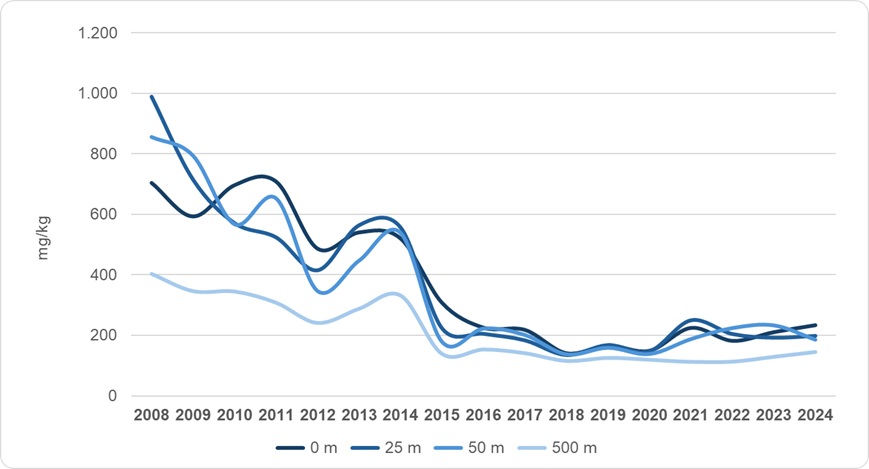
The mean (geometric mean) concentration of barium in marine sediments close to offshore platforms in 2024 (Table 1) ranges between 198 and 235 mg/kg, with only limited variation compared with the previous year, while at intermediate distance the value is about 186 mg/kg, decreasing compared with 2023. At 500 m from the platform, the mean value is close to 145 mg/kg and is increasing compared with 2023.
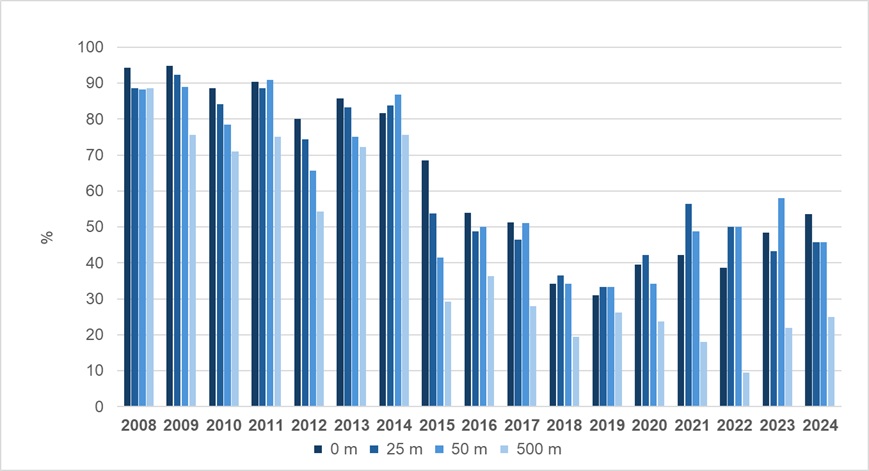
In 2024, the percentage of marine sediment samples with concentrations above the baseline reference value (193 mg/kg, Table 2) ranges between 45–54% of all analysed samples for the areas between 0 and 50 m from the platform, while in more distant areas (500 m) the percentage drops to 25%.
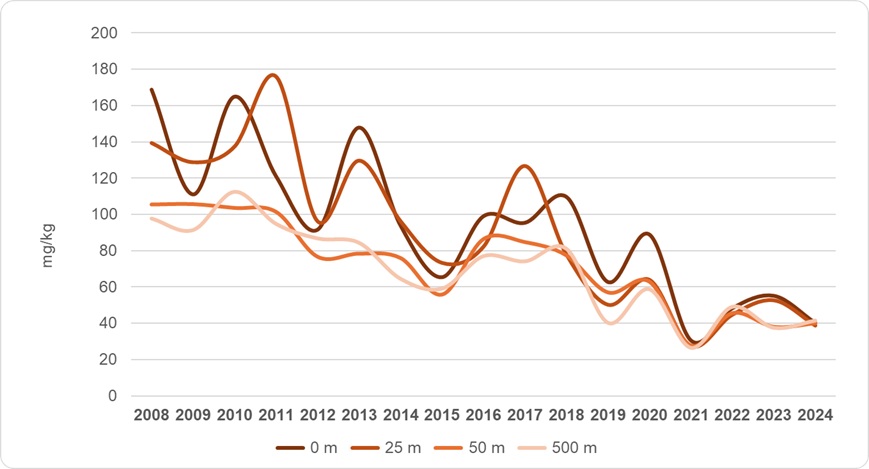
The mean (geometric mean) concentration of total PAHs in sediments around platforms (Table 3) in 2024 ranges between 38 and 41 mg/kg, with the highest value at the station located 500 m from the platform. In 2024, only almost 2% of samples at the 0 m station exceed the limit value for likely toxic effects on the marine environment (1,684 mg/kg, Table 4); no sediment sample at stations between 25 and 500 m from the platform exceeds this reference value.
Overall, the status can be defined as good, because the pressure on the environment resulting from offshore hydrocarbon field development is confined to the areas closest to the extraction platforms (0–25 m), and only in a very small number of cases are pollutant concentrations—such as PAHs—found to be above values associated with likely toxic effects.
Mean barium concentration values in marine sediments between 0 and 50 m from platforms (Figure 1) show an overall decrease in 2008–2015; they remain stable until 2020, then rise in 2021 and stabilise over the following three-year period. A similar pattern, but with markedly lower values, is observed for sediments located farther from the platform.
The share of exceedances of the baseline reference value for barium remains well above 50% in 2008–2014 at all stations around platforms—especially those between 0 and 50 m. In the subsequent period, a decline is observed, with a minimum in 2018–2019 and a stabilisation in 2021–2024, but at levels always below 60% of total samples.
Mean total PAH concentrations show wide fluctuations over the period considered, particularly for sediments between 0 and 50 m from the platform (Figure 3), but the overall trend is clearly decreasing. The percentage of exceedances of the reference value also varies widely (Figure 4), especially in 2008–2017, when exceedances were observed in a share of samples between 8 and 16% at sediments collected 25 m from the platform; at all other sampling stations, the percentage remained between 2 and 8%. In 2018–2024, except for a peak of exceedances at the 0 m station in 2023, the share of exceedances for all sediments is around 2–3%.
| Data |
|---|
Headline
Table 1: Geometric mean of barium concentration as a function of distance from the platform Data source
ISPRA processing on MASE and ISPRA data |
Headline
Table 2: Percentage of barium concentration exceedances compared to the reference value on the total samples Data source
ISPRA processing on MASE and ISPRA data Note
Reference value: 193 mg/kg |
Headline
Table 3: Geometric mean of IPTot concentration as a function of distance from the platform Data source
ISPRA processing on MASE and ISPRA data Note
Reference value: 193 mg/kg |
Headline
Table 4: Percentage of total PAH concentration exceedances compared to the reference value on the total samples Data source
ISPRA processing on MASE and ISPRA data Note
Reference value: 1,684 mg/kg |
Thumbnail
Headline
Figure 1: Trend of the average concentration of barium in marine sediments as a function of distance from the platform Data source
ISPRA processing on MASE and ISPRA data |
Thumbnail
Headline
Figure 2: Percentage of barium concentration exceedances compared to the reference value on the total samples Data source
ISPRA processing on MASE and ISPRA data |
Thumbnail
Headline
Figure 3: Trend of the average concentration of total PAHs in marine sediments as a function of distance from the platform Data source
ISPRA processing on MASE and ISPRA data |
Thumbnail
Headline
Figure 4: Percentage of total PAH concentration exceedances compared to the reference value on the total samples Data source
ISPRA processing on MASE and ISPRA data |
Barium and total PAH concentrations in marine sediments are useful environmental indicators of offshore hydrocarbon field development activities, although their release into the environment associated with such activities is only minimally due to produced-water discharges.
The marine areas most affected by the presence of these contaminants are those in the immediate vicinity of platforms. Indeed, barium at 500 m from platforms has remained near baseline values since 2015, while for total PAHs exceedances of the limit value associated with likely toxic effects have been recorded more frequently only in areas within 25 m of the platform.
Over the period considered, for both substances—both in terms of mean concentrations and exceedance percentages—a general reduction in values is observed.
Overall, therefore, the analysed data indicate that the environmental status around offshore platforms extracting gas from the seabed is good, and that the trend in environmental pressure from this activity is decreasing, as well as spatially limited to the immediate surroundings of the installations.