Gabriele Bellabarba, Francesca Sacchetti
The management of noise pollution produced by airport infrastructures is carried out through the implementation of the obligations required by current legislation, in particular the approval of the acoustic characterization of the airport surroundings, an act of planning of the territory surrounding the airport which allows its use to be regulated in a manner compatible with the sound levels produced by the infrastructure, the application of specific anti-noise procedures, in order to minimize the acoustic impact produced by aircraft, and the implementation and management of an airport noise monitoring system. To date, these requirements are still disregarded in many airports across the country. By 2025, in 25 of the 42 airports where national and international air traffic is present, 39 of which have been identified by ENAC as "airports of national interest", the acoustic characterization of the airport surroundings has been approved, a fundamental and priority act for managing noise pollution.
The indicator shows the number of airports that have approved the acoustic characterization of the airport surroundings. For completeness of information, the indicator also records the number of airports in which the airport surroundings are being assessed, the number of airports that have approved anti-noise procedures and the number of airports that have installed an airport noise monitoring system.
Assess the state of implementation of national legislation on noise pollution, with reference to the obligations set out in LQ 447/95 and the implementing decrees relating to airport noise.
LQ 447/95; Ministerial Decree 31 October 1997; Ministerial Decree 20 May 1999; Ministerial Decree 3 December 1999
The regulation of the protection of the external environment and the living environment from noise pollution is regulated by LQ 447/95 and the related implementing decrees. The containment of noise produced by airport infrastructures is governed by the Ministerial Decree of 31 October 1997 and subsequent decrees, relating to specific aspects, such as anti-noise procedures and the noise monitoring system: Ministerial Decree of 31 October 1997 "Airport noise methodology"; Ministerial Decree 20 May 1999 "Criteria for the design of monitoring systems for the control of noise pollution levels in the vicinity of airports as well as criteria for the classification of airports in relation to the level of noise pollution"; Ministerial Decree 3 December 1999 "Anti-noise procedures and buffer zones in airports".
This complex regulatory system provides, for each airport open to civil traffic, the establishment of a Commission (art. 5 Ministerial Decree 31/10/97), whose tasks are: the definition of anti-noise procedures; the definition of the acoustic characterization of the airport surroundings, through the identification of the buffer zones (A, B and C) characterized by a well-defined range of variability of the airport noise assessment descriptor (LVA) and for which the main land uses are also indicated; the classification of the airport based on three indices, defined according to the extension of the buffer zones, the type of settlements present in the airport surroundings and the population density.
SNPA 2023, SNPA Guidelines n. 45/2023 - Guidelines for the definition of the acoustic characterization of the airport surroundings
ISPRA, 2010, Guidelines for the design and management of airport acoustic monitoring networks
APAT CTN_AGF, 2004, Criteria for the use of calculation models for airport noise in the application of anti-noise procedures and in the determination of airport surroundings
APAT CTN_AGF, 2003, Criteria for the validation of airport noise simulation models and methodology for verifying the results of their use
--
--
ENAC (National Civil Aviation Authority)
ISPRA/ARPA/APPA
MASE (Ministry of the Environment and Energy Safety)
ENAC https://www. enac. gov. it/aeroporti/infrastrutture-aeroportuali/aeroporti-in-italia
National
update as of 12/31/2025
The indicator shows the number of airports that have approved the acoustic characterization of the airport surroundings; for completeness of information, the indicator also records the number of airports in which the airport surroundings are being assessed, the number of airports that have approved anti-noise procedures and the number of airports that have installed an airport noise monitoring system.
From the available data, by 2025, in 25 of the 42 airports where national and international air traffic is present, the acoustic characterization of the airport surroundings has been approved by the Airport Commission, a fundamental and priority act of managing the noise pollution produced by airport infrastructures.
There were modest changes compared to the past year.
| Data |
|---|
Headline
Table 1: Status of implementation of acoustic characterization of airport surroundings Data source
ISPRA/ARPA/APPA, MASE, ENAC |
Thumbnail
Headline
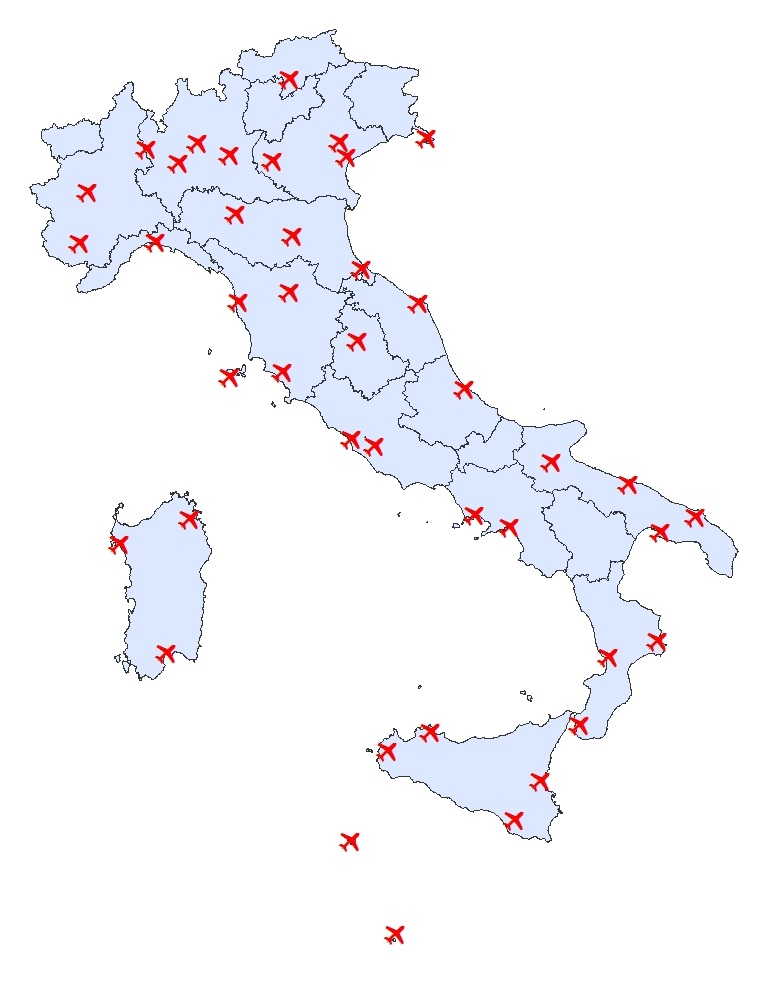
Figure 1: Italian airports Data source
ENAC |
On the national territory there are approximately 101 airports, differentiated into various types (civil, private, military, military open to civilian traffic, mixed); national and international commercial traffic is distributed in 42 of them, 39 of which have been identified by ENAC as "airports of national interest" (Figure 1). Table 1 presents the data relating to the implementation status of the acoustic characterization of the airport surroundings, approved in 25 airports and currently being evaluated in another 5 airports; data relating to the approval of anti-noise procedures, defined in 26 airports, and the creation and management of an aeronautical noise monitoring system are also reported, the responsibilities of which are attributed to the airport management company and which is active in 23 of the 42 airports identified.