Gabriele Bellabarba, Francesca Sacchetti
The municipal noise abatement plan is envisaged by the legislation as a fundamental tool for managing and resolving noise pollution problems in the area; this Plan represents the act consequent to the main fulfillment by the municipalities: the acoustic classification plan. The redevelopment plan must be coordinated with all the other tools provided for the management of the municipal territory and must incorporate the contents of the transport infrastructure noise containment and abatement plans. As of 2024, this planning tool is poorly used across the entire national territory: only 66 municipalities of the 5,106 with acoustic classification have approved the Noise Remediation Plan, confirming a percentage of just over 1% over the years.
The indicator reports, for each autonomous region/province, the number of municipalities with a noise classification plan, the number of municipalities that have approved a noise abatement plan, the list of the same and the relative year of approval of the plan.
Evaluate the state of implementation of the national legislation on noise with reference to the activities of the municipal administrations regarding planning and programming of remediation activities.
LQ 447/1995, Prime Ministerial Decree 14/11/1997
APAT CTN_AGF 2005, Review of the Guidelines for Municipal Noise Remediation Plans
--
--
ARPA/APPA (Regional and Autonomous Province Agencies for Environmental Protection)
The data for the development of the indicator are present in the Noise Observatory database, which can be populated by the ARPA/APPA representatives and can also be consulted by the public on the site. Https://agentifisici. isprambiente. it/associazionetoriorumore_public/home. php
National, Regional (20/20)
update as of 12/31/2024
The indicator is given by the number of municipalities that have approved the noise abatement plan.
The approval of a municipal noise abatement plan, a tool for managing and resolving noise pollution problems in the area envisaged by LQ 447/95, is not widespread and highlights the deficient response on the part of local administrations. This criticality is due to the not yet complete implementation on the national territory of other noise planning tools, in particular the municipal noise classification, to the incomplete updating of national legislation, to the failure to issue specific regulations in some regions regarding the management of noise pollution and to the lack of funds available to municipalities to be able to dedicate to remediation interventions.
It should be noted that while the number of municipalities that have approved the Noise Classification Plan has increased over the years (from 3,304 municipalities in 2009 to 5,106 in 2024), there has not been a corresponding increase in the number of municipalities that have approved the Noise Remediation Plan.
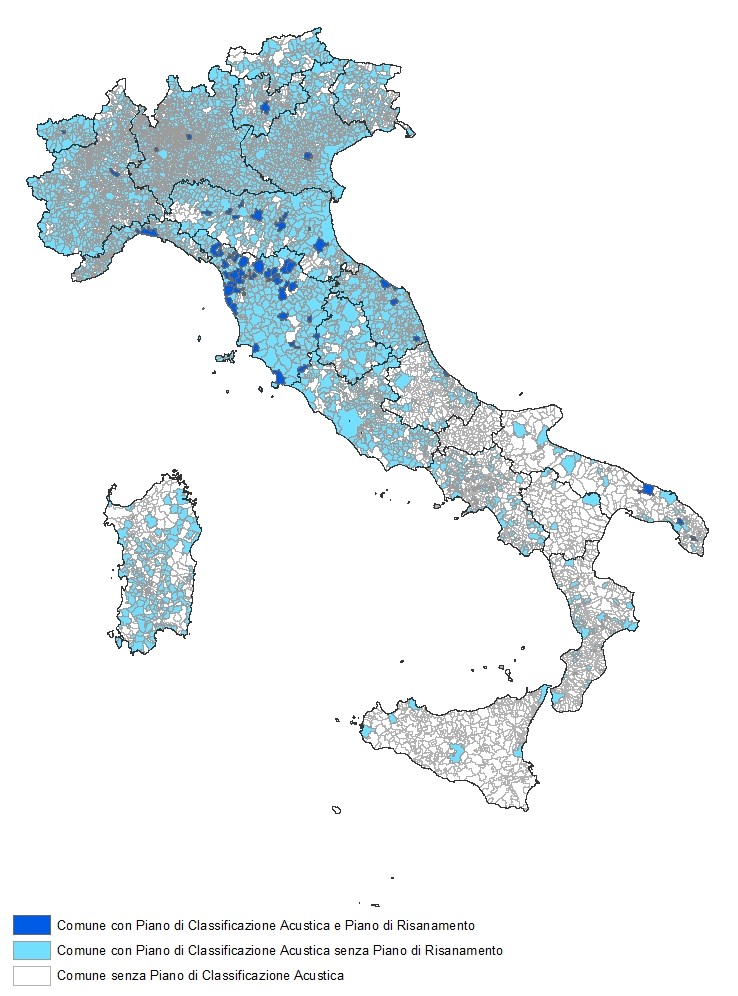
There are still only 66 municipalities that have approved the noise abatement plan (Table 1).
| Data |
|---|
Thumbnail
Headline
Figure 1: Municipal noise abatement plans Data source
Processing by ISPRA based on ARPA/APPA and ISTAT data |
Headline
Table 1: Municipalities, by Region/Autonomous Province, that have approved the Noise Abatement Plan Data source
Processing by ISPRA based on ARPA/APPA data |
As of 2024, only 66 municipalities of the 5,106 with a Noise Classification Plan have approved the Noise Remediation Plan, confirming over the years a very low percentage (stable for several years at 1.3%) of use of this planning tool.
The Redevelopment Plan is approved mainly in Tuscany, with 40 Plans, equal to 60.6% of the total municipalities with Redevelopment Plan, but only 15.3% of the total municipalities with Acoustic Classification Plan approved in the region itself (Table 1). As can be seen from Figure 1, the Noise Remediation Plan is a planning tool that is not consolidated and/or not applied on the national territory.