Elisa Calabretta, Chiara Maggi, Massimo Peleggi
The indicator summarizes the results of the Italian monitoring of the substances in the Watch List (2015-2024), established by Directive 2013/39/EU to identify among emerging pollutants and pollutants for which there is insufficient or quality monitoring data, those dangerous for the European aquatic environment and human health. In each year of monitoring, Member States select the representative stations and identify the sampling frequency and timing for each substance on the List, taking into account the uses and possible frequency of discovery of the same. Between 2015 and 2024, 25 substances and 5 groups were monitored, in the entire water sample (both particulate and filtered) and, for a total of 46 compounds. The results of the Italian monitoring highlight, compared to the number of total measurements carried out per substance and for concentration values greater than or equal to the corresponding PNEC (Predicted No Effect Concentration) value, a percentage of findings greater than 20% for 9 compounds, for the remaining substances it was zero or in any case small. These 9 substances exert chemical pressure on Italian water bodies, making the additional and dynamic monitoring of the Watch List a priority in order to update the ordinary one with newly defined priority and dangerous substances.
The indicator represents the percentage of findings higher than the PNEC (Predicted No Effect Concentration) values of the substances monitored in the control lists, in stations representative of Italian water bodies. The PNEC values, defined in the Implementing Decisions of the European Commission, are the estimated concentrations of a chemical substance in the environment, below which it is believed that no negative effects on ecosystems will occur. The Watch List is a dynamic list (updated every two years) of emerging substances or other substances for which sufficient or quality monitoring data is not available across the whole of Europe. Substances remain on the list until adequate data is collected; upon achieving this objective they are excluded and replaced by new compounds.
Provide a continuous update on the findings of new pollutants in Italy, defined by the Watch List (such as drugs, cosmetics, industrial products), to evaluate and prevent the environmental impact linked to their presence.
Article 8 ter of Directive 2013/39, which updates Directive 2008/105 relating to environmental quality standards in the water policy sector, implemented in Italy by Legislative Decree 172/2015, establishes the Checklist.
From 2015 to 2024, four control lists (Watch lists) have been identified through Commission Implementing Decisions (EU) no. 2015/495, n. 2018/840, n. 2020/116 and n. 2022/1307 (see Table A).
Each Implementing Decision specifies, for each substance on the list:
- the matrix for controls (whole sample of water, biota or sediment),
- the possible methods of analysis that do not involve excessive costs and the maximum permissible limit of quantification/detection of the method, i. e. The PNEC (predictable no-effect concentration).
Feasibility of a Monitoring Mechanism Supporting a Watch List under the Water Framework Directive Report EUR 27002 EN (2014)
JRC Technical Report- Development of the first Watch List under the Environmental Quality Standards Directive Report EUR 27142 EN (2015)
JRC Science and Policy Report- Analytical methods for possible WFD 1st watch list substances, Report EUR 27046 EN (2015)
ISPRA Reports n. 260/2017- “First Italian monitoring of the substances on the Watch List pursuant to Legislative Decree 172/2015”
JRC Technical Report- Review of the 1st Watch List under the Water Framework Directive and recommendations for the 2nd Watch list, Report EUR 29173 EN (2018)
JRC Technical Report- Selection of substances for the 3rd Watch list under the Water Framework Directive, EUR 30297 EN (2020)
JRC Technical Report- Selection of substances for the 4th Watch list under the Water Framework Directive, EUR 31148 EN (2022)
ISPRA
SINTAI - Information System for Water Protection in Italy - Webgis section
https://www. sintai. isprambiente. it/
National
2015-2024
The values measured in concentration (ug/L) that are greater than or equal to the PNECs compared to the total number of measurements carried out for that substance are counted ( n. Of findings ≥PNEC ). These counts are similarly also expressed as a percentage of presence (% findings ≥PNEC ).
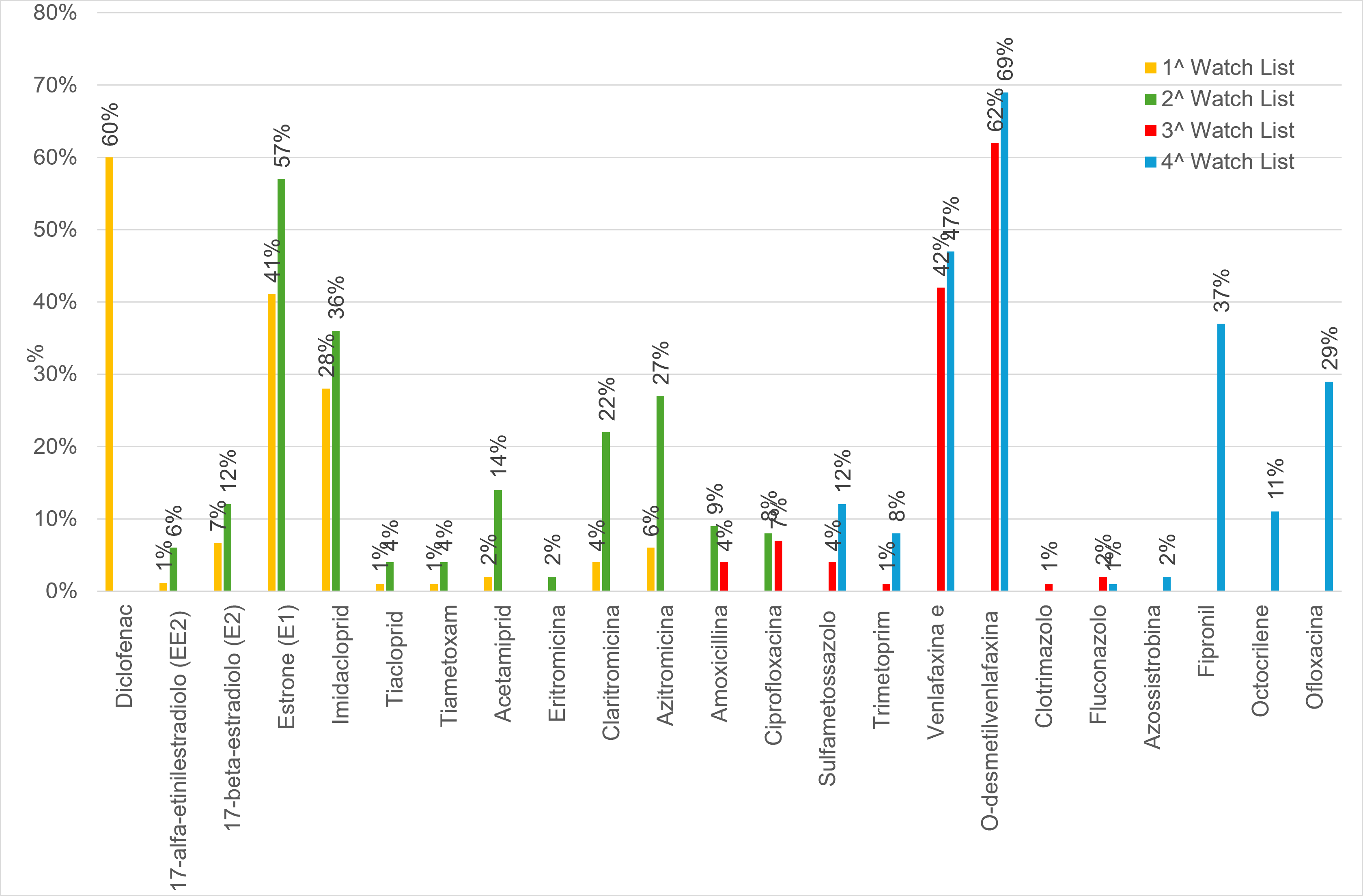
The results of nine years of monitoring outline a widespread presence of pollutants above the no-effect thresholds (PNEC). The data relating to the first Watch List (WL), (2015, 2017, 2018) highlight critical issues for Diclofenac (60% of PNEC exceedances) and Estrone E1 (41%) (Table 1). Subsequent analyses, relating to the other control lists, show polluting loads for other substances: Imidacloprid with exceedances of 36%, clarithromycin by 22%, azithromycin by 27% (Table 2), between 2019 and 2020, the antidepressant Venlafaxine with exceedances of 42% and 62% for its metabolite O-desmethylvenlafaxine (Table 3), between 2021 and 2022. Finally, in 2023 and 2024 the presence of Venlafaxine was confirmed at 47%, the high presence of its metabolite at 69% and findings for new monitoring pollutants such as Fipronil (37%) and Ofloxacin (29%) above the no-effect thresholds (PNEC) (Table 4). This picture indicates a chemical pressure on water bodies that needs attention, with potential risks to human health and the well-being of aquatic ecosystems.
The comparison between the results relating to the different Checklists highlights a persistent and widespread presence in Italian water bodies of some substances considered priorities for European monitoring.
Compared to the findings of substances from the 1st Watch List (2015, 2017, 2018) and the 2nd Watch List (2019-2020), an increase in the percentage of samples with concentrations above the ecotoxicological reference values (PNEC) is observed for several substances. In particular, Estrone (E1) goes from 41% to 57% of findings higher than PNEC, the insecticide imidacloprid from 28% to 36%, Clarithromycin from 4% to 22% and Azithromycin from 6% to 27%. For Imidacloprid, Clarithromycin and Azithromycin, this increase is also influenced by the revision of the PNEC values introduced with the 2nd Checklist, an effect that is particularly evident for macrolide antibiotics (Tables 1 and 2 and Figure 1).
The comparison between the findings of the substances from the 3rd Watch List (2021-2022) and those from the subsequent monitoring cycle (2023-2024) also confirms still high levels of presence for some pharmaceutical substances. In particular, Venlafaxine shows an increase in the percentage of exceedances from 42% to 47%, while its main metabolite increases from 62% to 69% (Tables 3 and 4 and Figure 1).
The persistence of these percentages of exceeding the toxicological reference values confirm the presence of pressure on Italian water bodies with respect to the substances on the Watch List.
| Data |
|---|
Headline
Table A. Monitoring years and Watch List overview |
Headline
Table 1. Number and percentage of detections of substances included in the 1st Watch List (1st, 2nd and 3rd monitoring years, 2015, 2017 and 2018) Data source
ISPRA calculations based on SINTAI data Data legend
CAS No.: Chemical Abstracts Service Registry Number; LOQlab: SNPA laboratory limit of quantification; PNEC: Predicted No-Effect Concentration. |
Headline
Table 2. Number and percentage of detections of substances included in the 2nd Watch List (4th and 5th monitoring years, 2019–2020) Data source
ISPRA calculations based on SINTAI data. Data legend
CAS No.: Chemical Abstracts Service Registry Number; LOQlab: SNPA laboratory limit of quantification; PNEC: Predicted No-Effect Concentration. |
Headline
Table 3. Number and percentage of detections of substances included in the 3rd Watch List (6th and 7th monitoring years, 2021–2022) Data source
ISPRA calculations based on SINTAI data. Data legend
CAS No.: Chemical Abstracts Service Registry Number; LOQlab: SNPA laboratory limit of quantification; PNEC: Predicted No-Effect Concentration. |
Headline
Table 4. Number and percentage of detections of substances included in the 3rd Watch List (8th and 9th monitoring years, 2023–2024) Data source
ISPRA calculations based on SNPA data. Data legend
CAS No.: Chemical Abstracts Service Registry Number; LOQlab: SNPA laboratory limit of quantification; PNEC: Predicted No-Effect Concentration. |
Thumbnail
Headline
Figure 1: Percentage of detections exceeding the PNEC (Predicted No-Effect Concentration) for Watch List substances (2015–2024) Data source
ISPRA calculations based on SINTAI data.
Data legend
PNEC: Predicted No-Effect Concentration; Watch List: Watch List of substances. |
The data highlight the presence of chemical pressures linked to the historical criticality of Diclofenac, to the high findings of the antidepressant (Venlafaxine) and its metabolite (O-desmethylvenlafaxine), of insecticides such as Imidacloprid and Fipronil, of the endocrine disruptor E1 and of the antibiotics Clarithromycin, Azithromycin and Ofloxacin. The analytical capacity of the SNPA laboratory network was fundamental in this monitoring; the laboratories' Limits of Quantification (LOQlab) must be constantly aligned with the European no-effect thresholds (PNEC), which are often extremely restrictive, to guarantee the detectability of pollutants at infinitesimal concentrations. This dynamic monitoring, a pillar of Directive 2013/39/EU, provides the scientific basis for the inclusion of new pollutants among priority substances, supporting the "Zero Pollution" objective of the Green Deal and the 8th Environmental Action Programme. Compared to the European context, the Italian data reflect models of anthropic consumption and agricultural pressures that require coordinated actions to protect human health and aquatic biodiversity, consistently with the aims of the 2030 Agenda.