Carmela Cascone, Elisa Quaranta (PhD student, Alma Mater Studiorum University of Bologna)
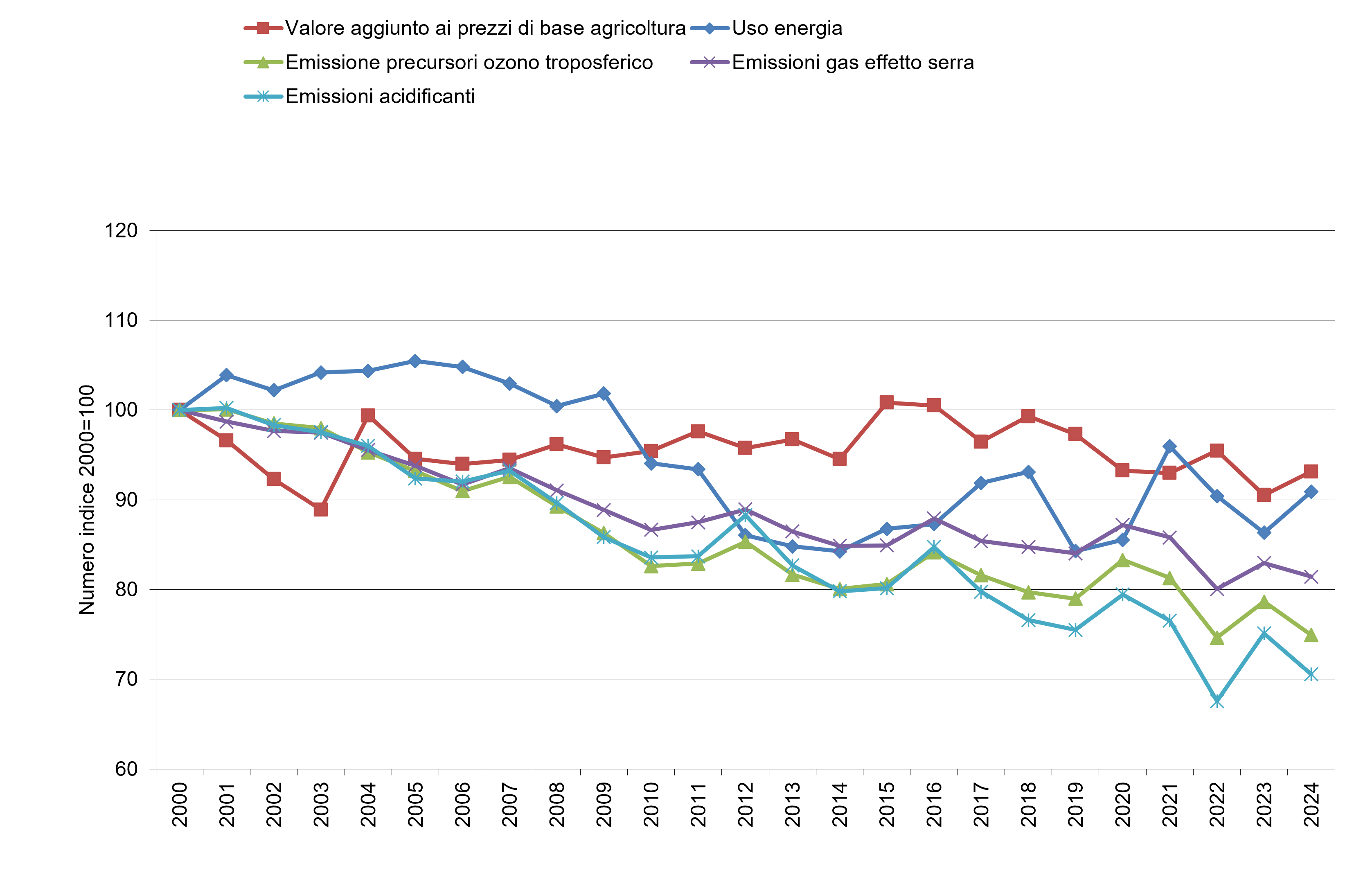
The indicator assesses the ability of the national agricultural sector to promote economic growth while reducing environmental pressures and impacts. Its purpose is to measure the eco-efficiency of agriculture, namely the sector's ability to achieve decoupling between economic growth and increases in environmental pressure and impact factors. The trends observed for the selected variables indicate an overall improvement in the eco-efficiency of Italian agriculture over the period 2000–2024. This is evident when comparing the trend in the economic variable (represented by gross value added at basic prices) with those of the environmental pressure indicators, all of which remain below their 2000 baseline levels.
The indicator analyzes the capacity of national agriculture to stimulate economic growth, while reducing pressures and impacts on the environment, and is created in line with both the European Commission Strategy for the sustainable use of natural resources (EC, 2005) and the objectives of the Green Deal european Union (EC, 2019), the 2030 Agenda (UN, 2015) and the Kunming-Montreal Global Biodiversity Framework (UN, 2022). The Strategy requires the development of aggregate indicators, in order to evaluate the ability of national policies to decouple the growth of GDP (which measures overall economic activity) from that of the wealth and well-being of society in a European context. This is especially true for the agricultural and fishing sectors, for which the issuing of policies is the exclusive responsibility of the European Commission.
The indicator is expressed through an index that compares the value added to the basic prices and the use of resources represented by the Utilized Agricultural Surface (UAA), the irrigated agricultural surface, the permanent meadows and pastures, the use of energy, simultaneously also considering any pressures generated such as emissions into the atmosphere, the use of plant protection products and fertilizers as well as the impacts on biodiversity.
Measuring the eco-efficiency of the agricultural sector, i. e. The ability to decouple ( decoupling ) the factors of economic growth from the increase in pressure and impact factors, in line with the requirements of Communication COM(2005) 670 and among the objectives of the Common Agricultural Policy (CAP) 2023-2027, of Green Deal european Union, Agenda 2030 and Kunming-Montreal Global Biodiversity Framework (K-M GBF).
-
- CIPE Resolution No 57 of 2 August 2002;
- Communication from the Commission COM(2005) 670 final, Thematic Strategy on the Sustainable Use of Natural Resources;
- Communication from the Commission COM(2019) 640 final, The European Green Deal;
- Communication from the Commission COM(2020) 98 final, A new Circular Economy Action Plan: For a cleaner and more competitive Europe;
- Communication from the Commission COM(2020) 380 final, EU Biodiversity Strategy for 2030: Bringing nature back into our lives;
- Communication from the Commission COM(2020) 381 final, A Farm to Fork Strategy for a fair, healthy and environmentally-friendly food system;
- Decision (EU) 2022/591 of the European Parliament and of the Council of 6 April 2022 on a General Union Environment Action Programme to 2030 (8th Environment Action Programme);
- Regulation (EU) 2021/2115 of the European Parliament and of the Council of 2 December 2021 establishing rules on support for the strategic plans to be drawn up by Member States under the Common Agricultural Policy (CAP Strategic Plans) (2023–2027);
- Decision No 1386/2013/EU of the European Parliament and of the Council of 20 November 2013 on a General Union Environment Action Programme to 2020 "Living well, within the limits of our planet";
- Regulation (EU) 2020/2220 of the European Parliament and of the Council of 23 December 2020 laying down certain transitional provisions for support by the European Agricultural Fund for Rural Development (EAFRD) and the European Agricultural Guarantee Fund (EAGF).
The sustainable use of natural resources, both in production and consumption, is a fundamental prerequisite for long-term prosperity at national, European and global levels.
In 2015, the United Nations adopted the Sustainable Development Goals (SDGs) set out in Transforming our world: the 2030 Agenda for Sustainable Development. These goals provide the global framework for sustainable development for the period 2015–2030, building upon and replacing the Millennium Development Goals. Several SDGs are directly related to the sustainable and efficient use of natural resources, including Goal 15 (Protect, restore and promote the sustainable use of terrestrial ecosystems, sustainably manage forests, combat desertification, halt and reverse land degradation and halt biodiversity loss), Goal 2 (End hunger, achieve food security and improved nutrition and promote sustainable agriculture), Goal 6 (Ensure availability and sustainable management of water and sanitation for all), and Goal 12 (Ensure sustainable consumption and production patterns).
In 2022, the 15th Conference of the Parties (COP15) to the Convention on Biological Diversity (CBD) adopted the Kunming–Montreal Global Biodiversity Framework (KMGBF), establishing an ambitious global pathway towards achieving the vision of living in harmony with nature by 2050. The Framework includes four long-term goals for 2050 and 23 action-oriented targets for 2030 aimed at halting and reversing biodiversity loss. Supporting the achievement of the Sustainable Development Goals, this landmark agreement represents the first comprehensive global framework designed to safeguard ecosystem services essential for human well-being, economic development, nature conservation and climate action.
At European Union level, the European Green Deal provides the overarching growth strategy for transforming the EU into a climate-neutral, resource-efficient and competitive economy. Within this framework, the Circular Economy Action Plan promotes the decoupling of economic growth from resource use, while the 8th Environment Action Programme (8th EAP) establishes the policy framework for the ecological transition up to 2030.
The EU Biodiversity Strategy for 2030 and the Farm to Fork Strategy set out a comprehensive policy agenda for making food systems more sustainable, including promoting organic farming, protecting biodiversity in agricultural ecosystems, and reducing both the use of and risks associated with plant protection products. These objectives provide the strategic framework for the EU's environmental and agricultural policies and have been integrated into the Common Agricultural Policy (CAP) 2023–2027, the related CAP Strategic Plans, as well as Regulation (EU) 2024/1991 on Nature Restoration and the corresponding National Restoration Plans.
In Italy, Law No 221 of 28 December 2015 (Environmental provisions to promote green economy measures and to limit the excessive use of natural resources) introduced measures covering nature conservation and sustainable development, environmental assessments, energy, green public procurement, waste management and remediation, soil protection and water resources management.
In addition, the National Sustainable Development Strategy (Strategia Nazionale per lo Sviluppo Sostenibile – SNSvS), adopted through CIPE Resolution No 108/2017 and updated in 2022 by CITE Resolution No 1/2023, represents Italy's main strategic framework for implementing the principles and objectives of the 2030 Agenda for Sustainable Development at national level.
ISPRA, 2026[a]. Italian Greenhouse Gas Inventory 1990-2024. National Inventory Document 2026. Annual Report for submission under the UN Framework Convention on Climate Change and the Paris Agreement. ISPRA Rapporti, 428/26 Disponibile: https://emissioni.sina.isprambiente.it/wp-content/uploads/2026/04/NID_Italy_Rapporto_428_2026.pdf
ISPRA, 2026[b]. Italian Emission Inventory 1990 – 2024. Informative Inventory Report 2026. Annual Report for submission under the UNECE Convention on Long-range Transboundary Air Pollution and European Union National Emission Ceiling Directive. ISPRA, Rapporti 426/26 Disponibile: https://emissioni.sina.isprambiente.it/wp-content/uploads/2026/04/IIR_Italy_Rapporto_426_2026.pdf
ISPRA, 2011. Agricoltura. Emissioni nazionali in atmosfera dal 1990 al 2009. Rapporto Ispra 140/2011. Roma, Italia. Disponibile: https://www.isprambiente.gov.it/contentfiles/00009800/9864-rapporto-140-2011.pdf/
Istat, 2022. 7° Censimento Generale dell'Agricoltura. Annata agraria 2019-2020
Istat, 2019. Struttura e caratteristiche delle unità economiche del settore agricolo. Anno 2017
Istat, 2017. Indagine sulla struttura e produzione delle aziende agricole. Anno 2016
Istat, 2011. 6° Censimento Generale dell'Agricoltura
United Nations, 2022. Kunming-Montreal Global Biodiversity Framework (CBD/COP/DEC/15/4)United Nations, 2015. The Millennium Development Goals Report 2015
United Nations, 2015. Transforming our world: the 2030 Agenda for Sustainable Development. A/RES/70/1
For further development of the indicator, it would be appropriate to integrate quantitative information on the evolution of the agricultural surface with qualitative information, to evaluate, for example, the extent of the agricultural surface transformed into forms of use with a lower degree of naturalness (infrastructure, construction, etc.) and the degree of fragmentation of the agricultural landscape.
ISPRA (Italian Institute for Environmental Protection and Research), Istat (National Institute of Statistics) MASE (Ministry of the Environment and Energy Safety), MSE (Ministry of Economic Development), MASAF (Ministry of Agriculture, Food Sovereignty and Forestry)
ISPRA, National Inventory of atmospheric emissions ( https://emissioni. sina. isprambiente. it/economia-nazionale/)
ISTAT, Survey on the structure and production of agricultural companies (SPA) ( https://esploradati. istat. it/databrowser/#/it/dw/categories/IT1, Z1000AGR,1.0/AGR_ECON )
ISTAT, Annual national economic accounts and aggregates ( https://esploradati. istat. it/databrowser/#/it/dw/categories/IT1, DATAWAREHOUSE,1.0/UP_ACC_ANNUAL )
ISTAT, 7th General Agricultural Census. Agricultural year 2019-2020 (https://www. istat. it/it/archivio/273753)
ISTAT, Agricultural Census 2020 - update ( https://esploradati. istat. it/databrowser/#/it/censimentoagricoltura)
MASE, 2025. The national energy situation in 2024. Energy Department - General Directorate of Energy Sources and Qualifications ( https://sisen. mase. gov. it/dgsaie/situazione-energetica-nazionale )
MiSE, National Energy Balance (https://dgsaie. mise. gov. it/ben. php)
MiTE, National Energy Situation (https://dgsaie. mise. gov. it/situazione-energetica-nazionale)
National Network of CAP & Lipu (2025). Farmland Bird Index national and population trends of the species in Italy in the period 2000-2025 (https://www. reterurale. it/farmlandbirdindex)
SINAB, Organic agriculture database (https://sinab. it/navigazione-banca-dati/)
National
2000-2024
The indicator compares the value added to basic prices (i. e. The difference between the value of goods and services obtained by the agricultural sector and the value of intermediate goods and services consumed in the period considered) with the use of resources, represented by the Utilized Agricultural Surface (UAA), the irrigated agricultural surface, permanent meadows and pastures and the use of energy, also considering both the environmental pressures deriving from emissions into the atmosphere and the use of plant protection products and fertilizers and the impacts on biodiversity. The trend of these quantities between 2000 and 2024 is evaluated in an indexed manner, assuming the value of 2000 equal to 100.
The status of the indicator is not defined, as it is an index number that aggregates various components aimed at describing the efficiency of the agricultural sector and therefore aimed at highlighting the trend and decoupling of pressures from economic growth as well as the impacts on biodiversity over time.
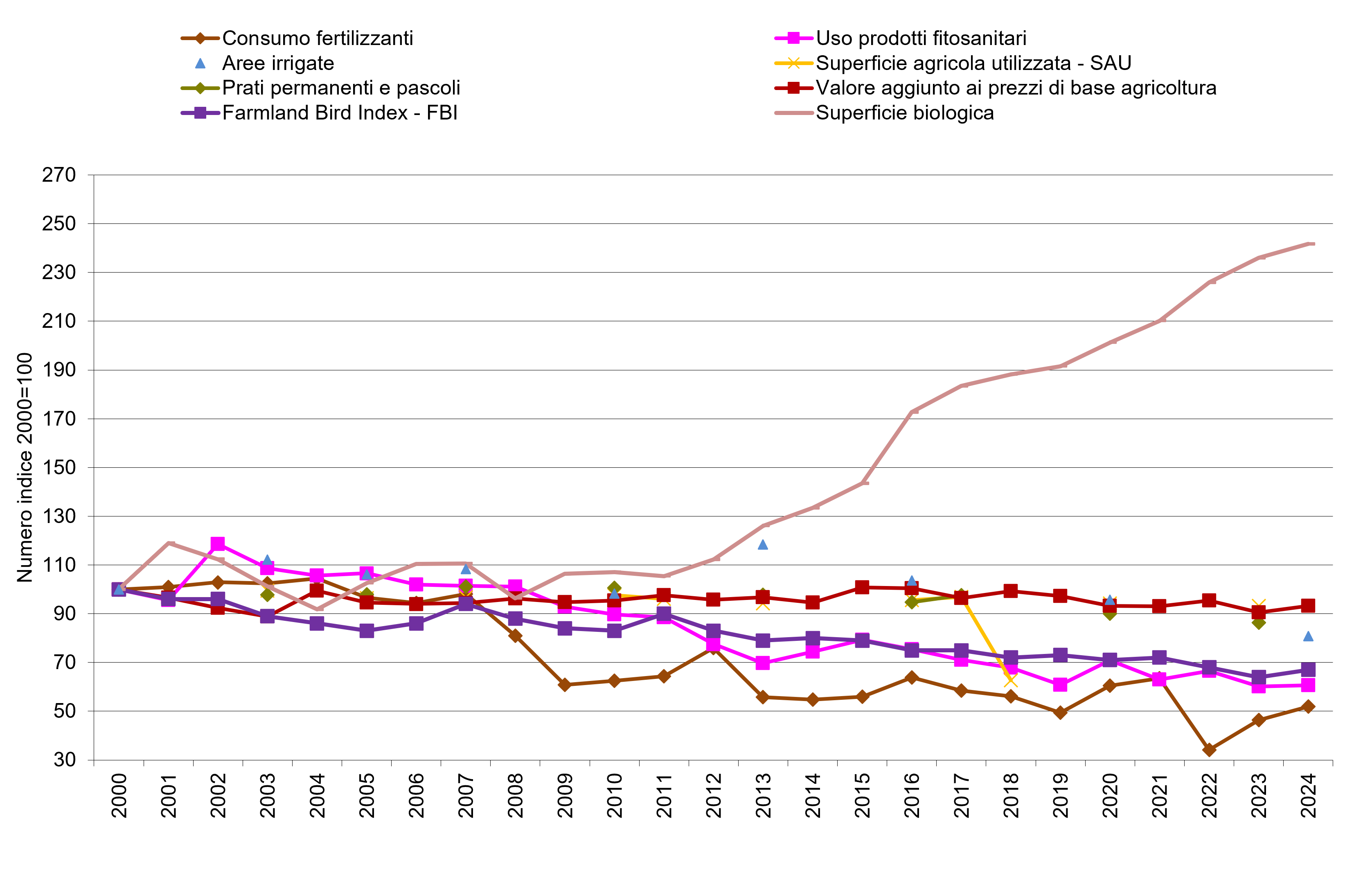
The evolution of the variables demonstrates a good trend in the eco-efficiency of Italian agriculture in the period 2000-2024. This can be seen if we compare the trend of the economic variable (Figures 1 and 2) to that of the pressures, which are all lower than the value of the reference year (2000).
| Data |
|---|
Thumbnail
Headline
Figure 1: Eco-efficiency in agriculture, expressed as an integrated index of value added at basic prices in agriculture, energy use and pollutant emissions Data source
ISPRA processing on ISPRA, ISTAT, MASE data |
Thumbnail
Headline
Figure 2: Eco-efficiency in agriculture, expressed as an integrated index of value added to basic prices in agriculture, use of natural resources, consumption of technical means and impact on biodiversity Data source
ISPRA processing on ISTAT data, Rural Network & LIPU, SINAB |
In 2024, the level of greenhouse gas emissions from the agricultural sector undergoes a slight reduction (index number equal to 81) compared to 2023 (index number equal to 83), but the general trend is decreasing (the value decreased by 19 percentage points compared to that of the reference year). As regards acidifying emissions (which include ammonia, nitrogen oxides, carbon monoxide, non-methane volatile organic compounds and sulfur oxides), the contribution of the agricultural sector mainly concerns ammonia; also in this case there is a decrease of approximately 5 percentage points compared to the previous year, however the overall reduction compared to 2000 is equal to -29 percentage points (index number equal to 71) (Figure 1). Non-methane volatile organic compounds (NMVOCs) and nitrogen oxides are considered among the precursors of tropospheric ozone. The contribution of the agricultural sector to the total national production of these gases is very limited; a significant decrease is highlighted starting from 2010, with an overall reduction compared to 2000 equal to 25 percentage points (index number equal to 75, minimum value of the series) in 2024. Energy consumption, which until 2009 had remained above the reference value, in 2024 shows a slight increase (5 percentage points) compared to 2023 but with an index value equal to 91.
Fertilizer consumption (Figure 2), which has remained below the reference value since 2005, recorded an increase (index number equal to 52) in 2024 compared to the previous year (index number equal to 46 in 2023), although the overall trend is one of decrease (-48 percentage points compared to 2000). The quantity of substances or active ingredients contained in plant protection products distributed since 2009 remains below the reference values of 2000 (39 percentage points less in 2024). This is compared to a UAA decreasing in 2023 compared to 2000 (-7 percentage points), reaching the value of 12.286 million hectares in the latest Istat survey (SPA2023). It should be noted that, within the UAA, the irrigated component, after having reached the minimum value in 2010 (2 points less than 2000) and recorded a strong increase in 2013 (20 points more than 2010), is significantly reduced in 2024 (-38 points compared to 2013) which corresponds to a lower use of the water resource in agriculture.
The component represented by permanent meadows and pastures reaches its minimum value (2.946 million hectares) in 2023. The area under organic cultivation, despite a fluctuating trend until 2008, records continuous growth until it doubles starting from 2020 (with an increase of 242 percentage points in 2024 compared to 2000). Furthermore, in 2024, the Italian organic surface area increased by 2.4% compared to the previous year (i. e. Approximately 60 thousand hectares, reaching over 2.5 million hectares as of 31 December 2024). Considering the strategic objective of the European Commission, defined in the "From producer to consumer" and "Biodiversity for 2030" strategies, of having, by 2030, at least 25% of agricultural area dedicated to organic farming in the EU, Italy contributes significantly to this objective, reaching, in 2024, 20.5% of organic agricultural area compared to the total UAA (ISTAT, SPA2023). The values assumed by National Farmland Bird Index in the period 2000-2024 show a progressive reduction over time in the populations of avifauna species typical of agricultural areas with a worrying net loss (33 percentage points less than in 2000) even if in 2024 there is a slight increase in the index number with a base of 2000 (equal to 3 percentage points compared to 2023).
Overall, there are typical aspects of an agriculture that tends to reduce its highly intensive character, even if not uniformly over time and across the entire national territory. The increase in eco-efficiency that has occurred in the long term is certainly linked to European and national legislative and economic measures, including those relating to organic agriculture and the protection of biodiversity. Unfortunately, the improvement in agronomic practices that has occurred in the last decade is still unable to guarantee a level of environmental quality capable of preserving and maintaining all the elements of agricultural biodiversity in good condition. The situation of recent years must be further evaluated but the trend of the economic component, associated with the simultaneous decrease in almost all pressures, demonstrates a good global trend.