Irma Lupica
In 2024, the quantity of municipal waste incinerated, including SRF, solid recovered fuel, the dry fraction and biodried waste obtained from the treatment of municipal waste, amounted to almost 5.5 million tonnes, corresponding to a 0.7% decrease compared with 2023. Of this waste, 74.8% was treated in Northern Italy, 8.1% in Central Italy and 17.1% in Southern Italy. The incineration capacity is mainly located in the northern regions, with 25 facilities, while 4 and 6 plants were operational in Central and Southern Italy, respectively.
An incineration plant is defined as any fixed or mobile technical unit and equipment intended for the thermal treatment of waste, with or without recovery of the heat generated by combustion. The indicator measures both the number of incineration plants primarily dedicated to the treatment of municipal waste and the quantities of municipal waste treated therein.
The indicator enables comparisons across different territorial contexts, at municipal, provincial and regional level, and supports decision-making processes and environmental policy choices, as well as the assessment of impacts resulting from anthropogenic activities.
The reference Directive on waste incineration is Directive 2010/75/EU of the European Parliament and of the Council of 24 November 2010 on industrial emissions, integrated pollution prevention and control, known as the IED, Industrial Emissions Directive, which consolidated and revised seven EU directives in this field into a single legislative act.
This Directive was transposed into Italian law by Legislative Decree No. 46 of 4 March 2014, “Industrial emissions, integrated pollution prevention and control - Implementation of Directive 2010/75/EU”, which introduced amendments to Parts II, III, IV and V of Legislative Decree No. 152/2006, the Environmental Code. In particular, Legislative Decree No. 46 of 4 March 2014 introduced Title III-bis into Part IV of Legislative Decree No. 152/2006, concerning the incineration and co-incineration of waste.
Commission Implementing Decision (EU) 2019/2010 established that the conclusions on best available techniques, BAT, for waste incineration serve as the reference for setting permit conditions, including emission limit values under normal operating conditions, for installations covered by Chapter II of Directive 2010/75/EU, Integrated Environmental Authorisation.
ISPRA - Rapporto rifiuti urbani 2025
No limitations
None
Modello Unico di dichiarazione Ambientale MUD ISPRA - Catasto rifiuti ( http://www. catasto-rifiuti. isprambiente. it )
National, Regional
2002-2024
The indicator measures the quantity of municipal waste incinerated in Italy. The dataset comprises the amount of mixed municipal waste, solid recovered fuel and waste generated from the treatment of municipal waste itself. The information base consists of data reported through the Single Environmental Declaration Form, submitted to the territorially competent Chambers of Commerce, Industry, Crafts and Agriculture by the entities identified under Article 189, paragraph 3, of Legislative Decree No. 152/2006.
In 2024, almost 5.5 million tonnes of municipal waste were incinerated. Of this amount, 50.9%, corresponding to approximately 2.8 million tonnes, consisted of untreated municipal waste, identified by European Waste List codes under Chapter 20, while the remaining share, almost 2.7 million tonnes, consisted of waste derived from the treatment of municipal waste, such as combustible waste, dry fraction and, to a lesser extent, biodried waste (Table 2).
A total of 35 plants were operational at national level, one fewer than in 2023 (Table 3).
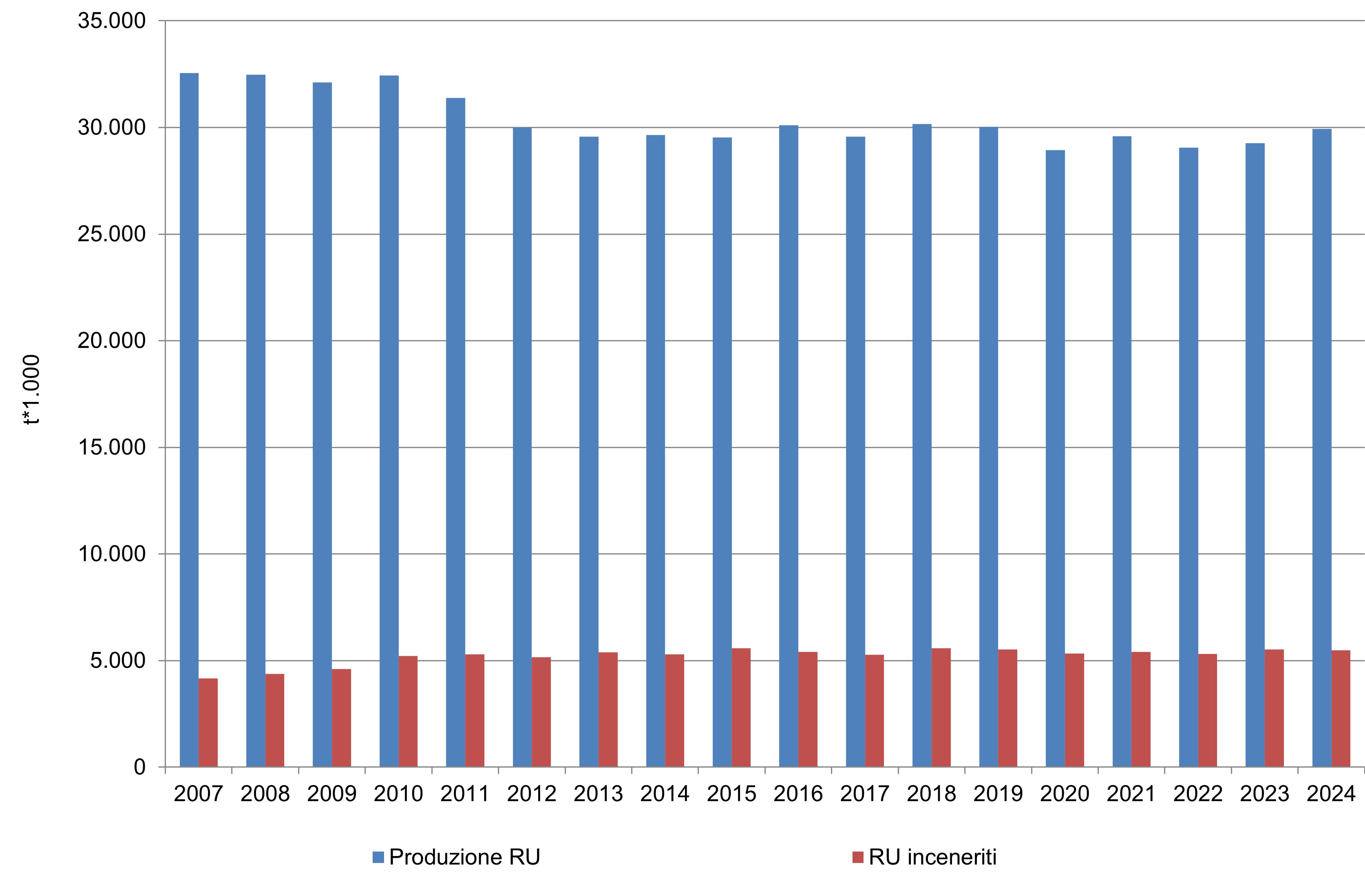
Table 3 shows that, between 2008 and 2024, the number of plants decreased by 14 units; in particular, a reduction of 9 plants was observed in the regions of Central Italy. Conversely, over the same period, the quantity of waste incinerated progressively increased (+25.4%). This can be explained by the fact that, where technically feasible, plants incinerated quantities of waste that allowed them to approach, or reach, saturation of the thermal load (Table 1).
| Allegati |
|---|
Titolo
Table 1: Municipal waste incinerated by region Fonte
ISPRA |
Titolo
Table 2: Waste incinerated in municipal waste incineration plants by waste type (2024) Fonte
ISPRA |
Titolo
Table 3: Number of incineration plants for municipal waste, dry fraction (DF), and solid recovered fuel (SRF) Fonte
ISPRA |
Thumbnail
Titolo
Figure 2: Municipal waste incinerated in relation to waste generation Fonte
ISPRA |
In 2024, municipal waste incinerated, including SRF and waste obtained from the treatment of municipal waste itself, amounted to almost 5.5 million tonnes, corresponding to a 0.7% decrease compared with 2023. Of this waste, 74.8% was treated in Northern Italy, 8.1% in Central Italy and 17.1% in Southern Italy (Table 1 and Figure 1).
Compared with the previous year, municipal waste incinerated in 2024 showed a reduction of almost 36 thousand tonnes. In particular, the quantities treated decreased in the Central macro-area, by 61 thousand tonnes (-12.1%), and in the Southern macro-area, by approximately 66 thousand tonnes (-6.5%), while an increase of 2.3%, corresponding to approximately 91 thousand tonnes, was recorded in Northern Italy.
In 2024, 35 incineration plants were operational in Italy, of which 25 were located in Northern Italy, 4 in Central Italy and 6 in Southern Italy. More specifically, Lombardy and Emilia-Romagna had 12 and 7 operational plants, respectively, which in 2024 treated a combined total of 3 million tonnes of municipal waste, corresponding to 73.7% of the waste incinerated in Northern Italy and 55.1% of the national total (Tables 1 and 3).