Lucilla Carnevali, Alessandro Calabrese, Stefania Ercole, Piero Genovesi
The indicator provides an overview of the current presence of alien animal and plant species in Italy, describing their numbers and trends in introductions over the past century. It reports the average annual introduction rate (the mean number of new alien species introduced each year), the main pathways of introduction (according to CBD categories), and the distribution of invasive alien species of Union concern.
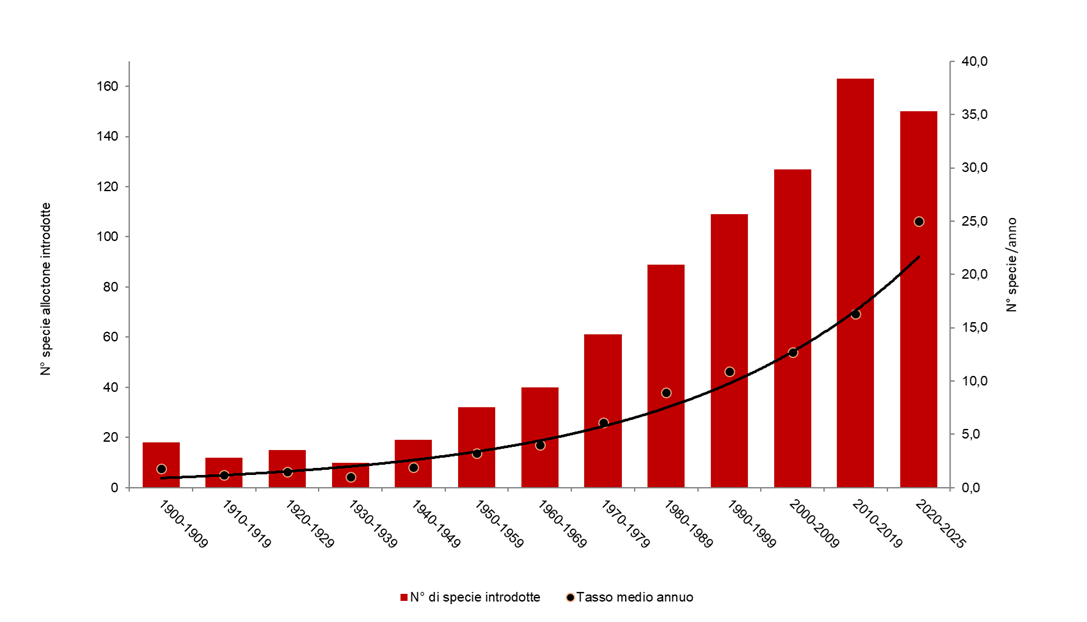
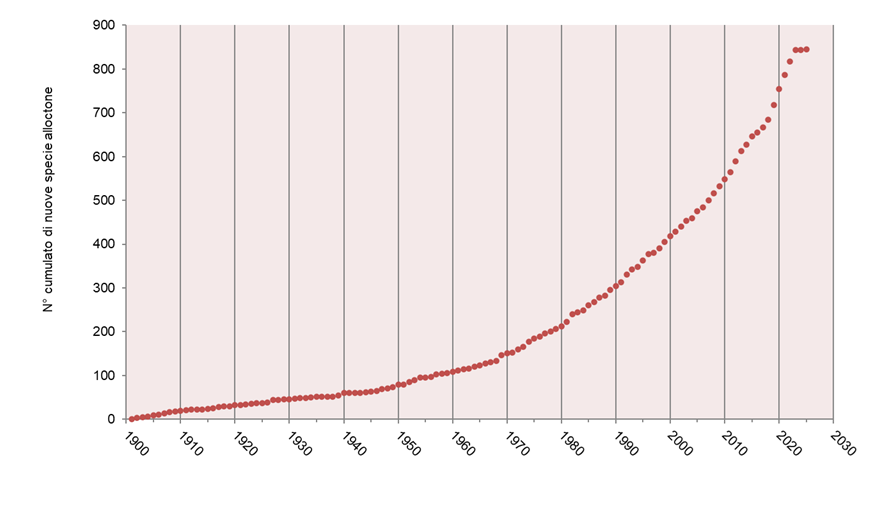
The number of alien species in Italy is steadily and continuously increasing. Based on the data currently available, more than 3,800 alien species have been introduced into the country, of which 3,699 are currently established in the territory. The average number of species introduced per year has grown exponentially over time — from 6 species per year in the 1970s, to 16 per year in the previous decade, and reaching 25 per year in the current one. The cumulative number of alien species introduced in Italy since 1900 also confirms this exponential trend, showing an increase of over 500% in 120 years.
According to the CBD (Convention on Biological Diversity), an alien (also referred to as exotic, non-native, introduced) species is defined as "a species, subspecies, or lower taxon introduced (due to human action, intentional or accidental) outside its natural past or present distribution, including any part of the species, gametes, seeds, eggs, or propagules of such species that might survive and subsequently reproduce." An invasive alien species is defined as "an alien species whose introduction and/or spread threatens biodiversity." The indicator provides an overview of the current presence of alien animal and plant species in Italy through quantitative data and shows both the trends of alien species introduction in the national territory over the last century and the average annual rate (average number of new alien species introduced each year). The data used for the indicator have been extracted from the National Alien Species Database, created by ISPRA on behalf of MASE, which is constantly updated and available on the website www.specieinvasive.isprambiente.it.
The indicator also includes distributional data related to the six-year reporting pursuant to Article 24 of EU Regulation 1143/14.
The indicator also includes updated (2025) distribution data for invasive alien species of Union concern occurring in natural environments in Italy, for which intervention and reporting obligations are established under EU Regulation 1143/2014.
The indicator is useful for representing the phenomenon of biological invasions, which cause damage to biodiversity, ecosystem services, human health, and the economy.
On January 1, 2015, Regulation (EU) 1143/2014 of the European Parliament and Council on the prevention and management of the introduction and spread of invasive alien species came into force. The Regulation establishes rules to prevent, minimize, and mitigate the impact on biodiversity, ecosystem services, human health, and the economy due to the intentional or accidental introduction and spread of invasive alien species within the European Union.
The Commission has adopted a list of invasive species of Union concern, which is continuously updated and reviewed at least every six years. The species on this list cannot be intentionally introduced into European territory, nor can they be bred, transported, placed on the market, or released into the environment.
The Regulation establishes the obligation to develop a surveillance system for the early detection and rapid eradication of species of Union concern that are not yet present in the Member State's territory, as well as the obligation to implement effective management measures for species already present. Additionally, each Member State must conduct a thorough analysis of pathways through which invasive exotic species are introduced and spread within its territory, developing and implementing an action plan for the identified priority pathways.
Member States are responsible for adopting the necessary measures to ensure the enforcement of the Regulation and to establish sanctions in case of violations.
Finally, a system of authorizations and special permits is provided to allow certain activities with invasive alien species, such as research or conservation activities. Member States may establish national lists of invasive species, also to introduce prevention and management measures on a national scale.
Legislative Decree No. 230/17, adapting national legislation to the provisions of EU Regulation 1143/2014, entered into force on February 14, 2018, and sets out measures for: official controls necessary to prevent the deliberate introduction of species of Union and national concern, granting derogation authorizations, establishing a national surveillance system, management measures aimed at eradicating or containing species of Union and national concern, and the penalty system for violations of the provisions.
In June 2019, Italy submitted data for the first reporting required under Article 24 of the EU Regulation on invasive alien species of Union concern. The second reporting is scheduled for 2025.
The list of invasive species of Union concern has been updated four times since the Regulation entered into force.
Aleffi, Tacchi, Cortini Pedrotti, 2008. Check-list of the Hornworts, Liverworts and Mosses of Italy. Bocconea, 22.
Bartolucci et al., 2018. An updated checklist of the vascular flora native to Italy. Plant Biosystems 152(2): 179-303.
Bartolucci F., Peruzzi L., Galasso G.,... & F. Conti, 2024. A second update to the checklist of the vascular flora native to Italy. Plant Biosystems, An International Journal Dealing with all Aspects of Plant Biology, 158 (2): 219-296, DOI: 10.1080/11263504.2024.2320126
Galasso et al., 2018. An updated checklist of the vascular flora alien to Italy. Plant Biosystems, 152(3), 556-592.
Galasso G., Conti F., Peruzzi L.,... & Bartolucci F., 2024. A second update to the checklist of the vascular flora alien to Italy. Plant Biosystems, An International Journal Dealing with all Aspects of Plant Biology, 158(2), 297-340.
ISPRA (Higher Institute for Environmental Protection and Research) - National Database of Alien Species
Minelli, Ruffo, La Posta (eds.), 1993-1995. Checklist of Italian fauna species. Files 1-110. Calderini Editions, Bologna
Ruffo, Stoch (eds), 2007. Checklist and distribution of the Italian fauna. Memoirs of the Civic Museum of Natural History of Verona, 2 series, Life Sciences Section, 17 (2006): 1-303 with CD ROM.
Seebens H., Blackburn T. M., Essl F., 2017. No saturation in the accumulation of alien species worldwide. Nature Communications, 8, 14435. http://www. nature. com/articles/ncomms14435
The available data represent an underestimation of the actual extent of the phenomenon, both due to the limited number of specific studies—especially in certain geographic areas—and to delays in the identification and publication of species records. Furthermore, data are still lacking for some taxonomic groups, particularly fungi and lichens.
Gaps need to be filled regarding the dates of introduction of alien species into Italy, at least from after World War II to the present.
Aleffi, Tacchi, Cortini Pedrotti, 2008 - Check-list of the Hornworts, Liverworts and Mosses of Italy. Bocconea, 22., Bartolucci F., Galasso G., Peruzzi L., Conti F., 2021 - Report 2020 on plant biodiversity in Italy: native and alien vascular flora. Natural History Sciences. Atti Soc. it. Sci. nat. Museo civ. Stor. nat. Milano, 8 (1): 41-54, 2021. DOI: 10.4081/nhs.2021.520., ISPRA - Banca Dati Nazionale Specie Alloctone., Minelli A., Ruffo S., La Posta S. (eds.), 1993-1995 - Checklist delle specie della fauna italiana. Fascicoli 1-110. Edizioni Calderini, Bologna [consistenza delle specie faunistiche - Checklist], Ruffo S., Stoch F. (eds), 2007. Checklist and distribution of the Italian fauna. Memorie del Museo Civico di Storia Naturale di Verona, 2 serie, Sezione Scienze della Vita, 17 (2006): 1-303 with CD ROM
The National Alien Species Database can be accessed online at www.specieinvasive.isprambiente.it
National
(Neolithic) - 1500 – 2025
The indicator was developed by calculating various sub-indicators based on data updated in October 2025 from the National Alien Species Database (ISPRA). The processing consists of simple calculation operations. The indicator is based on the entire dataset of alien animal and plant species (not just invasive alien species).
For the calculation of the introduction rate, only alien species that are established across the entire national territory and introduced after 1900 were considered. Species with uncertain status, those considered alien only in a part of the national territory, and species present only occasionally, or that have become extinct or been eradicated after introduction were excluded. Additionally, invertebrates classified as agricultural and/or forest pests, species associated with spatially limited crops (e.g., Heterodera elachista, a Japanese nematode affecting rice and corn cysts, introduced to Italy between 2012 and 2013) were excluded. This decision is based on the fact that EU Regulation 1143/14 explicitly excludes these species from its prohibitions, as they are already covered by other regulatory instruments. The methodology of Seebens et al. (2017) was followed for analyzing introduction dates.
The number of alien species in Italy is particularly high: based on currently available data, more than 3,800 exotic species (or species with uncertain status) have been introduced into the country, of which 3,699 are still present, almost equally divided between plant and animal species. This total also includes species with uncertain status (defined as cryptogenic, mostly belonging to terrestrial arthropods and various marine taxa) and exotic species exotic only in a part of the national territory. It is important to emphasize that these numbers represent an underestimation, particularly for some taxonomic groups (such as fungi, chromists, and protozoa), due in part to the difficulty in promptly detecting new species.
The trend is assessed as negative, as the increase in alien species in Italy remains steady and progressive: the number has grown from 3,182 species in 2017 (the first year this indicator was compiled) to 3,699 species in 2025. Moreover, the analysis of the average annual introduction rate (Figure 2) clearly shows an exponential growth pattern. Following an initial period of relative stability (1900–1950), with mean introduction rates below 2 species per year, a sharp increase began in the 1970s, exceeding 7 species per year and reaching a peak in 2025 with more than 25 species per year. The cumulative number of species introduced in Italy since 1900 confirms this exponential trend, with an increase of over 500% in 120 years (Figure 3).
| Allegati |
|---|
Thumbnail
Titolo
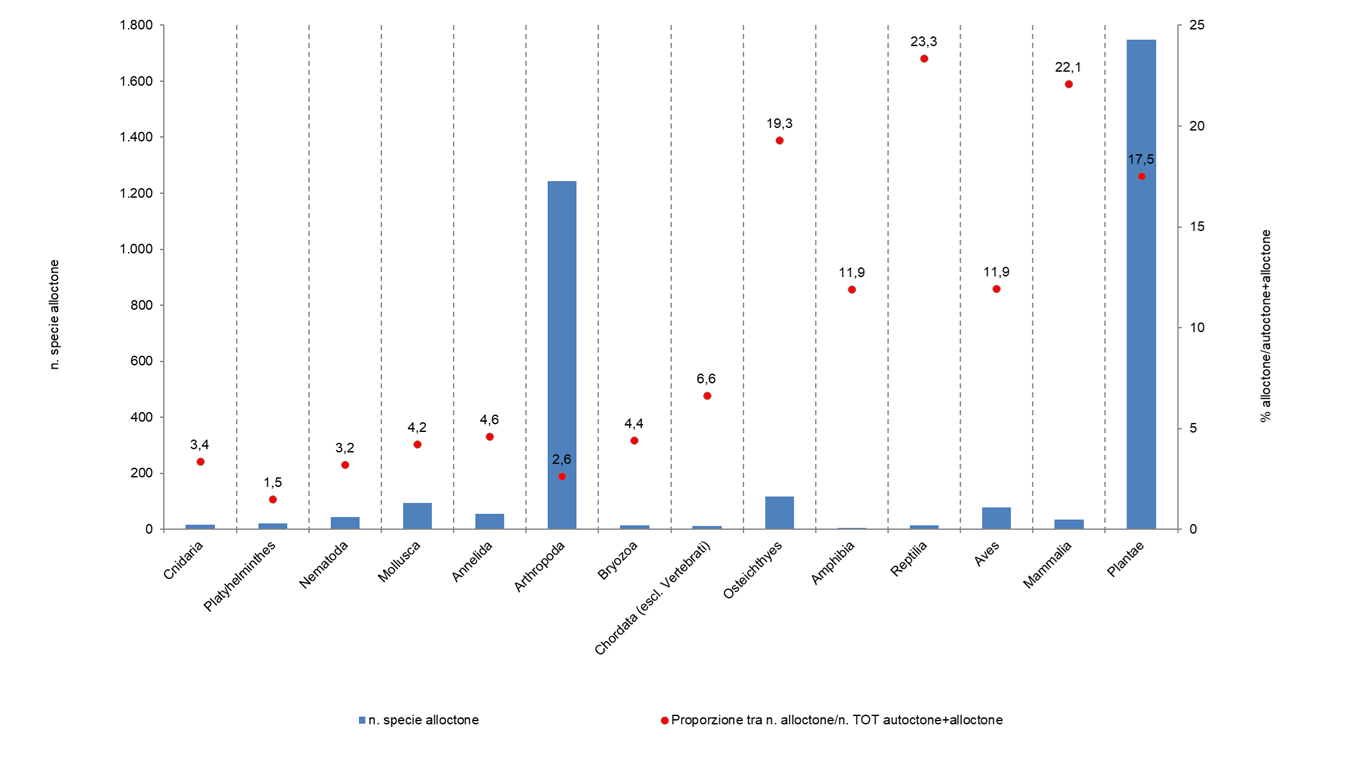
Figure 1 – Number of the main alien species currently present in Italy, belonging to the major taxonomic groups, and percentage of alien species relative to the total number of species estimated for each group (Fungi and Algae excluded). Fonte
ISPRA, National Database on Alien Species. Updated October 2025. Note
Data updated to 2025 (including all statuses except “alien in part of the territory” [1.1], and excluding occurrences classified as: absent, erroneous record, extinct, eradicated, intercepted). |
Thumbnail
Titolo
Figure 2 – Number of species introduced in Italy since 1900 and average annual rate of new introductions, calculated on 845 species with a confirmed year of introduction. Fonte
ISPRA, National Database on Alien Species. Updated October 2025. Note
For the calculation of the introduction rate, only alien species (status = 1.0) across the entire national territory were considered. Species with uncertain status (status = 3 or 4) or alien only in part of the territory (status = 1.1) were excluded. |
Thumbnail
Titolo
Figure 3: Cumulative number of alien species introduced in Italy since 1900, calculated on 845 species with a confirmed year of introduction. Fonte
ISPRA (2025), National Database on Alien Species. Updated October 2025. |
Thumbnail
Titolo
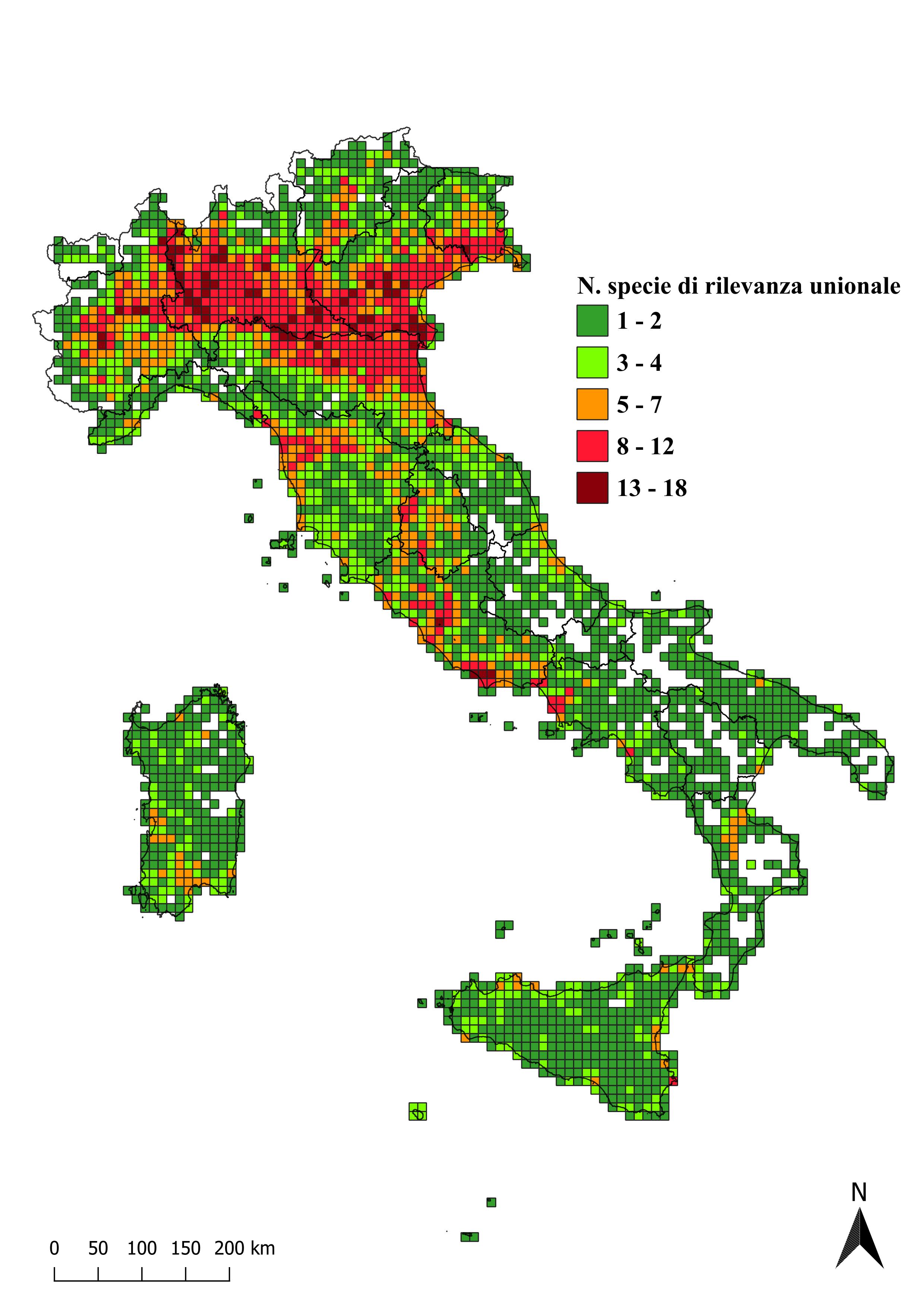
Figure 4 – Distribution of the 46 invasive alien species of Union concern occurring in natural environments in Italy and reported in June 2025 under Article 24 of EU Regulation 1143/2014. Fonte
ISPRA (2025), National Database on Alien Species. Updated October 2025. |
The progressive and continuous increase in alien species in Italy is confirmed. This growth can be linked to the rise in trade and transport systems that has occurred in Europe, particularly since the post-war period, and to the lack of effective biosecurity systems capable of preventing new introductions.
Figure 1 shows the numerical composition of alien and cryptogenic species (including occasional records) found in Italy, across the main taxonomic groups of animals and plants, as well as the proportion of alien species relative to the total estimated number of species (native + alien) in each group. Species native to one part of Italy but introduced into another part were considered native.
Compared to the previous assessment, based on data from December 2021, the most significant increases in the percentage of alien species relative to the total number of species present in the country (ranging between 2% and 4%) were recorded for reptiles and birds.
The analysis of the introduction rate (Figure 2) clearly shows that the average number of species introduced per year has grown exponentially over time — reaching 16 species per year during the 2010–2019 decade, and 25 species per year in the current decade. It should be noted that the absolute number of new introductions per decade is likely underestimated, as information on introduction dates for species in past decades is limited (available for only about 20% of the species recorded in the database). In recent years, for which introduction dates are better known, underestimation may instead result from the difficulty of promptly detecting new occurrences in the field.
To date, 2020 is the year with the highest number of new species introductions (n = 36).
The apparent stability in the number of alien species recorded in the last two years is most likely due to delays in data publication and to the absence of systematic monitoring across the national territory.
In June 2025, Italy submitted the second report required under Article 24 of EU Regulation 1143/2014 concerning invasive alien species of Union concern. Figure 4 illustrates the distribution, represented in 10×10 km grid cells, of the 46 species of Union concern found in natural environments in Italy (out of a total of 87 species listed as of June 2025). The map highlights a concentration of species in the northern part of the country, particularly in the Po Valley, along with two smaller hotspots in central Italy — the Pontine Plain in Lazio and the area around Florence.