Giovanni Finocchiaro, Silvia Iaccarino, Mariangela Soraci
The indicator describes the evolution in the adoption of low environmental impact building technologies in new residential buildings in Italy. Between 2010 and 2021, newly constructed buildings increasingly adopted photovoltaic systems and heat pumps, driven by European Union incentives and regulatory requirements. During the 2022–2024 period, however, installations declined, highlighting the sector's continued dependence on financial incentive schemes. Adoption rates are highest in medium-sized municipalities, while uptake has been slower in large urban centres, where roof availability is more limited, and in very small municipalities, where electricity grid constraints remain significant. The use of condensing boilers has declined sharply, although it has shown a partial recovery following the reintroduction of incentive schemes and hybrid heating systems. Consolidating the transition will require stable support mechanisms for photovoltaic systems, strengthened electricity grids to facilitate heat pump deployment, and the permanent phase-out of gas-fired boilers.
The indicator measures the diffusion of low-environmental-impact building technologies installed in new residential buildings for which a building permit has been issued. These technologies include photovoltaic systems, solar thermal systems, heat pumps, condensing boilers, geothermal systems, and other non-conventional technologies. The indicator is intended to assess the level of energy sustainability in the building sector and to evaluate the degree of alignment of new construction with ecological transition and climate neutrality policies. The indicator considers the total number of newly constructed buildings equipped with each type of sustainable building technology, as recorded by Istat. Both absolute values and percentages relative to the total number of new buildings completed each year can be calculated.
Monitor the level of penetration of sustainable energy technologies in the building sector, also with reference to the territorial distribution by urban density, to evaluate the effectiveness of energy and environmental policies to support the ecological transition.
• Directive 2010/31/EU - Energy Performance of Buildings (EPBD – Energy Performance of Buildings Directive); Consolidated text (modified by Directive (EU) 2018/844).
• Regulation (EU) 2021/1119 (European Climate Law), establishes the objective of climate neutrality by 2050.
• National Integrated Plan for Energy and Climate (PNIEC) - Strategic document for energy and climate for 2030.
• Long-term strategy for the energy requalification of the national building stock pursuant to Directive 2018/844/EU.
Istat
Istat – Statistics on building permits (various years) https://www. istat. it/tavole-di-dati/statistiche-sui-permessi-di-costruire-anno-2024/
National
2010 – 2024
The indicator considers the total number of new buildings equipped with each type of sustainable system detected by Istat. It is possible to calculate both absolute values and percentages with respect to the total number of new buildings built in each year.
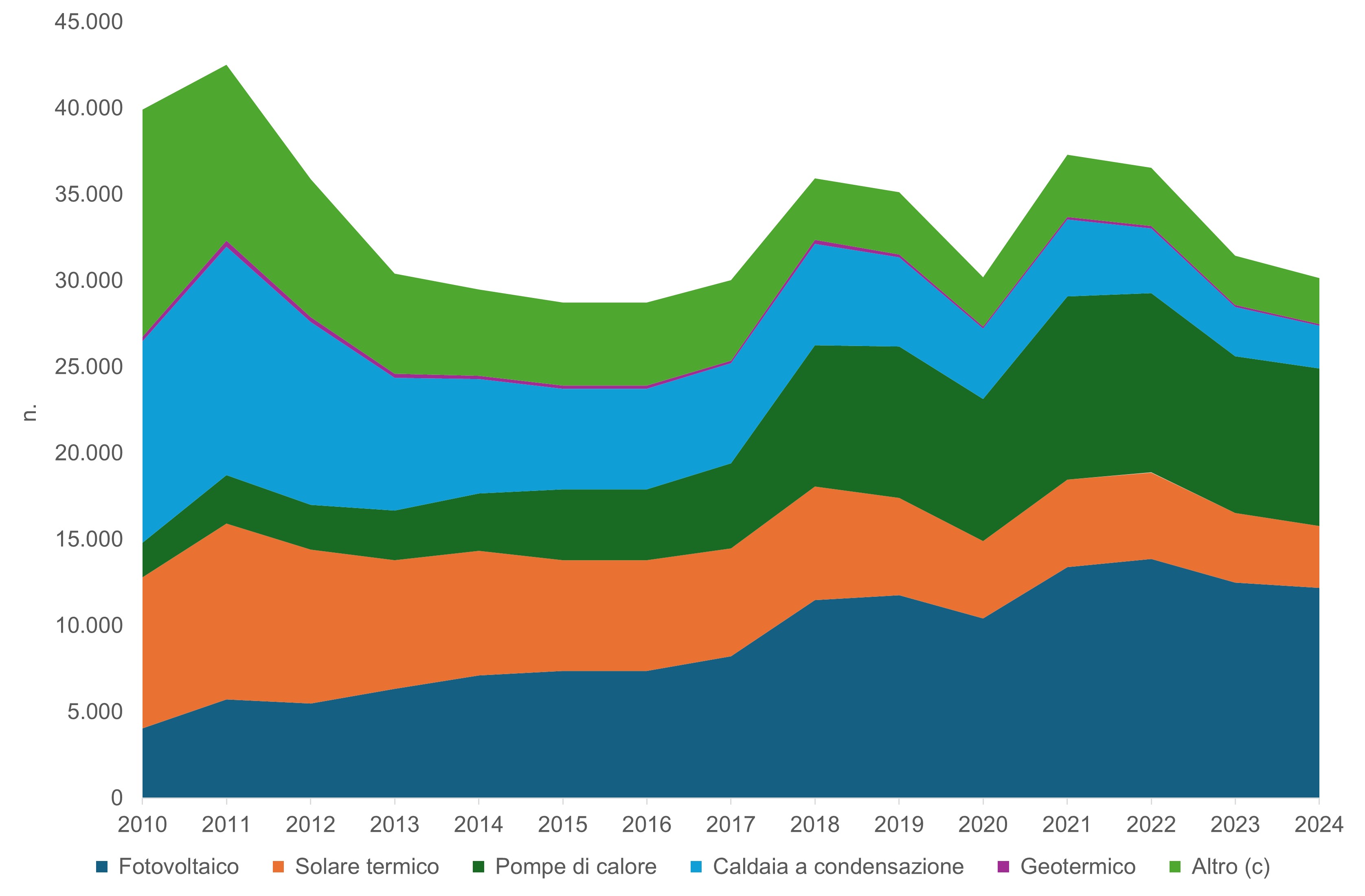
In 2024, the adoption of sustainable building technologies in newly constructed buildings remained at relatively significant levels but confirmed a weakening compared with 2023. In particular, the number of buildings equipped with photovoltaic systems declined to 12,181, down from 12,482 in 2023 and 13,852 in 2022 (Table 1). Buildings fitted with heat pumps totalled 9,151, representing a slight increase compared with 9,073 in 2023, although remaining below the 10,403 recorded in 2022. The decline in solar thermal systems also continued, falling from 4,056 buildings in 2023 to 3,585 in 2024. Condensing boilers likewise continued their downward trend, decreasing from 2,858 to 2,467, confirming the gradual phase-down of technologies still based on fossil fuels. Overall, the current status of the indicator can be assessed as moderately positive from an environmental perspective, since new residential construction continues to favour technologies that are more consistent with decarbonisation objectives. However, the recent slowdown suggests that the transition has not yet become fully established.
Over the period considered, the long-term trend remains positive but has clearly lost momentum during the last two years; consequently, the overall trend is assessed as stable. The underlying direction remains environmentally favourable, yet the recent slowdown suggests that progress continues to depend substantially on incentive schemes and has not yet become self-sustaining.
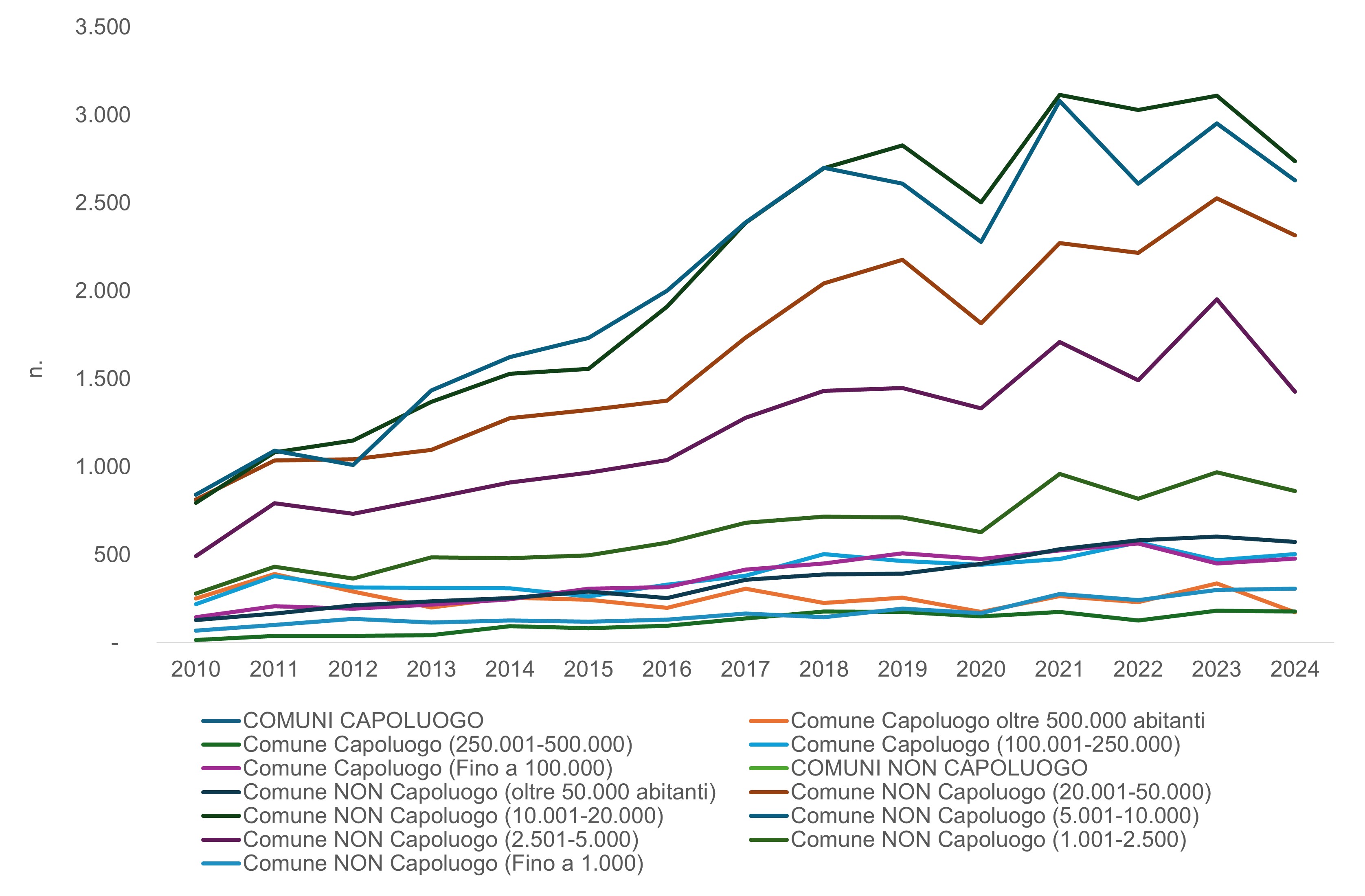
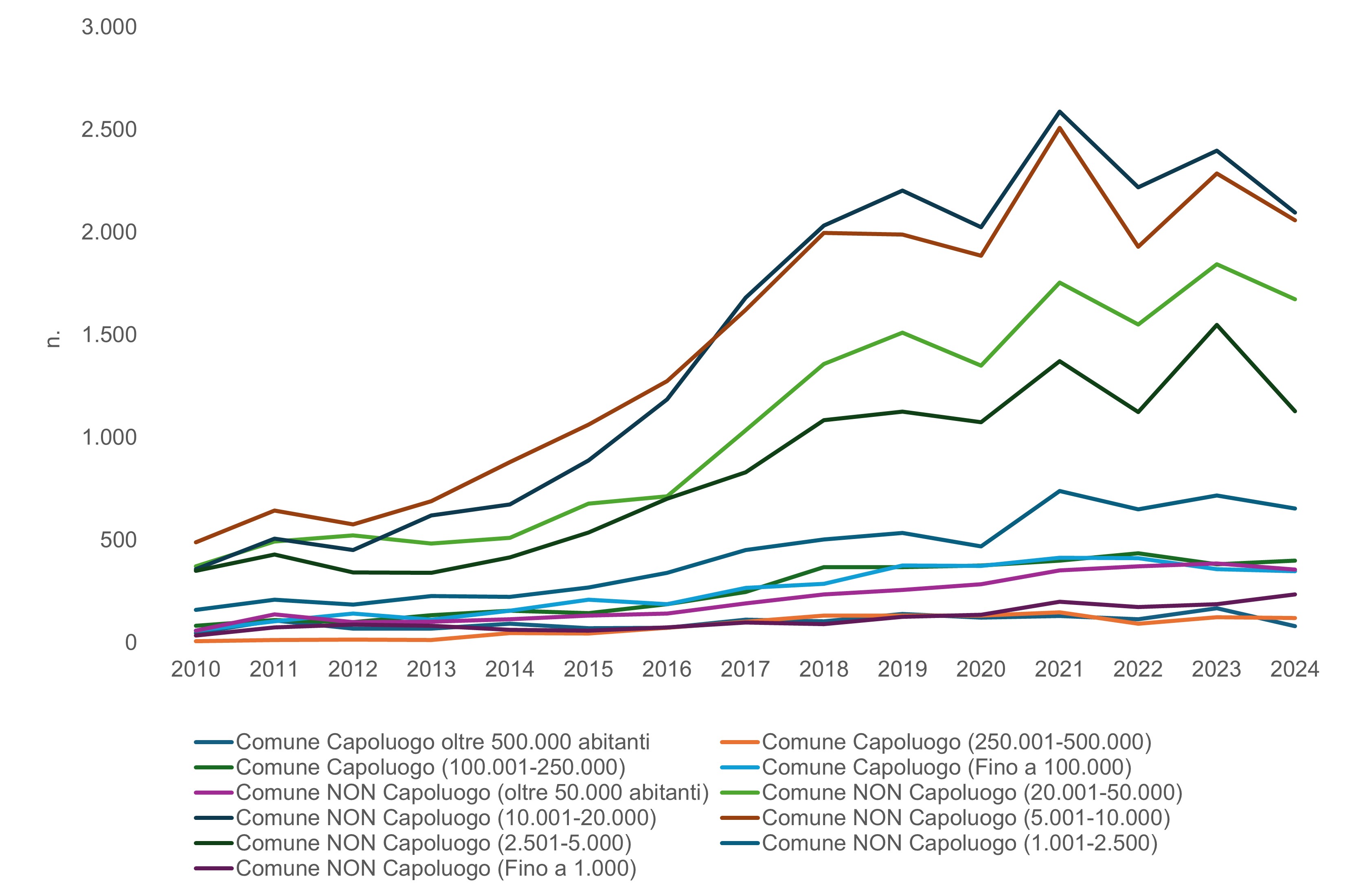
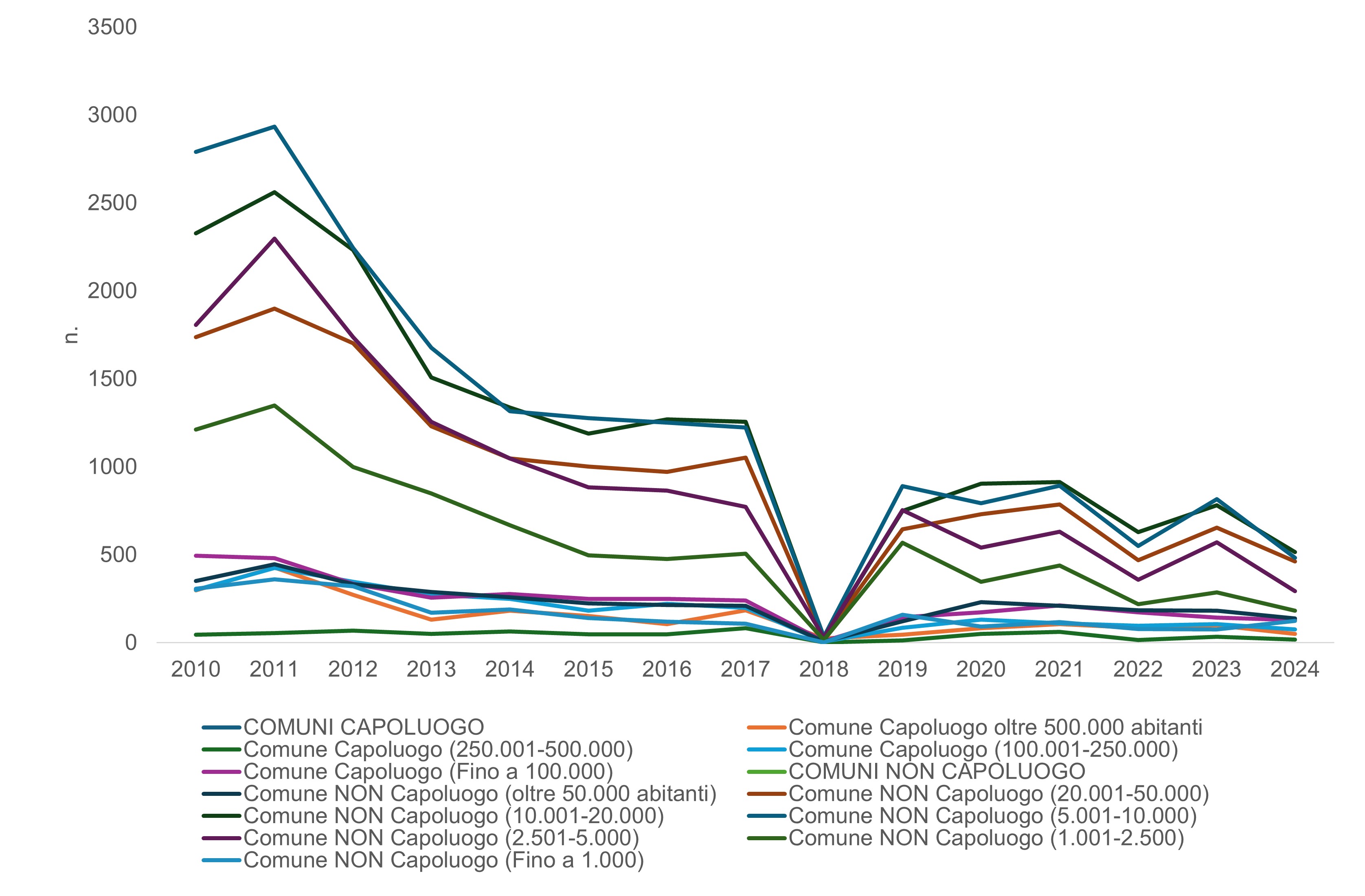
As shown in Table 1, between 2010 and 2024 the number of buildings equipped with photovoltaic systems increased from 4,051 to 12,181, while those fitted with heat pumps rose from 2,020 to 9,151. During the same period, solar thermal installations declined from 8,741 to 3,585, and condensing boilers decreased from 11,669 to 2,467, indicating a gradual shift in the technological mix towards more electrified and energy-efficient solutions. This pattern is confirmed by Figure 1, which illustrates the long-term expansion of photovoltaic systems and heat pumps alongside the decline in condensing boilers. Figures 2 and 3 further show that the strongest growth in photovoltaic systems and heat pumps has occurred in medium-sized non-provincial municipalities, while Figure 4 highlights the progressive decline in condensing boilers across almost all municipal size classes. Following the peak reached in 2022, however, the 2023–2024 period recorded a general slowdown across almost all technologies, with the only exception being a slight recovery in heat pump installations during 2024.
| Data |
|---|
Headline
Table 1: New residential buildings by system type and municipality class Data source
ISPRA elaboration based on Istat data Note
(a) "Other" refers to any category not listed in the table. |
Thumbnail
Headline
Figure 1: New residential buildings by type of system Data source
ISPRA elaboration based on Istat data |
Thumbnail
Headline
Figure 2: New residential buildings with photovoltaic systems and municipality classes Data source
ISPRA elaboration based on Istat data |
Thumbnail
Headline
Figure 3: New residential buildings with heat pump systems and municipality classes Data source
ISPRA elaboration based on Istat data |
Thumbnail
Headline
Figure 4: New residential buildings with condensing boiler systems and municipality classes Data source
ISPRA elaboration based on Istat data |
Photovoltaic systems and heat pumps remain the most widely adopted sustainable technologies in new residential buildings (Figures 1 and 2). Nevertheless, the latest data show a decline in 2024 compared with the 2022 peak, confirming that the overall development trajectory remains somewhat unstable. The reduction is evident across almost all technologies considered and demonstrates the extent to which the construction sector continues to depend on the availability of financial incentives. The absence of stable, long-term support mechanisms makes it difficult for sustainable technologies to become the market standard. In provincial capital cities with more than 500,000 inhabitants, 2024 recorded 172 newly constructed buildings equipped with photovoltaic systems and 80 with heat pumps. By contrast, municipalities with populations between 100,001 and 250,000 inhabitants recorded higher values, namely 504 and 400, respectively, confirming the greater diffusion of these technologies in medium-sized urban centres. In smaller municipalities, although the absolute number of installations remains substantial, adoption is more uneven and fragmented due to economic, infrastructural, and planning constraints (Table 1).