Antonio Caputo
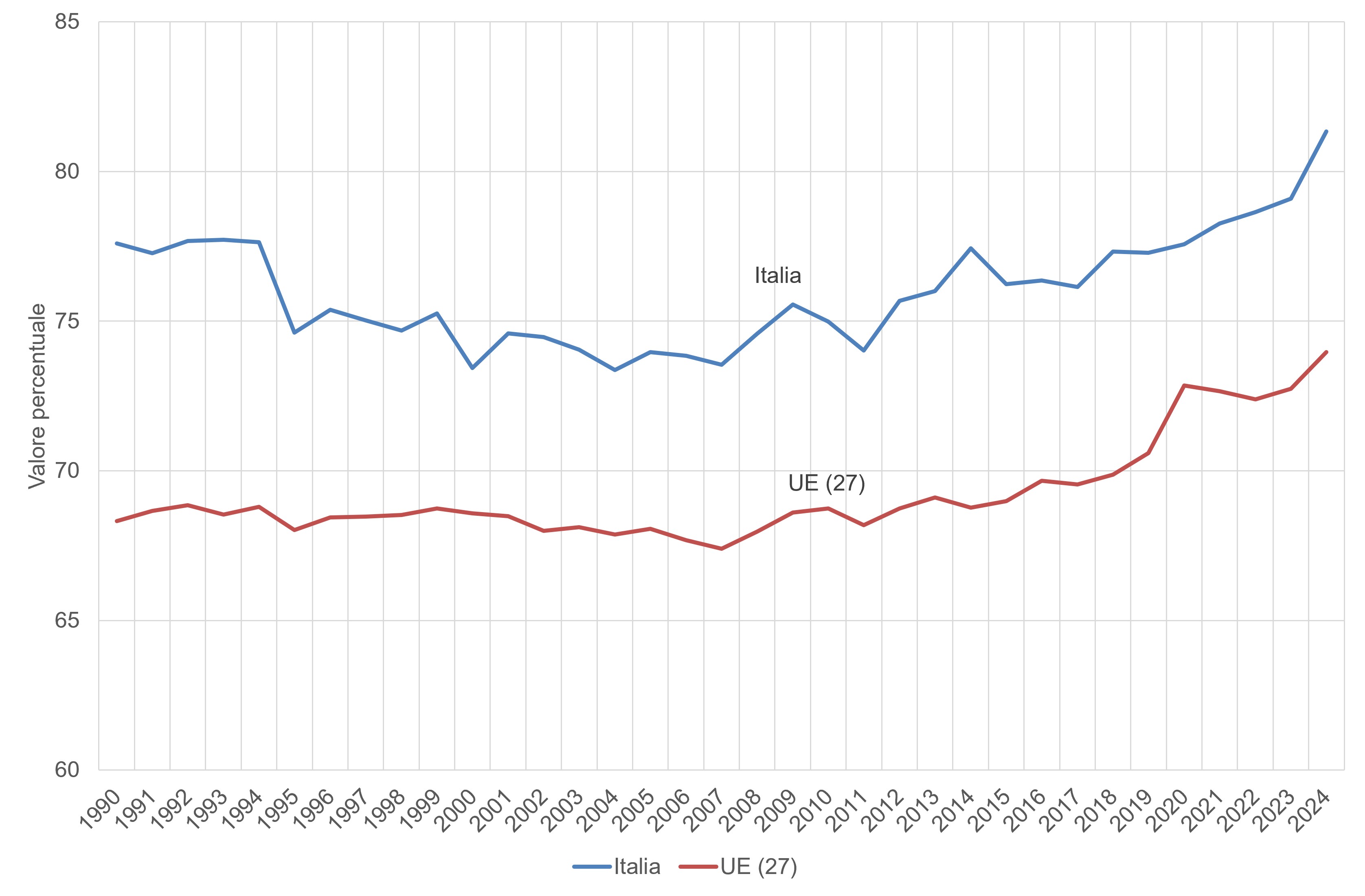
The ratio of final energy consumption to gross domestic energy consumption measures the overall efficiency of energy conversion from primary sources. The difference between these two measures corresponds to losses in conversion processes (such as electricity generation and oil refining), internal consumption by electricity generation plants, and losses in distribution. The percentage rate highlights the share of energy reaching the end user compared to the total energy fed into the system. This ratio for Italy stands at 81.3% in 2024, with a total energy volume of 113.7 Mtoe. This percentage value is consistently above the European Union (EU27) average, which in 2024 recorded a ratio of 74.0% out of a total of 939.3 Mtoe.
The ratio of final energy consumption to total energy consumption measures the overall efficiency of energy conversion in primary sources. The difference between these two measures corresponds to losses in conversion processes (such as electricity generation and oil refining), internal consumption in electricity generation plants, and losses in distribution.
Evaluate the overall efficiency of converting primary energy from different sources into usable energy, in order to increase the efficiency of energy supply.
Europe has updated its climate strategy, setting a target of reducing greenhouse gas emissions by 55% by 2030 compared to 1990, a share of at least 42.5% from renewable energy (provisional agreement in 2023 with the intention of aiming for 45%), and an 11.7% reduction in final energy consumption compared to the reference scenario projections (2020 reference scenario). In implementation of EU energy governance, Italy submitted the updated version of its National Integrated Energy and Climate Plan (PNIEC) to the European Commission on July 1, 2024. The PNIEC incorporates previous policy documents and defines the measures necessary to achieve European objectives for energy efficiency, renewable energy sources, and the reduction of greenhouse gas emissions. Regarding final energy consumption, in order to contribute to the achievement of the European Union's binding target, the NECP states that Italy's consumption level, considering additional measures to existing policies, should amount to 102 Mtoe of final energy and 123 Mtoe of primary energy in 2030, far from the targets calculated under the EED III Directive of 93 and 111 Mtoe, respectively. Binding targets for reducing final energy consumption through mandatory energy efficiency schemes defined pursuant to Article 7 of Directive 2018/2002/EU are also established. These targets translate into a reduction in final energy consumption, in each of the years from 2021 to 2030, of 0.8% of the average annual consumption for the three-year period 2016-2018, through active policies. This target is equivalent to a cumulative reduction of 73.42 Mtoe from 2021 to 2030.
With regard to the main national regulatory references for the 2020 targets, Legislative Decree no. 102/2014, amended and supplemented by Legislative Decree no. 73 of 14 July 2020, contains the provisions for the transposition of Directive 2012/27/EU, as amended by Directive 2018/2002/EU. With regard to energy efficiency and the 2030 targets, a list of the main regulatory acts is provided: EU Regulation no. 2018/1999 of the European Parliament and of the Council of 11 December 2018 on the Governance of the Energy Union. EU Directive 2018/2002 (the so-called EED Directive) on energy efficiency (amending the previous Directive 2012/27/EU), implemented by Legislative Decree no. 73 of 14 July 2020. The legislative decree introduced additions and amendments to Legislative Decree no. 102/2014. Directive (EU) 2018/844 amending Directive 2010/31/EU on the energy performance of buildings and Directive 2012/27/EU on energy efficiency (EPBD - Energy Performance of Buildings Directive), implemented by Legislative Decree no. 48 of 10 June 2020. EU Directive 2018/2001 on the promotion of the use of energy from renewable sources. Directive (EU) 2023/1791 on energy efficiency.
Regarding the main national regulatory references for the 2020 targets, we cite Legislative Decree no. 102/2014, amended and supplemented by Legislative Decree no. 73 of 14 July 2020, which contains the provisions for the transposition of Directive 2012/27/EU, as amended by Directive 2018/2002/EU. Regarding energy efficiency and the 2030 targets, a list of the main legislative acts is provided: EU Regulation no. 2018/1999 of the European Parliament and of the Council of 11 December 2018 on the Governance of the Energy Union. EU Directive 2018/2002 (the so-called EED Directive) on energy efficiency (amending the previous Directive 2012/27/EU), implemented by Legislative Decree no. 73 of 14 July 2020. The legislative decree introduced additions and amendments to Legislative Decree no. 102/2014. Directive (EU) 2018/844 amending Directive 2010/31/EU on the energy performance of buildings and Directive 2012/27/EU on energy efficiency (EPBD - Energy Performance of Buildings Directive), implemented by Legislative Decree no. 48 of 10 June 2020. EU Directive 2018/2001 on the promotion of the use of energy from renewable sources. Directive (EU) 2023/1791 on energy efficiency.
The indicator's relevance at the regional level is reduced compared to the national level due to the uneven distribution of electricity generation plants across the country.
Eurostat (Statistical Office of the European Communities)
Eurostat (https://ec.europa.eu/eurostat/data/database)
National
1990-2024
Final and total energy consumption (Mtoe)
The figure is calculated as the ratio between "Final energy consumption," defined as the sum of final energy consumption in the Industry, Transport, and Other sectors (Residential, Services, etc.) and "Gross domestic energy consumption," defined as primary production + recovered products + imports + changes in inventories - exports - bunkering.
As of 2024, Italy has a seemingly high conversion and transformation efficiency, with 81.3% of total energy transformed into final consumption (Table 1). This value, higher than that of industrial partners such as Germany (78.0%) or France (64.3%), is linked to the structure of the national production system, characterized by a high incidence of the service sector and a highly efficient manufacturing industry compared to very energy-intensive industries. Nonetheless, in terms of total energy volumes, Italy consumes 113.7 Mtoe, remaining the third-largest consumer in the EU27 behind Germany (196.1 Mtoe) and France (139.9 Mtoe) (Table 2).
The evolution of the ratio over the thirty-year period 1990-2024 highlights well-defined structural dynamics. From 1990-2006, Italy's total energy consumption grew to a peak of 140.1 Mtoe in 2005, maintaining a stable ratio of final to total consumption at around 73-77%. Starting in 2006, total consumption began to gradually decline, falling to 120.1 Mtoe in 2019 and reaching a low of 109.8 Mtoe in 2020 due to the pandemic emergency. In recent years (2021-2024), despite a slight decline in total consumption (113.7 Mtoe in 2024), the percentage ratio of final to total consumption has risen to 81.3%, reaching the highest level of the period under consideration. This increase is due to the contribution of numerous factors: increased efficiency in energy transformation processes, a shift in the consumption ratio between services and industry in favor of the former, a shift in the consumption ratio between light manufacturing and more energy-intensive industries in favor of the former, and a reduction in losses along the supply chain. In 2024, our country's share of final consumption compared to the 27 European countries is 12.1%, not far from the value recorded in 1990 (Table 2). The trend of the share of European consumption increased from 1990 (12%) to a peak in 2005 (13.1%) and then decreased in subsequent years to a low recorded in 2020 (11.4%).
| Data |
|---|
Headline
Table 1: Ratio of final energy consumption to gross inland energy consumption in the European Union Data source
ISPRA processing based on Eurostat data |
Headline
Table 2: Total final consumption in the European Union Data source
ISPRA processing based on Eurostat data |
Thumbnail
Headline
Figure 1: RATIO BETWEEN FINAL ENERGY CONSUMPTION AND TOTAL ENERGY CONSUMPTION Data source
ISPRA processing based on Eurostat data |
The ratio of final to total consumption is a key indicator for measuring the overall efficiency with which a country transforms primary energy resources into energy useful for economic and domestic activities. The high percentage achieved by Italy (81.3%) in 2024 is due to the contribution of energy efficiency policies, the progressive modernization of national infrastructure, and the shift in the country's production structure (a shift in the ratio between services and industry and between different types of industry).