Antonio Caputo
This indicator considers gross electricity production in Italy broken down by source from 1990 to 2024. Total generation went from 216.6 TWh in 1990 to a peak of 314.1 TWh in 2007, before settling at 271 TWh in 2024. The energy mix has undergone a profound structural transformation: traditional thermoelectric power, while remaining the leading source with 152.1 TWh in 2024 (56.1% of the total), has reduced its weight compared to the past. At the same time, the combination of wind and photovoltaic rose from just 6 GWh in 1990 to 58.3 TWh in 2024 (21.5% of the total), joining hydroelectric production (54.8 TWh), geothermal production (5.7 TWh) and bioenergy (17.2 TWh). The contribution of all renewable sources (hydroelectric, geothermal, wind, photovoltaic and bioenergy), net of production from pumped storage and storage, was approximately 50%.
The indicator measures the electrical energy produced by each of the primary energy sources.
Evaluate the contribution of different energy sources to electricity production, in order to increase the use of less polluting fuels.
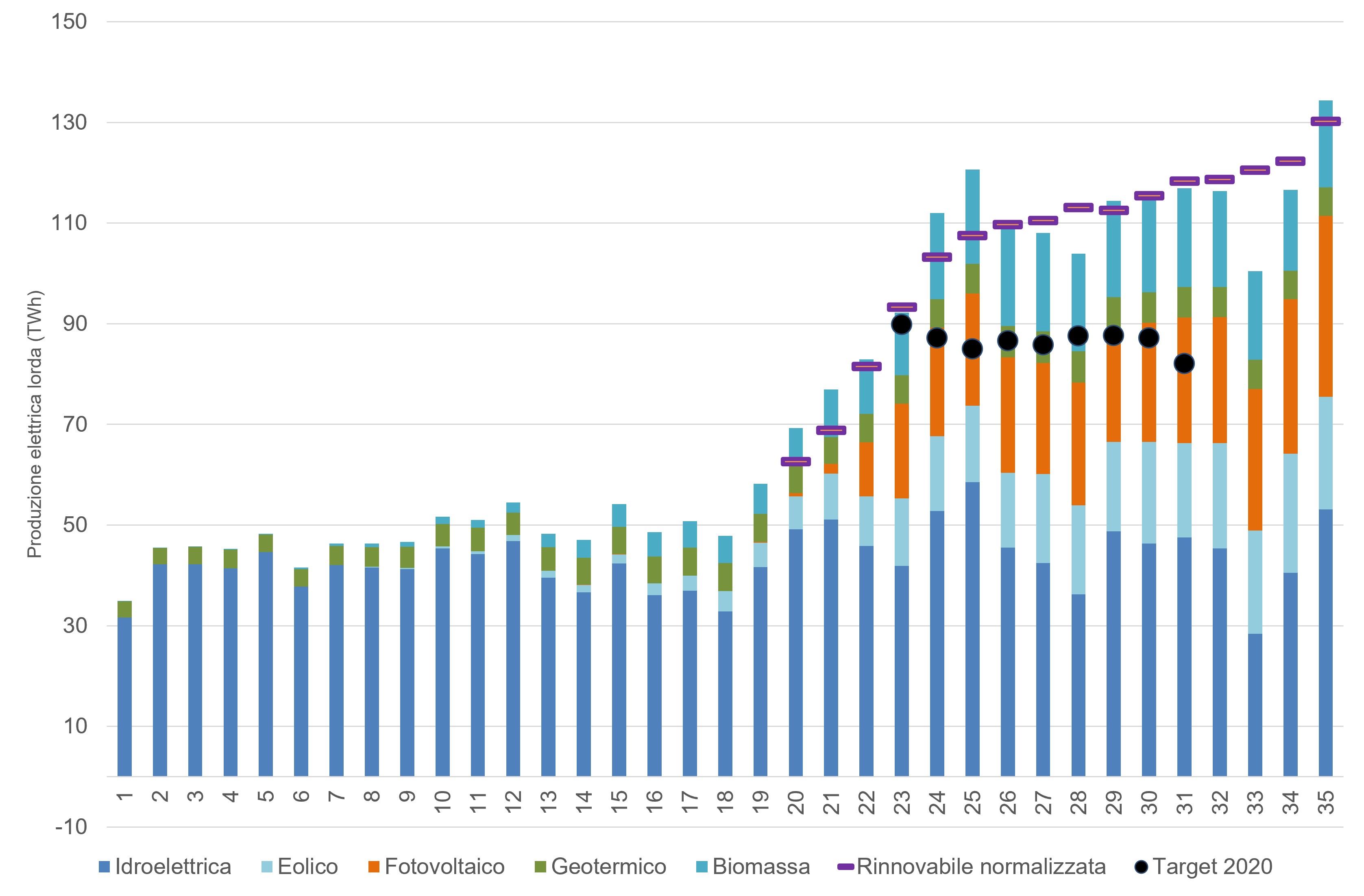
The indicator has no specific references with targets set by law. The regulatory evolution of the Italian electricity sector reflects the gradual transition from a centralized model based on fossil fuels to a sustainable, efficient generation system driven by renewable sources. The first key milestone in this process was Legislative Decree 79/1999, known as the Bersani Decree, which initiated the liberalization of the electricity market and promoted the gradual phasing out of high-impact fuels, such as fuel oil, in favor of natural gas. Subsequently, to stimulate the adoption of clean technologies, the "Conto Energia" Decrees were introduced between 2005 and 2013, complemented by the auction and registry mechanisms established by Ministerial Decrees 28/2011 and FER 1; This complex incentive framework has led to an increase in photovoltaic and wind power production, particularly between 2008 and 2015. Specifically, Directive 2009/28/EC, transposed into national law by Legislative Decree No. 28 of 3 March 2011, establishes the share of energy from renewable sources in gross final consumption for each European Union country by 2020; these shares include both renewable energy consumption for electricity generation and for thermal and transport uses. The indicative target for the electricity sector for 2020, calculated as the ratio between normalized electricity production from renewable sources and gross domestic consumption, was 26.4%, while the indicative target for 2030 set by the Italian National Plan (PNIEC) is 63%. Legislative Decree No. 199 of 2021, the implementing decree for Directive (EU) 2018/2001 on the promotion of renewable energy, establishes the distribution of the minimum power of renewable energy plants between regions and autonomous provinces. Following the aforementioned legislative decree, the decree of the Ministry of the Environment and Energy Security (MASE) of June 21, 2024, identifies the distribution among regions and autonomous provinces of the national 2030 target of an additional 80 GW of renewable energy capacity compared to December 31, 2020, required to achieve the objectives set by the National Energy and Climate Plan (PNIEC) and meet the new targets resulting from the implementation of the "Fit for 55" initiative, also in light of the "Repower EU" initiative. Monitoring and verification of the requirements established by the June 21, 2024, decree are the responsibility of MASE, with the support of GSE and RSE.
Terna - National Electricity Network S.p.A.
TERNA S.p.A., Statistical data on electricity in Italy https://www.terna.it/it/sistema-elettrico/statistiche/pubblicazioni-statistiche
National
1990-2024
Electricity production from renewable sources (GWh).
The data is available at the national and regional levels, with a more aggregated classification of renewable energy sources (hydraulic, thermoelectric, renewable). Since 2000, GRTN (subsequently Terna Rete Italia SpA) has published data on the consumption of fuels used in traditional thermoelectric generation only in aggregate form, by fuel class.
In 2024, the Italian electricity generation system is in an advanced phase of energy transition, in which renewable sources (hydroelectric, net of the contribution of pumped storage and stand-alone storage, wind, photovoltaic, geothermal, and biomass) will cover 49.5% of gross national production. Natural gas remains the main driver of transition and system adequacy, generating 118.6 TWh (43.7% of the total). The now almost definitive collapse of solid fuels (coal), which have fallen to just 3.9 TWh (1.5% of the total), and of petroleum products (8.6 TWh), is evident. The item relating to stand-alone storage is also starting to appear in the budget (136 GWh in 2024), signaling the start of the diffusion of large-scale storage systems (Table 1).
Total electricity production in 2024 was 271 TWh (+20.1% compared to 1990), an increase of 2.3% compared to the previous year (Table 1). The contraction in 2020 was due to the economic lockdown measures necessary to contain the spread of the SARS-CoV-2 pandemic, which reduced electricity demand. In 2021, electricity production recovered, followed by a further decline in the last two years. Of particular note is the growth in the contribution of renewable sources from 2007 to 2014, from 15.5% to 43.4%, with a consequent decrease in the share of natural gas (from 55% to 33.5%). The thirty-year trend shows a double technological substitution. The first phase, spanning the 1990s and 2000s, saw natural gas replace petroleum products (from 102.7 TWh in 1990, equal to 47.4% of the mix, to less than 9 TWh in 2024). The second phase, which began around 2008-2010, saw the exponential growth of non-programmable renewables: wind and photovoltaic increased tenfold in fifteen years, from 4.1 TWh in 2007 to over 58 TWh in 2024. At the same time, hydroelectricity maintained its role as a renewable pillar, despite being affected by climate variability (with a low of 30.3 TWh in 2022 and a recovery to 54.8 TWh in 2024). The overall trend indicates a progressive decarbonization of national electricity production, accompanied by a sharp reduction in coal use over the last three years (from 22.6 TWh in 2022 to less than 4 TWh in 2024) (Figure 1).
In recent years, the thermoelectric sector has seen a reduction in the share of natural gas, while the share of renewable energy, after the reduction recorded in 2022, has exceeded the maximum value of 2014. The drastic reduction in the share of renewable energy in 2022 (35.6%) was caused by the contraction in hydroelectric production. Energy from wind and photovoltaic sources increased from 1% in 2007 to 22% in 2024. After a rapid increase in electricity generated from these sources from 2007 to 2014, the previously observed electricity production rates slowed until 2020, followed by significant annual increases until 2024. The contribution of the thermoelectric sector (56% in 2024) showed a significant decrease in the last year. The lowest value (63%) was recorded in 2014, before the lowest value recorded in 2024.
| Data |
|---|
Headline
Table 1: Gross electricity production by source Data source
Terna |
Thumbnail
Headline
Figure 1: Gross electricity production by source. Data source
Terna |
The historical series reflects the effectiveness of the decarbonization policies applied to the Italian electricity sector. The drastic reduction in the use of coal and oil in favor of natural gas first, and then renewable sources, has significantly reduced specific emissions per kWh produced. However, the presence of over 56% thermoelectric generation highlights how the system still requires a massive acceleration in the installation of renewables (especially photovoltaic and wind) and in the development of the electricity transmission network and storage systems. The challenge for the coming years will be to replace the remaining natural gas through the further installation of renewable energy plants and the integration of large-scale storage, while ensuring the stability and security of the national electricity grid.