Marina Vitullo
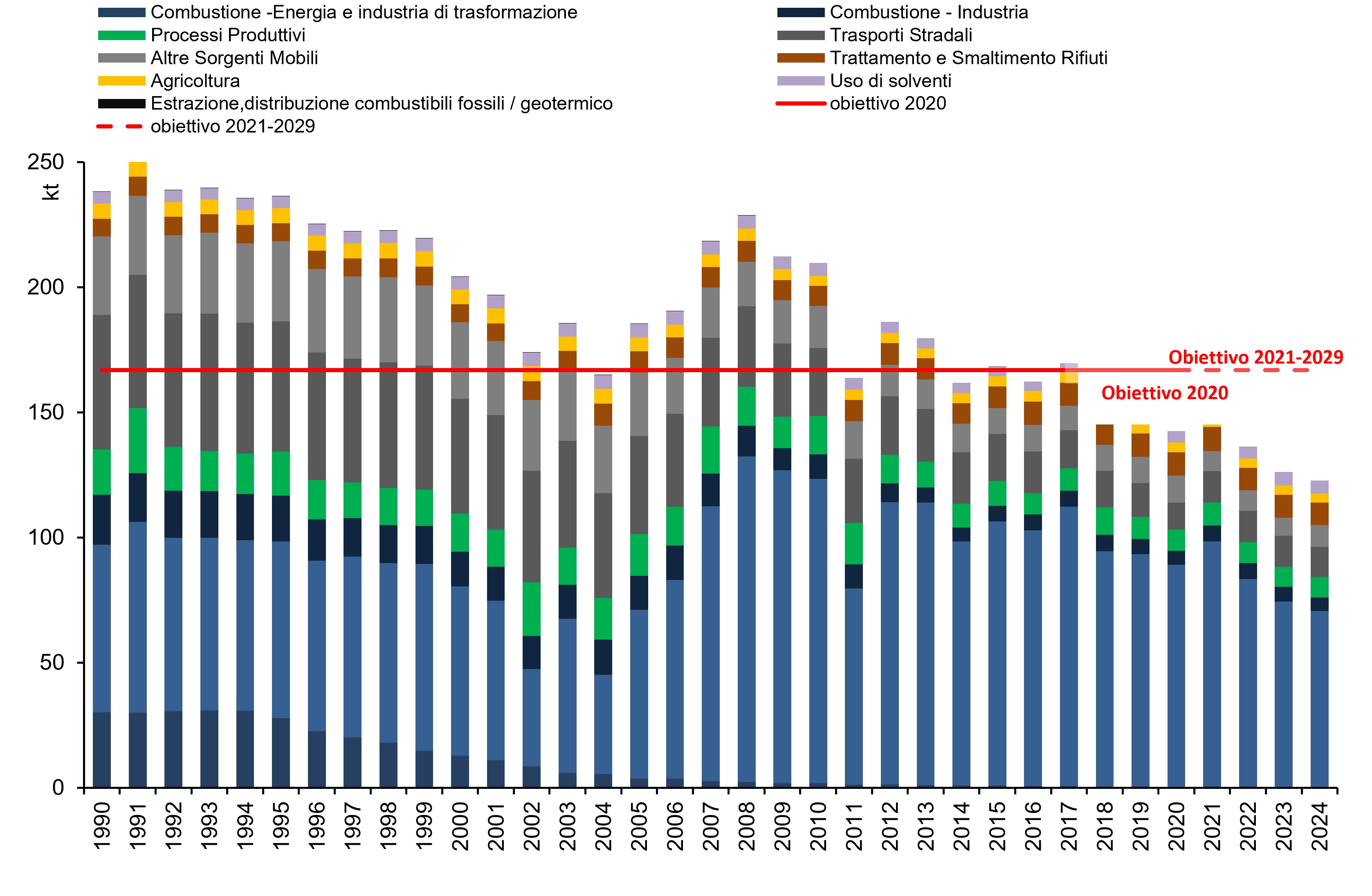
The indicator represents the trend of national emissions of particulate matter (PM2.5) by sector of origin from 1990 to 2024, highlighting a marked reduction over the years on a total level (-48.5%). The road transport sector, which contributes to total emissions with an emission share of 9.9% in 2024, presents a reduction of 77.5% over the entire period. Emissions from non-industrial combustion, in the same period, grew by 5.1%, representing the most important sector in 2024 with 57.3% of total emissions.
Particulate matter smaller than 2.5 µm consists of airborne particles of such a size that, once inhaled, they penetrate deeply into the human respiratory system. Like PM10, PM2.5 particulate matter is also partly emitted as such directly from sources into the atmosphere (primary PM2.5) and is partly formed through chemical reactions between other polluting species (secondary PM2.5). The direct emission of PM2.5 is associated with all combustion processes, in particular those that involve the use of solid fuels (coal, wood) or liquids such as diesel and fuel oil. Fine particles are therefore emitted by road transport, energy production plants, home heating systems and forest fires. The estimates made relate only to emissions of primary origin, while those of secondary origin are not calculated, as are those due to the resuspension of dust deposited on the ground.
Evaluate the trend over time of PM2.5 emissions (particles smaller than 2.5 µm) disaggregated by sector, relevant for monitoring the effectiveness of emission reduction regulations with particular attention to urban areas.
As part of the UNECE Convention on long-range transboundary air pollution (CLRTAP), Italy is required to update and annually communicate the national inventory of polluting emissions into the atmosphere, which includes, among the various pollutants, also PM2.5. The national reference legislation for the protection of the air and the reduction of emissions into the atmosphere is Legislative Decree 3 April 2006, n. 152 (“Environmental regulations”, part five). The Decree was subsequently updated by Legislative Decree 128/2010 and underwent further changes following the entry into force of Legislative Decree no. 4 March 2014. 46 on industrial plants. Numerous regulations limit particulate emissions in certain sectors, particularly road transport and industry. As regards stationary sources, Directive 2010/75/EU indicates the particulate emission limit values for solid, liquid and gaseous fuels in large combustion plants. For medium combustion plants, Directive (EU) 2015/2193 also establishes rules for the control of air emissions, in order to reduce potential risks to human health and the environment. For mobile sources, the most recent provisions regarding emissions of particulate matter derive from EC Regulation 715/2007 relating to the approval of motor vehicles with regard to emissions from light passenger and commercial vehicles (Euro 5 and Euro 6) and from EC Regulation 595/2009 relating to the approval of motor vehicles and engines with regard to emissions from heavy-duty vehicles (Euro VI). The new NEC Directive 2016/2284 of the European Parliament and of the Council (implemented with Legislative Decree 81 of 2018), concerning the reduction of national emissions of certain air pollutants, defines the national emissions reduction commitments compared to 2005, applicable from 2020 to 2029 and starting from 2030: reduction commitments of 10% and 40% respectively.
ISPRA
Used ISPRA data from the National Inventory of Atmospheric Emissions (https://emissioni. sina. isprambiente. it/interno-nazionale/).
National
1990-2024
Estimate calculated as part of the creation of the national inventory of atmospheric emissions. For air pollutants the methodology used is that indicated by the European Environment Agency (EMEP/EEA air pollutant emission inventory guidebook 2023). For the description of the estimation methodology, reference is made to the Information Inventory Report – IIR ( https://www. isprambiente. gov. it/it/pubblicazioni/rapporti/italian-emission-inventory-1990-2024-informative-inventory-report-2026; https://www. ceip. at/status-of-reporting-and-review-results/2026-submission )
PM2.5 emission levels are equal to 123 kt in 2024, remaining below the target set for 2020-2029 (167 kt, 10% reduction compared to 2005 values) (Figure 1).
Le emissioni nazionali di PM2,5 si riducono nel periodo 1990-2024 del 48,5% delineando un andamento positivo dal punto di vista ambientale (Tabella 1). Although the overall trend is decreasing, from the detailed sector analysis, increases are highlighted, in particular emissions from non-industrial combustion which grew by 5.1% between 1990 and 2024, due to the increase recorded in wood combustion in residential heating systems which, in 2024, represents the most important sector with 57.3% weight on total emissions.
| Data |
|---|
Headline
Table 1: National PM2.5 emissions by source sector Data source
ISPRA Note
A: Combustion – Energy production and transformation industries B: Non-industrial combustion C: Combustion in manufacturing industries D: Production processes E: Fossil fuel extraction and distribution / Geothermal energy F: Solvent use G: Road transport H: Other mobile sources I: Waste treatment and disposal L: Agriculture |
Thumbnail
Headline
Figure 1: National PM2.5 emissions by source sector Data source
ISPRA Note
Emission values have been updated in line with the annual update of the national emission inventory. |
National emissions are calculated in accordance with the estimation methodology adopted at European level and reported no in the EMEP/EEA Air pollutant emission inventory guidebook – 2023. Emissions from natural sources (other emission sources and absorptions) are not counted in the totals in accordance with the classification adopted in the estimate of emissions in the national inventory. In the period 1990-2024, the road transport sector shows a decrease of 77.5% and contributes to total emissions with an emission share of 9.9% in 2024. Emissions from non-industrial combustion, however, increase by 5.1% while the other combustion processes record significant drops in particulate emissions. In particular, emissions deriving from combustion for energy production and in the transformation industry decreased by 99.1%, representing only 0.2% of total emissions in 2024, compared to an average of around 13% until 1995. Emissions from combustion processes in industry fell by 72.5%, reaching a weight of 4.5% of the total in 2024. The reductions found in the energy sectors and industry are mainly due to the introduction of two regulatory instruments: Presidential Decree 203/88 which establishes the rules for the authorization of plants and the Ministerial Decree of 12 July 1990, which introduces emission limits for plants. In 2024, emissions from agricultural activities, production processes and other mobile sources will weigh respectively 2.9%, 6.5% and 7.1% of the total, with decreases since 1990 of -41.1%, -55.8% and -72.4% respectively. Emissions linked to the treatment and disposal of waste have increased by 30.5% since 1990, reaching a share of total emissions of 7.4% in 2024 (Table 1, Figure 1).