Gabriele Bellabarba, Maria Logorelli
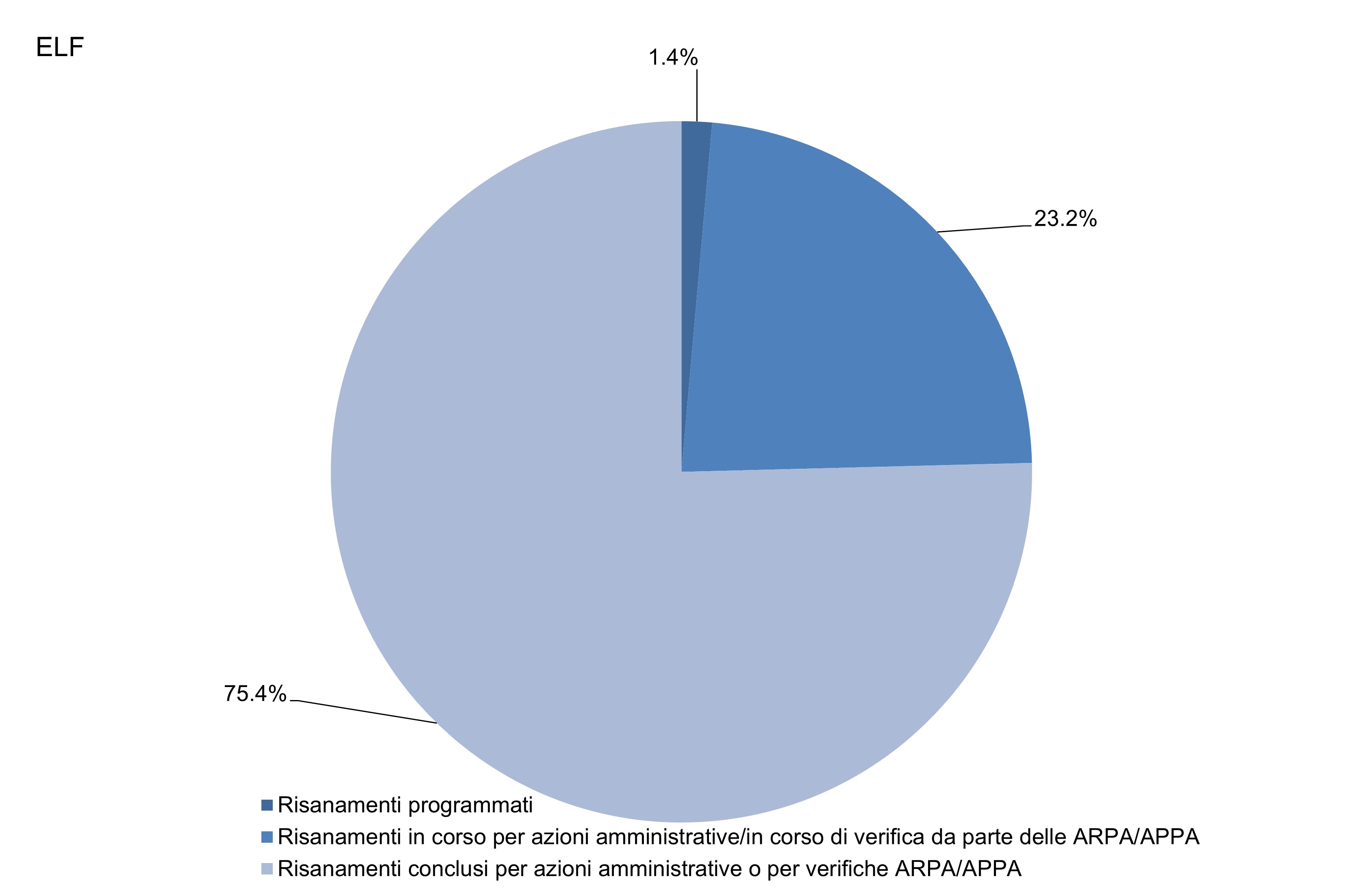
The indicator quantifies situations of non-compliance with the limits set by the regulations for power lines (power lines, substations and transformation cabins). For the autonomous regions/provinces, whose data are updated until September 2025, the remediated cases of exceeding are 75.4% of the total. The cases of exceeding the legal limits relating to power lines remained almost unchanged in the reference time periods (1999-September 2024 and 1999-September 2025), equal to 68 and 69 respectively.
The indicator quantifies situations of non-compliance with the limits set by the regulations for power lines (power lines, substations and transformation cabins). The planned recovery actions, currently being verified by ARPA/APPA, in progress (for administrative actions), concluded for ARPA/APPA verification and concluded for administrative actions are also calculated.
Quantify the situations of non-compliance for low frequency (ELF) sources present in the national territory and the remediation actions.
Framework Law 36/2001 establishes the exposure limits, the attention values and the quality objectives of the electric field and magnetic induction, to be respected in environments where a significant stay of the population can be expected. The detection of exceedances arises from the control activity of the ARPA/APPA during the operation of the ELF plant which is aimed at respecting the exposure limits, the attention values and the quality objectives for the protection of the population defined by the Prime Ministerial Decree 08/07/03 (50 Hz). According to the provisions of the art. 5 and 6 of the aforementioned Prime Ministerial Decree, two decrees were issued in May 2008 relating respectively to the calculation methodology for determining the buffer zones for power lines and to the measurement and evaluation procedures of magnetic induction.
ISPRA - Environmental data yearbook, various editions
ISPRA/MASE/SNPA - Thematic reports
Partial data due to lack of consolidated data collection tools at local level, lack of human and financial resources dedicated to this data collection activity. It should be underlined that there is no obligation on the part of the local authority/manager that arranges/carries out the remediation requested to communicate this to ARPA/APPA. For this last reason it is necessary to specify that the information regarding the status of the recovery actions corresponds to the state of knowledge of the ARPA/APPA agency system, i. e. To that set of information obtainable after adequate investigations by analyzing the data available in sector databases/publications. Furthermore, the lack at a regulatory level of the implementing decree of Law 36/2001 (art.4, paragraph 4) which regulates the criteria for developing power line rehabilitation plans is the main cause of the percentage of rehabilitations not yet defined in the face of a situation of non-compliance that still exists.
Synergistic actions by the subjects involved in trying to support the flow of information with suitable regulatory tools and with activities aimed at analyzing the critical issues mentioned above in order to shed light on the problems and propose solutions for greater uniformity and completeness of the data at a national level.
Electromagnetic Fields Observatory
17/20
1999-September 2025
Calculation of the number of exceedances of the regulatory reference values and the number of cases of exceedance for which there are planned remediation actions, being verified by ARPA/APPA, in progress (for administrative actions), concluded due to ARPA/APPA verification, concluded due to administrative actions, no action taken. Exceedance concerns situations in which levels above the exposure limit or the warning value or both are measured. The calculation is carried out for the regions whose data is updated and comparable.
For the autonomous regions/provinces for which the data is updated in September 2025 (Piedmont, Valle d'Aosta, Lombardy, Trentino-Alto Adige, Veneto, Friuli-Venezia Giulia, Liguria, Emilia-Romagna, Tuscany, Umbria, Lazio, Abruzzo, Molise, Campania, Puglia, Basilicata and Calabria) the remedied cases of exceedance are equal to 75.4% of the total (Figure 1). The total number of exceedances generated by ELF sources is equal to 69 (Table 1) considering only the autonomous regions/provinces for which the data is updated. Exceedances relating to power lines generally occur in private homes mainly due to the presence of secondary transformation substations (often located inside residential buildings) whose completed rehabilitation actions have led to a movement of the cables and the low voltage switchgear (interventions of this type aim to reduce the magnetic field in the place affected by the exceedance through a change in the arrangement of some elements constituting the secondary substation) and to a shielding of the substation itself with metallic material on the side bordering the apartment.
For the regions whose data is updated, complete and comparable (Piedmont, Valle d'Aosta, Lombardy, Autonomous Province of Trento, Veneto, Friuli-Venezia Giulia, Liguria, Emilia-Romagna, Tuscany, Umbria, Lazio, Campania, Puglia, Basilicata and Calabria) it can be noted that the cases of exceeding the legal limits have remained almost unchanged in the reference time periods (1999-September 2024 and 1999-September 2025) equal to 68 and 69 respectively (Table 2).
| Data |
|---|
Headline
Table 1: Number of exceedances detected and remediation status for power lines (1999–September 2025). Data source
ISPRA processing based on ARPA/APPA data (EMF Observatory). Data legend
a Data not updated. |
Headline
Table 2: Number of exceedances detected and remediation status for power lines in the two reference periods 1999–September 2024 / 1999–September 2025. Data source
ISPRA processing based on ARPA/APPA data (EMF Observatory). Data legend
a Data not updated; |
Thumbnail
Headline
Figure 1: Status of remediation actions at sites where at least one exceedance due to ELF installations was detected (1999–September 2025). Data source
ISPRA processing based on ARPA/APPA data (EMF Observatory). Note
Only the regions for which updated and complete data are available for the 1999–September 2025 time period were considered. |
The situations of exceeding the legal limits that characterize this electromagnetic source appear to be few in number and not increasing even in the face of adequate control activity by the ARPA/APPA. The information in Table 1 is affected by some problems such as lack of consolidated data collection tools at local level, lack of human and financial resources dedicated to this data collection activity, no obligation on the part of the competent authority (Municipality or Province) to inform ARPA/APPA of the state of the art of the remediation action from the latter request following the situation of non-compliance of a given plant.