Cristina Frizza
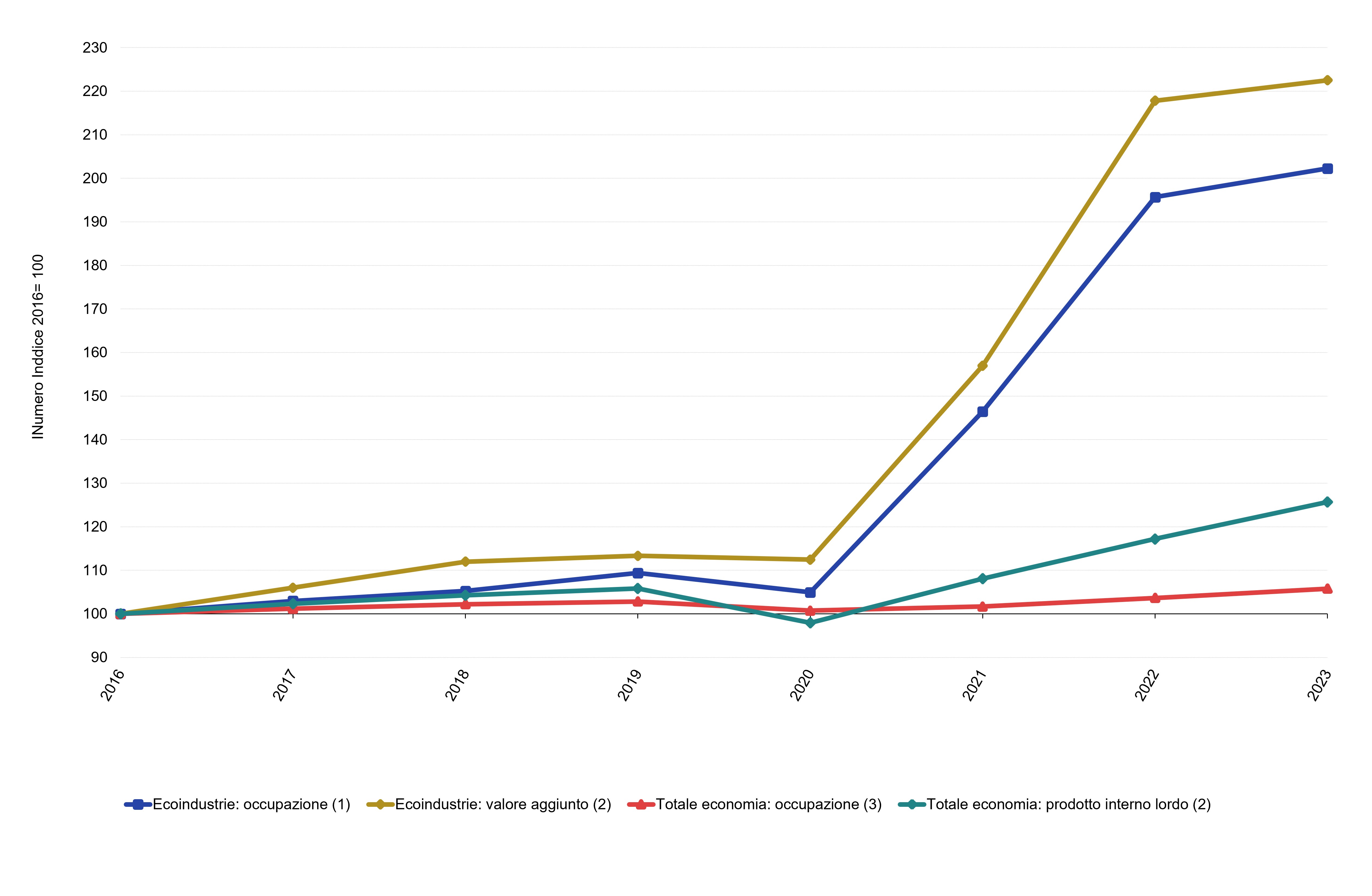
The indicator on the Environmental Goods and Services Sector (EGSS) measures the economic and employment contribution of production activities dedicated to environmental protection and the sustainable management of natural resources. In recent years, the environmental goods and services sector has experienced strong growth, highlighting the dynamism of Italy's green economy. Between 2016 and 2023, employment in the sector more than doubled, while gross value added (GVA) increased by 122.5%, with particularly strong expansion during the last three years. Between 2021 and 2023, the value added generated by environmental activities grew by 41.7%, substantially outpacing the overall growth of the Italian economy (GDP: +4%). As a result, the contribution of the environmental goods and services sector to the national economy increased from 3.1% of GDP in 2021 to 3.7% in 2023, confirming the growing importance of sustainability-oriented production activities in Italy.
The environmental purpose of economic activities is classified according to the Classification of Environmental Purposes (CEP), the new international classification adopted within the Economic-Environmental Accounting System (SEEA), which integrates the previous classifications relating to the protection of the environment and the management of natural resources into a single scheme. CEP includes the protection of air and climate, the production of energy from renewable sources, energy saving, waste water management, sustainable management of water resources, waste management, recovery and saving of materials, protection of soil and water, protection of biodiversity and landscape, management of forestry resources, reduction of noise and radiation pollution, as well as research and development activities and other transversal environmental objectives. Indicators derived from the Environmental Goods and Services Sector (EGSS) provide information on employment, added value, production and exports generated by these sectors. The data comes from the environmental satellite accounts developed by the European Statistical System, in coherence with the national economic accounts and with the international standard System of Environmental-Economic Accounting (SEEA-CF). In summary, eco-industries measure the contribution of the green economy to growth and employment, highlighting how production activities can support the sustainable transition and environmental protection.
To measure the economic and employment contribution of productive activities with an environmental purpose, namely those engaged in the production of goods and services aimed at environmental protection and the sustainable management of natural resources, using data on value added and employment.
Directive 2010/31/EU, which from 2021 imposes nZEB (nearly Zero Energy Building) standards for all new buildings and major renovations. The term nZEB – nearly Zero-Energy Building means: “Nearly zero-energy building” i. e. With a very high level of energy performance, in which the very low or almost zero energy requirement should be covered to a very significant extent by energy from renewable sources, including energy from renewable sources produced on site or nearby.
Regulation (EU) no. 691/2011 relating to European environmental economic accounts, as amended by Regulation (EU) No. 538/2014. In the European Union, the Commission presented the Communication 'The European Green Deal' at the end of 2019 to reshape European commitments to achieve a sustainable, efficient use of resources and competitive economy. The goods and services produced by eco-industries are key to achieving these goals.
Environmental goods and services sector accounts — Handbook 2016 edition. Eurostat, Luxembourg (https://ec. europa. eu/eurostat/web/products-manuals-and-guidelines/-/KS-GQ-16-008)
System of Environmental-Economic Accounting 2012 - Central Framework. United Nations, New York, 2014 (https://seea. un. org/content/seea-central-framework)
Istat: https://esploradati. istat. it/databrowser/#/it/dw/categories ---> Environmental accounts --> Accounts of environmental goods and services
National
2016-2023
The methodology used to develop the indicator can be consulted in the document Environmental goods and services sector accounts — Handbook 2016 edition. Eurostat, Luxembourg (https://ec. europa. eu/eurostat/web/products-manuals-and-guidelines/-/KS-GQ-16-008)
In 2023, the Environmental Goods and Services Sector employed approximately 1.16 million full-time equivalent workers and generated almost EUR 80 billion in gross value added. The gross value added generated by the sector accounted for approximately 4% of Italy's Gross Domestic Product (GDP) in 2023 (Table 1), compared with a European Union average of 3.3% in 2022. These results confirm the significant contribution of environmental activities to the Italian economy and highlight the country's comparatively strong position within the European green economy.
Between 2016 and 2023, both employment and gross value added in the Environmental Goods and Services Sector recorded substantial increases, rising by 102.3% and 122.5%, respectively, with particularly strong growth during the last three years. Overall, the environmental sector has expanded at a significantly faster pace than the Italian economy as a whole (Figure 1), confirming the increasing importance of environmentally oriented production activities.
| Data |
|---|
Headline
Table 1: Eco-industry indicators by economic activity (2023) Data source
ISPRA elaboration based on Istat data Note
Monetary variables expressed at current prices (billions of euros); employment expressed in work units (thousands) |
Thumbnail
Headline
Figure 1: Trends in key indicators for eco-industries and the total economy. (Index number 2016=100) Data source
ISPRA elaboration based on Istat data Data legend
(1) in work units; (2) current prices; (3) thousands of employed persons |
Thumbnail
Headline
Figure 2: Employment in eco-industries by environmental purpose (environmental protection and resource management) (thousands of work units) Data source
ISPRA elaboration based on Istat data |
Thumbnail
Headline
Figure 3: Value added of environmental goods and services by economic activity (2023) Data source
ISPRA elaboration based on Istat data |
Thumbnail
Headline
Figure 4: Value added of eco-industries by environmental purpose (environmental protection and resource management) Data source
ISPRA elaboration based on Istat data |
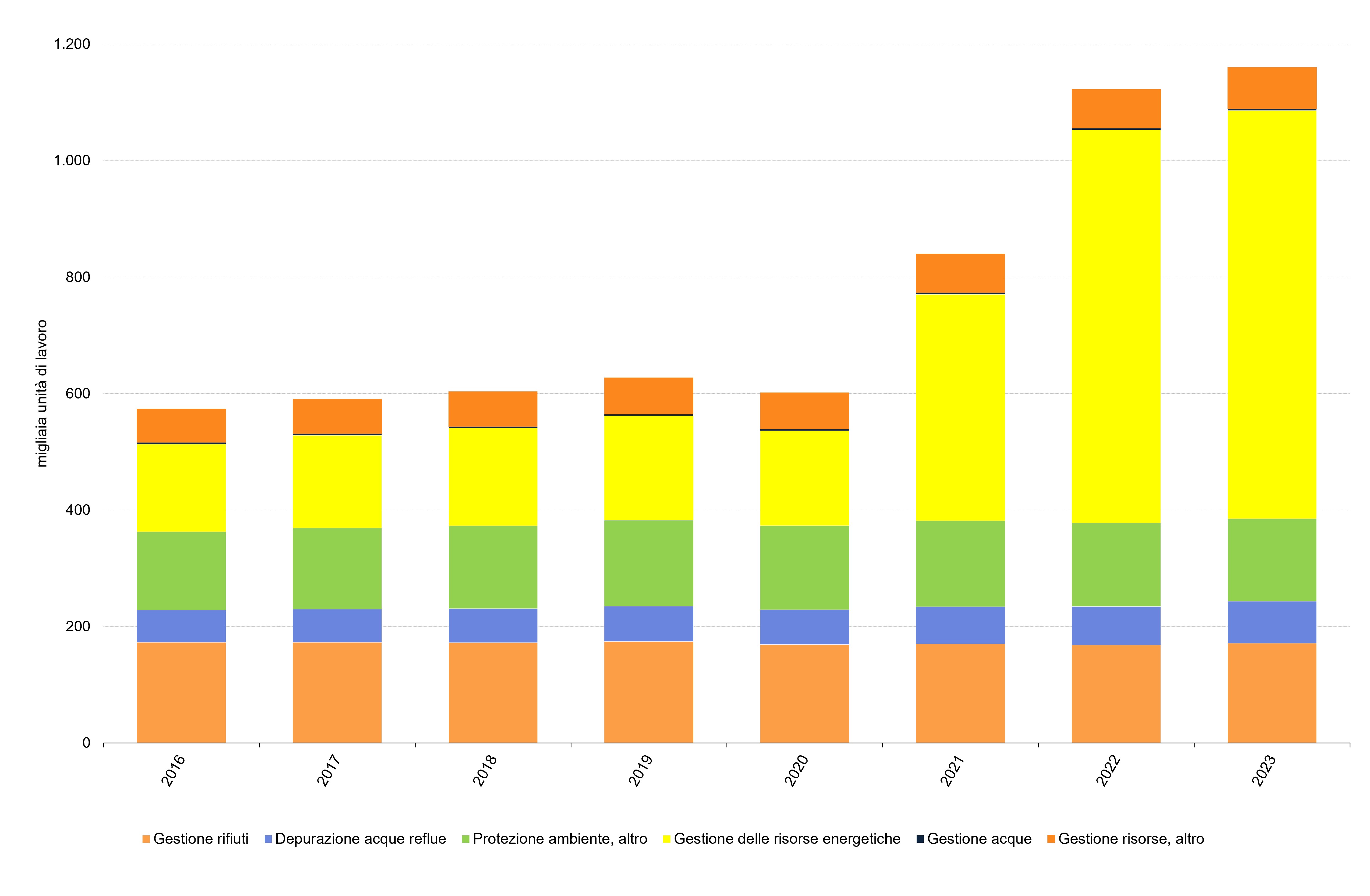
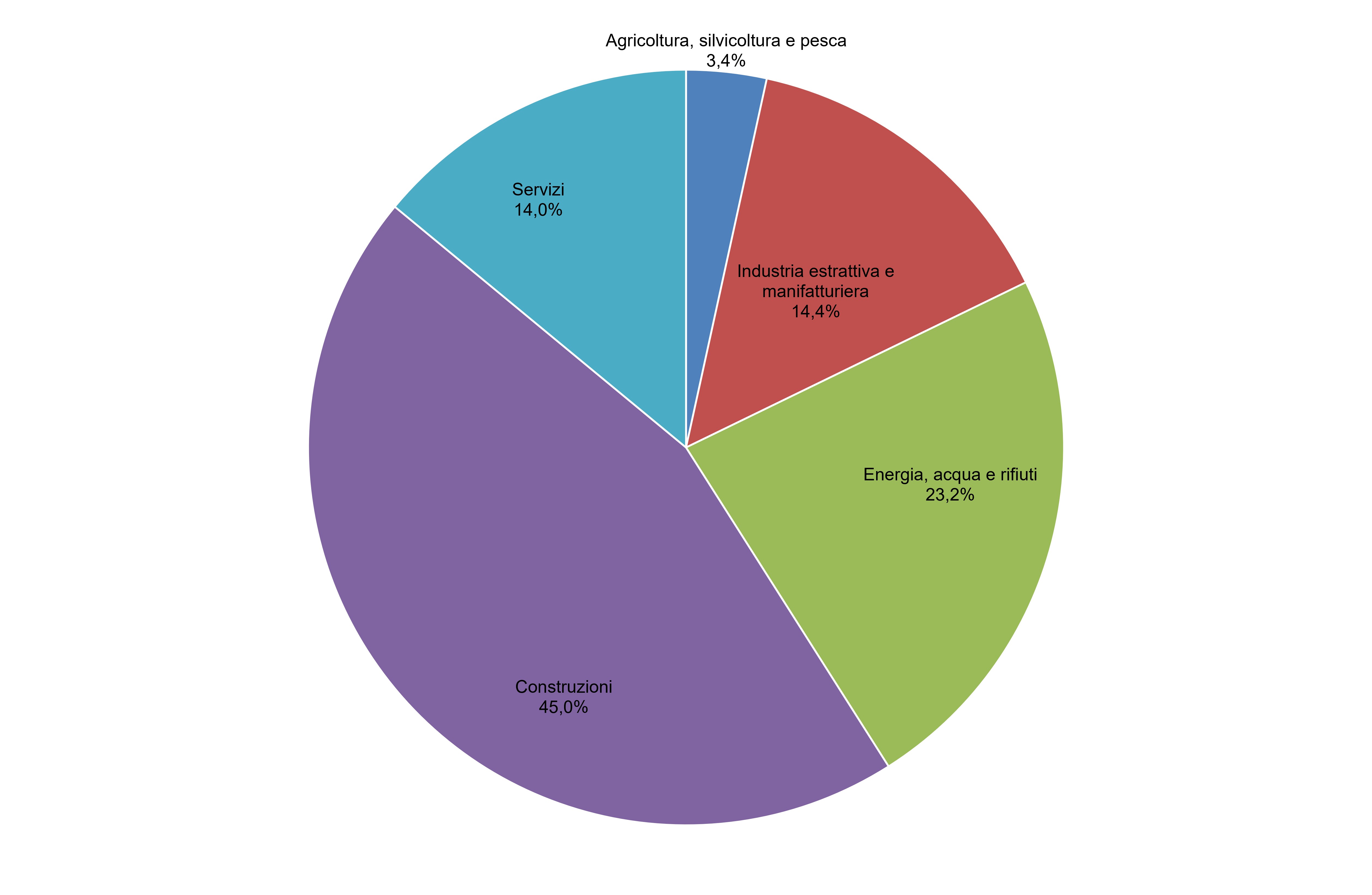
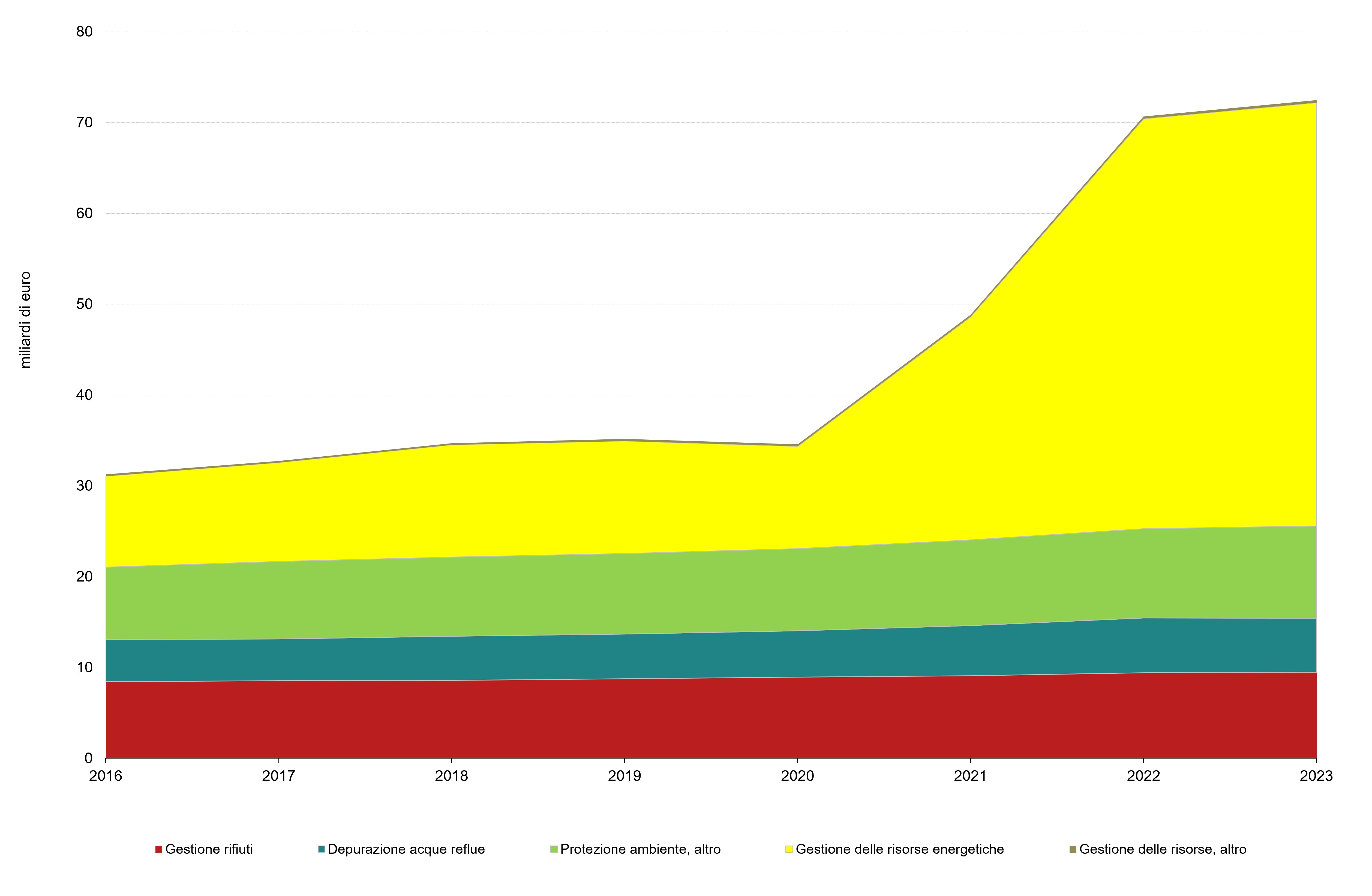
In recent years, the Environmental Goods and Services Sector has experienced broad-based growth across all its principal areas of activity. Particularly strong expansion has been observed in activities related to energy efficiency improvements, which constitute a core component of energy resource management (Figures 2 and 4). This growth has been largely supported by the evolution of European environmental legislation. In particular, Directive 2010/31/EU, which since 2021 has required nearly Zero Energy Building (nZEB) standards for all new buildings and major renovations, has stimulated demand for high-performance energy efficiency interventions, thereby fostering both employment growth and value added within the sector. In 2023, energy resource management represented the largest component of the Environmental Goods and Services Sector, accounting for 60.4% of total employment and 58.3% of total gross value added (Figures 2 and 4). An analysis by economic activity further confirms the leading role of the construction sector, which in 2023 accounted for more than half of total employment (52.9%) within the Environmental Goods and Services Sector and generated the largest share of gross value added (45%), while also exhibiting higher labour productivity than other economic activities (Table 1; Figure 3). These findings reflect the growing integration of environmental objectives into building renovation policies and the increasing adoption of sustainable construction technologies, in line with broader developments observed across the European Union.