Cristina Frizza
The Circular Material Use Rate (CMUR) measures the share of material resources reused by an economy. In the period 2004-2024 the rate of circular use of Italian materials goes from 5.8% to 21.6%
The Circular Material Use Rate (CMUR) measures the contribution of reused materials (R) compared to the overall use of materials (T), both for the economy as a whole and by material category (biomass, metal ores, non-metallic minerals, and fossil energy materials). The indicator therefore represents the percentage of secondary raw materials used in production processes. The indicator was developed by Eurostat and has been published since January 2018 as part of the European Commission's Circular Economy Monitoring Framework.
The indicator measures the contribution of recycled materials to total material demand. A higher CMUR means that a greater quantity of secondary raw materials replaces extracted or imported materials, giving emphasis to the effort made by an economy in collecting materials for recovery.
Communication COM (2020) 98 final of 11 March 2020 'A new Circular Economy Action Plan - For a cleaner and more competitive Europe'. Communication COM (2020) 98 aims to "double the percentage of use of circular materials in the next decade".
Circular material use rate — Calculation method — 2018 edition. Eurostat, Luxembourg (https://ec. europa. eu/eurostat/web/products-manuals-and-guidelines/-/KS-GQ-18-013? inheritRedirect=true&redirect=%2Feurostat%2Fpublications%2Fmanuals-and-guidelines)
The material input of an economic system is given by raw materials and secondary raw materials, both internal and imported. The secondary raw materials are broken down as follows: a) recovered materials (waste); b) materials (not deriving from waste management) generated as secondary products of some production processes; these by-products can be further divided into b.1) materials with economic value exchanged between factories; b.2) intra-plant flows. Case a) can be approximated by waste statistics, assuming that the input of the recovery plants is equal to the output and that everything becomes secondary raw material. Case b) is currently outside the official statistics. Ultimately, what is currently being evaluated is only the contribution of the waste management system to the circular economy. Other circular uses of material are excluded, for example industrial symbiosis.
Eurostat, Istat, ISPRA (Institute of Environmental Protection and Research)
Eurostat database for EU27 and Member State data: https://ec. europa. eu/eurostat/databrowser/view/env_ac_cur/default/table? lang=en
National
2004-2024
The calculations are based on the integration of three data sources: waste statistics (ISPRA); international trade statistics (Istat); material flow accounts (Istat). The indicator is defined as the ratio (R / T) between reused materials (R) and the overall use of materials (T). A higher rate corresponds to a greater use of secondary materials to replace raw materials (and therefore extracted natural resources). The numerator (R) includes: 'Waste recovery' minus 'Imports of waste for recovery' plus 'Exports of waste for recovery'. Please note that “Waste Recovery” does not include energy recovery and backfilling. The denominator (T) includes: “Internal material consumption” plus reused materials (R).
For further information: Circular material use rate — Calculation method — 2018 edition. Eurostat, Luxembourg (https://ec. europa. eu/eurostat/web/products-manuals-and-guidelines/-/KS-GQ-18-013? inheritRedirect=true&redirect=%2Feurostat%2Fpublications%2Fmanuals-and-guidelines)
In 2024, Italy's Circular Material Use Rate reached 21.6%, the highest value recorded over the entire 2004–2024 time series. This figure is substantially higher than the European Union average, which stood at 12.2% in the same year (Table 1; Figure 2). The positive assessment reflects the ability of the Italian production system to integrate significant amounts of secondary raw materials into production processes, considerably outperforming the EU average and contributing effectively to reducing dependence on virgin raw materials.
The indicator exhibits a steady and substantial upward trend, increasing from 5.8% in 2004 to 21.6% in 2024, corresponding to an overall increase of almost 16 percentage points over the last twenty years. This long-term improvement represents a favourable environmental trend, reflecting the structural strengthening of recycling and material reuse practices within the Italian economy (Table 1; Figure 2).
| Data |
|---|
Headline
Table 1: Circular material use rate Data source
ISPRA elaboration based on Eurostat and ISPRA data |
Thumbnail
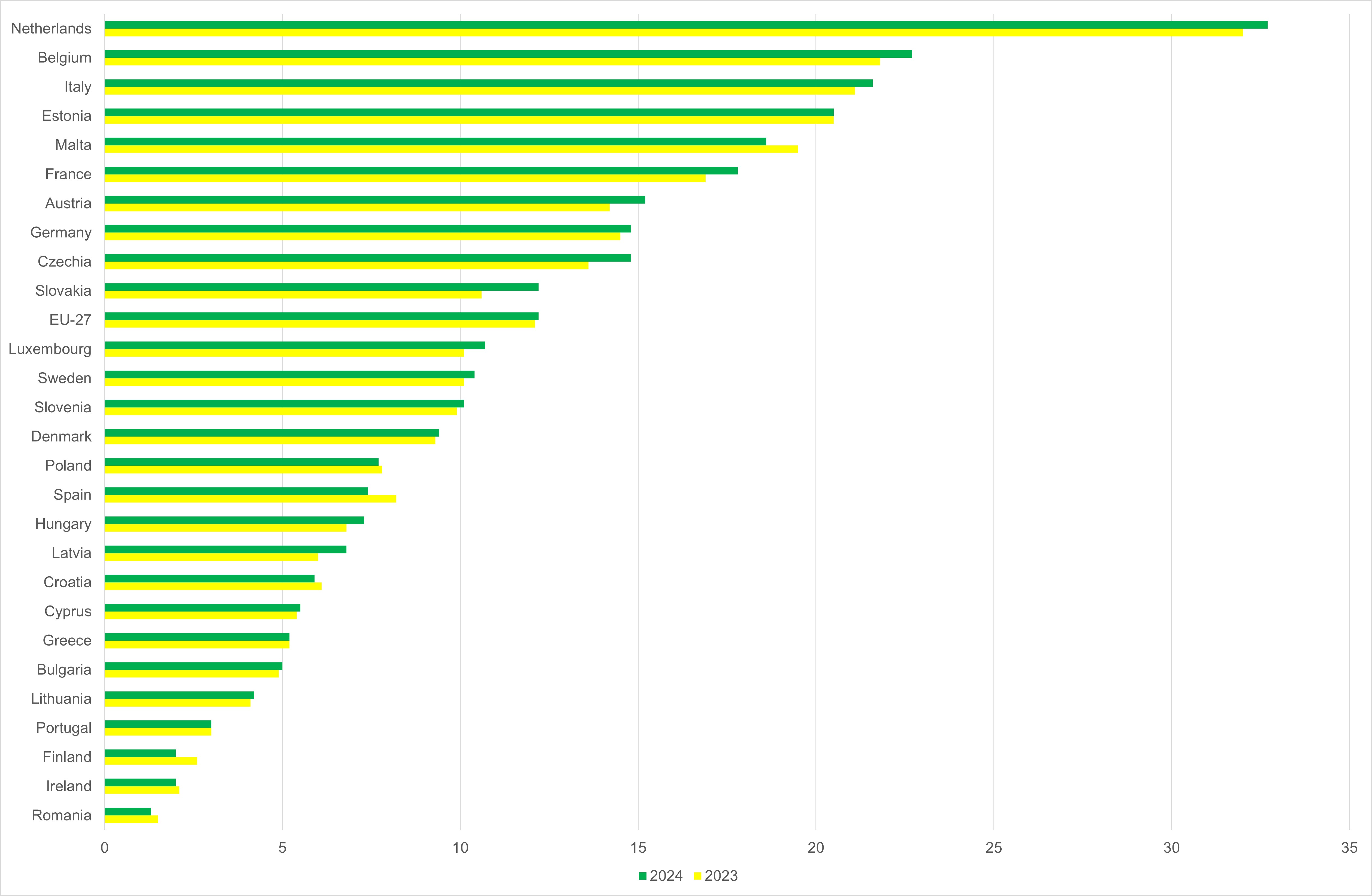
Headline
Figure 1: Circular material use rate in the EU-27 Data source
ISPRA elaboration based on Eurostat data Note
2024: provisional estimates |
Thumbnail
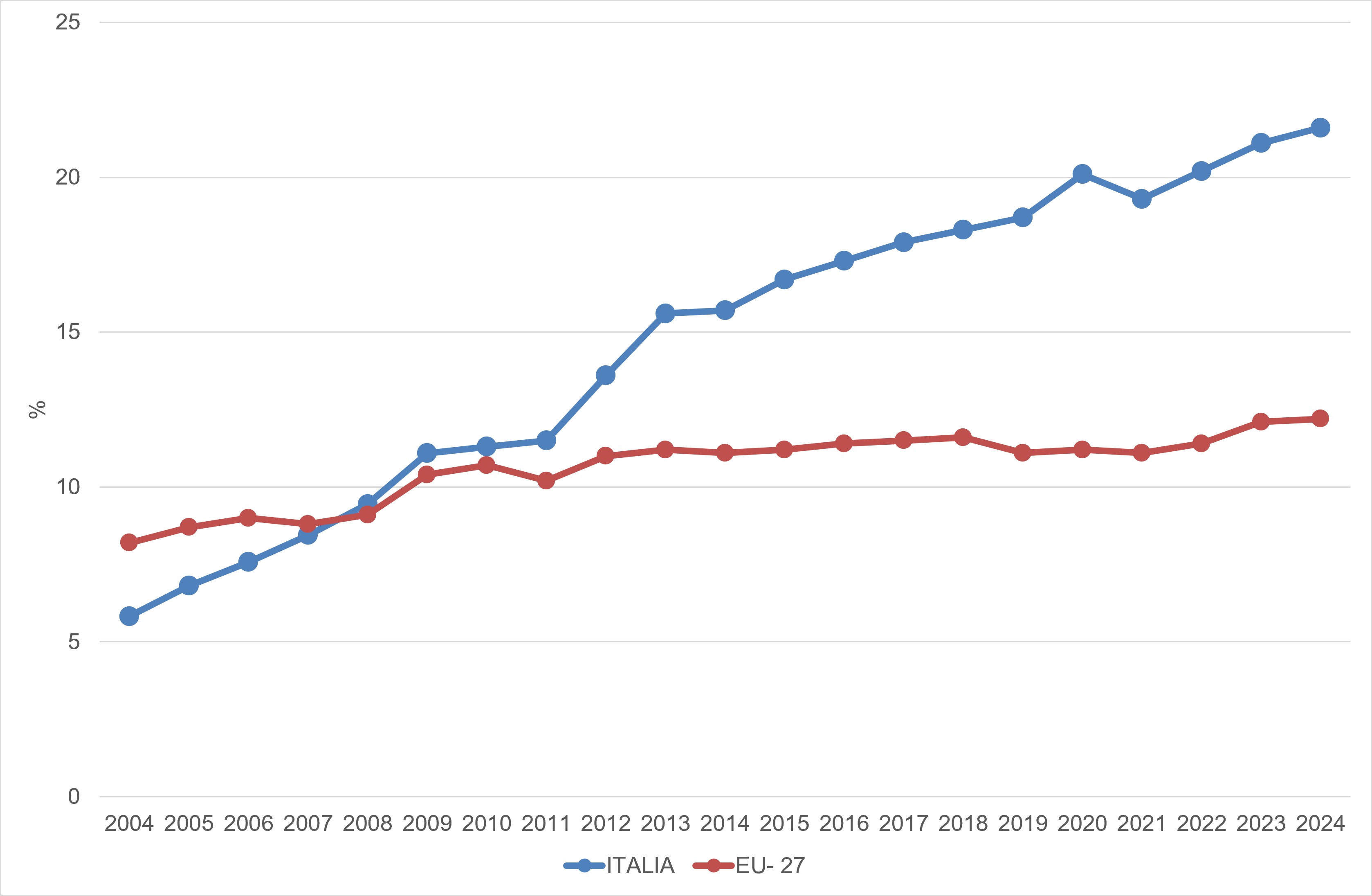
Headline
Figure 2: Trend in the circular material use rate Data source
ISPRA elaboration based on Eurostat data |
In 2024, Italy recorded a Circular Material Use Rate (CMUR) of 21.6%, ranking third among European Union Member States, behind the Netherlands (32.7%) and Belgium (22.7%) (Figure 1). This result highlights Italy's strong commitment to promoting material recycling and reuse, thereby reducing dependence on virgin raw materials and supporting the transition towards a more circular and sustainable economy. Despite these encouraging results, the European Union as a whole is not yet on track to achieve the objective set out in the 2020 Circular Economy Action Plan of doubling the Circular Material Use Rate by 2030. Achieving this ambitious target will require additional efforts at both the national and European levels to strengthen recycling infrastructure, foster innovation, and promote more sustainable production and consumption patterns.