Valter Bellucci, Franco Mutinelli (Istituto Zooprofilattico Sperimentale delle Venezie – IZSVe), Valerio Silli
Bees, pollen, and other bee matrices provide important information on the state of the environment and contamination, particularly chemical contamination from pesticides, that may be present in the environment. Specific laboratory analyses can detect traces of active ingredients contained in plant protection products used in areas where insects fly and forage. ISPRA has long been involved in research aimed at identifying the possible factors and causes responsible for bee mortality and the depopulation of bee colonies, including as a result of various agricultural practices using plant protection products implemented in natural and agricultural areas. The data collected show a trend fluctuating around an annual average of several dozen cases of bee mortality, with the presence of active ingredients on the bodies of insects or other bee matrices.
The indicator describes bee mortality events recorded throughout Italy, correlating them with the presence of active ingredients in plant protection products in beekeeping matrices or in the bees themselves; these cases are confirmed by analyses conducted in designated laboratories recognized by the legislation (IIZZSS, ARPA, ICQRF, and others). The data is collected through monitoring of bees and hive products, conducted based on voluntary reports from beekeepers, established in 2014 by the Ministry of Health with the support of the National Health Service (SSN). These checks involve the public Veterinary Services, the Phytosanitary Services, and the laboratories of the Experimental Zooprophylactic Institutes (II.ZZ.SS.), which operate in an integrated and synergistic manner with other institutions, through the application of specific protocols and guidelines (Ministry of Health Guidelines, 2014). Additionally, this indicator can also be supported by reports from beekeepers and the results of research projects on the health of bees and hives.
Identify the relationships and extent, on a national scale, with which the active ingredients of plant protection products are associated with mortality in honeybees (Apis mellifera subsp.). It is also possible to highlight the active ingredients of the most widespread and used pesticides, also describing the monthly/seasonal trend of mortality. These data can also provide important information on the spread and environmental contamination of pesticides.
Framework legislation on beekeeping: Law no. 313 of 24 December 2004 - "Regulations on beekeeping".
Amendments to Law no. 313 of 24 December 2004 and other provisions on beekeeping, as well as delegation to the Government for regulatory simplification and the protection of the national beekeeping sector.
Dossier no. 78 - Elements for the evaluation of aspects of constitutional legitimacy, 18 December 2023 Information on reference acts A.C. 706.
Inter-ministerial Decree 15 July 2015 – PAN Indicators Sustainable use of plant protection products (Official Gazette 27 July 2015, General Series no. 172). Establishes the collection and processing methods for 15 specific indicators provided for by the PAN (National Action Plan). These indicators measure the intensity of use and the environmental impact of plant protection products, assessing the reduction of risks to human health and ecosystems.
Directive 2009/128/EC of the European Parliament and of the Council of 21 October 2009.
Legislative Decree 14 August 2012, no. 150: "Implementation of Directive 2009/128/EC establishing a framework for Community action to achieve the sustainable use of pesticides".
Interministerial Decree of 22 January 2014 "National action plan for the sustainable use of plant protection products adopted pursuant to Article 6 of the aforementioned Legislative Decree of 14 August 2012, no. 150".
Interministerial Decree 10 March 2015 "Guidelines for the protection of the aquatic environment and drinking water and for the reduction of the use of plant protection products and related risks in Natura 2000 sites and protected natural areas", provided for by the National Action Plan.
Decree of 22 January 2018, no. 33 "Regulation on measures and requirements for plant protection products for safe use by non-professional users".
Presidential Decree 320/1954 Veterinary Police Regulations.
The control and surveillance activity for food products of animal origin is reaffirmed by Regulation (EC) no. 852/2004, Ministry of Agriculture (SPIA-BEENET).
The beekeeping registry (Apiculture Database [BDA]) in Italy is regulated by the Decree of 4 December 2009 and by Legislative Decree of 5 August 2022, no. 134. This legislation implements the European Union regulations on animal health (e.g. EU Regulation 2016/429).
Ministry of Health Decree of 27 January 2025 - Amendments to the decree of 7 March 2023, concerning the operational manual relating to the management and operation of the identification and registration system for operators, establishments and animals (I&R system). (25A01598) Official Journal, General Series No. 63 of March 17, 2025
Bellucci, V., Lucci, S., Campanelli, F., Sannino R., Formato, G., Giacomelli, A., Scaramozzino, Baggio A. (2010). Results of the first semester of the survey on the phenomenon of bee mortality within protected natural areas. APOidea Year VII, 23-27;
Bellucci V., Bianco P., Formato G., Mutinelli F., Porrini C., Lodesani M. (2016). Bee mortality and plant protection products. Apitalia Ricerca, 12/2016, 46-52, (https://www.researchgate.net/profile/Pietro_Bianco/publication/31229513…);
Bellucci V., Bianco P. M., Iorio M. (2018). The complex world of bees. Science and Research 56, 5-10;
Bellucci V., Lucci S., Bianco P., Ubaldi A., Felicioli A., Porrini C., Mutinelli F., Battisti S., Spallucci V., Cersini A., Pietropaoli M. and Formato G. (2019). Monitoring honey bee health in five natural protected areas in Italy. Veterinaria Italiana, 55 (1), pp. 15-25. doi: 0.12834/VetIt.1209.6739.4;
Celli G., Maccagnani B. (2003). Honey bees as bioindicators of environmental pollution. Bulletin of Insectology56 (1): 137-139, 2003 ISSN 1721-8861;
EFSA (European Food Safety Authority), Adriaanse P, Arce A, Focks A, Ingels B, Jölli D, Lambin S, Rundlöf M, Süßenbach D, Del Aguila M, Ercolano V, Ferilli F, Ippolito A, Szentes Cs, Neri FM, Padovani L, Rortais A, Wassenberg J and Auteri D, 2023.Revised guidance on the risk assessment of plant protection products on bees (Apis mellifera, Bombus spp. and solitary bees). EFSA Journal 2023; 21(5):7989, 133 pp. https://doi.org/10.2903/j.efsa.2023.7989
ISPRA (2021) Report 350/2021 “Plants and pollinating insects: an alliance for biodiversity”. ISBN: 978-88-448-1066-5. Available at the link: https://www.isprambiente.gov.it/it/pubblicazioni/rapporti/piante-e-insetti-impollinatori-unalleanza-per-la-biodiversita
ISPRA (2021) Quaderni NATURA e Biodiversità 16/2021 "Apoidea and sustainable agriculture". ISBN: 978-88-448-1050-4 https://www.isprambiente.gov.it/it/pubblicazioni/quaderni/natura-e-biodiversita/quaderno-nat-bio-gli-apoidei-e-agricoltura-sostenibile
ISPRA (2020), ISPRA Report 330/2020 “Testing the effectiveness of the measures of the National Action Plan for the sustainable use of plant protection products (PAN) for the protection of biodiversity” https://www.isprambiente.gov.it/it/pubblicazioni/rapporti/la-sperimentazione-dellefficace-delle-misure-del-pan-per-la-tutela-della-biodiversita
ISPRA (2015), Report 216/2015. Assessment of the potential risk of plant protection products in Natura 2000 areas;
ISPRA (2011). Technical fact-finding survey on the phenomenon of bee mortality within protected natural areas. Final Report, pp. 185. Trace analysis of pollutants by use of honeybees, immunoassays, and chemiluminescence detection. Anal Bioanal Chem 405: 555 (https://doi.org/10.1007/s00216-012-6443-3);
Ministry of Health (2014). Guidelines for the management of reports of beehive mortality or depopulation related to the use of agrochemicals, (https://www.izsvenezie.it/linee-guida-per-la-gestione-delle-segnalazion…);
Mitchell E. A. D, Mulhauser B., Mulot M., Mutabazi A., Glauser G., Aebi1 A. (2017). A worldwide survey of neonicotinoids in honey. Science 358, (6359): 109-111;
Neumann., P., Carreck N. (2010). Honey bee colony losses. J. Apic. Res. 49 (1): 1-6. (http://www.ask-force.org/web/Bees/Neumann-Honey-Bee-Colony-Losses-2010… );
Porrini, C., Sabatini, A., Girotti, S., Ghini, S., Medrzycki, P., Grillenzoni, F., Bortolotti, … Celli G. (2003). Honey bees and bee products as monitors of the environmental contamination APIACTA 38, 63-70;
Porrini C., Mutinelli F., Bortolotti L., Granato A., Laurenson L., Roberts K., et al. (2016). The Status of Honey Bee Health in Italy: Results from the Nationwide Bee Monitoring Network. PLoS ONE 11(5): e0155411. doi.org/10.1371/journal.pone.0155411;
Rişcu A., Bura M. (2013). The impact of pesticides on honey bees and hence on humans. Animal Science and Biotechnologies, 46 (2), 272;
Sánchez-Bayo F., Goulson D., Pennacchio F, Nazzi F., Goka K., Desneux N. (2016). Are bee diseases linked to pesticides? — A brief review. Environment International89–90, 7–11;
Whitehorn P.R., Connor S.O. Wackers F.L., Goulson D., (2012). Neonicotinoid Pesticide Reduces Bumble Bee Colony Growth and Queen Production. Science336 (6079): 351-352. (https://www.sussex.ac.uk/webteam/gateway/file.php?name=whitehorn-2012.p…);
http://www.izslt.it/apicoltura
http://www.isprambiente.gov.it/it
https://www.izsvenezie.it/istituto/centri-di-referenza-nazionale/apicoltura/
https://apidologia.crea.gov.
http://www.informamiele.it/
Data relating to bee mortality may be underestimated, as reporting, and therefore the related data collection, is voluntary, and does not provide incentives for interested beekeepers or protection for the reporting entity's production activities.
Data collection and analysis themselves have limitations, as toxic active ingredients (e.g., neonicotinoids, pyrethroids) rapidly degrade in the environment due to atmospheric agents (temperature, UV radiation, precipitation). To avoid this, bee samples (especially dead bees) must be sampled quickly and stored at freezing temperatures until laboratory analysis.
To encourage beekeepers to report cases of mortality and thus improve data accuracy, it may be appropriate to introduce protective measures for beekeepers that encourage them to report events and cooperate with regulatory authorities, while also allowing for rapid investigations and continued production.
ASL (Local Health Authority) CREA (Council for Research and Experimentation in Agriculture) Experimental Zooprophylactic Institutes (II.ZZ.SS.) MIPAAF (Ministry of Agricultural, Food and Forestry Policies)
National; Regional
2015-2025
Number of recorded bee deaths
PAN Indicator (National Action Plan for the Sustainable Use of Plant Protection Products) – Interministerial Decree of 15 July 2015
ISPRA analyzes the data communicated by the II.ZZ.SS., validates them, processes them and aggregates them on a spatial and temporal basis.
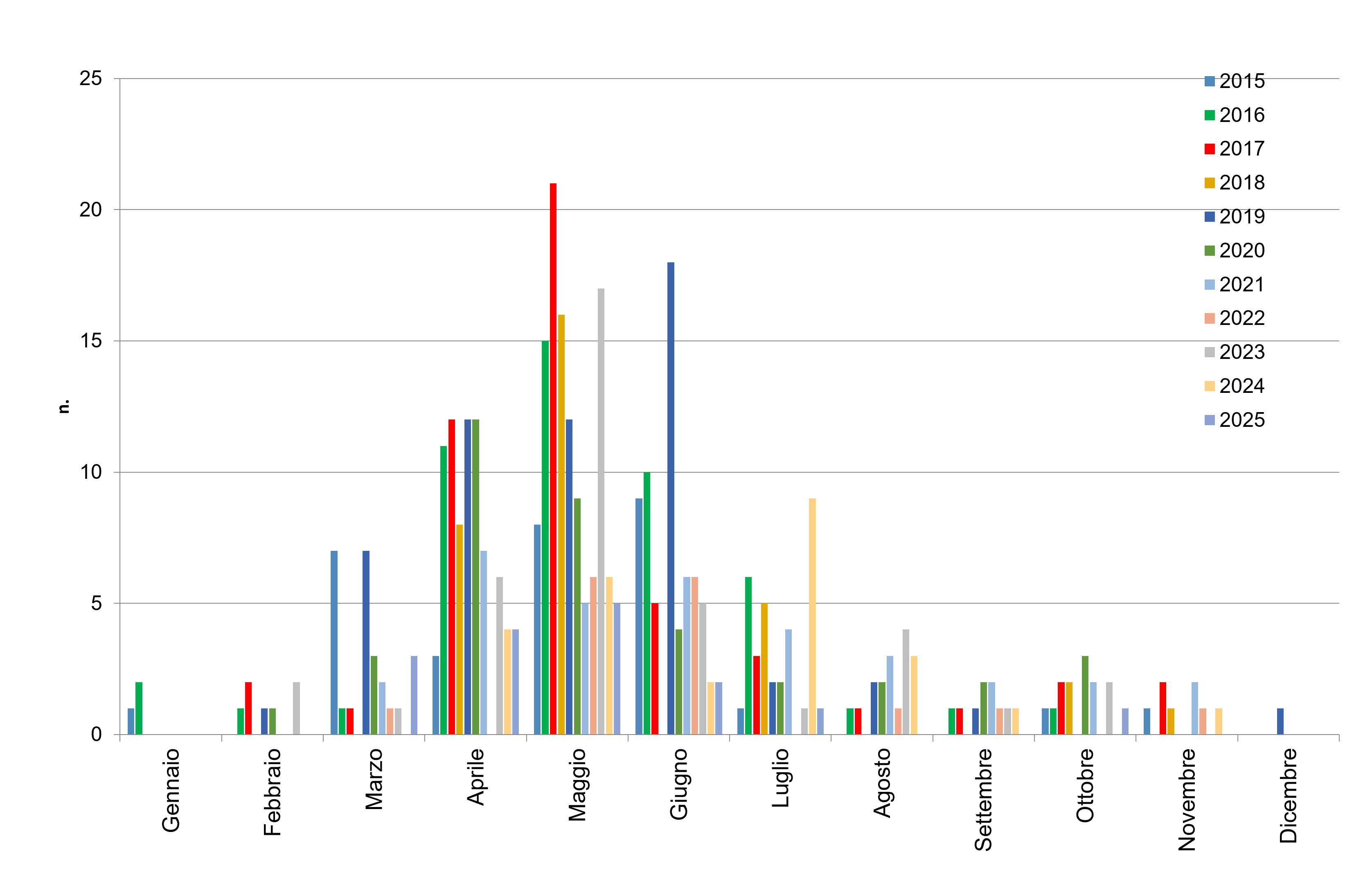
In 2025, 22 suspected apiary poisonings related to the use of pesticides were reported, 16 of which were found to contain at least one or more active ingredients (Table 1). As in previous years, the months with the highest number of reported die-offs were April and May, coinciding with the spring flowering periods (Figure 2). During these periods, pesticide treatments are prohibited because bees are intensely foraging, making them more vulnerable to the presence of pollutants present in the environment and on flowers, particularly pesticides used in agricultural areas.
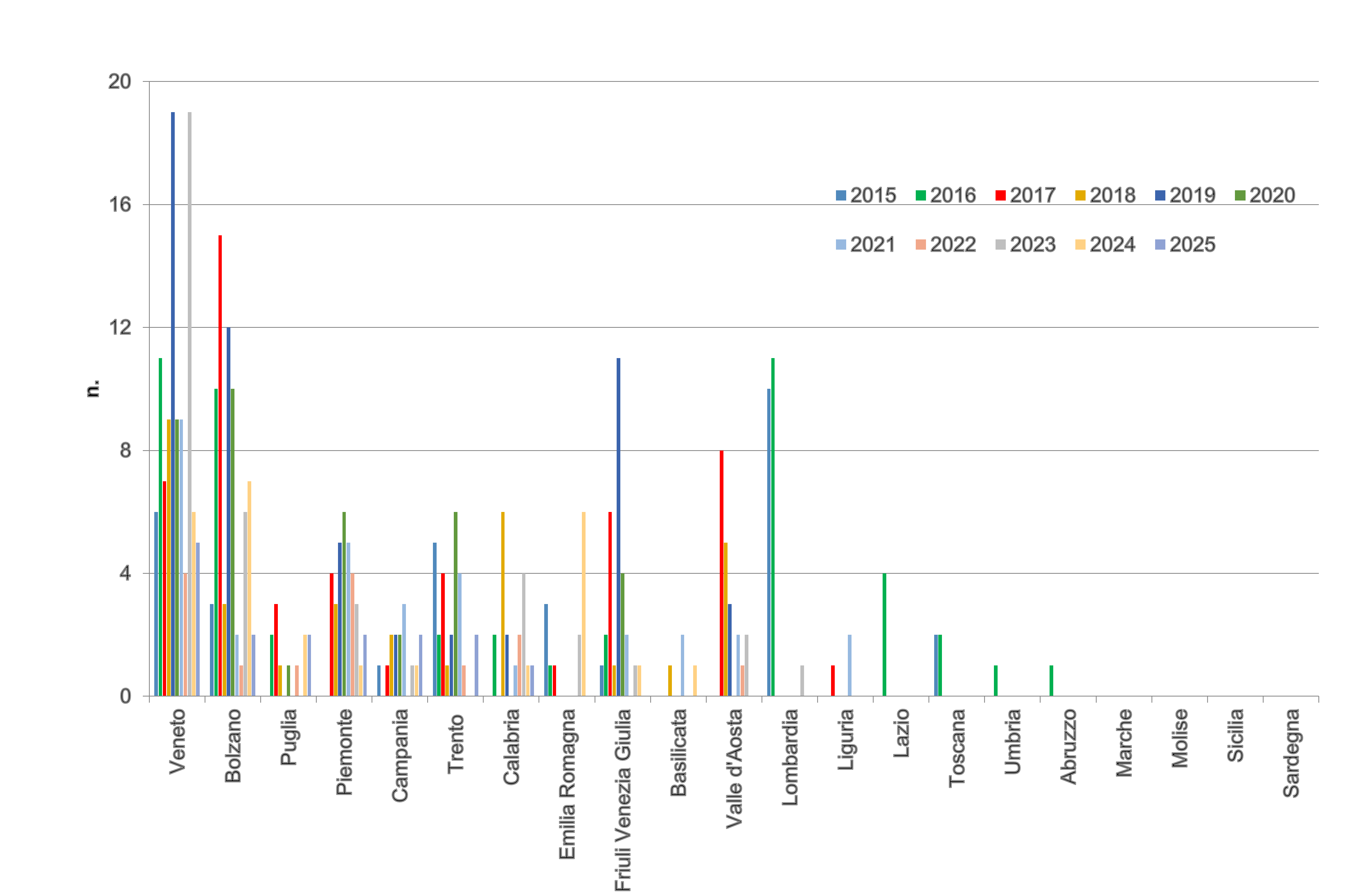
Data collected from 2015 to 2025 indicate a trend fluctuating around 35 cases of bee mortality per year, with the presence of active ingredients on the body or other bee matrices. In 2016, 2017, and 2019, however, the average mortality rate was around 50. Only in 2022 and 2025 was there a halving of bee matrix samples, with only 16 cases detected with active ingredients. The observed trend, however, indicates a continued presence of plant protection products, especially in some areas of the country (Figure 1). An important finding concerns the simultaneous presence of active ingredients on the bodies of dead bees, which can range from two to five different active ingredients in a single sample.
Furthermore, it is noted that the active ingredients found often have synergistic effects (such as that between neonicotinoid insecticides and triazole fungicides).
It is not possible to assign a trend, as the reported cases may not be exhaustive, due to unreported or delayed reports of bee mortality. Also not to be overlooked is the time required, too often very long, to ascertain the probable or certain mortality due to pesticides. All these factors mean that the reported bee mortality cases are often underestimated compared to those that actually occurred.
| Data |
|---|
Titolo
Table 1: Cases of bee mortality associated with the presence of active substances, by region Fonte
ISPRA processing of II.ZZ.SS data |
Titolo
Table 2: Active substances detected in samples of dead bees Fonte
ISPRA processing of II.ZZ.SS data |
Thumbnail
Titolo
Figura 1: Casi di moria di api con presenza di principi attivi, suddivise per regione Fonte
Elaborazione ISPRA su dati II.ZZ.SS |
Thumbnail
Titolo
Figura 2: Casi di moria di api con presenza di principi attivi, suddivisi per mese Fonte
Elaborazione ISPRA su dati II.ZZ.SS |
The causes of abnormal mortality, according to the information provided, may be attributable either to poisoning by plant protection products or to the action of various pathogens on bees. In cases where the analyses for the active ingredients contained in plant protection products have given positive results, it means that the presence of one or more active ingredients has been found, thus indicating that a combination of multiple factors can lead to abnormal mortality and depopulation of hives.
According to what has been highlighted by the analyses of the data available for the eleven years examined (Table 2), the active substances most frequently found in the samples and characterised by high toxicity for bees are mainly attributable to the following categories:
- in 2025, similarly to what has been observed previously, it is noted that pyrethroids as well as some organophosphoruses are among the most common active ingredients widely used in agriculture, as well as for disinfestations against mosquitoes and other nuisance insects. In particular, chlorfenvinphos and permethrin were found several times on the bodies of bees. The marketing authorisations for products based on chlorfenvinphos were revoked at the end of 2003 (EC Regulation 2076/2002). In general, many compounds belonging to these categories are highly toxic to pollinating insects, including bees, even at low concentrations, with possible both acute and longer-lasting effects;
- permethrin has been constantly present over the years, being a pyrethroid insecticide widely used as an insecticidal active ingredient in many plant protection products and biocides, used for the control of nuisance insects in the agricultural and civil sectors. Its widespread diffusion and the different areas of use can contribute to explaining the frequent detection of this substance in bee samples;
- among the systemic acaricidal active ingredients detected in 2025, are The acaricides amitraz and fluvalinate, were found on the body of bees in numerous samples. These substances are mainly used to control mites and, in particular, can be used in beekeeping to combat the mite Varroa destructor. Some of these active ingredients are also used in products intended for the treatment of parasites in domestic and livestock animals;
- among the neonicotinoid insecticides discovered in 2025: thiamethoxan, clothianidin and imidacloprid, particularly toxic, even at very low concentrations, for bees and all pollinating insects, and also the less toxic acetamiprid, an active ingredient historically characterized by a lower relative toxicity for bees;
- triflostrobin, tebuconazole, pyrimethanil: are first-generation systemic fungicides often used preventively in vineyards and horticultural crops. They were discovered on the body of bees in 2, 2 and 1 poisoning case, respectively, in 2025. Triflostrobin is often formulated in a mixture with tebuconazole, a combination used to broaden and enhance its fungicidal action.
From the regional analysis of data on bee deaths due to pesticide residues, it emerges that in 2025 – in line with the trend of previous years – Veneto and the Autonomous Provinces of Bolzano and Trento recorded the highest number of positive findings, with 5, 2 and 2 cases respectively. Two more cases each were recorded in Piedmont, Campania, and Puglia, while in Calabria a single positive case was detected (See Table 1 and Figure 1).
Also in 2025, an uneven distribution of bee mortality cases across the country was confirmed, with the identification of positive samples with the simultaneous presence of active ingredients that are toxic or very toxic to bees. Although in some areas, a significant use of pesticides was observed, with evident confirmed mortality, in other areas, also characterized by a significant use of such substances, such a high number of cases was not observed.
The different number of cases detected at the territorial level could be influenced by various factors, including the methods and intensity of monitoring, the timeliness of reporting and control activities, as well as the characteristics of the crops and agricultural practices present in the different areas. Therefore, the number of detected cases cannot be directly interpreted as an exact measure of the actual frequency of deaths across the country (see Table 1 and Figure 1).