Valeria Giovannelli, Matteo Lener, Giovanni Staiano
The pressure indicator reports the number and area of field trials involving genetically modified plants (GMPs) authorised in Italy under Directive 2001/18/EC since 1999.
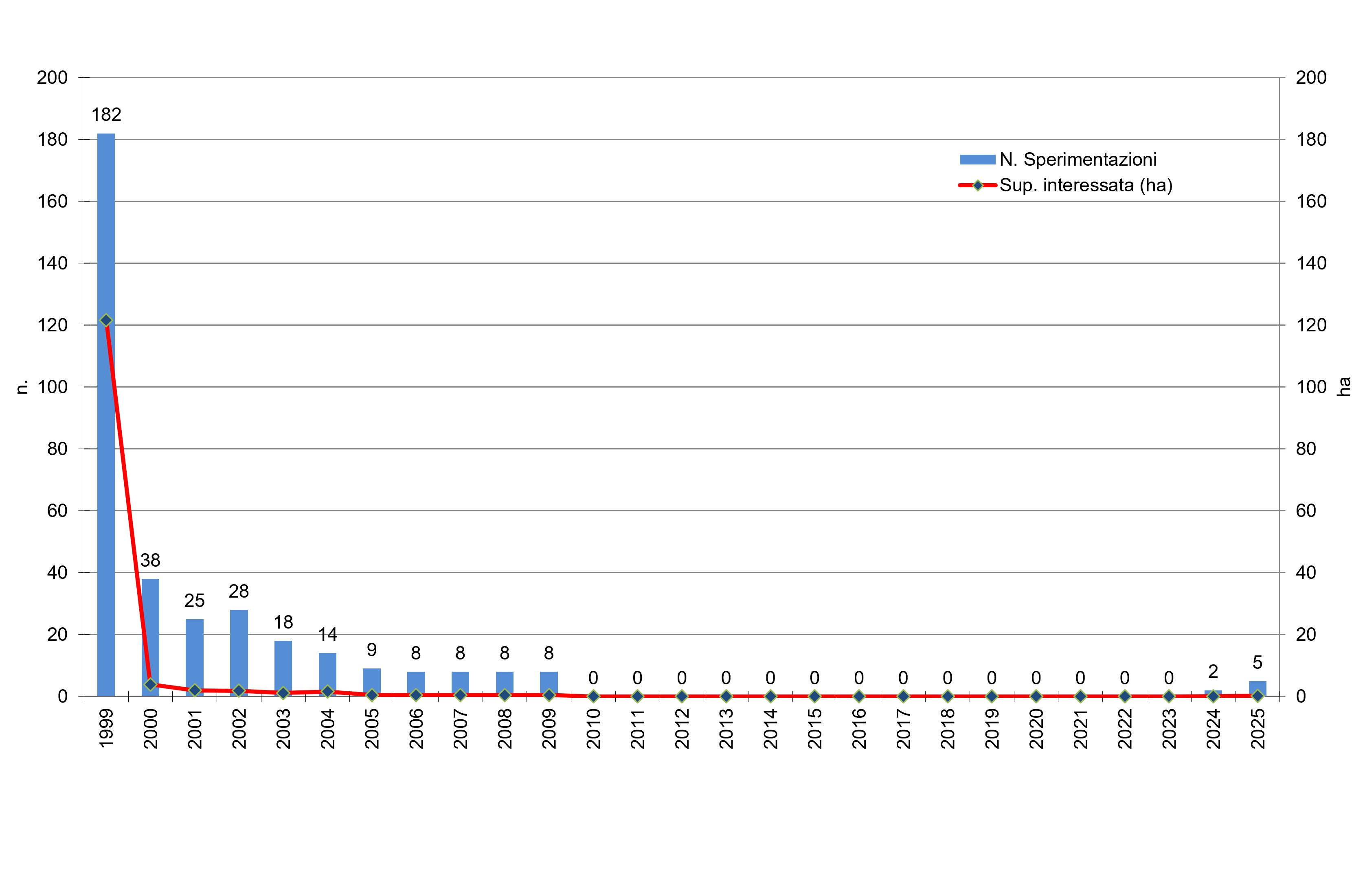
The indicator has been compiled using data provided by the Ministry of the Environment and Energy Security (MASE). The number of field trials declined sharply in 2000, and no new trials were authorised from 2001 onwards. The last field trials, which had been granted multi-year authorisations, were completed in 2010. Following the entry into force of Law No. 68 of 13 June 2023, two new field trials were authorised in 2024 on rice and grapevine varieties resistant to plant pathogens, developed using genome editing techniques. In 2025, the number of field trials increased to five, with an additional trial on pathogen-resistant tomato, alongside those on rice and grapevine.
Pressure indicator relating to the number and extent of Genetically Modified Plants (PGM) trials present from 1999 until December 2025 on Italian territory.
Quantify the number of deliberate experimental releases of PGMs within natural and agricultural ecosystems.
Directive (EU) 2001/18;
Regulation (EC) 1829/2003;
Legislative Decree 224/2003;
Ministerial Decree 19 January 2005;
Directive (EU) 2015/412;
Legislative Decree no. 227/2016;
MATTM decree 8 November 2017;
MATTM decree n. 58 of 1 March 2018;
Law 13 June 2023, n. 68.
The deliberate release into the environment, for experimental purposes, of PGMs on Italian territory is authorized on the basis of Legislative Decree of 8 July 2003, n. 224 "Implementation of Directive 2001/18/EC concerning the deliberate release into the environment of genetically modified organisms". In accordance with the directive, the decree establishes that before authorizing any release of GMOs into the environment, a risk assessment for the environment and human health must be carried out, which ensures that they are not dangerous.
Legislative Decree 224/2003 attributes the role of competent national authority to the Ministry of the Environment and Land Protection and establishes the Register of locations where releases of Genetically Modified Organisms (GMOs) take place for both experimental and commercial purposes.
Law 13 June 2023, n. 68 establishes that for the testing of GMOs produced with techniques editing genomic through site-directed mutagenesis or cisgenesis, until 31 December 2025, the risk assessment for agrobiodiversity, agricultural systems and the agri-food chain and the requirements established by the decree of the Minister of Agriculture Ministerial Decree 19 January 2005 do not apply.
In accordance with article 32 of Legislative Decree 2003/224, the Decree of 8 November 2017 of the Minister of the Environment and Protection of Land and Sea was also adopted which defines the general plan for the supervisory activity on the deliberate release into the environment of genetically modified organisms. The plan defines the fields of application of the decree, the forms of coordination between the competent administrations, the criteria and methods for updating the plan itself to be carried out on an annual basis. The general surveillance plan is implemented by a National Operational Plan in which the number and scope of inspections to be conducted are identified and described annually. With the same decree, the national register of inspectors was established, who, in carrying out their supervisory activity, carry out judicial police functions.
In 2018 ISPRA, on the basis of decree no. 58 of 1 March 2018 issued by the Ministry of the Environment and Protection of Land and Sea, acquired the consultative and support functions for the competent national authority previously exercised by the Inter-Ministerial Evaluation Commission (ex art. 2 Legislative Decree 224/2003).
MASE (Ministry of the Environment and Energy Safety)
MASE, Registry of GMO environmental releases ( https://bch. mase. gov. it/index. php/it/? view=article&id=435&catid=15)
National
1999 - 2025
The indicator, free of complex calculations, was conceived as a review of the main data relating to PGM trials in Italy, from 1999 to 2025.
In 2025, the number of authorised deliberate experimental releases of genetically modified plants (GMPs) in Italy increased to five, following the launch of three new field trials in addition to the two authorised in 2024. The 2024 authorisations marked the resumption of experimental field activities after an interruption that had lasted since 2010.
In Italy, no applications for new experimental releases were submitted after 2005 because the operational technical protocols for species-specific risk management, required under Article 1(2) of the Ministerial Decree of 19 January 2005 (Requirements for the assessment of risks to agricultural biodiversity, agricultural systems and the agri-food chain related to the deliberate release into the environment of GMOs for any purpose other than placing on the market), were never adopted. The number of field trials had already declined sharply from 2000 onwards. From 2005, only trials covered by multi-year authorisations granted under the legislation in force before Legislative Decree No. 224/2003 remained active. Following the completion of these trials in 2009, no deliberate experimental releases were carried out from 2010 onwards. This trend was reversed in 2024, when two new field trials were authorised following the entry into force of Law No. 68 of 13 June 2023. In 2025, the number of authorised field trials increased further, reaching five.
| Data |
|---|
Thumbnail
Headline
Figure 1: Number of trials and surface area affected by the experimental release of GMOs (1999-2025) Data source
ISPRA processing on MASE data Note
Data updated as of December 31st of each year. |
The highest number of authorised field trials was recorded in 1999, with 182 trials covering a total area of approximately 122 hectares. From 2000 onwards, the number of field trials declined markedly and, between 2005 and 2009, only those covered by multi-year authorisations remained active. Experimental field activities ceased in 2010 as a consequence of the regulatory framework then in force. Following the entry into force of Law No. 68/2023, field trials resumed: two new trials were authorised in 2024 and the number of active trials increased to five in 2025, including those with multi-year authorisations (Figure 1).